Within Targets
The Target Clues Hidden in Transcripts
The Hammid series became a key example of how transcript cues could make target matching look stronger than it was.
On this page
- What the Hammid sessions were trying to test
- Dates, order hints, and incidental references
- Why the critique mattered for site targets
Page outline Jump by section
Introduction
The Hammid site sessions occupy a distinctive place in the history of remote-viewing research because the debate surrounding them was not primarily about the content of the reported perceptions, but about how those reports were judged. The sessions, conducted at the Stanford Research Institute (SRI) with photographer and experimenter Hella Hammid, became the focal example in a long-running dispute over whether apparent successes reflected anomalous perception or ordinary information embedded in the session records. The controversy reshaped later remote-viewing methodology by drawing attention to subtle sources of information leakage that could influence judges even when participants were nominally blind to the targets.[CIA]cia.govAN EVALUATION OF REMOTE VIEWING: RESEARCH…A remote viewer is asked to visualize a place, location, or object being viewed by a "bea…
What the Hammid sessions were trying to test
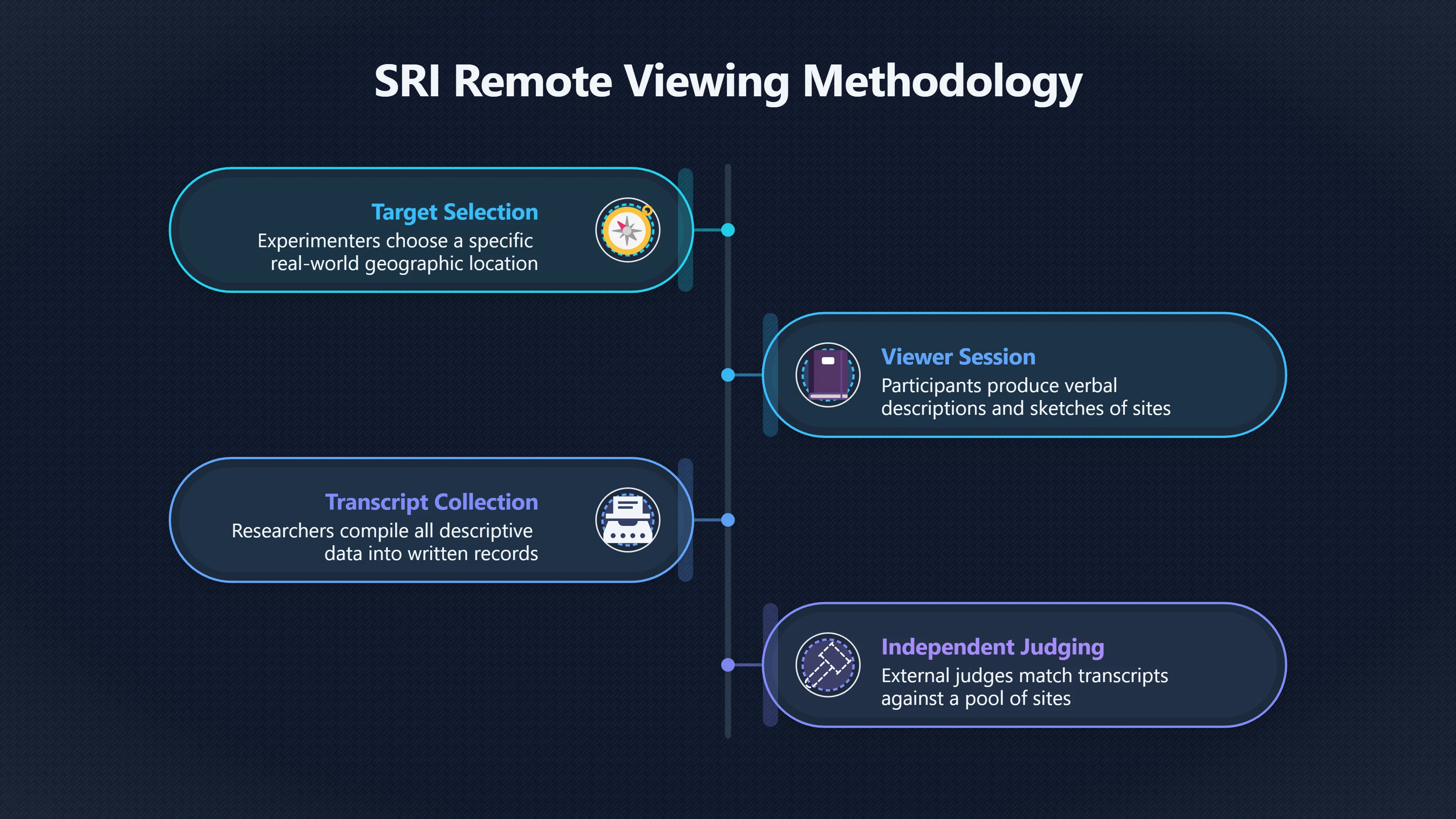
The Hammid series formed part of SRI’s early “outbounder” experiments. In these studies, a target location was selected, an experimenter travelled to that site, and a remote viewer attempted to describe the destination without ordinary sensory contact. Afterwards, independent judges compared the viewer’s transcript with a pool of possible target sites to determine whether the correct location could be identified. This free-response approach differed from earlier card-guessing experiments by asking participants to produce rich verbal descriptions and sketches rather than simple forced-choice answers.[CIA]cia.govAN EVALUATION OF REMOTE VIEWING: RESEARCH…A remote viewer is asked to visualize a place, location, or object being viewed by a "bea…
Hella Hammid’s role extended beyond acting as an outbound experimenter. Several published demonstrations associated with her became widely cited examples of successful site descriptions, making the collection particularly influential in discussions about whether remote viewing could identify real-world locations. Because these sessions were among the best-known examples, they also attracted unusually detailed scrutiny from critics.[Psi Encyclopedia]psi-encyclopedia.spr.ac.ukPsi Encyclopedia Remote ViewingPsi EncyclopediaRemote Viewing - Psi Encyclopedia13 Jan 2017 — Remote viewing replaced repetitive forced-choice tasks with free-response…
Dates, order hints, and incidental references
The central criticism advanced by psychologists David Marks and Richard Kammann was that the judging material contained ordinary clues unrelated to any claimed psychic ability. According to their analysis, transcripts frequently preserved information that revealed where each session belonged in the chronological sequence of experiments. Examples included:
- Session dates written on the transcripts.
- References such as “yesterday’s target” or comments linking one session to another.
- Incidental remarks made during the experiment that reflected the running order.
- Information that could be matched against the known sequence of target visits.
Marks argued that these cues allowed an informed judge to reconstruct the correspondence between transcripts and targets without relying on the descriptive content itself. In a widely discussed demonstration, he reported correctly matching the transcripts to their intended target sites using only these ordinary clues, without visiting the locations or evaluating whether the descriptions resembled the sites.[Wikipedia+2Wikipedia]WikipediaRemote viewingRemote viewing
The critique therefore shifted attention from the apparent quality of the remote-viewing descriptions to the integrity of the judging procedure. If chronological information effectively labelled the transcripts, then successful matching no longer constituted strong evidence that the descriptions themselves identified the correct sites.
Why the critique mattered for site targets
The Hammid dispute highlighted a methodological problem that is particularly acute for site-target experiments. Unlike simple laboratory stimuli, visits to real locations naturally generate contextual information. Experimenters travel, schedules unfold over several days, participants refer to previous sessions, and administrative records accumulate. Unless all such material is removed before judging, these seemingly trivial details can become unintended identifiers.
The issue is important because remote-viewing judging relies on pattern matching. Judges are expected to decide which target best fits a transcript. Any information that narrows the possibilities—whether consciously recognised or not—can increase apparent accuracy independently of the transcript’s descriptive quality. The Hammid case demonstrated that leakage need not involve deliberate cheating or explicit disclosure of the target. Routine administrative details may be sufficient.[SAGE Knowledge+2Skeptical Inquirer]sk.sagepub.comSAGE KnowledgePsychology and the Paranormal: Exploring Anomalous ExperienceOutline: In a spirit of open inquiry, a zetetic examination of…
Responses from SRI researchers
SRI investigators Russell Targ and Harold Puthoff rejected the conclusion that the original findings were explained by cueing alone. They argued that the descriptive correspondences remained meaningful and that critics underestimated the richness of the remote-viewing reports. Supporters also noted that Charles Tart later re-examined one subset of transcripts after attempting to remove the cues identified by Marks and concluded that matching performance still exceeded chance.[Wikipedia]WikipediaRemote viewingRemote viewing
Critics responded that the cue removal was incomplete and that the remaining material still contained information capable of guiding judges. The disagreement therefore evolved into a dispute over whether the transcripts had truly been sanitised before reanalysis rather than simply over the statistical results themselves. Subsequent exchanges in journals such as Nature continued for several years, reflecting how significant the issue had become for evaluating the early SRI evidence.[Wikipedia+2Wikipedia]WikipediaRemote viewingRemote viewing
How the Hammid case influenced later judging procedures
Regardless of one’s assessment of remote viewing as a whole, the Hammid controversy had a lasting methodological impact. Later remote-viewing studies increasingly adopted stricter transcript preparation and judging practices designed to eliminate exactly the kinds of cues identified in the debate. Common safeguards included:
- Removing dates and administrative information before judging.
- Eliminating references to previous or later sessions.
- Randomising transcript order independently of target order.
- Ensuring judges received only the descriptive material needed for matching.
- Separating personnel responsible for transcript preparation from those performing the judging.
These procedures became standard because they addressed a general experimental principle rather than a uniquely paranormal issue: whenever human judges compare free-response material against multiple targets, incidental information must be prevented from influencing their decisions.[CIA+2Psi Encyclopedia]cia.govAN EVALUATION OF REMOTE VIEWING: RESEARCH…A remote viewer is asked to visualize a place, location, or object being viewed by a "bea…
Why the Hammid sessions remain an important case
The Hammid site sessions continue to be cited not because they conclusively settled the question of remote viewing, but because they illustrate how evaluation procedures can determine the credibility of apparently successful results. The dispute demonstrated that free-response experiments are vulnerable to subtle forms of information leakage that may only become visible under close methodological inspection.
For historians of remote-viewing research, the Hammid case marks a turning point. It redirected attention from whether individual descriptions seemed impressive to whether judging procedures adequately isolated those descriptions from ordinary sources of information. That shift influenced subsequent protocol design across remote-viewing research and remains one of the clearest examples of why transcript handling and blind judging are inseparable from claims based on site-target experiments.[CIA+2Skeptical Inquirer]cia.govAN EVALUATION OF REMOTE VIEWING: RESEARCH…A remote viewer is asked to visualize a place, location, or object being viewed by a "bea…
Amazon book picks
Further Reading
Books and field guides related to The Target Clues Hidden in Transcripts. Use these as the next step if you want deeper reading beyond the article.
The Reality of ESP: A Physicist's Proof of Psychic Abilities
Discusses evidence and criticisms surrounding ESP research.
Limitless Mind
Provides historical context for SRI remote-viewing work and judging debates.
eBay marketplace picks
Marketplace Samples
Live-tested eBay searches with available results related to this page.
Endnotes
1.
Source: cia.gov
Link:https://www.cia.gov/readingroom/document/cia-rdp96-00791r000200180006-4
Source snippet
AN EVALUATION OF REMOTE VIEWING: RESEARCH...A remote viewer is asked to visualize a place, location, or object being viewed by a "bea...
2.
Source: Wikipedia
Title: Remote viewing
Link:https://en.wikipedia.org/wiki/Remote_viewing
3.
Source: Wikipedia
Title: Sensory leakage
Link:https://en.wikipedia.org/wiki/Sensory_leakage
4.
Source: psi-encyclopedia.spr.ac.uk
Title: Psi Encyclopedia Remote Viewing
Link:https://psi-encyclopedia.spr.ac.uk/articles/remote-viewing/
Source snippet
Psi EncyclopediaRemote Viewing - Psi Encyclopedia13 Jan 2017 — Remote viewing replaced repetitive forced-choice tasks with free-response...
5.
Source: skepticalinquirer.org
Link:https://skepticalinquirer.org/wp-content/uploads/sites/29/2019/03/Issue-02-7.pdf
Source snippet
Skeptical InquirerUsing such clues within the transcripts Marks successfully matched each description against its intended target without...
6.
Source: sk.sagepub.com
Link:https://sk.sagepub.com/book/mono/download/psychology-and-the-paranormal/chpt/5-remote-viewing-psychic-staring.pdf
Source snippet
SAGE KnowledgePsychology and the Paranormal: Exploring Anomalous ExperienceOutline: In a spirit of open inquiry, a zetetic examination of...
Additional References
7.
Source: journalofscientificexploration.org
Link:https://journalofscientificexploration.org/index.php/jse/article/view/1371/841
Source snippet
JSE 324 online.inddRemote viewing (RV) has been defined as “... the ability of a person to perceive, by an intellectual process, remote...
8.
Source: academia.edu
Link:https://www.academia.edu/9540484/Through_Time_and_Space_The_Evidence_for_Remote_Viewing
Source snippet
Through Time and Space: The Evidence for Remote ViewingThis paper discusses the evolution and methodology of nonlocal perception research...
9.
Source: researchgate.net
Title: 369604750 Remote Viewing a 1974 2022 systematic review and [meta analysis]({{ ‘meta-analysis/’ | relative_url }})
Link:https://www.researchgate.net/publication/369604750_Remote_Viewing_a_1974-2022_systematic_review_and_meta-analysis
Source snippet
(PDF) Remote Viewing: a 1974-2022 systematic review...This is the first meta-analysis of all studies related to remote viewing tasks con...
10.
Source: pmc.ncbi.nlm.nih.gov
Link:https://pmc.ncbi.nlm.nih.gov/articles/PMC10275521/
Source snippet
Central Intelligence Agency's (CIA...by Á Escolà‐Gascón · 2023 · Cited by 10 — Since 1972, the U.S. Central Intelligence Agency (CIA) co...
11.
Source: youtube.com
Title: [Third Eye Spies]({{ ‘third-eye-spies/’ | relative_url }}) with Russell Targ
Link:https://www.youtube.com/watch?v=3D7A-X1nd3c
Source snippet
Researching Anomalous Cognition with Edwin C. May...
12.
Source: youtube.com
Title: Mind and Matter with Russell Targ
Link:https://www.youtube.com/watch?v=EhZ_ty3f4-M
Source snippet
Remote Viewing and Statistical Validation...
13.
Source: youtube.com
Title: Remote Viewing and Statistical Validation
Link:https://www.youtube.com/watch?v=YrwAiU2g5RU
Source snippet
Third Eye Spies with Russell Targ...
14.
Source: youtube.com
Title: Researching Anomalous Cognition with Edwin C. May
Link:https://www.youtube.com/watch?v=sT_tbmB4J5I
15.
Source: youtube.com
Title: Hella Hammid_remoteviewing
Link:https://www.youtube.com/watch?v=HloGG3CWJ-w
Source snippet
Mind and Matter with Russell Targ...
Topic Tree