Within SRI Tests
Did Pat Price Really Match the Targets?
Pat Price's famous SRI sessions looked impressive partly because matching transcripts to targets became the central battleground.
On this page
- What the local target sessions involved
- Why the matches impressed supporters
- How judging and cues complicated the result
Page outline Jump by section
Introduction
Pat Price became one of the most celebrated participants in the Stanford Research Institute (SRI) remote-viewing programme because several of his descriptions of nearby, randomly selected targets appeared remarkably close to the locations eventually visited by experimenters. For supporters, these sessions provided some of the strongest early evidence that remote viewing deserved scientific attention. For critics, however, the apparent successes raised a different question: were the transcripts genuinely specific enough to identify the correct targets, or did later judging and subtle sources of information make the matches appear stronger than they really were? That dispute over judging procedures—not simply whether Price produced impressive descriptions—became one of the defining controversies in the history of remote-viewing research.[CIA]cia.govAN EVALUATION OF REMOTE VIEWING: RESEARCH…A remote viewer is asked to visualize a place, location, or object being viewed by a "bea…
What the local target sessions involved
The SRI local-target experiments were designed to test whether a participant could describe a location without ordinary sensory access. A “beacon” experimenter travelled to a randomly selected site within the San Francisco Bay Area while the remote viewer remained at SRI. After a fixed interval, the viewer described impressions verbally and often produced sketches. Later, judges compared the transcript against a set of possible targets to determine whether the intended location could be identified.[CIA]cia.govAN EVALUATION OF REMOTE VIEWING: RESEARCH…A remote viewer is asked to visualize a place, location, or object being viewed by a "bea…
Pat Price, a former police commissioner from Burbank, California, quickly became one of SRI’s most successful participants. His sessions often contained recognisable physical features rather than vague emotional impressions. The best-known examples include descriptions of swimming pools, open recreational spaces, buildings, bridges and industrial facilities that supporters argued corresponded closely with the selected locations.[CIAO]ciaotest.cc.columbia.educircular pool of water…
One frequently cited session involved the Rinconada Park swimming complex in Palo Alto. Price described a large circular pool, a rectangular pool and nearby structures, producing sketches that advocates regarded as strikingly similar to the target. Although some details were incorrect—including references to water-treatment equipment and storage tanks that were not present in 1974—supporters have continued to regard the session as one of the strongest demonstrations from the early SRI programme.[CIAO]ciaotest.cc.columbia.educircular pool of water…
Why the matches impressed supporters
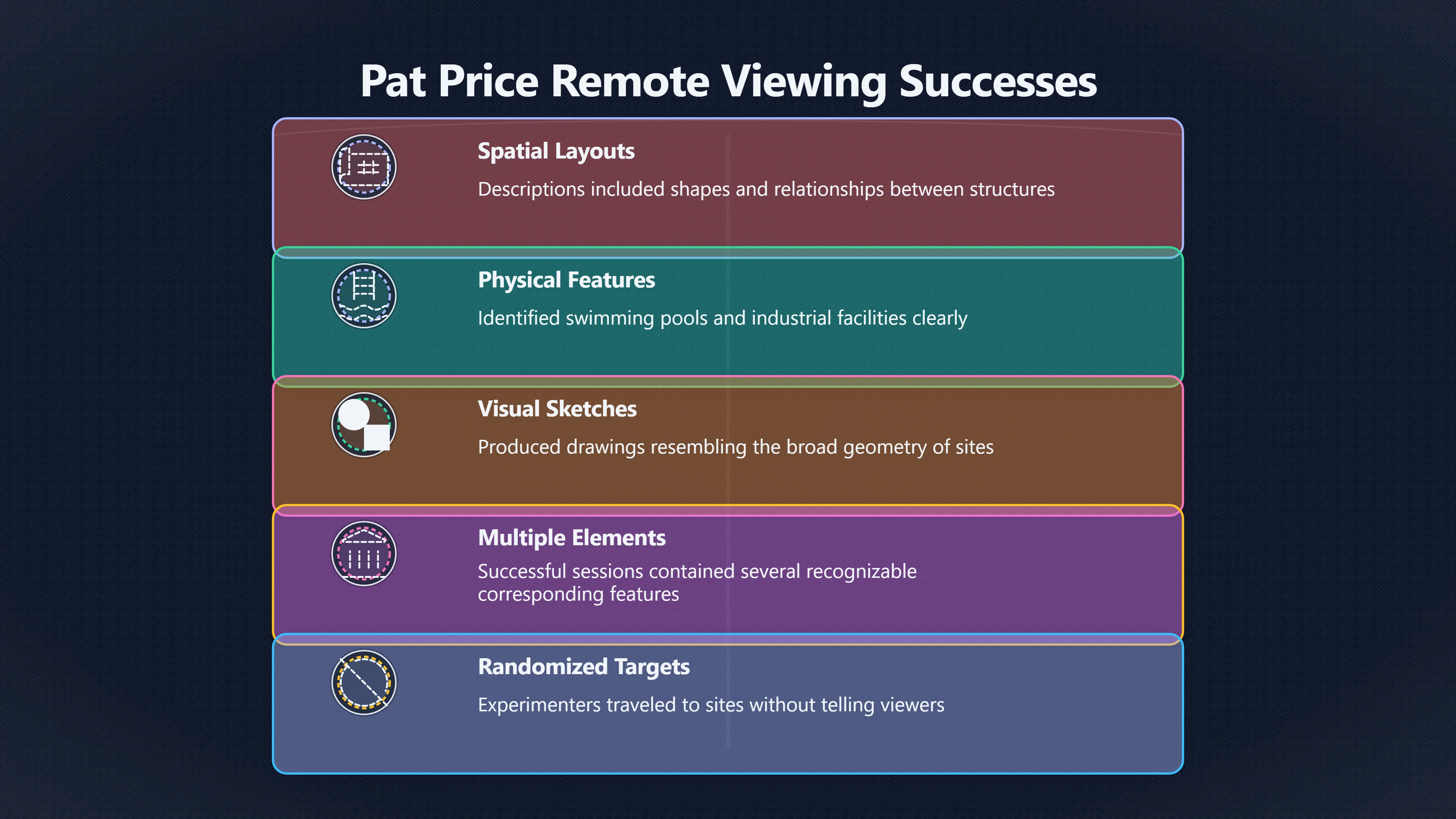
Price’s transcripts differed from many earlier ESP experiments because they often contained concrete spatial information. Rather than guessing isolated symbols or cards, he attempted to describe layouts, shapes and relationships between structures.
Supporters point to several features:
- Multiple corresponding elements. Successful sessions often included several recognisable features rather than a single correct statement.
- Sketches as well as verbal reports. Drawings sometimes resembled the broad geometry of the target site.
- Random target selection. SRI researchers argued that the viewer did not know where the outbound experimenter had travelled.
- Independent judging. The intended protocol relied on judges matching transcripts against several candidate locations rather than relying on subjective impressions alone.[CIA]cia.govAN EVALUATION OF REMOTE VIEWING: RESEARCH…A remote viewer is asked to visualize a place, location, or object being viewed by a "bea…
These characteristics helped distinguish remote viewing from earlier clairvoyance experiments and formed the basis for SRI’s claim that the phenomenon could be investigated under laboratory conditions.
Why judging became the central controversy
The most important methodological issue was not whether Price produced interesting descriptions, but how those descriptions were evaluated afterwards.
Remote-viewing transcripts are typically rich in imagery but also flexible enough to fit many environments. Statements such as “water”, “metal”, “tower”, “open area” or “people moving” can apply to numerous locations. Determining whether a transcript uniquely matches one target therefore depends heavily on the judging procedure.
In principle, judges should receive carefully anonymised transcripts and target materials so they cannot infer which description belongs to which session. If any additional information leaks into the judging process, even unintentionally, the apparent accuracy can increase without any paranormal explanation.[CIA]cia.govAN EVALUATION OF REMOTE VIEWING: RESEARCH…A remote viewer is asked to visualize a place, location, or object being viewed by a "bea…
This made judging the critical step in evaluating Price’s results. Even an excellent transcript has limited scientific value if the matching procedure is vulnerable to bias.
How critics argued cues affected the results
Psychologists David Marks and Richard Kammann re-examined the early SRI material after being unable to reproduce comparable results in their own studies. Instead of concentrating on the descriptions themselves, they analysed the transcripts available to judges.
Their central criticism was that many transcripts contained unintended chronological or contextual clues. Session dates, references to previous targets and other identifying details sometimes allowed a knowledgeable reader to reconstruct the order of experiments. If the target list was also ordered chronologically, a judge could match transcripts to targets using ordinary reasoning rather than paranormal information.[Wikipedia]WikipediaRemote viewingRemote viewing
Marks reported that after obtaining fuller transcript material, he could correctly match targets using these ordinary cues alone. He argued that the apparent success rates therefore could not be interpreted as clean evidence for remote viewing until such information leakage was eliminated.[Wikipedia]WikipediaRemote viewingRemote viewing
Importantly, this criticism was directed at the experimental protocol rather than at Pat Price personally. The claim was not necessarily that Price fabricated his descriptions, but that the published evidence did not isolate paranormal perception from conventional explanations.
How supporters responded
Russell Targ and Harold Puthoff disputed the criticism and maintained that Price’s strongest sessions remained impressive even without reliance on chronological cues. They argued that critics overstated the importance of incidental transcript details and overlooked correspondences that independent observers found compelling.
Supporters have also noted that later remote-viewing research adopted more rigorous blind judging procedures intended specifically to eliminate the weaknesses identified in the early SRI experiments. Some proponents argue that because later studies continued to report statistically significant results under improved protocols, the criticisms of the Price sessions should not be taken as a complete refutation of remote viewing as a whole.[psi-encyclopedia.spr.ac.uk]psi-encyclopedia.spr.ac.ukRemote ViewingPsi Encyclopedia13 Jan 2017 — Ray Hyman conceded methodological criticisms had largely fallen away. Hyman, a significant skeptical critic…
Critics counter that the famous Price cases cannot simply be reinterpreted using later protocols. They maintain that each experiment must be judged according to the controls actually in place at the time, and that the original SRI demonstrations remain methodologically vulnerable regardless of subsequent developments.[Wikipedia]WikipediaRemote viewingRemote viewing
What Pat Price’s case ultimately shows
Pat Price’s local-target sessions remain historically important because they illustrate both sides of the remote-viewing debate in unusually clear form.
On one hand, his descriptions were often detailed enough to persuade many observers that something unusual might have occurred. Few early participants generated as many memorable examples or had such influence on the reputation of the SRI programme.
On the other hand, the scientific value of those sessions depends not only on the quality of the descriptions but also on the integrity of the judging process. The controversy demonstrated that in free-response experiments, the evaluation stage can be as important as the observations themselves. Whether Price’s transcripts genuinely identified hidden targets or merely appeared to do so because of imperfect judging remains one of the central unresolved questions in the history of SRI remote-viewing research.[CIA+2Wikipedia]cia.govAN EVALUATION OF REMOTE VIEWING: RESEARCH…A remote viewer is asked to visualize a place, location, or object being viewed by a "bea…
Amazon book picks
Further Reading
Books and field guides related to Did Pat Price Really Match the Targets?. Use these as the next step if you want deeper reading beyond the article.
The Men Who Stare At Goats
Rating: 3.5/5 from 11 Google Books ratings
Introduces readers to the personalities and legacy of the program.
eBay marketplace picks
Marketplace Samples
Live-tested eBay searches with available results related to this page.

Endnotes
1.
Source: cia.gov
Link:https://www.cia.gov/readingroom/document/cia-rdp96-00791r000200180006-4
Source snippet
AN EVALUATION OF REMOTE VIEWING: RESEARCH...A remote viewer is asked to visualize a place, location, or object being viewed by a "bea...
2.
Source: Wikipedia
Title: Parapsychology research at SRI
Link:https://en.wikipedia.org/wiki/Parapsychology_research_at_SRI
3.
Source: ciaotest.cc.columbia.edu
Link:https://ciaotest.cc.columbia.edu/olj/sa/sa_jan02srm01.html
Source snippet
circular pool of water...
4.
Source: psi-encyclopedia.spr.ac.uk
Title: Remote Viewing
Link:https://psi-encyclopedia.spr.ac.uk/articles/remote-viewing/
Source snippet
Psi Encyclopedia13 Jan 2017 — Ray Hyman conceded methodological criticisms had largely fallen away. Hyman, a significant skeptical critic...
5.
Source: Wikipedia
Title: Remote viewing
Link:https://en.wikipedia.org/wiki/Remote_viewing
6.
Source: Wikipedia
Title: Russell Targ
Link:https://en.wikipedia.org/wiki/Russell_Targ
Additional References
7.
Source: researchgate.net
Link:https://www.researchgate.net/publication/327166514_Remote_Viewing_of_Concealed_Target_Pictures_Under_Light_and_Dark_Conditions
Source snippet
Remote Viewing of Concealed Target Pictures Under Light...(2019) found that image targets rated as more numinous by [independent judges]({{ 'independent-judges/' | relative_url }}) p...
8.
Source: scribd.com
Link:https://www.scribd.com/document/150673461/Remote-Viewing
Source snippet
the course of a year. The study uses 12 experienced remote...Read more...
9.
Source: reddit.com
Link:https://www.reddit.com/r/remoteviewing/comments/1501do7/the_complete_skeptics_guide_to_remote_viewing_how/
Source snippet
nd what the field needs to address in order to be legitimized.Read more...
10.
Source: academia.edu
Link:https://www.academia.edu/38286031/Remote_Viewing_of_Concealed_Target_Pictures_Under_Light_and_Dark_Conditions
Source snippet
The study involved 19 sessions from 7 remote viewers, highlighting...
11.
Source: facebook.com
Link:https://www.facebook.com/100090372200308/posts/during-the-[cold-war
Source snippet
was given nothing but a set of geographic coordinates and asked...
12.
Source: facebook.com
Link:https://www.facebook.com/AskImtinan/posts/project-stargate-the-cias-search-for-tabut-e-sakinahin-1972-the-cia-secretly-fun/1575907587435890/
Source snippet
SRI, and remote viewers like Ingo Swann and Pat Price. 3. **Methodology**: Remote viewers would attempt to describe locations, objects, o...
13.
Source: youtube.com
Title: Remote Viewing, The Dangers of Being a Government Spy & A UFO Tangent
Link:https://www.youtube.com/watch?v=tppqY39sigY
Source snippet
Scientific and Spiritual Implications of Psychic Abilities - Russell Targ...
14.
Source: youtube.com
Title: Scientific and Spiritual Implications of Psychic Abilities
Link:https://www.youtube.com/watch?v=zgyYms376Mg
Source snippet
Early Years of Psi Research at SRI International with Russell Targ...
15.
Source: youtube.com
Title: Early Years of Psi Research at SRI International with Russell Targ
Link:https://www.youtube.com/watch?v=WJ9gkGqXuXE
Source snippet
Beyond the Five Senses: Leanne Whitney Interviews Russell Targ in 2005...
16.
Source: pmc.ncbi.nlm.nih.gov
Link:https://pmc.ncbi.nlm.nih.gov/articles/PMC10275521/
Source snippet
Central Intelligence Agency's (CIA...by Á Escolà‐Gascón · 2023 · Cited by 10 — Since 1972, the U.S. Central Intelligence Agency (CIA) co...
Topic Tree