Within Fair Test
Why Decoys Matter More Than Hits
Rank-order judging forces a response to beat decoys instead of letting a vague sketch become impressive after the answer is revealed.
On this page
- How rank order judging works with decoys
- Why vague matches become persuasive after feedback
- What first place hits and mean ranks actually test
Page outline Jump by section
Introduction
In a remote viewing experiment, the central question is not whether a description can be made to resemble the target after it is revealed. The more important question is whether the description can be distinguished from plausible alternatives while the correct answer remains unknown. This is why modern remote viewing research has generally favoured rank-order judging over informal post-hoc matching. Instead of asking whether a transcript contains recognisable features of the target, rank-order judging requires a judge to compare the transcript against the true target and several carefully chosen decoys, then rank them from best to worst match. If the true target consistently receives the highest rank more often than chance predicts, the result can be analysed statistically. If it does not, apparently impressive descriptions may simply reflect the flexibility of human interpretation.[CIA]cia.govAN EVALUATION OF REMOTE VIEWING: RESEARCH…A remote viewer is asked to visualize a place, location, or object being viewed by a "bea…

Why Decoys Matter More Than Hits
The intuitive appeal of a “hit” can be deceptive. Many remote viewing transcripts contain broad descriptions such as “water”, “large structure”, “movement”, “people”, or “bright colours”. Once the actual target is revealed, readers often notice similarities while overlooking equally plausible mismatches.
Decoy targets change the question from “Can this description fit the real target?” to “Does it fit the real target better than several alternatives?” This comparison is much harder to satisfy by chance.
Suppose a viewer sketches curved lines and writes “cold, open, reflective”. After feedback, this might seem an excellent description of an icy lake. However, if the judge must compare the same transcript against five photographs—including a glacier, a modern stadium, a coastal harbour, a silver sculpture and the lake—the transcript must outperform all four decoys. A description that feels convincing in isolation may no longer stand out.
This approach reduces the influence of selective attention, because every trial contains competing explanations that must also be considered before assigning a score.[CIA]cia.govAN EVALUATION OF REMOTE VIEWING: RESEARCH…A remote viewer is asked to visualize a place, location, or object being viewed by a "bea…
How Rank-Order Judging Works with Decoys
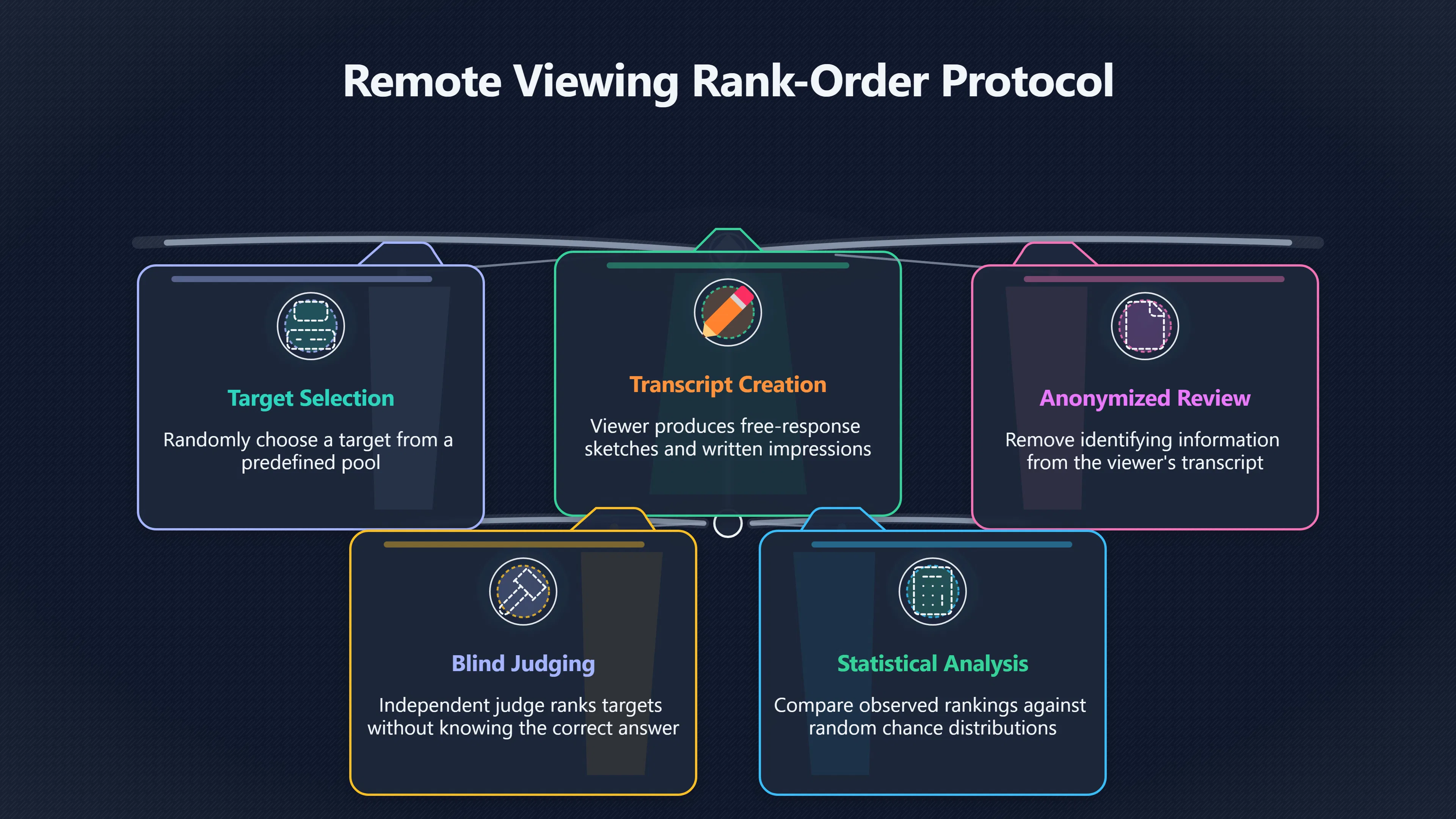
The procedure is straightforward but carefully structured.
- A target is selected randomly from a predefined pool.
- The viewer produces a free-response transcript, often including sketches and written impressions.
- The transcript is anonymised.
- An independent judge receives the transcript together with the true target and several decoys, without knowing which one is correct.
- The judge ranks every target from best to worst match.
Because the judge is blind to the correct answer, they cannot intentionally or unintentionally favour it. Statistical analysis is then performed across many trials rather than relying on a few memorable successes.
Historically, many remote viewing experiments have used sets of five photographs. Under this design, chance alone would produce a first-place ranking approximately one time in five. Researchers therefore evaluate whether the observed rankings exceed what random guessing would predict over many independent trials.[CIA]cia.govAN EVALUATION OF REMOTE VIEWING: RESEARCH…A remote viewer is asked to visualize a place, location, or object being viewed by a "bea…
Why Vague Matches Become Persuasive After Feedback
Post-hoc matching exploits several well-studied features of human judgement rather than necessarily revealing anything unusual about perception.
Confirmation bias
Once observers know the target, they naturally search for supporting details. Features that agree with the target become memorable, while contradictory statements receive less attention.
A transcript containing twenty observations may include only three genuine similarities. After feedback, those three similarities often dominate the interpretation.
The Barnum effect
General descriptions can appear highly specific once attached to a known answer.
For example, references to “height”, “energy”, “movement”, or “complex shapes” could plausibly apply to mountains, skyscrapers, waterfalls, aircraft, industrial sites, sporting events or many other targets.
Without decoys, there is little pressure to distinguish between these competing interpretations.
Hindsight reconstruction
Readers frequently reinterpret ambiguous drawings after learning the target.
An irregular sketch might initially resemble nothing recognisable. After seeing a photograph of a suspension bridge, the same drawing may suddenly appear to contain bridge cables and towers. Had a different photograph been shown first, the interpretation might have changed accordingly.
Rank-order judging limits this flexibility because every possible interpretation must compete simultaneously against multiple alternatives.
What First-Place Hits and Mean Ranks Actually Test
A common misunderstanding is that only first-place rankings matter.
In practice, researchers often analyse both:
- First-place hits measure how often the true target is ranked above every decoy.
- Mean rank measures the average position of the correct target across all trials.
Mean rank can be informative because consistent second-place or near-top rankings may indicate a weak but systematic tendency, whereas isolated spectacular hits mixed with poor performance may simply reflect chance variation.
Statistical tests compare the observed distribution of ranks with the distribution expected under random assignment. The strength of the evidence depends on the entire collection of trials rather than on selected examples.[CIA]cia.govAN EVALUATION OF REMOTE VIEWING: RESEARCH…A remote viewer is asked to visualize a place, location, or object being viewed by a "bea…
What Rank-Order Judging Does—and Does Not—Control
Rank-order judging addresses an important source of bias, but it is not a complete safeguard.
It helps reduce:
- selective interpretation after feedback;
- unconscious preference for the known target;
- inflated impressions created by isolated anecdotes;
- scoring methods that change from trial to trial.
However, it does not automatically eliminate every methodological concern. Critics of remote viewing research have noted that results may still be influenced by target selection, similarities among photographs, repeated use of the same viewers or judges, inadequate blinding, cue leakage, or low agreement between independent judges. The American Institutes for Research review concluded that although some laboratory studies reported above-chance outcomes, the available evidence did not establish that these effects could be unambiguously attributed to paranormal perception rather than characteristics of the judging process or other features of the experimental design.[CIA]cia.govAN EVALUATION OF REMOTE VIEWING: RESEARCH…A remote viewer is asked to visualize a place, location, or object being viewed by a "bea…

Why Rank Judging Became the Preferred Standard
The move from informal “Does this look right?” evaluations to blind rank-order judging reflects a broader principle of experimental design: evidence becomes more persuasive when success must be demonstrated against realistic alternatives rather than explained after the answer is known.
For remote viewing, this means that the meaningful comparison is not between a transcript and its target alone. It is between that transcript and a set of equally plausible decoys evaluated under blind conditions using a scoring rule established before any feedback is given. A transcript that consistently ranks first under those conditions provides stronger evidence than one that merely appears impressive after the correct target has already been revealed, regardless of one’s prior view on whether remote viewing itself is a genuine phenomenon.
Amazon book picks
Further Reading
Books and field guides related to Why Decoys Matter More Than Hits. Use these as the next step if you want deeper reading beyond the article.

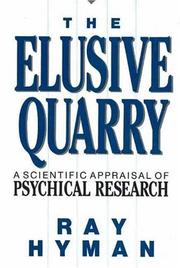
The elusive quarry
First published 1989. Subjects: Book reviews, Controversial literature, Parapsychology, Psychical research.
eBay marketplace picks
Marketplace Samples
Live-tested eBay searches with available results related to this page.



Endnotes
1.
Source: cia.gov
Link:https://www.cia.gov/readingroom/document/cia-rdp96-00791r000200180006-4
Source snippet
AN EVALUATION OF REMOTE VIEWING: RESEARCH...A remote viewer is asked to visualize a place, location, or object being viewed by a "bea...
2.
Source: Wikipedia
Title: Remote viewing
Link:https://en.wikipedia.org/wiki/Remote_viewing
Source snippet
Remote viewingRemote viewing (RV) is the practice of seeking impressions about a distant or unseen subject, purportedly sensing with t...
Additional References
3.
Source: researchgate.net
Title: 369604750 Remote Viewing a 1974 2022 systematic review and [meta analysis]({{ ‘meta-analysis/’ | relative_url }})
Link:https://www.researchgate.net/publication/369604750_Remote_Viewing_a_1974-2022_systematic_review_and_meta-analysis
Source snippet
(PDF) Remote Viewing: a 1974-2022 systematic review...This is the first meta-analysis of all studies related to remote viewing tasks con...
4.
Source: academia.edu
Link:https://www.academia.edu/38286031/Remote_Viewing_of_Concealed_Target_Pictures_Under_Light_and_Dark_Conditions
Source snippet
conducted, to determine if this characteristic was associated with success.Read more...
5.
Source: scribd.com
Link:https://www.scribd.com/doc/92017954/Air-Report
Source snippet
ilarity of each remote viewing report to each photograph in the...Read more...
6.
Source: youtube.com
Title: Edwin May, [Psychic Spying]({{ ‘psychic-spying/’ | relative_url }}) (Remote Viewing, Star Gate Program)
Link:https://www.youtube.com/watch?v=EPvrOsEXBbE
Source snippet
Dr. Edwin May, Psychic Theories (Precognition, Remote Viewing) - Jimmy Akin's Mysterious World...
7.
Source: koestler-parapsychology.psy.ed.ac.uk
Title: KPU 1034 Published Results
Link:https://www.koestler-parapsychology.psy.ed.ac.uk/Documents/KPU_1034_Published_Results.pdf
Source snippet
remote viewing projects: Assessing rater...by DL KATZ · 2021 · Cited by 10 — To gauge inter-rater reliability, the new scores and predic...
8.
Source: youtube.com
Title: Dr. Edwin May, Psychic Theories ([Precognition]({{ ‘precognition/’ | relative_url }}), Remote Viewing)
Link:https://www.youtube.com/watch?v=fk3f47jOAFs
Source snippet
Russell Targ - Remote Viewing & Third Eye Spies...
9.
Source: arxiv.org
Link:https://arxiv.org/abs/2602.11453
Source snippet
Learning to Rank via Denoising Diffusionby S Ebrahimi · 2026 — We propose an alternative denoising diffusion-based generative approach to...
10.
Source: facctconference.org
Title: facct22 3533102
Link:https://facctconference.org/static/pdfs_2022/facct22-3533102.pdf
Source snippet
This paper extends Becker [3]'s outcome test of discrimination to settings where a (human or algorithmic) decision-maker produces a ranke...
11.
Source: youtube.com
Title: Russell Targ
Link:https://www.youtube.com/watch?v=E_cLp15CaPE
Source snippet
Mind and Matter with Russell Targ (4K Reboot)...
12.
Source: youtube.com
Link:https://www.youtube.com/watch?v=YrwAiU2g5RU
Topic Tree