Within Remote Viewing
How to Read Remote Viewing Files Carefully
Declassified remote viewing files are fascinating, but readers need to separate raw records from validated conclusions.
On this page
- Raw Session Material
- Evaluation Language
- Common Interpretation Traps
Page outline Jump by section
Introduction
Declassified remote viewing documents are best read as raw intelligence-era records, not as verdicts. A session transcript, tasking sheet or sketch in the CIA Reading Room shows that a remote viewing attempt was recorded, handled and sometimes evaluated; it does not by itself show that the description was accurate, useful or paranormal. The careful reader separates three layers: what the viewer said before feedback, what the target or tasking actually was, and how later evaluators judged the match.
That distinction matters because the Stargate archive contains both intriguing session material and blunt institutional doubts. The 1995 American Institutes for Research review found that recent laboratory studies had produced a statistically significant effect, but also concluded that the evidence did not unambiguously establish a paranormal phenomenon and that operational reports had no real intelligence value at the time.[National Security Archive]nsarchive2.gwu.eduNational Security Archiveremote~1.PD FNational Security Archiveremote~1.PD F
Start by identifying what kind of document you are reading
Remote viewing files are not all the same. A transcript is different from a protocol, a training manual, a tasking requirement, an operational summary or a retrospective evaluation. Confusing these categories is one of the fastest ways to overread the archive.
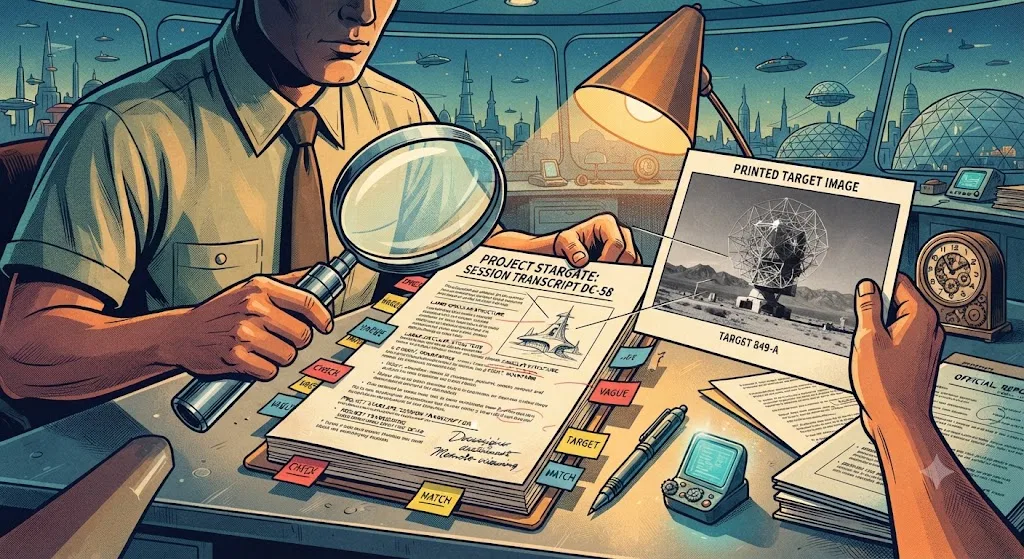
A raw session transcript usually records the session itself: the monitor’s prompts, the viewer’s spoken impressions, pauses, sketches and sometimes post-session comments. For example, CIA Reading Room entries include individual session transcripts such as “Remote Viewing Session DC-58” and “Remote Viewing Session #849”, each presented as a record of a particular attempt rather than as proof that the attempt succeeded.[CIA]cia.govTRANSCRIPT REMOTE VIEWING (RV) SESSION DC-58This report documents a remote viewing session conducted in compliance with a request for…
A protocol or evaluation document explains how sessions were meant to be judged. One declassified evaluation protocol describes a procedure in which a judge is given remote viewing transcripts and target sites, then ranks the transcripts from best to least match for each target. That tells the reader something crucial: “accuracy” was often not a simple yes-or-no fact but a judgement made through comparison, ranking and interpretation.[CIA]cia.govOpen source on cia.gov.
A programme review sits at a still higher level. The AIR review was commissioned to assess both the research component and the intelligence-gathering component of the Star Gate programme. It considered laboratory studies, interviews with users and viewers, and user feedback about operational value.[National Security Archive]nsarchive2.gwu.eduNational Security Archiveremote~1.PD FNational Security Archiveremote~1.PD F
Read raw session material without turning impressions into findings
Raw session notes are often the most fascinating documents because they feel immediate. They can include visual fragments, sensory impressions, emotional tones, geometric sketches, place descriptions and speculative nouns. But that vividness is exactly why they require discipline.
The first rule is to preserve the order of events. Ask whether the viewer’s material was recorded before feedback, whether the target was known to the monitor, whether background information was given, and whether the final document includes later summaries or edits. In operational settings, the AIR review found that viewers sometimes had at least some background knowledge, and in some cases substantial background knowledge, about the task. That makes it unsafe to treat every plausible detail as isolated from ordinary inference.[National Security Archive]nsarchive2.gwu.eduNational Security Archiveremote~1.PD FNational Security Archiveremote~1.PD F
The second rule is to separate description from interpretation. A viewer might say “metallic”, “large”, “water nearby”, “enclosed space” or “movement”. Those are not the same as “a submarine base”, “a missile gantry” or “a hostage location”. The more a later reader supplies the missing noun, the more the apparent hit may be produced by interpretation rather than by the original record.
A practical reading method is to mark each item in a transcript as one of four types:
- Specific and checkable: a distinctive object, number, layout, name, direction or relation that could be verified.
- Broad but possibly relevant: terrain, activity level, size, human presence or general mood.
- Ambiguous: phrases that could fit many targets.
- Wrong or irrelevant: material contradicted by later evidence or unrelated to the target.
This prevents a common mistake: counting only the matches while silently dropping the misses. The AIR review warned that most remote viewing reports contained many potentially interpretable components, with an unknown share unrelated to the target, leaving end users unable to know which parts were valid and which were irrelevant.[National Security Archive]nsarchive2.gwu.eduNational Security Archiveremote~1.PD FNational Security Archiveremote~1.PD F
Treat evaluation language as a warning label, not a stamp of proof
Words such as “accurate”, “value”, “hit”, “match” and “significant” do not always mean what a casual reader assumes. In remote viewing records, they may refer to different levels of assessment: a judge’s ranking, a user’s practical reaction, a statistical result across trials, or a manager’s operational impression.
The 1995 review is useful because it separates these meanings. On the research side, it acknowledged that a statistically significant effect had been observed in recent laboratory experiments. But it immediately added that this did not settle whether the effect was paranormal, methodological or caused by some alternative explanation.[National Security Archive]nsarchive2.gwu.eduNational Security Archiveremote~1.PD FNational Security Archiveremote~1.PD F
On the operational side, the same review was much less favourable. It found that the information provided in viewings was vague and general, inconsistent across independent viewings, lacking in specific content consistent with known facts, and mixed with large amounts of irrelevant or erroneous material. For intelligence work, where information must be specific, reliable and verifiable, that distinction is decisive.[National Security Archive]nsarchive2.gwu.eduNational Security Archiveremote~1.PD FNational Security Archiveremote~1.PD F
A reader should therefore ask: evaluation by whom, for what purpose, and against what standard? A transcript that feels impressive in a narrative retelling may not have scored well under blind judging. A report that contains broad background resemblance may still fail as actionable intelligence. A statistically significant laboratory result may still be too weak, too inconsistent or too poorly explained to support operational use.
Watch for the three biggest interpretation traps
The declassified archive can inform readers without requiring either belief or dismissal. The danger lies in reading documents through a conclusion chosen in advance.
Trap one: treating declassification as endorsement. A CIA or defence archive page means the document was held, processed and released; it does not mean the agency validated the claims inside it. The CIA’s Star Gate collection includes many kinds of material, from session transcripts to meeting notes and tasking documents, because those records formed part of the programme archive.[CIA]cia.govSTARGATE | CIA FOIA (foia.cia.gov)REMOTE VIEWING SESSION 898 · TARGETING REQUIREMENTS TASK · TRANSCRIPT REMOTE VIEWING SESSION 899 · MEETINGSTARGATE | CIA FOIA (foia.cia.gov)REMOTE VIEWING SESSION 898 · TARGETING REQUIREMENTS TASK · TRANSCRIPT REMOTE VIEWING SESSION 899 · MEETING
Trap two: confusing “some accurate material” with “usable intelligence”. A report can contain a few broad correspondences and still fail operationally. AIR found that users regarded some broad background characteristics as more accurate than concrete specifics, but noted that such broad material could reflect background knowledge, analytic cues or report modification rather than remote viewing itself.[National Security Archive]nsarchive2.gwu.eduNational Security Archiveremote~1.PD FNational Security Archiveremote~1.PD F
Trap three: ignoring cueing and judging problems. Critics of early remote viewing experiments focused heavily on sensory leakage: clues in transcripts, dates, ordering information or other details that could help judges match reports to targets without any paranormal process. David Marks’s 1981 Nature critique was explicitly titled “Sensory cues invalidate remote viewing experiments”, and later debates continued to focus on whether cueing had been adequately removed.[PubMed]pubmed.ncbi.nlm.nih.govOpen source on nih.gov.
These traps do not prove that every document is worthless. They show why the archive must be read like a disputed evidentiary record: interesting, historically real, but uneven and highly dependent on procedure.
Use the AIR review as a calibration tool
The AIR review is not the only source worth reading, but it is a strong calibration point because it included both favourable and sceptical expert perspectives. Jessica Utts, a statistician with experience in parapsychological research, and Ray Hyman, a psychologist known for sceptical work on paranormal claims, were asked to prepare independent reviews. The panel also included behavioural-science and statistical expertise from AIR and Stanford.[National Security Archive]nsarchive2.gwu.eduNational Security Archiveremote~1.PD FNational Security Archiveremote~1.PD F
The review’s most useful lesson for readers is not “remote viewing is real” or “remote viewing is fake”. It is that different evidentiary questions need different standards:
- Did a session happen? The transcript can usually answer that.
- Was the viewer blind to the target? The protocol and tasking details matter.
- Was the description judged independently? Look for blind judging and more than one judge.
- Did the result beat chance across trials? That requires statistical reporting, not anecdotes.
- Was it useful for intelligence decisions? User feedback and operational outcomes matter more than colourful matches.
The AIR reviewers agreed that independent judging was a major unresolved issue in the research they examined. The report noted that only one judge, apparently the principal investigator, was used in assessing matches across the experimental studies, making it difficult to separate viewer ability from judge interpretation or subtle unintentional influences.[National Security Archive]nsarchive2.gwu.eduNational Security Archiveremote~1.PD FNational Security Archiveremote~1.PD F
A practical reading workflow
A careful reader can get much more from the archive by using a simple workflow before drawing conclusions.
First, record the document type and date. Is it a transcript, a protocol, a training text, a tasking memo, a summary or an evaluation? The same phrase has different weight in each.
Second, reconstruct the chain of custody. Identify who tasked the session, who monitored it, what the viewer knew, when feedback occurred and whether the record appears to include later editing or summary.
Third, score the transcript before reading the target feedback. This is the closest a modern reader can get to resisting hindsight. Write down the concrete claims first, then compare them with the target.
Fourth, count misses as well as hits. A few strong resemblances can look more impressive when the surrounding vague, wrong or irrelevant material is ignored.
Fifth, distinguish laboratory evidence from operational usefulness. AIR’s review makes this distinction central: even if an effect appears in laboratory experiments, field intelligence work requires consistent, specific and verifiable information under conditions that may not allow feedback or controlled judging.[National Security Archive]nsarchive2.gwu.eduNational Security Archiveremote~1.PD FNational Security Archiveremote~1.PD F
Sixth, prefer converging records over isolated anecdotes. A strong case would have contemporaneous session notes, clear tasking, blinding, independent judging, target feedback, user evaluation and a documented operational consequence. Many striking archive examples have only some of those pieces.

What the documents can and cannot tell you
The declassified remote viewing files are valuable historical evidence. They show that U.S. agencies funded, managed, tested and debated remote viewing for years; they preserve how sessions were run; and they reveal how difficult it was to translate ambiguous impressions into intelligence value. They also show that some officials, researchers and viewers took the work seriously enough to build protocols, training systems and evaluation methods around it.
What they cannot do, by themselves, is settle the paranormal claim. A transcript cannot prove accuracy without a clean comparison process. A match cannot prove remote perception if cueing, prior information or flexible interpretation are possible. A programme review cannot make every session worthless simply because the operational conclusion was negative.
The most responsible reading stance is therefore neither hype nor dismissal. Treat the archive as a layered dataset: raw impressions, judging procedures, user feedback, institutional evaluation and later criticism. Read each layer for what it can actually support, and the documents become more interesting, not less, because their real value lies in the tension between ambition, method, ambiguity and evidence.
Amazon book picks
Further Reading
Books and field guides related to How to Read Remote Viewing Files Carefully. Use these as the next step if you want deeper reading beyond the article.
Phenomena: The Secret History of the U.S. Government's Invest...
Helps readers interpret declassified remote-viewing records in context.
Phenomena
Covers the military and intelligence context behind remote viewing and the lab-to-operations gap.
The Men Who Stare At Goats
Rating: 3.5/5 from 11 Google Books ratings
Provides cultural and historical context for government files.
The Demon-Haunted World: Science as a Candle in the Dark
Encourages critical reading of extraordinary claims and documents.
eBay marketplace picks
Marketplace Samples
Live-tested eBay searches with available results related to this page.




Endnotes
1.
Source: cia.gov
Link:https://www.cia.gov/readingroom/document/cia-rdp96-00788r000500810001-8
Source snippet
TRANSCRIPT REMOTE VIEWING (RV) SESSION DC-58This report documents a remote viewing session conducted in compliance with a request for...
2.
Source: cia.gov
Link:https://www.cia.gov/readingroom/document/cia-rdp96-00788r000700190001-5
Source snippet
TRANSCRIPT REMOTE VIEWING SESSION #849This will be a remote viewing session for 20 January 1982 with a start time of 0900 hours. PAUSE...
Published: January 1982
3.
Source: cia.gov
Link:https://www.cia.gov/readingroom/document/cia-rdp96-00788r001800080001-5
4.
Source: cia.gov
Link:https://www.cia.gov/readingroom/collection/[stargate
5.
Source: cia.gov
Link:https://www.cia.gov/readingroom/docs/CIA-RDP96-00787R000200090017-5.pdf
6.
Source: cia.gov
Link:https://www.cia.gov/readingroom/docs/CIA-RDP96-00791R000200180005-5.pdf
7.
Source: cia.gov
Link:https://www.cia.gov/readingroom/document/cia-rdp96-00791r000200180005-5
8.
Source: cia.gov
Link:https://www.cia.gov/readingroom/docs/CIA-RDP96-00789R002800180001-2.pdf
9.
Source: cia.gov
Link:https://www.cia.gov/readingroom/docs/CIA-RDP96-00791R000200300002-2.pdf
10.
Source: cia.gov
Link:https://www.cia.gov/readingroom/document/cia-rdp96-00791r000200180006-4
11.
Source: cia.gov
Link:https://www.cia.gov/readingroom/docs/CIA-RDP96-00791R000200180006-4.pdf
12.
Source: cia.gov
Link:https://www.cia.gov/readingroom/document/cia-rdp96-00789r003800440001-2
13.
Source: cia.gov
Link:https://www.cia.gov/readingroom/docs/CIA-RDP96-00789R002800260001-3.pdf
14.
Source: cia.gov
Link:https://www.cia.gov/readingroom/docs/CIA-RDP96-00789R002200070001-0.pdf
15.
Source: cia.gov
Link:https://www.cia.gov/readingroom/document/cia-rdp96-00789r002700010001-1
16.
Source: cia.gov
Link:https://www.cia.gov/readingroom/document/cia-rdp96-00789r002200070001-0
17.
Source: cia.gov
Link:https://www.cia.gov/readingroom/document/cia-rdp96-00788r001800150001-7
18.
Source: cia.gov
Link:https://www.cia.gov/readingroom/docs/CIA-RDP96-00789R002600250001-6.pdf
19.
Source: cia.gov
Link:https://www.cia.gov/readingroom/document/cia-rdp96-00792r000500590002-7
20.
Source: cia.gov
Link:https://www.cia.gov/readingroom/document/cia-rdp96-00787r000300290001-9
21.
Source: cia.gov
Link:https://www.cia.gov/readingroom/docs/CIA-RDP96-00789R002700010001-1.pdf
22.
Source: cia.gov
Link:https://www.cia.gov/readingroom/docs/CIA-RDP96-00788R001000410001-6.pdf
23.
Source: archive.org
Title: cia readingroom document cia rdp96 00788r000700380001 4
Link:https://archive.org/details/cia-readingroom-document-cia-rdp96-00788r000700380001-4
24.
Source: nsarchive2.gwu.edu
Title: National Security Archiveremote~1.PD F
Link:https://nsarchive2.gwu.edu/NSAEBB/NSAEBB438/docs/doc_57.pdf
25.
Source: pubmed.ncbi.nlm.nih.gov
Link:https://pubmed.ncbi.nlm.nih.gov/7242682/
26.
Source: pmc.ncbi.nlm.nih.gov
Link:https://pmc.ncbi.nlm.nih.gov/articles/PMC10275521/
27.
Source: Wikipedia
Title: Remote viewing
Link:https://en.wikipedia.org/wiki/Remote_viewing
28.
Source: Wikipedia
Title: Sensory leakage
Link:https://en.wikipedia.org/wiki/Sensory_leakage
29.
Source: ics.uci.edu
Link:https://www.ics.uci.edu/~jutts/may.pdf
30.
Source: ics.uci.edu
Link:https://www.ics.uci.edu/~jutts/hyman.html
31.
Source: huggingface.co
Link:https://huggingface.co/datasets/GotThatData/STARGATE
Additional References
32.
Source: youtube.com
Title: Remote Viewing is Unlike Anything I’ve Ever Experienced | Sky Life
Link:http://www.youtube.com/watch?v=pYck4KX3Zxo
Source snippet
How to analyze declassified remote viewing documents Stargate CIA Project Stargate & Other Declassified Secrets - How Successful Were They?...
33.
Source: youtube.com
Title: Analyzing Remote Viewing with Paul Smith (Project Star Gate)
Link:http://www.youtube.com/watch?v=-CuR7gSHZU0
Source snippet
CIA Project Stargate & Other Declassified Secrets - How Successful Were They?...
34.
Source: youtube.com
Title: CIA Project Stargate & Other Declassified Secrets
Link:http://www.youtube.com/watch?v=xDf7OUKpyvs
Source snippet
The CIA’s Very Real Experiments into Psychic Powers...
35.
Source: youtube.com
Title: How to access declassified documents from the CIA or FBI
Link:http://www.youtube.com/watch?v=3FJ9SaGb4T4
Source snippet
Remote Viewing is Unlike Anything I've Ever Experienced | Sky Life...
36.
Source: youtube.com
Title: The CIA’s Very Real Experiments into Psychic Powers
Link:http://www.youtube.com/watch?v=DVZ2P5pe0-Q
Source snippet
How to access declassified documents from the CIA or FBI...
37.
Source: researchgate.net
Link:https://www.researchgate.net/publication/403178755_The_Star_Gate_Archives_Reports_of_the_United_States_Government_Sponsored_Psi_Program_1972-1995_Volume_4_Operational_Remote_Viewing_Memorandums_and_Reports
38.
Source: reddit.com
Link:https://www.reddit.com/r/aliens/comments/nqvskt/cia_document_showing_a_transcript_of_a_remote/
39.
Source: skepsis.nl
Link:https://skepsis.nl/stargate/
40.
Source: reddit.com
Link:https://www.reddit.com/r/remoteviewing/comments/qrmn2c/can_someone_explain_remote_viewing_to_me_i_dont/
41.
Source: reddit.com
Link:https://www.reddit.com/r/remoteviewing/comments/1dazs09/creation_of_study_on_statistical_evidence_of/
Topic Tree