Within Remote Viewing
Why the Best Stories May Not Be Evidence
Striking remote viewing stories are memorable, but anecdotes rarely show how many misses and vague statements were ignored.
On this page
- Memorable Hits
- Invisible Misses
- Anecdotes Versus Records
Page outline Jump by section
Introduction
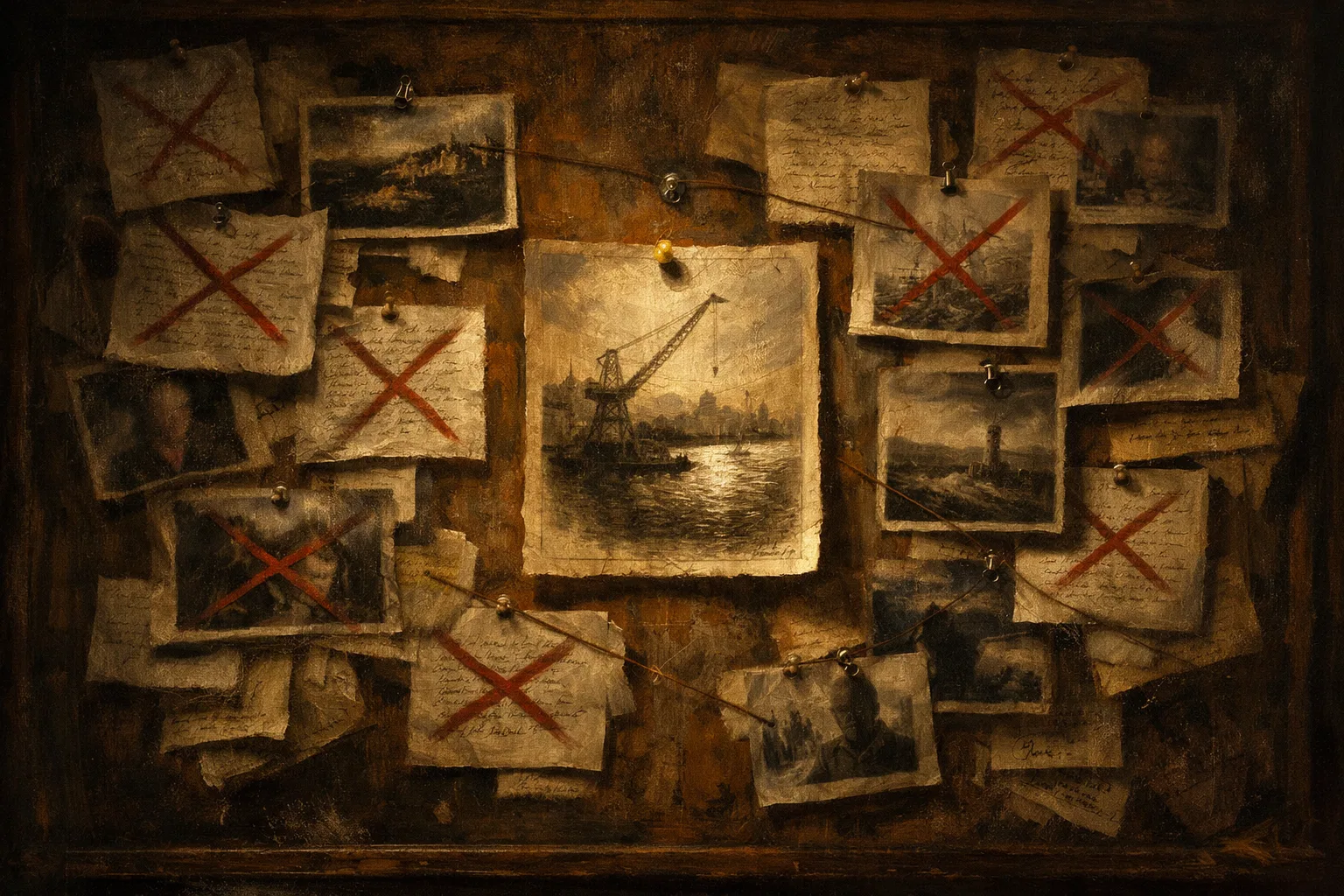
Remote-viewing stories feel persuasive because they arrive as scenes: a viewer sketches a crane, names water nearby, senses a hidden site, or appears to locate a target. Data arrive differently. They ask the reader to count all sessions, not just the dramatic ones; to include vague statements, failed predictions, evaluator discretion and operational usefulness. That shift changes the picture. In the U.S. Stargate review, evaluators found that remote-viewing material often seemed interesting in isolated examples but became far less impressive when judged across records: information was frequently vague, ambiguous, inconsistent, wrong or already inferable from background knowledge.[National Security Archive]nsarchive2.gwu.eduNational Security Archiveremote~1.PD FNational Security Archiveremote~1.PD F
That does not mean every striking story is fabricated. It means a memorable “hit” is not the same thing as a reliable method. In remote viewing, the central evidential risk is not that anecdotes never happen. It is that anecdotes are naturally good at hiding the denominator: how many attempts, interpretations, misses and near-matches were needed to produce the story.
Why Memorable Hits Stick
Remote viewing is almost designed to produce vivid anecdotes. A session can contain sketches, sensory impressions, fragments of landscape, emotional tones and physical descriptions. When one detail later appears to match the target, it feels more like recognition than probability. The early Stanford Research Institute work by Russell Targ and Harold Puthoff helped establish this style of evidence, reporting experiments in which participants allegedly obtained information under sensory shielding.[Semantic Scholar]semanticscholar.orgSemantic Scholar Information transmission under conditions of sensory shielding | Semantic ScholarSemantic Scholar Information transmission under conditions of sensory shielding | Semantic Scholar
The appeal is easy to understand. A sentence such as “there is water nearby” is image-rich, flexible and easy to remember. A later evaluator who knows the target can connect that phrase to a lake, river, pipe, toilet, rain puddle or coastal region. The American Institutes for Research review highlighted precisely this problem in its operational interviews: one evaluator could treat a broad phrase as accurate because they already knew the site, while a blind evaluator would not necessarily have been able to identify the correct target from the same material.[National Security Archive]nsarchive2.gwu.eduNational Security Archiveremote~1.PD FNational Security Archiveremote~1.PD F
Psychology helps explain why this feels convincing. Research comparing anecdotal and statistical evidence finds that anecdotes are vivid, specific and easy to imagine; they can make an issue feel close and personally relevant, while statistics are more abstract and require more effortful interpretation.[Athene Forschung]athene-forschung.unibw.deOpen source on unibw.de. A 2020 meta-analysis on “anecdotal bias” found that statistical evidence is often stronger overall, but anecdotes can outweigh statistics when emotional engagement is high, especially where the issue feels personal, severe or self-relevant.[ScienceDirect]sciencedirect.comOpen source on sciencedirect.com.
Remote-viewing stories exploit that gap between feeling and measurement. A viewer’s apparent success feels like a human moment: someone “saw” something they should not have known. A statistical review feels like a procedural correction: how often did this happen, under what controls, compared with what chance baseline, and with how many unusable statements? The first is easier to tell at dinner. The second is harder, but it is the part that decides whether the claim survives as evidence.

The Invisible Misses Behind a Hit
The strongest remote-viewing anecdotes usually arrive pre-filtered. The reader hears about the crane, the submarine, the missing aircraft or the unexpectedly apt sketch. Much less often does the reader see the complete file: all viewer statements, all wrong details, all ambiguous descriptions, all failed sessions and all cases where the information could not be checked. That missing denominator matters because a method can generate occasional impressive-looking matches even when most output is useless.
The Stargate record makes this problem visible. The Federation of American Scientists summary of the programme lists several reported successes, including claims about Semipalatinsk, a crashed Soviet bomber, a Soviet submarine and hostage or weapons-related targets. But the same summary notes that in the Semipalatinsk example “most of the receiver’s data were incorrect or could not be evaluated”, and that by the early 1990s the programme was troubled by poor performance and few accurate results.[Intelligence Resource Program]irp.fas.orgIntelligence Resource Program STAR GATE [Controlled Remote ViewingIntelligence Resource Program STAR GATE [Controlled Remote Viewing
The AIR operational review reached a similar point in less colourful language. It concluded that remote viewing, as used in the programme, had limited value as an intelligence-gathering technique. The reasons were practical rather than philosophical: laboratory conditions did not match intelligence operations, target pools were unconstrained, feedback was often unavailable, and the information provided was too vague and ambiguous to be consistently useful.[National Security Archive]nsarchive2.gwu.eduNational Security Archiveremote~1.PD FNational Security Archiveremote~1.PD F
This is why anecdotes can reverse the burden of proof. A story asks, “How could the viewer have known that one detail?” A record asks, “How many details were offered, how many were wrong, how many were broad enough to fit many targets, and who decided what counted?” In remote viewing, the second question is usually the safer one.
Vague Statements Create Room for Matching
Remote-viewing transcripts often contain open-ended material: shapes, textures, emotions, colours, structures, water, movement, machinery, containers, darkness, height, heat or biological impressions. These may be sincere impressions, but they are also easy to retrofit. The more general the phrase, the more targets it can partially match.
This is not a minor technicality. The AIR review found that in operational settings, remote-viewing information tended to be too broad and vague to provide the concrete, specific information needed for actionable intelligence. It also noted that any potential usefulness appeared limited to information that could be acquired in other ways.[National Security Archive]nsarchive2.gwu.eduNational Security Archiveremote~1.PD FNational Security Archiveremote~1.PD F
The review’s appendix gives the mechanism in plain terms. If an evaluator knows the real site, they can interpret broad comments as accurate. But that is different from asking whether an independent, blind evaluator could use the same transcript to identify the target. The example “there is water nearby” shows the danger: without a precise definition of what kind of water counts, the phrase can be made to fit many environments.[National Security Archive]nsarchive2.gwu.eduNational Security Archiveremote~1.PD FNational Security Archiveremote~1.PD F
This matters because many remote-viewing anecdotes are told after feedback. Once people know the target, they naturally search the transcript for correspondences. That search can be honest and still misleading. The matching process becomes a form of pattern selection: the hit is highlighted, the weak fit is softened, and the miss is treated as noise.

Records Ask a Different Question
Anecdotes ask whether a particular description sounds impressive. Records ask whether the full procedure works better than chance, under controls, often enough to matter. Those are different standards.
In the 1995 AIR review, Jessica Utts and Ray Hyman agreed that statistically significant effects had been observed in recent laboratory remote-viewing experiments. But they disagreed about what those effects meant. The report stated that a significant effect could reflect a real phenomenon, methodological artefacts or other alternative explanations.[National Security Archive]nsarchive2.gwu.eduNational Security Archiveremote~1.PD FNational Security Archiveremote~1.PD F Hyman’s separate review, indexed by PhilPapers, was specifically commissioned to evaluate the SRI and SAIC programme for scientific value and intelligence utility.[PhilPapers]philpapers.orgPhil Papers Ray Hyman, Evaluation of Program on Anomalous Mental PhenomenaPhil Papers Ray Hyman, Evaluation of Program on Anomalous Mental Phenomena
That distinction is crucial for readers. “There is a statistical anomaly in some laboratory work” is not the same claim as “remote viewers can provide dependable intelligence.” The AIR review’s operational conclusion was that evidence from research, interviews and user assessments indicated no real value for intelligence operations at that time.[National Security Archive]nsarchive2.gwu.eduNational Security Archiveremote~1.PD FNational Security Archiveremote~1.PD F
The denominator problem becomes even clearer in the review of 40 operational tasks. The appendix concluded that the value and utility of the information could not be readily discerned, and that much of the data was normally wrong or irrelevant, though analysts could not always tell which without further investigation. That is the opposite of the anecdotal version, where the useful-looking detail appears clean, isolated and self-validating.[National Security Archive]nsarchive2.gwu.eduNational Security Archiveremote~1.PD FNational Security Archiveremote~1.PD F
Why Data Can Feel Less Fair Than Stories
There is a paradox in remote-viewing debates: the more complete the record becomes, the less satisfying it can feel. A good story has a protagonist, a target and a reveal. A dataset has scoring rules, blind judging, target pools, statistical thresholds and failed trials. To believers, this can feel like draining the mystery out of an event. To sceptics, it is the only way to stop the mystery from doing the scoring.
Cognitive bias helps explain the tension. Base-rate neglect is the tendency to underweight or ignore the general frequency of events when judging a particular case. In a remote-viewing context, the base rate is the full run of attempts: how often viewers produced accurate, specific, non-obvious information compared with all statements made. Modern research finds that base-rate neglect is real but variable across individuals, meaning some people rely heavily on case details while others integrate the underlying rate more fully.[ScienceDirect]sciencedirect.comScienceDirect On the generality and cognitive basis of base-rate neglectScienceDirect On the generality and cognitive basis of base-rate neglect
Anecdotes also benefit from psychological closeness. The 2024 research on anecdotal versus statistical evidence argues that concrete thinking favours anecdotes, while abstract thinking favours statistics; a remote-viewing “hit” is concrete because it gives the mind a scene to inspect.[Athene Forschung]athene-forschung.unibw.deOpen source on unibw.de. That is why even cautious readers may feel pulled towards the story first and the dataset second.
The fair response is not to dismiss every anecdote, but to demote it. A striking anecdote can justify asking for the records. It cannot substitute for them.

A Practical Way to Read Remote-Viewing Claims
The most useful question is not “Does this story sound impossible?” It is “Would the claim still look impressive if I saw the whole testing record?” For remote viewing, that means looking for features that reduce the power of selective storytelling.
A stronger claim should show:
- The full transcript, not only the best-matching excerpts.
- The target pool, so the reader can see how many possible targets shared similar features.
- Blind judging, so the evaluator cannot fit vague language to a known answer.
- Predefined scoring rules, so “hits” are not invented after feedback.
- All trials, including misses, unusable sessions and ambiguous material.
- Operational value, meaning information specific enough to guide action before ordinary confirmation.
The Stargate record shows why these criteria matter. The programme produced stories that still circulate because some sound remarkable in isolation. Yet the official evaluation found that operational material was often vague, ambiguous and not concrete enough for intelligence use, while the broader programme was recommended for termination.[National Security Archive]nsarchive2.gwu.eduNational Security Archiveremote~1.PD FNational Security Archiveremote~1.PD F
Anecdotes feel convincing because they compress uncertainty into a memorable moment. Data feels colder because it restores the missing context. In remote viewing, that missing context is usually where the evidential weight is lost.
eBay marketplace picks
Marketplace Samples
Live-tested eBay searches with available results related to this page.



Endnotes
1.
Source: sciencedirect.com
Link:https://www.sciencedirect.com/science/article/abs/pii/S0749597819301633
2.
Source: philpapers.org
Title: Phil Papers Ray Hyman, Evaluation of Program on Anomalous Mental Phenomena
Link:https://philpapers.org/rec/HYMEOP
3.
Source: sciencedirect.com
Title: ScienceDirect On the generality and cognitive basis of base-rate neglect
Link:https://www.sciencedirect.com/science/article/pii/S0010027722001482
4.
Source: sciencedirect.com
Link:https://www.sciencedirect.com/journal/organizational-behavior-and-human-decision-processes/vol/160/suppl/C
5.
Source: nsarchive2.gwu.edu
Title: National Security Archiveremote~1.PD F
Link:https://nsarchive2.gwu.edu/NSAEBB/NSAEBB438/docs/doc_57.pdf
6.
Source: semanticscholar.org
Link:https://www.semanticscholar.org/paper/Information-transmission-under-conditions-of-[Targ-Puthoff
7.
Source: athene-forschung.unibw.de
Link:https://athene-forschung.unibw.de/doc/149773/149773.pdf
8.
Source: irp.fas.org
Title: Intelligence Resource Program STAR GATE [Controlled Remote Viewing]
Link:https://irp.fas.org/program/collect/stargate.htm
9.
Source: ics.uci.edu
Link:https://www.ics.uci.edu/~jutts/hyman.html
10.
Source: semanticscholar.org
Link:https://www.semanticscholar.org/paper/Comparing-the-persuasiveness-of-narrative-and-using-Allen-Preiss/69a7c1702524e89d0b9ed986b92e616ef7bf82cd
11.
Source: Wikipedia
Title: Remote viewing
Link:https://en.wikipedia.org/wiki/Remote_viewing
12.
Source: Wikipedia
Title: Jessica Utts
Link:https://en.wikipedia.org/wiki/Jessica_Utts
13.
Source: frontiersin.org
Link:https://www.frontiersin.org/journals/developmental-psychology/articles/10.3389/fdpys.2024.1324704/pdf
14.
Source: ui.adsabs.harvard.edu
Link:https://ui.adsabs.harvard.edu/abs/1974Natur.251..602T/abstract
15.
Source: sixthsensereader.org
Title: remote viewing
Link:https://sixthsensereader.org/about-the-book/abcderium-index/remote-viewing/
Additional References
16.
Source: youtube.com
Title: The Psychology of Data Storytelling: Why Facts Alone Don’t Move Your Customers
Link:http://www.youtube.com/watch?v=qqbNP8LSV7Q
Source snippet
Why anecdotes are more convincing than data psychology The Psychology of Data Storytelling: Why Facts Alone Don’t Move Your Customers Piv...
17.
Source: youtube.com
Title: 12 Cognitive Biases Explained
Link:http://www.youtube.com/watch?v=wEwGBIr_RIw
Source snippet
Anecdotal Evidence: How to use critical thinking skills to overcome this common logical fallacy...
18.
Source: youtube.com
Title: Psychological Research: Crash Course Psychology #2
Link:http://www.youtube.com/watch?v=hFV71QPvX2I
Source snippet
The Psychology of Data Storytelling: Why Facts Alone Don’t Move Your Customers...
19.
Source: cia.gov
Link:https://www.cia.gov/readingroom/docs/CIA-RDP96-00791R000200070001-9.pdf
20.
Source: cia.gov
Link:https://www.cia.gov/readingroom/document/cia-rdp96-00791r000200180006-4
21.
Source: cia.gov
Link:https://www.cia.gov/readingroom/docs/CIA-RDP96-00791R000200180006-4.pdf
22.
Source: cia.gov
Link:https://www.cia.gov/readingroom/document/cia-rdp96-00791r000200180005-5
23.
Source: cia.gov
Link:https://www.cia.gov/readingroom/docs/CIA-RDP96-00791R000200180005-5.pdf
24.
Source: cia.gov
Link:https://www.cia.gov/readingroom/docs/CIA-RDP96-00787R000200090017-5.pdf
25.
Source: cia.gov
Link:https://www.cia.gov/readingroom/document/cia-rdp96-00787r000100220001-8
Topic Tree