Within Read Files
Who Decided It Was a Match?
A claimed match may come from ranked comparison, blind judging or subjective interpretation rather than a simple right-or-wrong score.
On this page
- Ranking transcripts against targets
- Why judging standards change the result
- How to read evaluation language cautiously
Page outline Jump by section
Introduction
When reading declassified remote viewing documents, one of the easiest mistakes is to assume that a reported “match” means a viewer correctly described a hidden target. In many of the programme’s research protocols, that is not what the word meant. Instead, a match often emerged through a formal judging process in which independent evaluators compared a transcript against several possible targets and decided which one seemed to fit best. The strength of a result therefore depended not only on what the viewer said, but also on how the judging was designed, who performed it, and what scoring rules were used. Understanding those evaluation protocols is essential because the same transcript can appear more or less impressive depending on the comparison method and the standards applied.[National Security Archive]nsarchive2.gwu.eduNational Security ArchiveAn Evaluation of Remote Viewing: Research and…March 13, 2015 — by MD Mumford · 1995 · Cited by 76 — RESULTS…

Who Decided It Was a Match?
In many laboratory-style remote viewing experiments, the viewer was not judged by simply asking whether the description was “correct”. Instead, a judge received a completed transcript together with several possible targets, only one of which had actually been assigned. The judge’s task was to rank the targets from best to worst match, using only the content of the transcript. If the correct target consistently received the highest or near-highest ranking across many trials, researchers treated that as evidence exceeding random expectation.[National Security Archive]nsarchive2.gwu.eduNational Security ArchiveAn Evaluation of Remote Viewing: Research and…March 13, 2015 — by MD Mumford · 1995 · Cited by 76 — RESULTS…
This approach attempted to reduce hindsight bias. Rather than allowing someone to search afterwards for any detail that resembled the real target, the judge had to compare all available alternatives under blind conditions. In principle, if several targets contained similar features—such as buildings, water or people—the transcript had to distinguish the correct one better than the others before it counted as a successful result.[UC Irvine Bren School]uci.eduStOlaf1. 2. 3. 4. Simplest analysis just counts a “direct hit” if actual target is ranked #1. This example was …Read more
The emphasis on blind judging is why many protocol documents devote more space to evaluation procedures than to the remote viewing session itself. From the researchers’ perspective, the credibility of any apparent success depended heavily on preventing the judge from knowing which target was correct in advance.[National Security Archive]nsarchive2.gwu.eduNational Security ArchiveAn Evaluation of Remote Viewing: Research and…March 13, 2015 — by MD Mumford · 1995 · Cited by 76 — RESULTS…

Ranking Transcripts Against Targets
Ranking methods changed how success was measured.
Instead of asking, “Did the viewer describe the target?”, the protocol often asked a narrower statistical question: “Out of several candidate targets, which one does this transcript resemble most?” That distinction matters because a transcript rarely consisted of precise statements alone. It typically contained a mixture of specific observations, broad impressions, ambiguous imagery and incorrect details.
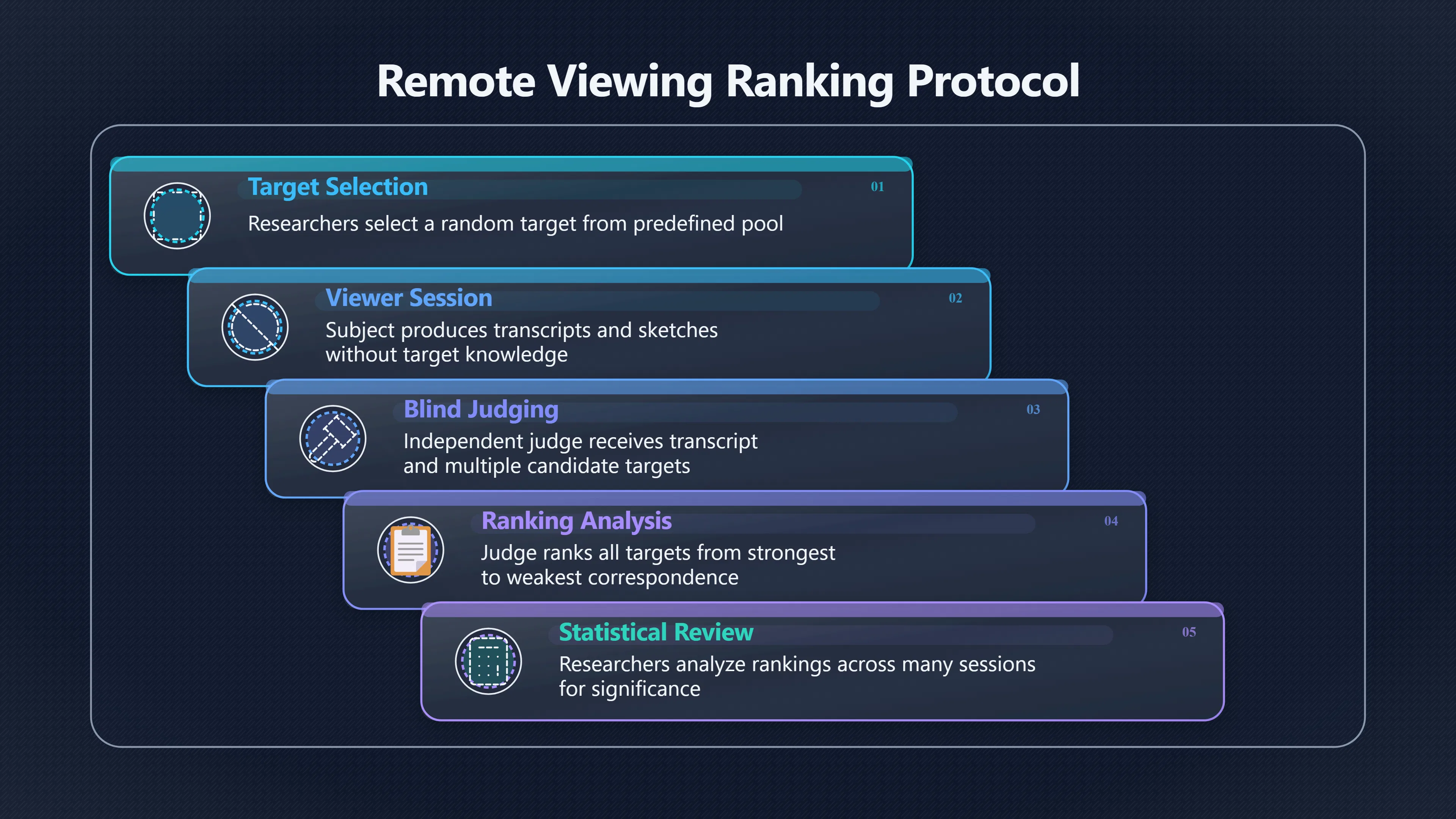
A simplified ranking process looked like this:

- A target was randomly selected from a predefined pool.
- The viewer produced a transcript and sketches without being told the target.
- An independent judge received the transcript alongside multiple candidate targets.
- The judge ranked every target from strongest to weakest correspondence.
- Researchers analysed the rankings across many sessions rather than relying on isolated examples. UC Irvine Bren School
Because the outcome depended on comparative ranking, a “successful” session did not necessarily mean that every statement was accurate. A transcript could contain many vague or incorrect elements and still receive the best rank if the competing targets matched even less well.
Conversely, a transcript containing several strikingly accurate details might fail if another candidate target happened to resemble those descriptions more closely. The scoring system therefore measured relative discrimination rather than absolute descriptive accuracy.
Why Judging Standards Change the Result
Evaluation protocols are not neutral. Small methodological choices can materially affect the apparent success rate.
For example, different studies varied in:
- the number of alternative targets presented to judges;
- whether one or several judges scored each transcript;
- whether judges worked independently;
- whether transcripts were edited before judging;
- whether numerical scoring or simple ranking was used;
- how ties and uncertain rankings were handled. UC Irvine Bren School
Each decision changes the meaning of a reported “hit”. A first-place ranking among four targets is not equivalent to an unrestricted claim that the viewer accurately perceived the target. Likewise, statistical significance across dozens or hundreds of sessions does not imply that every individual transcript was compelling.
This is one reason debates over remote viewing often focus less on the transcripts themselves than on protocol design. Supporters have argued that carefully blinded ranking procedures reduce subjective interpretation, while critics have questioned whether remaining sources of bias, cueing or analytical flexibility could still influence the outcomes. The disagreement frequently concerns the quality of the judging process rather than only the content of the sessions. National Security Archive+2UC Irvine Bren School
Why Operational Reports Are Harder to Judge
The ranking procedures used in laboratory experiments were not always practical in operational intelligence work.
Operational tasks often involved unknown locations, missing persons or foreign facilities for which there was no neat set of alternative targets available. In those circumstances, evaluation frequently relied on later comparisons with intelligence reporting or historical events rather than formal blind judging.
That creates a more difficult interpretive problem. If analysts know the real-world outcome before reviewing a transcript, it becomes easier—consciously or unconsciously—to notice apparent correspondences while overlooking mismatches. A vivid phrase or sketch may seem impressive after the target is known even if it would not have identified the target prospectively.
The 1995 independent evaluation commissioned by the CIA distinguished between laboratory research, where statistical protocols could be examined, and operational intelligence claims, where consistent objective evaluation was much more difficult. Although the reviewers found statistically significant effects in some research data, they concluded that the operational material did not demonstrate intelligence value sufficient for practical use. National Security Archive
How to Read Evaluation Language Cautiously
When reading declassified documents, the wording used to describe results deserves careful attention.
Terms such as matched, corresponded, consistent with, good fit, or ranked first are not interchangeable. Each may refer to a different evaluation process rather than a straightforward factual confirmation.
A useful reading strategy is to ask four questions whenever a document reports a successful session:
- Who performed the judging? Was the evaluator blind to the target?
- What alternatives were considered? Was the transcript compared against several possible targets or only the correct one?
- What scoring rule was used? Was this a rank-order result, a numerical score or a retrospective opinion?
- Were misses reported alongside hits? Reliable evaluations describe both successful and unsuccessful sessions rather than highlighting only memorable examples.
Applying these questions helps separate the historical record from later storytelling. The declassified archive documents genuine attempts to formalise evaluation, but it also shows that the meaning of a “match” depends heavily on the protocol under which that judgement was reached. National Security Archive
Amazon book picks
Further Reading
Books and field guides related to Who Decided It Was a Match?. Use these as the next step if you want deeper reading beyond the article.
The Men Who Stare At Goats
Rating: 3.5/5 from 11 Google Books ratings
Explores strange U.S. military attempts to turn psychic and paranormal ideas into operational capability.
Phenomena: The Secret History of the U.S. Government's Invest...
Places judging protocols in historical context.

Paranormality: Why We See What Isn't There
Addresses judging bias and pattern recognition.
Endnotes
1.
Source: cia.gov
Link:https://www.cia.gov/readingroom/document/cia-rdp96-00791r000200180005-5
Source snippet
n in place for some time.Read more...
2.
Source: cia.gov
Link:https://www.cia.gov/readingroom/docs/CIA-RDP96-00791R000200180005-5.pdf
Source snippet
AN EVALUATION OF THE REMOTE VIEWING PROGRAMThis evaluation was intended to determine: (a) whether this research has any long-term practic...
3.
Source: cia.gov
Link:https://www.cia.gov/readingroom/collection/[stargate
Source snippet
STARGATE | CIA FOIA (foia.cia.gov)AN EVALUATION OF THE REMOTE VIEWING PROGRAM: RESEARCH AND OPERATIONAL APPLICATIONS - DRAFT REPORT; PDF...
4.
Source: cia.gov
Link:https://www.cia.gov/readingroom/docs/CIA-RDP96-00791R000200180006-4.pdf
5.
Source: nsarchive2.gwu.edu
Link:https://nsarchive2.gwu.edu/NSAEBB/NSAEBB438/docs/doc_57.pdf
Source snippet
National Security ArchiveAn Evaluation of Remote Viewing: Research and...March 13, 2015 — by MD Mumford · 1995 · Cited by 76 — RESULTS...
Published: March 13, 2015
7.
Source: ics.uci.edu
Link:https://www.ics.uci.edu/~jutts/may.pdf
Source snippet
UC Irvine Bren Schoolresearch review of the departmentby C EDwIN · 1996 — Their conclusion on remote viewing was that “the literature on...
8.
Source: Wikipedia
Title: Remote viewing
Link:https://en.wikipedia.org/wiki/Remote_viewing
Source snippet
Remote viewingThe program ran from 1975 to 1995 and ended after evaluators concluded that remote viewers consistently failed to produc...
Additional References
9.
Source: researchgate.net
Link:https://www.researchgate.net/publication/342292415_The_Star_Gate_Archives_Reports_of_the_United_States_Government_Sponsored_Psi_Program_1972-1995_Volume_3_Psychokinesis_compiled_and_edited_by_Edwin_C_May_and_Sonali_Bhatt_Marwaha
Source snippet
(PDF) The [Star Gate]({{ 'star-gate/' | relative_url }}) Archives: Reports of the United States...18 Jun 2026 — PDF | The remote viewing research conducted at Stanford Rese...
10.
Source: reddit.com
Link:https://www.reddit.com/r/Mars/comments/hpwnm9/cia_transcript/
Source snippet
CIA transcript: r/MarsThe CIA's remote viewing research was able to show highly significant, objectively verified, and effective results...
11.
Source: facebook.com
Link:https://www.facebook.com/fox9kmsp/posts/an-unclassified-cia-document-circulating-on-social-media-claims-agents-may-know-/1100879212081534/
Source snippet
CIA used psychic to locate Ark of the Covenant, unclassifiedAn unclassified CIA document circulating on social media claims agents may kn...
12.
Source: facebook.com
Link:https://www.facebook.com/jakeduceyauthor/posts/the-cia-called-them-remote-viewersthey-could-describe-places-theyd-never-been-pe/1403524731140708/
Source snippet
The CIA called them “remote viewers.” They could describeThe CIA called them “remote viewers.” They could describe: ✨ Places they'd never...
13.
Source: academia.edu
Link:https://www.academia.edu/9540484/Through_Time_and_Space_The_Evidence_for_Remote_Viewing
Source snippet
Through Time and Space: The Evidence for Remote ViewingThis paper discusses the evolution and methodology of nonlocal perception research...
14.
Source: reddit.com
Link:https://www.reddit.com/r/Unexplained/comments/1q6n5jw/when_cia_psychics_got_scientifically_tested/
Source snippet
"When CIA psychics got scientifically tested: r/UnexplainedIt is a broader evaluation of the program, available at [https://www.cia.gov/re..."](https://www.cia.gov/re...")...
15.
Source: irp.fas.org
Link:https://irp.fas.org/program/collect/air1995.pdf
Source snippet
reportJavaScript is disabled. In order to continue, we need to verify that you're not a robot. This requires JavaScript. Enable JavaScrip...
16.
Source: osakalanguagesolutions.com
Link:https://osakalanguagesolutions.com/the-suppressed-human-a-global-history-of-paranormal-capabilities-covert-psi-research-and-the-utopian-singularity/
Source snippet
The Suppressed Human: A Global History of Paranormal...The program utilized “remote viewing” to collect specific intelligence...
17.
Source: facebook.com
Link:https://www.facebook.com/historyoasis/posts/from-1972-to-1995-the-united-states-military-invested-over-20-million-in-one-of-/790173214116954/
Source snippet
From 1972 to 1995, the United States military invested over...[3] The Stargate Project was terminated in 1995 following an independent r...
18.
Source: researchgate.net
Link:https://www.researchgate.net/publication/403178755_The_Star_Gate_Archives_Reports_of_the_United_States_Government_Sponsored_Psi_Program_1972-1995_Volume_4_Operational_Remote_Viewing_Memorandums_and_Reports
Source snippet
(1995). An. evaluation of remote viewing: Research and applications. American Institutes for Research. Mörck, N. C. (2018). Review of the...
Topic Tree