Within Lab vs Real
Photo Matching Is Not Field Accuracy
Rank-order judging can test whether a transcript resembles a target, but real users need coordinates, identities, timings, or verifiable claims.
On this page
- How rank order judging works
- Why photo pools shrink the problem
- What actionable answers require instead
Page outline Jump by section
Introduction
One of the most important distinctions in the remote-viewing literature is between identifying the best match from a limited set of photographs and providing information that someone can act upon in the real world. Many of the strongest laboratory studies did not ask participants to produce precise locations, names, dates or operational intelligence. Instead, viewers described an unknown target, after which independent judges compared the transcript with a small pool of candidate photographs and ranked them by similarity. This design addresses a narrow statistical question—whether the correct target is ranked unusually highly—but it does not answer the practical question of whether the information is specific enough to guide decisions. The difference between those two tasks explains why reported laboratory effects have remained controversial as evidence for operational usefulness.[CIA]cia.govAN EVALUATION OF THE REMOTE VIEWING PROGRAM" Thus, we conclude that continued use of remote viewing in intelligence gathering operatio…

How rank-order judging works
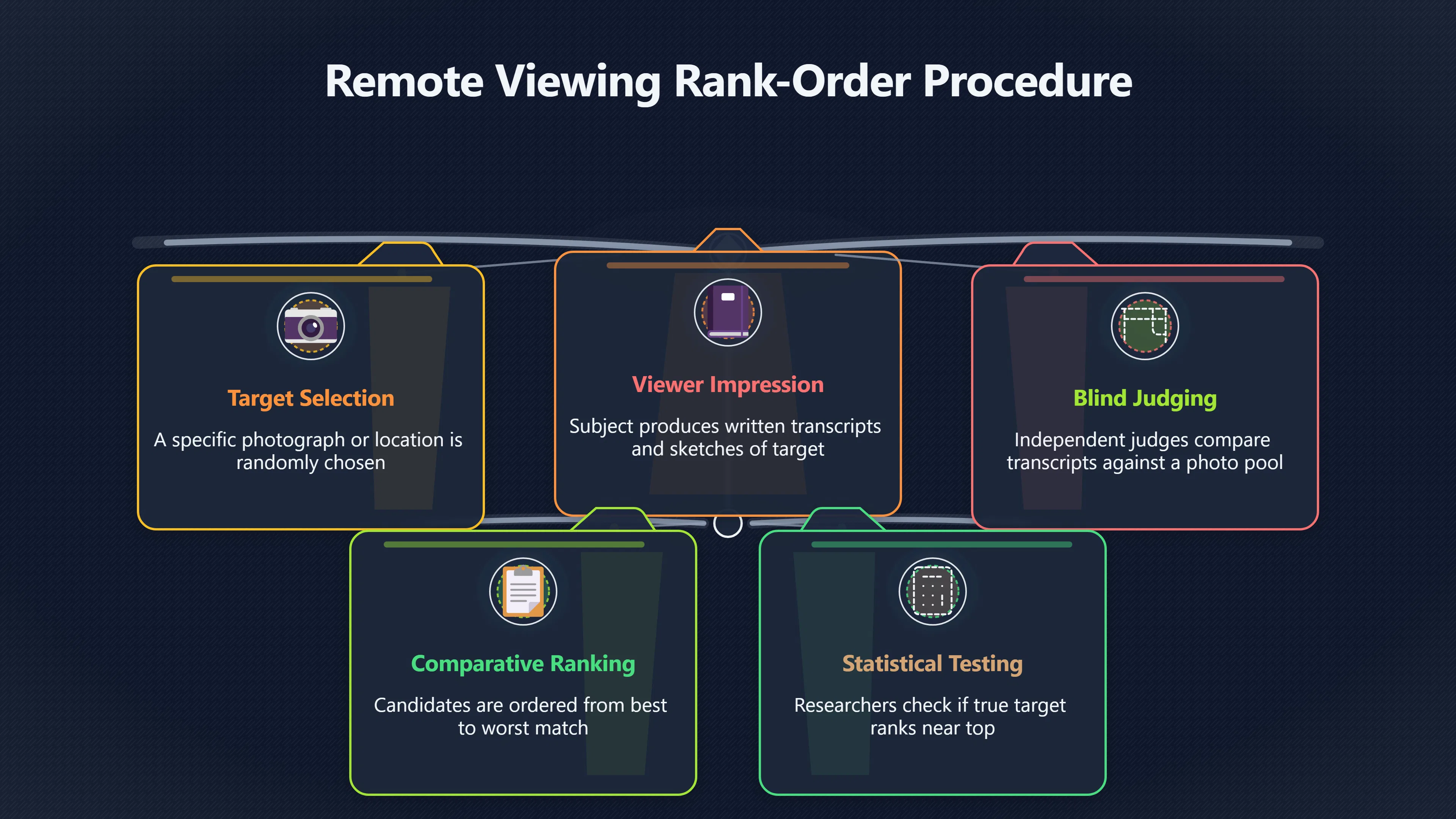
Rank-order judging was developed to reduce subjective interpretation while avoiding simple yes-or-no scoring. A typical experiment follows several stages:
- A target photograph or location is randomly selected.
- The remote viewer produces written impressions and sketches without seeing the target.
- A judge, blind to the correct answer, compares the transcript with several possible targets.
- The judge ranks the candidates from best to worst match.
- Researchers test whether the true target is ranked first, or near the top, more often than chance predicts.
Because every transcript is evaluated against a fixed set of alternatives, success is measured comparatively rather than absolutely. The question is not “Did the viewer accurately describe the location?” but “Which photograph resembles this transcript most closely?”[CIA]cia.govAN EVALUATION OF THE REMOTE VIEWING PROGRAM" Thus, we conclude that continued use of remote viewing in intelligence gathering operatio…
This distinction matters because many remote-viewing descriptions are broad rather than uniquely identifying. A transcript mentioning “water”, “large structures”, “metal”, “open space” or “height” could partially resemble numerous photographs. Rank-order judging attempts to determine whether one image fits noticeably better than the others, even if the description remains incomplete or ambiguous.
The method became widely used because it permits statistical testing under controlled conditions and reduces some forms of experimenter bias compared with informal scoring. More recent remote-viewing studies and meta-analyses continue to include variations of blind judging and rank-based evaluation as standard laboratory procedures.[Journal of Scientific Exploration]journalofscientificexploration.orgThis is the first meta-analysis of all studies related to remote-viewing tasks conducted up to December 2022.Read more…
Why photo pools shrink the problem
A pool of candidate photographs makes the task substantially easier to evaluate than most operational questions.
The target is already known to the experimenter, finite in scope and represented visually. The judge is not required to determine whether a transcript corresponds to reality in general; only whether it resembles one image more closely than several alternatives.
Several consequences follow from this design.
- The possible answers are constrained. A transcript needs only to outperform a limited number of competing photographs rather than identify an unlimited real-world possibility.
- Similarity is judged retrospectively. The comparison occurs after both the transcript and the target set already exist.
- Partial correspondences can matter. A few distinctive shared features may be sufficient for a high ranking even when many details are incorrect or omitted.
- Chance probabilities are easier to calculate. Researchers know exactly how many alternatives were available, allowing formal statistical analysis.
These features make laboratory experiments manageable and reproducible. They do not necessarily mirror the uncertainty encountered outside the laboratory, where neither the range of possible answers nor the correct solution is known in advance.
Critics have also argued that judging remains vulnerable to subjective interpretation because viewers often produce symbolic or general descriptions that could plausibly match multiple targets. Earlier debates surrounding the original SRI experiments included concerns that judges might inadvertently exploit non-paranormal cues if transcripts contained identifying information or chronological hints. Subsequent studies attempted to strengthen blinding procedures precisely because researchers recognised the importance of eliminating such alternative explanations.[Wikipedia]WikipediaRemote viewingRemote viewing
What actionable answers require instead
Operational users rarely need to identify the “best matching photograph.” They need information that can be independently verified before action is taken.
An intelligence analyst, police investigator or search-and-rescue coordinator typically requires answers such as:
- a precise location or coordinates;
- the identity of a person or object;
- a reliable timeline;
- an accurate prediction of future events;
- information that distinguishes one hypothesis from many plausible alternatives;
- an estimate of confidence before resources are committed.
These requirements are fundamentally different from selecting one photograph out of four or five possibilities.
Consider a missing-person investigation. A transcript describing “trees”, “water” and “a bridge” might later resemble a photograph of the eventual discovery site. That resemblance does not necessarily help investigators unless it identifies a searchable location before the outcome is known. Operational success therefore depends on prospective specificity rather than retrospective similarity.
The same issue applies in intelligence work. Analysts cannot act simply because a report vaguely resembles a location after comparison with a curated image set. They require information that narrows uncertainty enough to influence planning, resource allocation or decision-making.
Why laboratory success does not automatically become field success
This gap between laboratory scoring and operational usefulness became central to official evaluations of the US government’s remote-viewing programme.
The 1995 American Institutes for Research review distinguished between evidence suggesting statistically unusual laboratory performance and evidence that remote viewing had produced intelligence of practical value. Although the reviewers acknowledged reports of statistically significant laboratory findings, they concluded that operational applications had not demonstrated sufficient reliability, consistency or usefulness to justify continued intelligence use.[CIA]cia.govAN EVALUATION OF THE REMOTE VIEWING PROGRAM" Thus, we conclude that continued use of remote viewing in intelligence gathering operatio…
This assessment reflects an important methodological point rather than a rejection of rank-order judging itself. Rank-order methods may be appropriate for investigating whether an anomalous effect exists under controlled conditions. They are not designed to demonstrate that the same information would meet operational standards for accuracy, precision and timeliness.
Modern proponents sometimes cite recent meta-analyses reporting average effects above chance across remote-viewing studies. Those analyses concern aggregate laboratory performance measured under controlled protocols. They do not by themselves establish that individual sessions consistently produce the kind of detailed, decision-ready information required in intelligence, law enforcement or commercial forecasting.[Journal of Scientific Exploration]journalofscientificexploration.orgThis is the first meta-analysis of all studies related to remote-viewing tasks conducted up to December 2022.Read more…
Photo matching is not field accuracy
The distinction between photograph matching and actionable information helps explain why debates about remote viewing often appear to talk past one another.
Supporters frequently point to experiments showing statistically significant rank-order performance under blinded laboratory conditions. Critics accept that these experiments ask a legitimate experimental question but argue that success on that question does not demonstrate practical capability outside the laboratory.
The difference can be summarised simply:
Laboratory photo-target taskReal-world operational taskChoose the closest match from a known poolGenerate the correct answer from unlimited possibilitiesEvaluate similarity after the sessionMake decisions before the outcome is knownStatistical success across many trialsReliable success in individual casesRelative rankingAbsolute correctnessControlled evaluationActionable, independently verifiable information
For understanding the history of remote-viewing research, this distinction is more than a technical detail. It marks the boundary between evidence that a laboratory scoring method detects an unusual statistical pattern and evidence that remote viewing can reliably answer the kinds of questions that governments, investigators and other real-world users actually need solved.
Amazon book picks
Further Reading
Books and field guides related to Photo Matching Is Not Field Accuracy. Use these as the next step if you want deeper reading beyond the article.


Endnotes
1.
Source: cia.gov
Link:https://www.cia.gov/readingroom/docs/CIA-RDP96-00791R000200180005-5.pdf
Source snippet
AN EVALUATION OF THE REMOTE VIEWING PROGRAM" Thus, we conclude that continued use of remote viewing in intelligence gathering operatio...
2.
Source: cia.gov
Link:https://www.cia.gov/readingroom/document/cia-rdp96-00791r000200180006-4
Source snippet
" or sender. A judge then examines the viewer's report.Read more...
3.
Source: Wikipedia
Title: Remote viewing
Link:https://en.wikipedia.org/wiki/Remote_viewing
4.
Source: Wikipedia
Title: Air (disambiguation)
Link:https://en.wikipedia.org/wiki/Air_%28disambiguation%29
Source snippet
Air (disambiguation)Air is the name given to the atmosphere of Earth. Air or AIR may also refer to: Contents. 1 Arts, entertainment, a...
5.
Source: Wikipedia
Title: Air (French band)
Link:https://en.wikipedia.org/wiki/Air_%28French_band%29
Source snippet
Air (French band)Air is a French music duo from Versailles, consisting of Nicolas Godin and Jean-Benoît Dunckel. [1] Their critically...
6.
Source: journalofscientificexploration.org
Link:https://journalofscientificexploration.org/index.php/jse/article/view/2931
Source snippet
This is the first [meta-analysis]({{ 'meta-analysis/' | relative_url }}) of all studies related to remote-viewing tasks conducted up to December 2022.Read more...
Published: December 2022
7.
Source: ics.uci.edu
Link:https://www.ics.uci.edu/~jutts/may.pdf
Source snippet
review of the departmentby C EDwIN · 1996 — The CIA-sponsored AIR investigation concluded that a statistically significant laboratory eff...
8.
Source: uk-air.defra.gov.uk
Title: defra.gov.uk Home
Link:https://uk-air.defra.gov.uk/
Source snippet
DEFRA UK Air - GOV.UKAir pollution alerts · Stay updated. Here are some of the ways you can stay updated with UK-Air. Subscribe to mailin...
9.
Source: journalofscientificexploration.org
Link:https://journalofscientificexploration.org/index.php/jse/citationstylelanguage/get/apa?publicationId=3853&submissionId=2931
Source snippet
"(2023). Remote Viewing: A 1974-2022 Systematic Review and Meta-Analysis. Journal of Scientific Exploration, 37(3), 467–489. [https://doi.o..."](https://doi.o...")...
10.
Source: hsdl.org
Link:https://www.hsdl.org/c/view?docid=482054
Source snippet
Transcendent and Asymmetric Warfare Implications of...28 Apr 2001 — In 1995, after assuming remote viewing program management responsibi...
Additional References
11.
Source: merriam-webster.com
Link:https://www.merriam-webster.com/dictionary/air
Source snippet
AIR Definition & Meaning1. a: the mixture of invisible odorless tasteless gases (such as nitrogen and oxygen) that surrounds the earth a...
12.
Source: airbnb.co.uk
Link:https://www.airbnb.co.uk/
Source snippet
Holiday rentals, cabins, beach houses & moreGet an Airbnb for every kind of trip → 7 million holiday rentals → 2 million Guest F...
13.
Source: yourairhost.co.uk
Link:https://www.yourairhost.co.uk/
Source snippet
Your AirHost: Airbnb Management Company LondonFlexible short-term rental management services, including corporate booking services, short...
14.
Source: pure.northampton.ac.uk
Link:https://pure.northampton.ac.uk/en/publications/remote-viewing-of-concealed-target-pictures-under-light-and-dark-
Source snippet
viewing of concealed target pictures under light...A statistically significant difference between remote viewer and independent judge ra...
15.
Source: irp.fas.org
Link:https://irp.fas.org/program/collect/air1995.pdf
Source snippet
reportJavaScript is disabled. In order to continue, we need to verify that you're not a robot. This requires JavaScript. Enable JavaScrip...
16.
Source: researchgate.net
Link:https://www.researchgate.net/publication/327166514_Remote_Viewing_of_Concealed_Target_Pictures_Under_Light_and_Dark_Conditions
Source snippet
Remote Viewing of Concealed Target Pictures Under Light...(2019) found that image targets rated as more numinous by independent judges p...
17.
Source: reddit.com
Link:https://www.reddit.com/r/remoteviewing/comments/1dazs09/creation_of_study_on_statistical_evidence_of/
Source snippet
Creation of study on statistical evidence of remote viewingRemote Viewing - A 1974-2022 Systematic Review and Meta-Analysis is a recent r...
18.
Source: researchgate.net
Title: 369604750 Remote Viewing a 1974 2022 systematic review and meta analysis
Link:https://www.researchgate.net/publication/369604750_Remote_Viewing_a_1974-2022_systematic_review_and_meta-analysis
Source snippet
(PDF) Remote Viewing: a 1974-2022 systematic review...This is the first meta-analysis of all studies related to remote viewing tasks con...
19.
Source: med.virginia.edu
Link:https://med.virginia.edu/perceptual-studies/wp-content/uploads/sites/360/2024/03/Acunzo2023_ESP-Research-and-Cognitive-Neuroscience_Possibly-Incompatible-But-Methodologically-Complementary.pdf
Source snippet
Katz, 2023) are meta-analyses of forced-choice and Re- mote Viewing (RV) experiments, showing...Read more...
20.
Source: scribd.com
Title: Evaluation of Remote Viewing Program | PDFThe document provides an executive
Link:https://www.scribd.com/doc/92017954/Air-Report
Source snippet
summary of a review conducted by the American Institutes for Research (AIR) to evaluate the research program and...Read more...
Topic Tree