Within Marks Critique
The Journal Fight Over Cues
The remote-viewing dispute played out across Nature replies and rebuttals that kept returning to ordinary sensory cues.
On this page
- The 1978 criticism
- The 1980 and 1981 exchanges
- The 1986 follow up and its significance
Page outline Jump by section
Introduction
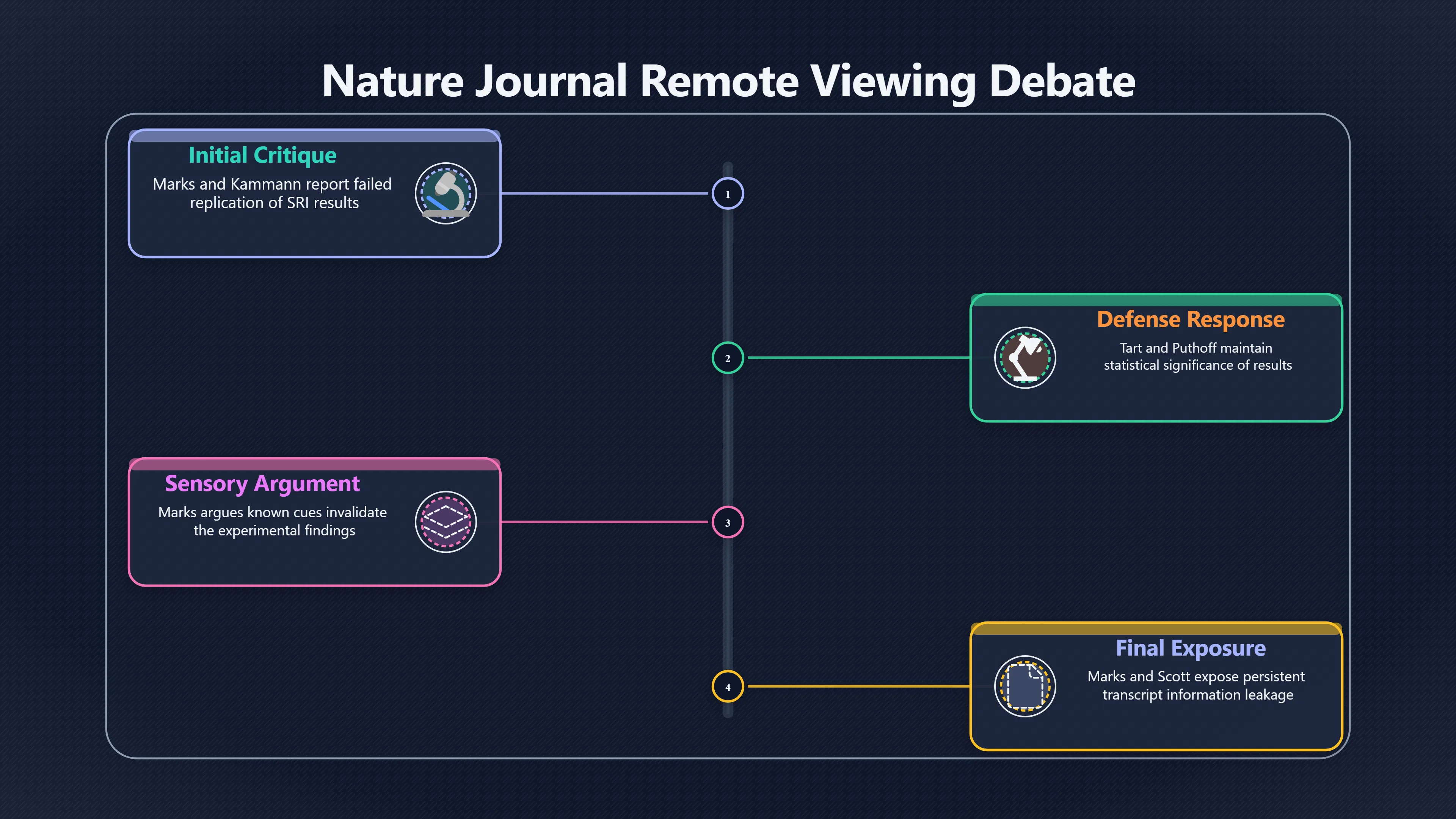
The debate over sensory cueing in Nature became one of the defining methodological disputes in the history of remote-viewing research. Rather than arguing primarily about whether extrasensory perception was possible, the exchange centred on a narrower scientific question: had the published experiments adequately excluded ordinary sources of information that could influence judging? Between 1978 and 1986, psychologists David Marks and Richard Kammann, and later Christopher Scott, challenged the interpretation of the Stanford Research Institute (SRI) experiments, while Charles Tart, Harold Puthoff and Russell Targ defended them. The controversy mattered because it shifted attention from extraordinary claims to experimental design, particularly whether subtle clues embedded in transcripts could explain apparently successful remote-viewing matches.[Nature+2Nature]nature.comInformation transmission in remote viewing experimentsby CT TART · 1980 · Cited by 57 — Sensory cues invalidate remote viewing expe…
The 1978 criticism
The first major exchange came in 1978 when David Marks and Richard Kammann published a short Nature correspondence reporting that they had attempted duplicate remote-viewing experiments but did not reproduce the positive findings reported by SRI researchers. More importantly, they argued that the published judging procedures allowed ordinary information to reach the judges through the experimental records themselves rather than through any claimed paranormal process.[ResearchGate]researchgate.netDavid MARKS | Independent | PhD | Research profileView Sensory cues invalidate remote viewing experiments have described inve…
Their criticism focused on the distinction between sensory shielding and information shielding. The SRI experiments had attempted to prevent viewers from seeing or hearing the target location directly, but Marks and Kammann argued that this alone was insufficient. If judges later received transcripts containing dates, references to previous sessions, comments about target order or other contextual details, they might reconstruct which transcript belonged to which target without relying solely on descriptive similarity. This transformed the debate from one about psychic functioning into one about experimental controls.[ResearchGate]researchgate.netDavid MARKS | Independent | PhD | Research profileView Sensory cues invalidate remote viewing experiments have described inve…
The practical implication was significant. Remote-viewing experiments relied on free-response descriptions rather than fixed-choice answers, making judging inherently subjective. Even seemingly trivial contextual information could influence matching decisions if judges were attempting to identify one target from a small set of possibilities.
The 1980 and 1981 exchanges
Tart, Puthoff and Targ’s response
In 1980 Charles Tart joined Harold Puthoff and Russell Targ in replying through Nature. They argued that the criticism did not invalidate the remote-viewing evidence and maintained that rejudging of one experimental series still produced statistically significant results. Their position was that the experiments remained supportive of anomalous information transfer despite the objections that had been raised.[Nature]nature.comInformation transmission in remote viewing experimentsby CT TART · 1980 · Cited by 57 — Sensory cues invalidate remote viewing expe…
The response reflected a broader disagreement over scientific standards. The SRI researchers viewed the positive statistical outcomes as surviving criticism, whereas Marks regarded the presence of any uncontrolled cueing as fundamentally compromising the interpretation.
Marks’ 1981 reply
Marks answered in Nature the following year with the pointedly titled “Sensory cues invalidate remote viewing experiments.” His argument was not simply that cueing might have occurred but that the known cues were sufficient to explain the reported successes. If ordinary information could account for correct matching, then the experiments no longer provided evidence that remote viewing itself had been demonstrated.[Nature]nature.comSensory cues invalidate remote viewing experiments. DAVID MARKS. Nature volume 292, page 177 (1981) Cite this article.Read more…
The disagreement therefore became one of competing explanations rather than competing statistics:
- Supporters argued that significant matching remained after criticism and therefore indicated an anomalous effect.
- Critics argued that statistical significance became irrelevant if judges had access to conventional identifying information.
- The methodological issue was whether cue removal had been demonstrated rather than merely assumed.
Marks’ position reflected a common principle in experimental psychology: before invoking an extraordinary mechanism, researchers must eliminate simpler explanations such as information leakage.

Why transcript cues became the central issue
The controversy repeatedly returned to the same practical problem. Remote-viewing transcripts were often lengthy narratives containing sketches, remarks and conversational material. Marks argued that apparently incidental features—including chronological references, editing marks and procedural comments—could function as identifiers.
This concern differed from accusations of fraud. The criticism assumed that participants and investigators could act honestly while still allowing unconscious information leakage. From this perspective, sensory cueing represented a design flaw rather than deliberate misconduct.[Nature]nature.comSensory cues invalidate remote viewing experiments. DAVID MARKS. Nature volume 292, page 177 (1981) Cite this article.Read more…
The 1986 follow-up and its significance
The debate resurfaced in 1986 when David Marks and Christopher Scott published “Remote Viewing Exposed” in Nature. By this stage the controversy had narrowed even further. Rather than discussing remote viewing in general, they focused specifically on whether previously disputed transcripts actually had been cleansed of identifying information before reanalysis.[Springer]link.springer.comRemote viewing | Cellular and Molecular Life Sciencesby C Scott · 1988 · Cited by 3 — Marks, D., Sensory cues invalidate remote v…
Marks and Scott argued that when the original transcripts finally became available for independent examination, they still contained sensory cues that should have been removed before judging. They criticised Charles Tart’s earlier rejudging because, in their view, it had not first eliminated these cues. Their conclusion was that the experiments demonstrated repeated failures to remove conventional information rather than convincing evidence for remote viewing.[Springer]link.springer.comRemote viewing | Cellular and Molecular Life Sciencesby C Scott · 1988 · Cited by 3 — Marks, D., Sensory cues invalidate remote v…
Whether one accepts that conclusion or not, the exchange illustrates an important feature of scientific controversy. The dispute had moved beyond headline claims about psychic perception and become an argument over documentary details, record handling and blind judging procedures.
Why the Nature debate still matters
The series of Nature correspondences had an influence extending beyond remote viewing itself because they highlighted principles now regarded as standard in experimental design.
The exchanges reinforced several methodological lessons:
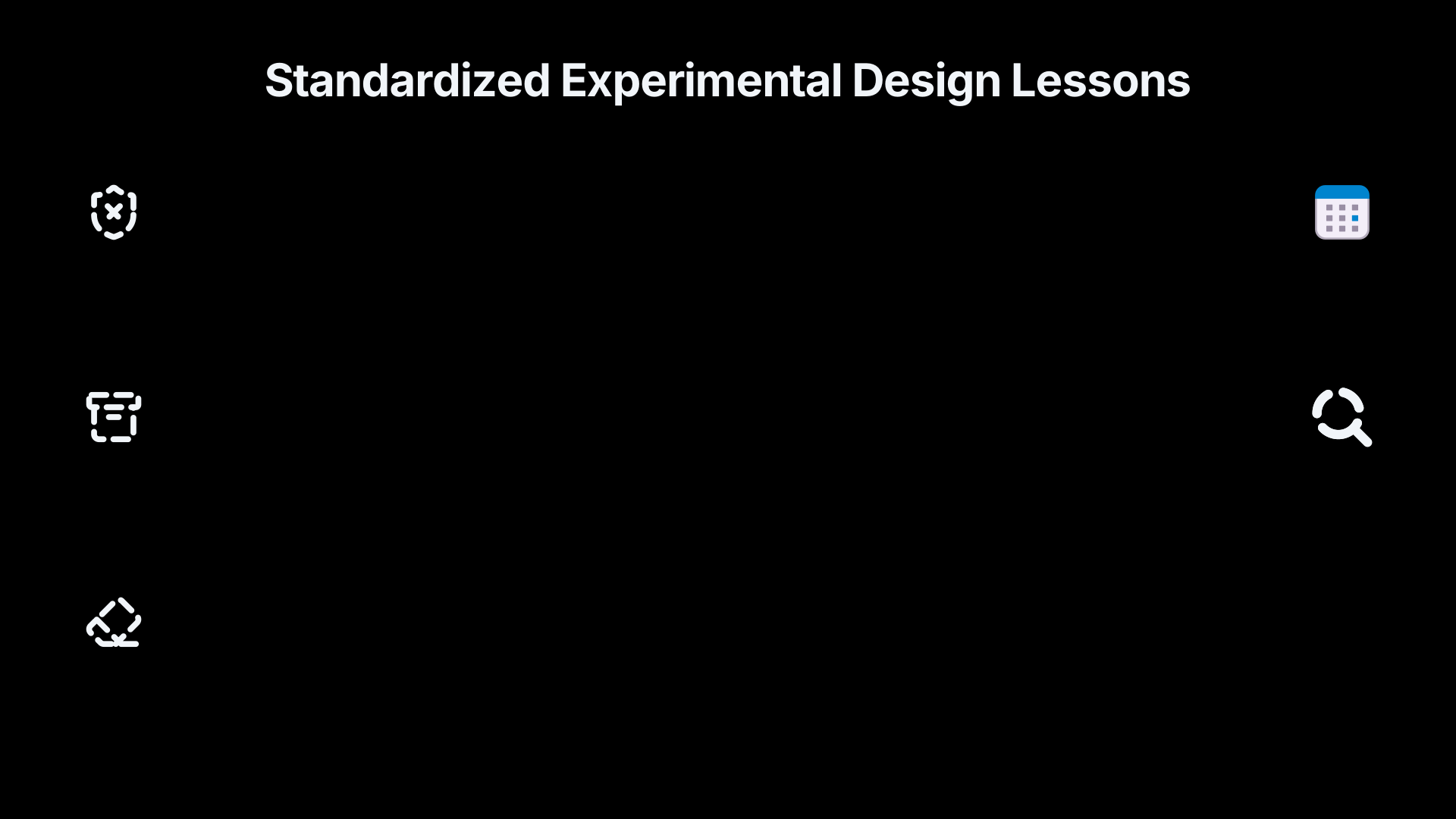
- Blind procedures must protect not only participants but also judges and analysts.
- Experimental materials should be stripped of dates, sequencing information and procedural annotations before evaluation.
- Independent access to original records is essential when published findings become disputed.
- Positive statistical results cannot by themselves establish an extraordinary claim if plausible conventional explanations remain.
These principles have since become routine across psychology and related behavioural sciences, where concerns about experimenter effects, observer bias and information leakage receive extensive attention.
The lasting historical importance
The Nature correspondence between 1978 and 1986 represents one of the most sustained published exchanges over the methodology of remote viewing. Although neither side persuaded the other, the debate permanently altered how later remote-viewing studies were evaluated.
Rather than asking only whether experiments produced statistically unusual results, subsequent critics and many later researchers first asked whether every possible pathway for ordinary information transfer had been convincingly blocked. That shift—from evaluating outcomes to scrutinising experimental controls—became the enduring legacy of the sensory-cueing debate.[Nature+2Nature]nature.comInformation transmission in remote viewing experimentsby CT TART · 1980 · Cited by 57 — Sensory cues invalidate remote viewing expe…
Amazon book picks
Further Reading
Books and field guides related to The Journal Fight Over Cues. Use these as the next step if you want deeper reading beyond the article.
eBay marketplace picks
Marketplace Samples
Live-tested eBay searches with available results related to this page.



Endnotes
1.
Source: nature.com
Link:https://www.nature.com/articles/284191a0
Source snippet
Information transmission in remote viewing experimentsby CT TART · 1980 · Cited by 57 — Sensory cues invalidate remote viewing expe...
2.
Source: nature.com
Link:https://www.nature.com/articles/292177a0
Source snippet
Sensory cues invalidate remote viewing experiments. DAVID MARKS. Nature volume 292, page 177 (1981) Cite this article.Read more...
3.
Source: researchgate.net
Link:https://www.researchgate.net/profile/David-Marks-2/3
Source snippet
David MARKS | Independent | PhD | Research profileView Sensory cues invalidate remote viewing experiments have described inve...
4.
Source: link.springer.com
Link:https://link.springer.com/article/10.1007/BF01961270
Source snippet
Remote viewing | Cellular and Molecular Life Sciencesby C Scott · 1988 · Cited by 3 — Marks, D., Sensory cues invalidate remote v...
5.
Source: researchgate.net
Title: 15839349 Information transmission in remote viewing experiments
Link:https://www.researchgate.net/publication/15839349_Information_transmission_in_remote_viewing_experiments
Source snippet
Information transmission in remote viewing experiments27 May 2016 — Rebuttal of criticisms of remote viewing experiments. August 1981 · N...
Published: May 2016
6.
Source: researchgate.net
Link:https://www.researchgate.net/publication/15945437_Rebuttal_of_criticisms_of_remote_viewing_experiments
Source snippet
Rebuttal of criticisms of remote viewing experimentsDavid F Marks · Richard Kammann · View · Information... Sensory cues invalidate remo...
7.
Source: pubmed.ncbi.nlm.nih.gov
Link:https://pubmed.ncbi.nlm.nih.gov/7242682/
Source snippet
Nature. 1981 Jul 9;292(5819):177. doi: 10.1038/292177a0. Author. D Marks. PMID: 7242682; DOI: 10.1038/...Read mor...
8.
Source: ui.adsabs.harvard.edu
Link:https://ui.adsabs.harvard.edu/abs/1981Natur.292..177M
Source snippet
cues invalidate remote viewing experiments - ADSSensory cues invalidate remote viewing experiments. Marks, David. Abstract. Publication...
9.
Source: Wikipedia
Title: Remote viewing
Link:https://en.wikipedia.org/wiki/Remote_viewing
Source snippet
Remote viewingDavid Marks, a critic of remote viewing, after finding sensory cues and... "Sensory cues invalidate remote viewing expe...
Additional References
10.
Source: scilit.com
Link:https://www.scilit.com/publications/5ed26ba9011b0b4560a9aa5bfcd882c4
Source snippet
Sensory cues invalidate remote viewing experimentsThis publication has 3 references indexed in Scilit: The Psychology of the Psychic. The...
11.
Source: scispace.com
Title: rebuttal of criticisms of remote viewing experiments 1j3arh0xxi
Link:https://scispace.com/pdf/rebuttal-of-criticisms-of-remote-viewing-experiments-1j3arh0xxi.pdf
Source snippet
Rebuttal of criticisms of remote viewing experiments23 Jul 1981 — Rebuttal of criticisms of remote viewing experiments. MARKS1 has argued...
12.
Source: centerforinquiry.s3.amazonaws.com
Title: Remote Viewing Revisitedby DF Marks · Cited by 13 — Marks, D
Link:https://centerforinquiry.s3.amazonaws.com/wp-content/uploads/sites/29/1982/07/22165420/p20.pdf
Source snippet
F. 1981a. "Sensory Cues Invalidate Remote Viewing Experiments." Nature. 292:177. 1981b. "The Assessment of Parapsychological Studies on R...
13.
Source: iris-ic.com
Title: bibliographie scientifique du remote viewing
Link:https://www.iris-ic.com/bibliographie-scientifique-du-remote-viewing/
Source snippet
Remote viewing: Examination of the Marks and Kamman cueing artifact hypothesis.Read more...
14.
Source: davidfmarks.net
Title: ‘That Dude’ Strikes Again
Link:https://davidfmarks.net/that-dude-strikes-again/
Source snippet
319 of Nature can be used to invalidate the [Pat Price]({{ 'pat-price/' | relative_url }}) series of remote viewing experiments...Read more...
15.
Source: youtube.com
Title: Scientific and Spiritual Implications of Psychic Abilities
Link:https://www.youtube.com/watch?v=zgyYms376Mg
Source snippet
Remote Viewing and Statistical Validation...
16.
Source: youtube.com
Title: Mind and Matter with Russell Targ
Link:https://www.youtube.com/watch?v=EhZ_ty3f4-M
Source snippet
Proof Positive of Remote Viewing, with excerpts from the original scientists Targ and Puthoff...
17.
Source: youtube.com
Title: Remote Viewing and Statistical Validation
Link:https://www.youtube.com/watch?v=YrwAiU2g5RU
Source snippet
Statistics in Parapsychology with Jessica Utts...
18.
Source: youtube.com
Link:https://www.youtube.com/watch?v=uQStMAwKNew
19.
Source: youtube.com
Title: Statistics in Parapsychology with Jessica Utts
Link:https://www.youtube.com/watch?v=WmYGtKB9EEA
Source snippet
Mind and Matter with Russell Targ...
Topic Tree