Within SAIC Tests
Can Five Targets Make Psychic Claims Testable?
The five-target judging system made chance expectations clear, but it also made the judge's role central to the SAIC debate.
On this page
- How rank order judging worked
- Why an average rank of three mattered
- Why judging familiarity became a problem
Page outline Jump by section
Introduction
Rank-order judging was designed to solve one of the central problems in free-response remote-viewing experiments: how to convert a loose collection of sketches, words and impressions into a numerical result that could be tested statistically. During the later Science Applications International Corporation (SAIC) studies, researchers commonly used a five-target judging procedure in which a blind judge compared one viewing transcript against one correct target and four decoys. If the correct target was consistently ranked nearer the top than chance would predict, researchers treated that as evidence that something unusual had occurred. The method was attractive because it made chance expectations explicit, but it also shifted much of the experiment’s credibility onto the judging process itself. By the time of the 1995 review of the U.S. government’s remote-viewing programme, the mechanics and reliability of rank-order judging had become one of the most closely debated aspects of the evidence.[National Security Archive]nsarchive2.gwu.eduNational Security ArchiveAn Evaluation of Remote Viewing: Research and…March 13, 2015 — by MD Mumford · 1995 · Cited by 76 — For examp…
How rank-order judging worked
Unlike forced-choice experiments, where participants selected from a small number of predefined answers, remote-viewing sessions produced open-ended descriptions. A viewer might draw shapes, describe textures or mention impressions such as “water”, “metal”, or “high structure”. Any single description could partially resemble many different targets.
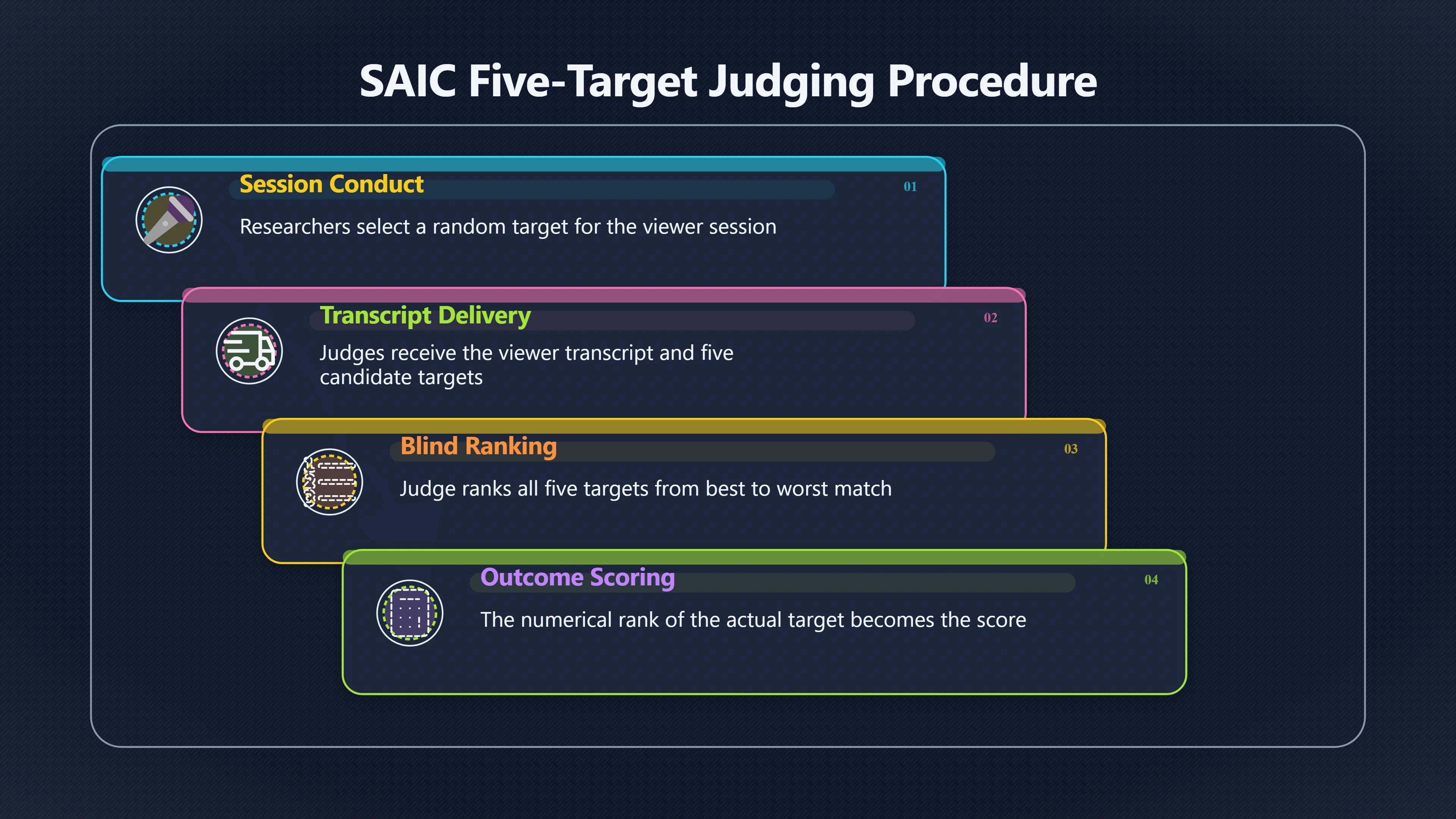
The five-target procedure attempted to evaluate these descriptions under blind conditions:
- A session was conducted with a randomly selected target.
- After the session, the judge received the viewer’s transcript together with five candidate targets.
- One candidate was the actual target; the remaining four were randomly selected decoys.
- The judge ranked all five targets from best match (rank 1) to worst match (rank 5).
- The numerical score assigned to the actual target became that trial’s outcome.
Because the judge ranked every candidate rather than simply deciding “correct” or “incorrect”, the procedure captured degrees of similarity while preserving a clear statistical expectation. If the judging were entirely random, every rank would occur equally often for the correct target.[ResearchGate]researchgate.netAn Assessment of the Evidence for Psychic FunctioningMay 14, 2019 — response most closely, and a rank of 5 means it matches t…
This approach also helped reduce one criticism of earlier free-response studies. Instead of asking whether a description looked “impressive”, investigators could analyse a predefined numerical variable across many independent trials.
Why an average rank of three mattered
The mathematics of the five-target design is straightforward. With five equally likely candidates, the expected average rank under pure chance is exactly:
1=3\frac{1}{5}=351=3
That simple expectation gave researchers a benchmark that was easy to interpret.
- Average rank near 3: consistent with random judging.
- Average rank below 3: the correct targets tended to receive better-than-chance rankings.
- Average rank well above 3: performance worse than chance.
Rather than relying on a few striking individual sessions, researchers combined many trials and tested whether the average rank was significantly lower than three. Statistical tests then estimated how unlikely such a result would be if viewers possessed no information beyond chance. This emphasis on aggregate performance became an important feature of the later SAIC work and figured prominently in Jessica Utts’s statistical evaluation of the programme.[CIA]cia.govAN EVALUATION OF REMOTE VIEWINGChapter Three: Research Reviews. Review 1 (Dr. Jessica Utts). Review 2 (Ray Hyman). ▻. The Reply (Dr. J…
The attraction of this design was that the hypothesis was specified before analysis. Investigators were not asking whether a transcript “felt convincing”; they were testing whether correct targets occupied unusually high positions within repeated blind rankings.
Why judging familiarity became a problem
Although the scoring rule was mathematically clear, critics argued that the validity of the experiment depended heavily on how judging was performed.
One concern involved target familiarity. If judges repeatedly worked with the same target pool, they could gradually remember distinctive photographs or locations. Even when they remained blind to the correct answer, repeated exposure might subtly influence later rankings in ways unrelated to the viewer’s performance. The concern was not necessarily conscious bias but the possibility that accumulated familiarity could affect matching decisions.[National Security Archive]nsarchive2.gwu.eduNational Security ArchiveAn Evaluation of Remote Viewing: Research and…March 13, 2015 — by MD Mumford · 1995 · Cited by 76 — For examp…
A related issue involved transcript familiarity. When judges scored many sessions from the same experiment, memorable sketches or phrases from earlier trials might influence later rankings. Critics argued that this could create statistical dependence between supposedly independent judgements.
Ray Hyman highlighted another technical problem identified in some earlier remote-viewing work: ranking procedures had to ensure that every possible rank remained equally available throughout the judging process. If previous rankings constrained later choices, chance expectations could become distorted. Later SAIC protocols were developed partly to avoid these known statistical pitfalls, but debate continued over whether every source of dependence had been eliminated.[National Security Archive]nsarchive2.gwu.eduNational Security ArchiveAn Evaluation of Remote Viewing: Research and…March 13, 2015 — by MD Mumford · 1995 · Cited by 76 — For examp…
Why supporters and critics interpreted the same method differently
Supporters regarded rank-order judging as one of the strongest methodological improvements introduced into free-response remote-viewing research.
From this perspective, the procedure:
- defined chance performance precisely;
- permitted blinded judging;
- allowed statistical analysis across many trials; and
- reduced reliance on anecdotal “best hits”.
Jessica Utts argued that, when properly implemented, these methods produced statistically significant deviations from chance that could not easily be dismissed as coincidence alone.[CIA]cia.govAN EVALUATION OF REMOTE VIEWINGChapter Three: Research Reviews. Review 1 (Dr. Jessica Utts). Review 2 (Ray Hyman). ▻. The Reply (Dr. J…
Critics accepted that the statistics themselves could be calculated correctly while questioning whether the experimental process generating those numbers was sufficiently insulated from subtle bias. Hyman’s position was not that rank-order statistics were inherently invalid, but that apparently small dependencies in judging, target reuse or experimental procedure could produce misleading significance without demonstrating anomalous perception. Consequently, he argued that statistical significance alone did not establish a paranormal explanation.[CIA]cia.govAN EVALUATION OF REMOTE VIEWINGChapter Three: Research Reviews. Review 1 (Dr. Jessica Utts). Review 2 (Ray Hyman). ▻. The Reply (Dr. J…
Why the five-target test remains central to the SAIC debate
The five-target scoring system illustrates both the strengths and the limitations of the later SAIC experiments.
Its principal achievement was methodological. Instead of relying on subjective impressions of impressive drawings, it translated qualitative responses into a predefined quantitative outcome with a known chance expectation. That represented a substantial advance over less structured forms of evaluation.
At the same time, the method demonstrated that stronger statistics do not automatically settle broader scientific questions. Once scoring depended on human ranking rather than direct measurement, questions naturally shifted from probability calculations to the reliability, independence and blindness of the judging process. As a result, the five-target protocol became one of the defining mechanisms through which supporters saw evidence for anomalous cognition while sceptics focused on the possibility of subtle methodological artefacts.[National Security Archive+2CIA]nsarchive2.gwu.eduNational Security ArchiveAn Evaluation of Remote Viewing: Research and…March 13, 2015 — by MD Mumford · 1995 · Cited by 76 — For examp…
Amazon book picks
Further Reading
Books and field guides related to Can Five Targets Make Psychic Claims Testable?. Use these as the next step if you want deeper reading beyond the article.
Statistics Done Wrong
Clarifies statistical reasoning behind rank-based experimental results.
Discovering Statistics Using Ibm Spss Statistics
Supports readers wanting to understand statistical testing in experiments.
Parapsychology: A Handbook for the 21st Century
Explains free-response methodologies including judging approaches.
eBay marketplace picks
Marketplace Samples
Live-tested eBay searches with available results related to this page.



Endnotes
1.
Source: cia.gov
Link:https://www.cia.gov/readingroom/docs/CIA-RDP96-00791R000200180006-4.pdf
Source snippet
AN EVALUATION OF REMOTE VIEWINGChapter Three: Research Reviews. Review 1 (Dr. Jessica Utts). Review 2 (Ray Hyman). ▻. The Reply (Dr. J...
2.
Source: researchgate.net
Link:https://www.researchgate.net/publication/333228024_An_Assessment_of_the_Evidence_for_Psychic_Functioning
Source snippet
An Assessment of the Evidence for Psychic FunctioningMay 14, 2019 — response most closely, and a rank of 5 means it matches t...
Published: May 14, 2019
3.
Source: cia.gov
Link:https://www.cia.gov/readingroom/docs/CIA-RDP96-00791R000200180005-5.pdf
Source snippet
AN EVALUATION OF THE REMOTE VIEWING PROGRAMUtts and Hyman were asked to prepare independent reports based on their review. In this review...
4.
Source: cia.gov
Link:https://www.cia.gov/readingroom/docs/CIA-RDP96-00792R000400240002-6.pdf
Source snippet
TRANSCONTINENTAL REMOTE VIEWING (SCHLITZ...Judges visited the target locations independently and in the order of their choice...
5.
Source: researchgate.net
Title: 374881423 Remote Viewing A 1974 2022 Systematic Review and [Meta Analysis]({{ ‘meta-analysis/’ | relative_url }})
Link:https://www.researchgate.net/publication/374881423_Remote_Viewing_A_1974-2022_Systematic_Review_and_Meta-Analysis
Source snippet
(PDF) Remote Viewing: A 1974-2022 Systematic Review...26 Oct 2023 — This is the first meta-analysis of all studies related to remote-vie...
6.
Source: nsarchive2.gwu.edu
Link:https://nsarchive2.gwu.edu/NSAEBB/NSAEBB438/docs/doc_57.pdf
Source snippet
National Security ArchiveAn Evaluation of Remote Viewing: Research and...March 13, 2015 — by MD Mumford · 1995 · Cited by 76 — For examp...
Published: March 13, 2015
Additional References
7.
Source: koestlerunit.wordpress.com
Link:https://koestlerunit.wordpress.com/wp-content/uploads/2015/06/wiseman-milton-1998.pdf
Source snippet
Koestler UnitExperiment One of the SAIC Remote Viewing Programby R Wiseman · Cited by 24 — When judging the first trial the judge would e...
8.
Source: academia.edu
Link:https://www.academia.edu/9540484/Through_Time_and_Space_The_Evidence_for_Remote_Viewing
Source snippet
Through Time and Space: The Evidence for Remote Viewing“The rank of the correct target is the numerical score for that remote vie...
9.
Source: skeptics.stackexchange.com
Title: have remote viewing tests shown a positive effect 5 15 above chance
Link:https://skeptics.stackexchange.com/questions/17741/have-remote-viewing-tests-shown-a-positive-effect-5-15-above-chance
Source snippet
Utts maintained that there had been a statistically significant positive effect, with some...Read more...
10.
Source: youtube.com
Title: HELLA HAMMID
Link:http://www.youtube.com/watch?v=oZq4urdRbgw
Source snippet
Edwin May remote viewing judging methods rank order Classic Reboot: Training Anomalous Cognition with Edwin C. May New Thinking Allowed w...
11.
Source: academia.edu
Link:https://www.academia.edu/108445581/Remote_Viewing_A_1974_2022_Systematic_Review_and_Meta_Analysis
Source snippet
Remote Viewing: A 1974- 2022 Systematic Review and...The systematic review covers 36 studies, revealing a decline effect in remote viewi...
12.
Source: psi-encyclopedia.spr.ac.uk
Title: Psi Encyclopedia Remote Viewing
Link:https://psi-encyclopedia.spr.ac.uk/articles/remote-viewing/
Source snippet
Psi EncyclopediaRemote Viewing - Psi Encyclopedia13 Jan 2017 — Remote viewing replaced repetitive forced-choice tasks with free-response...
13.
Source: metabunk.org
Link:https://www.metabunk.org/threads/claim-remote-viewing-is-a-scientifically-proven-technique-that-utilizes-a-natural-human-ability-to-enable-access-to-hidden-information.13057/page-3
Source snippet
Claim: Remote Viewing is a Scientifically Proven...24 Jul 2023 — No, it is very clear from Jessica Utts' paper that she is saying ESP ha...
14.
Source: scribd.com
Title: aperture08 c047c010
Link:https://www.scribd.com/document/879020129/aperture08-c047c010
Source snippet
Remote Viewing Insights and Updates | PDF21 Jun 2025 — Three [independent judges]({{ 'independent-judges/' | relative_url }}) effects when remote viewers use hypnosis. These rank-orde...
15.
Source: youtube.com
Title: Dr. Edwin May, Psychic Theories (Precognition, Remote Viewing)
Link:http://www.youtube.com/watch?v=fk3f47jOAFs
Source snippet
HELLA HAMMID - RUSSELL TARG / REMOTE VIEWING - OUTBOUNDER...
16.
Source: youtube.com
Title: Classic Reboot: Training Anomalous Cognition with Edwin C. May
Link:http://www.youtube.com/watch?v=6vbb7E7UD30
Source snippet
CLASSIC REBOOT: Lessons Learned From the Stargate Program with Edwin C. May...
Topic Tree