Within Read Files
What a Session Transcript Really Shows
A remote viewing transcript can prove a session was recorded, but not that its impressions were accurate, paranormal or useful.
On this page
- What appears in a raw session record
- Where feedback and later edits can distort reading
- How to separate occurrence from accuracy
Page outline Jump by section
Introduction
A declassified remote viewing session transcript proves that a session took place and that specific words, sketches and impressions were recorded. It does not by itself prove that those impressions were accurate, that they were obtained through paranormal means, or that they had operational value. That distinction is essential when reading Cold War-era remote viewing files. Many documents in the archive are primary records of an attempted session rather than validated intelligence products, and treating them as if they were confirmed findings is one of the most common mistakes readers make. The most useful approach is to ask what the document can actually demonstrate, what it cannot demonstrate, and what additional evidence would be needed before any stronger conclusion could be justified.[CIA]cia.govAN EVALUATION OF THE REMOTE VIEWING PROGRAMEvidence has not been provided that clearly demonstrates that the causes of hits are due to…
What appears in a raw session record
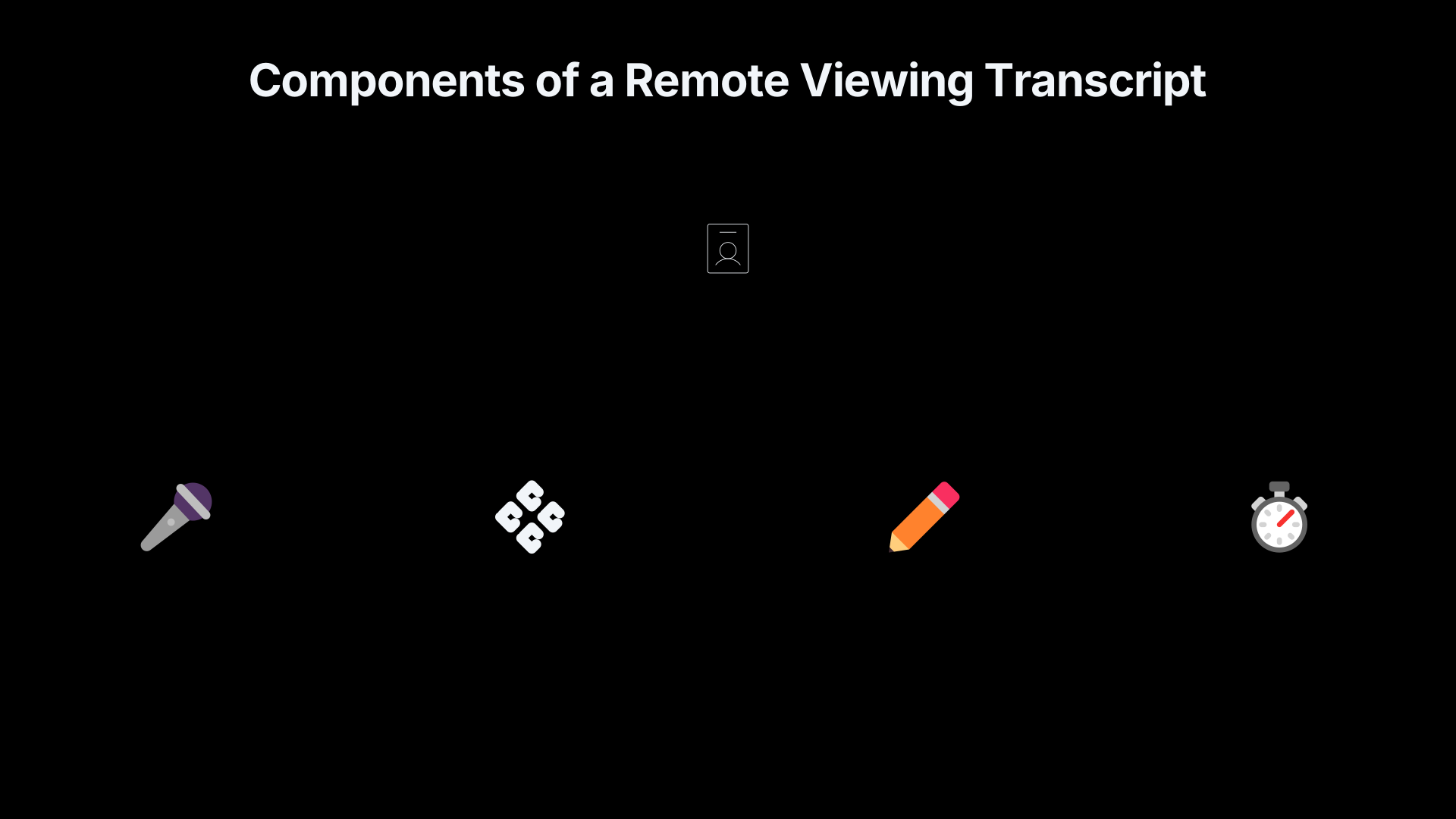
A typical session transcript is a contemporaneous record of an attempt at remote viewing. Depending on the programme and time period, it may contain:
- The tasking identifier or target reference.
- The monitor’s prompts and questions.
- The viewer’s spoken descriptions.
- Sketches drawn during the session.
- Time markers, pauses and corrections.
- Occasional post-session comments by the viewer or monitor.
These elements establish a chain of documentation. They show that a particular participant reported particular impressions before the official target feedback was recorded. That is valuable historical evidence because it allows later readers to examine exactly what was claimed, rather than relying on retrospective summaries.
However, the transcript itself is usually silent on whether those statements corresponded to reality. A page filled with detailed descriptions demonstrates only that the descriptions were made. It does not establish that they were correct.
This distinction mirrors the way many remote viewing programmes were evaluated. Rather than treating transcripts as self-proving, analysts compared them against known targets using structured judging procedures. In one declassified evaluation protocol, judges received transcripts and candidate targets under blind conditions and ranked how well each transcript matched each target. Accuracy therefore depended on an additional analytical step beyond the existence of the transcript itself.[CIA]cia.govA REMOTE VIEWING EVALUATION PROTOCOL…This completes the information that was given to the analyst, and thus the analysis was carrie…
Where feedback and later edits can distort reading
One reason transcripts are frequently misunderstood is that many readers encounter them alongside annotations, summaries or known target information. Once the reader already knows the intended target, vague statements can appear far more specific than they seemed during the original session.
Several forms of hindsight can alter how a transcript is perceived:
- Target knowledge. Reading a transcript after learning the target naturally encourages matching broad descriptions to known features.
- Editorial summaries. Later reports may highlight apparent successes while giving less attention to incorrect or irrelevant statements.
- Selective quotation. Popular discussions often reproduce only the most impressive passages rather than the complete session.
- Memory effects. Participants or commentators writing years later may remember successful correspondences more readily than unsuccessful ones.
For these reasons, the original ordering of the documents matters. The transcript should be read before consulting feedback documents or evaluations whenever possible. Preserving that sequence makes it easier to distinguish what the viewer actually reported from what later readers inferred.
Historical criticism of early remote viewing research has also emphasised the importance of preventing unintended cues. Researchers David Marks and Richard Kammann argued that some published transcripts contained information that could unintentionally help judges identify targets without invoking remote viewing. Their critique became an important reminder that even apparently raw documents may contain contextual clues requiring careful scrutiny.[Wikipedia]WikipediaRemote viewingRemote viewing

How to separate occurrence from accuracy
A practical way to read any transcript is to evaluate three separate questions rather than collapsing them into one.
Did the session occur?
The transcript usually answers this well. A dated document with contemporaneous notes provides evidence that a session was conducted and recorded.
Were the recorded impressions accurate?
The transcript alone cannot answer this. Accuracy requires comparison with independently established target information, preferably using predefined evaluation methods rather than subjective interpretation.
If some descriptions matched, why did they match?
This is a further question altogether. A correspondence between transcript and target does not automatically demonstrate paranormal perception. Chance coincidence, broad language, prior knowledge, sensory cues, inference and subjective matching must also be considered before attributing any particular explanation. The 1995 independent evaluation commissioned by the US government concluded that although some laboratory findings appeared statistically interesting, the available evidence did not clearly establish paranormal functioning, and the programme had not demonstrated operational intelligence value.[CIA]cia.govAN EVALUATION OF THE REMOTE VIEWING PROGRAMEvidence has not been provided that clearly demonstrates that the causes of hits are due to…
Keeping these questions separate prevents the common error of treating documentation of an event as proof of the event’s claimed mechanism.
Reading transcripts without overinterpreting them
The strongest evidence in a transcript usually comes from details that are:
- Recorded before any feedback.
- Specific enough to be independently checked.
- Difficult to reinterpret in multiple ways.
- Evaluated using criteria established before judging begins.
Conversely, caution is warranted when descriptions consist primarily of broad adjectives, emotional impressions or symbolic imagery that can fit many different targets. Statements such as “large structure”, “metal”, “water”, or “movement” often require substantial interpretation before appearing to match a particular location or object.
Another useful habit is to examine the entire transcript rather than isolated successes. Every inaccurate description, abandoned interpretation and contradictory statement forms part of the evidential record. Looking only at apparent hits creates an incomplete picture of what the viewer actually produced.
What a transcript can genuinely prove
When read carefully, a remote viewing transcript can support several modest but important conclusions.
It can show that a documented session occurred, identify what information was recorded at the time, preserve the sequence in which impressions developed, and provide material that later analysts or researchers can independently evaluate. Those are genuine evidential strengths of the archival record.
What it cannot do on its own is establish that the reported perceptions were objectively correct, demonstrate that they resulted from paranormal processes, or prove that remote viewing produced reliable intelligence. Those broader claims require additional evidence beyond the transcript itself, including controlled evaluation procedures, independent judging, and consideration of alternative explanations. Recognising that boundary allows readers to treat declassified session records as valuable historical documents without asking them to prove more than the documents themselves can support.
Amazon book picks
Further Reading
Books and field guides related to What a Session Transcript Really Shows. Use these as the next step if you want deeper reading beyond the article.
The Men Who Stare At Goats
Rating: 3.5/5 from 11 Google Books ratings
Provides historical background for readers exploring transcripts.
The seventh sense
Shows what session records looked like from a participant perspective.
Phenomena
From the author of Nuclear War: A Scenario, this is the gripping story of how a select group of scientists, under the watchful eye of the...
Endnotes
1.
Source: cia.gov
Link:https://www.cia.gov/readingroom/docs/CIA-RDP96-00791R000200180005-5.pdf
Source snippet
AN EVALUATION OF THE REMOTE VIEWING PROGRAMEvidence has not been provided that clearly demonstrates that the causes of hits are due to...
2.
Source: cia.gov
Link:https://www.cia.gov/readingroom/document/cia-rdp96-00788r001800080001-5
Source snippet
A REMOTE VIEWING EVALUATION [PROTOCOL]({{ 'protocol/' | relative_url }})...This completes the information that was given to the analyst, and thus the analysis was carrie...
3.
Source: Wikipedia
Title: Remote viewing
Link:https://en.wikipedia.org/wiki/Remote_viewing
4.
Source: Wikipedia
Title: Sensory leakage
Link:https://en.wikipedia.org/wiki/Sensory_leakage
5.
Source: archive.org
Title: cia readingroom document cia rdp96 00792r000600310001 7
Link:https://archive.org/details/cia-readingroom-document-cia-rdp96-00792r000600310001-7
Source snippet
CIA Reading Room cia-rdp96-00792r000600310001-7:...27 Jun 2023 — To obtain a numerical evaluation of the accuracy of the remote-viewing...
Additional References
6.
Source: researchgate.net
Title: 374881423 Remote Viewing A 1974 2022 Systematic Review and [Meta Analysis]({{ ‘meta-analysis/’ | relative_url }})
Link:https://www.researchgate.net/publication/374881423_Remote_Viewing_A_1974-2022_Systematic_Review_and_Meta-Analysis
Source snippet
(PDF) Remote Viewing: A 1974-2022 Systematic Review...26 Oct 2023 — This is the first meta-analysis of all studies related to remote-vie...
7.
Source: intelligence.senate.gov
Title: sites default files hearings 95mkultra
Link:https://www.intelligence.senate.gov/wp-content/uploads/2024/08/sites-default-files-hearings-95mkultra.pdf
Source snippet
MKULTRA, THE CIA'S PROGRAM OF RESEARCH...The Death.-Because they could not obtain air transportation for a return trip on Friday night...
8.
Source: reddit.com
Link:https://www.reddit.com/r/consciousness/comments/181s71r/the_cias_experiments_with_remote_viewing_and/
Source snippet
perimentation with Ingo Swann can provide some evidence toward “non-local...Read more...
9.
Source: facebook.com
Link:https://www.facebook.com/100090372200308/posts/during-the-cold-war-the-cia-funded-research-into-what-they-called-remote-viewing/937678002587931/
Source snippet
show it's not a controlled, predictable ability under current...
10.
Source: facebook.com
Link:https://www.facebook.com/AskImtinan/posts/project-[stargate
Source snippet
ccess. Analysts rated the session as "partially successful...Read more...
11.
Source: youtube.com
Title: On Being a Remote Viewing Student with Paul H. Smith
Link:http://www.youtube.com/watch?v=fAInBcIwz74
Source snippet
Paul H. Smith remote viewing session demonstration How To Do a Simple Remote Viewing Dr. Paul H. Smith...
12.
Source: youtube.com
Title: Remote Viewing Training, Part One: The Initial Phases, with Paul H. Smith
Link:http://www.youtube.com/watch?v=Y2Ryc196s0I
Source snippet
Remote Viewing Esoteric Targets with Dr. Paul H. Smith (Episode 114)...
13.
Source: pmc.ncbi.nlm.nih.gov
Link:https://pmc.ncbi.nlm.nih.gov/articles/PMC10275521/
Source snippet
Central Intelligence Agency's (CIA...by Á Escolà‐Gascón · 2023 · Cited by 10 — Programs addressed remote viewing (RV), that is, determin...
14.
Source: youtube.com
Title: Remote Viewing Esoteric Targets with Dr. Paul H. Smith (Episode 114)
Link:http://www.youtube.com/watch?v=fxGAj5Tji08
Source snippet
Remote Viewing of UFOs and Other Mysteries with Paul H. Smith...
15.
Source: youtube.com
Title: Remote Viewing of UFOs and Other Mysteries with Paul H. Smith
Link:http://www.youtube.com/watch?v=CwPi8RzeIC8
Source snippet
On Being a Remote Viewing Student with Paul H. Smith...
Topic Tree