Within Hits
Why Misses Matter as Much as Hits
A fair score must keep the misses visible, not retell the session around the few details that seem to fit.
On this page
- Why long sessions create more chances to match
- How selective retelling changes the apparent result
- What a fair denominator should include
Page outline Jump by section
Introduction
When a remote viewing session is long, the apparent number of “hits” almost always increases. A transcript containing dozens or hundreds of words, sketches and impressions offers many opportunities for later matching with a target. The crucial question is therefore not simply how many details seem correct, but how many details were produced altogether and how many failed to match. A fair assessment depends on keeping both sides of the record visible rather than reconstructing the session around its most memorable successes.
This issue sits at the centre of the broader problem of pattern matching. In free-response remote viewing, transcripts often contain numerous descriptions of shapes, textures, emotions, movements and objects. If only the successful fragments are highlighted after the target is revealed, the apparent accuracy can be greatly inflated. Researchers evaluating remote viewing have repeatedly recognised that subjective judging is a central methodological challenge, which is why formal blind judging and predefined scoring procedures have been used in laboratory studies rather than simple anecdotal comparisons.[CIA]cia.govAN EVALUATION OF THE REMOTE VIEWING PROGRAMUtts and Hyman were asked to prepare independent reports based on their review. In this rev…
Why Long Sessions Create More Chances to Match
Longer transcripts naturally increase the probability that some statements will resemble aspects of almost any complex target. A photograph of a city, industrial site or landscape contains many potential features that can be connected with broad descriptions such as “metal”, “movement”, “water”, “people”, “vertical structure” or “bright area”.
The problem is statistical as much as psychological. If a viewer produces fifty separate impressions instead of ten, there are five times as many opportunities for partial agreement. Unless unsuccessful impressions are counted as well, the apparent success rate becomes difficult to interpret.
This is one reason remote-viewing experiments have generally relied on blind judging rather than informal reading of transcripts. In many laboratory protocols, judges compare complete transcripts against multiple possible targets or rank candidate matches. Such procedures attempt to evaluate the session as a whole instead of allowing readers to focus only on isolated successful phrases.[CIA]cia.govAN EVALUATION OF REMOTE VIEWING: RESEARCH…The results were scored by having a blind judge attempt to match the target material with…
An analogy illustrates the point. Imagine someone predicts fifty different weather conditions for tomorrow:
- sunny
- windy
- foggy
- thunderstorms
- warm afternoon
- heavy rain
- frost
- clear evening
- hail
- cloudy morning
If only the one correct prediction is remembered afterwards, the forecast appears impressive. If all fifty predictions are considered together, the strength of the forecast looks very different.
The same logic applies to lengthy remote-viewing sessions.[scribd.com]scribd.comKatz Associative Remote ViewingPDF | Parapsychology17 Nov 1986 — This book explores Associative Remote Viewing (ARV) as a method for p…
How Selective Retelling Changes the Apparent Result
Most published anecdotes do not reproduce every line of a session transcript. Instead, they often present the statements that appear to fit the revealed target.
This selective retelling changes the reader’s perception in several ways.
First, incorrect descriptions disappear from view. If a transcript contains repeated references to mountains, circular objects, machinery and crowds but the target is an isolated lighthouse, those unsuccessful elements may receive little attention while “tower”, “water” and “height” are emphasised.
Second, broad statements may be treated as multiple successes. A single phrase such as “metal structure” might be counted as matching railings, pipes, vehicles and buildings simultaneously, even though it originated as one ambiguous impression.
Third, readers rarely know how many alternative interpretations were discarded before arriving at the final narrative. The finished story therefore represents the best-fitting reconstruction rather than the complete evidential record.
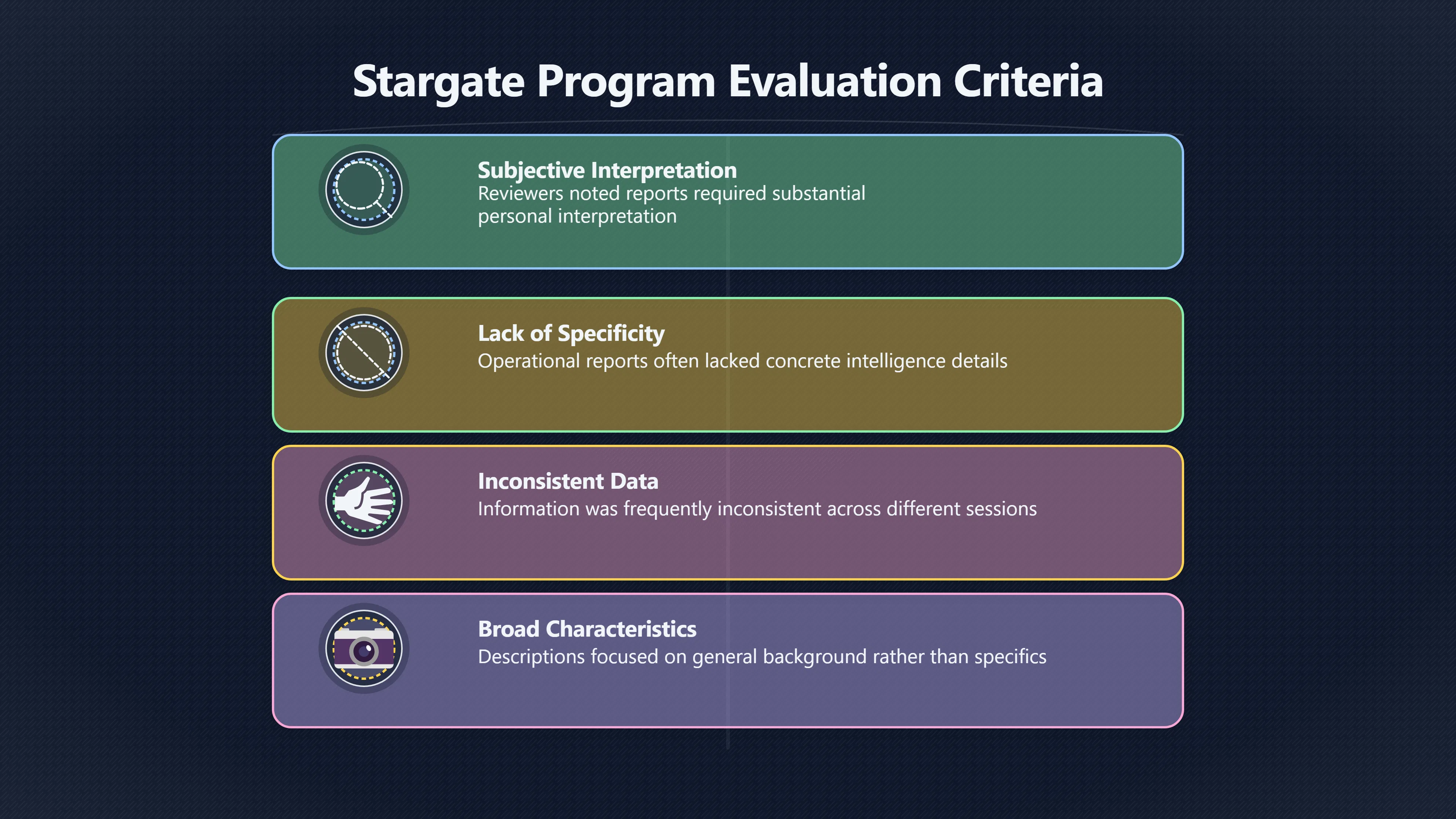
The American Institutes for Research’s evaluation of the U.S. government’s Stargate programme noted that operational reports often contained broad background characteristics but lacked the concrete specificity needed for intelligence use. Reviewers concluded that the information was inconsistent, inaccurate in important particulars and required substantial subjective interpretation.[National Security Archive]nsarchive2.gwu.eduUtts and Hyman were asked to prepareNational Security ArchiveAn Evaluation of Remote Viewing: Research and…March 13, 2015 — by MD Mumford · 1995 · Cited by 76 — Typically…
That observation is directly relevant to counting misses. A report requiring extensive interpretation makes it easier for later readers to concentrate on successful correspondences while overlooking the larger set of inaccurate or irrelevant material.
What a Fair Denominator Should Include
A meaningful assessment requires more than counting apparent hits. It also requires defining the denominator: the total body of information from which those hits emerged.
A fair denominator should normally include:
- Every independent descriptive statement made before feedback.
- All sketches and written annotations, not only the portions later highlighted.
- Incorrect descriptions alongside correct ones.
- Vague statements that could plausibly fit many different targets.
- Statements that cannot reasonably be evaluated either way.
Keeping the entire transcript visible allows readers to ask more informative questions:
- How many specific predictions proved wrong?
- How many descriptions were too general to discriminate among targets?
- How many accurate statements were genuinely distinctive rather than broadly applicable?
- Would an independent judge, unaware of the correct target, identify the same transcript as the best match?
These questions are harder to answer from edited anecdotes than from complete session records.
Why Researchers Developed Formal Scoring Methods
Remote-viewing researchers themselves recognised that informal judging could not resolve disputes about accuracy. Experimental protocols therefore introduced structured scoring systems, blind matching, rank-order methods and predefined target pools in an effort to reduce hindsight and confirmation bias.[CIA]cia.govREMOTE VIEWING EVALUATION TECHNIQUES1 Is any significant part of the scene hectic, chaotic, congested, or cluttered? · 2 Does a single…
These methods do not merely count memorable correspondences. Instead, they evaluate whether an entire transcript can be distinguished from alternative targets under controlled conditions.
The 1995 CIA-sponsored review highlighted that although some laboratory findings showed statistical deviations from chance, uncertainties remained about whether the observed effects reflected paranormal functioning or characteristics of the judging procedures, target selection or other aspects of the experimental design.[National Security Archive]nsarchive2.gwu.eduUtts and Hyman were asked to prepareNational Security ArchiveAn Evaluation of Remote Viewing: Research and…March 13, 2015 — by MD Mumford · 1995 · Cited by 76 — Typically…
This distinction matters because a scoring method that ignores misses can produce an inflated impression of success even if no genuine information transfer has occurred.
Why Counting Misses Improves Interpretation
Misses are not simply failed predictions; they provide essential context for interpreting apparent successes.
A transcript containing five striking correspondences and two incorrect statements presents different evidence from one containing five correspondences embedded within eighty unrelated impressions. Although both sessions contain the same number of hits, the evidential weight differs because the proportion of successful information differs.
For this reason, complete transcript analysis is generally more informative than collections of memorable quotations. Preserving the full balance of correct, incorrect and ambiguous material makes it easier to judge whether a session demonstrates unusually specific information or whether a few successful details have been selected from a much larger body of mixed impressions.
Within debates about remote viewing, counting misses therefore serves a simple but important purpose: it keeps the apparent strength of a session tied to everything that was actually recorded, not only to the details that remained persuasive after the answer became known.


eBay marketplace picks
Marketplace Samples
Live-tested eBay searches with available results related to this page.



Endnotes
1.
Source: cia.gov
Link:https://www.cia.gov/readingroom/docs/CIA-RDP96-00791R000200180005-5.pdf
Source snippet
AN EVALUATION OF THE REMOTE VIEWING PROGRAMUtts and Hyman were asked to prepare independent reports based on their review. In this rev...
2.
Source: cia.gov
Link:https://www.cia.gov/readingroom/document/cia-rdp96-00789r003800440001-2
Source snippet
REMOTE VIEWING EVALUATION TECHNIQUES1 Is any significant part of the scene hectic, chaotic, congested, or cluttered? · 2 Does a single...
3.
Source: cia.gov
Link:https://www.cia.gov/readingroom/document/cia-rdp96-00791r000200180006-4
Source snippet
AN EVALUATION OF REMOTE VIEWING: RESEARCH...The results were scored by having a blind judge attempt to match the target material with...
4.
Source: cia.gov
Link:https://www.cia.gov/readingroom/document/cia-rdp96-00791r000200180005-5
5.
Source: nsarchive2.gwu.edu
Title: Utts and Hyman were asked to prepare
Link:https://nsarchive2.gwu.edu/NSAEBB/NSAEBB438/docs/doc_57.pdf
Source snippet
National Security ArchiveAn Evaluation of Remote Viewing: Research and...March 13, 2015 — by MD Mumford · 1995 · Cited by 76 — Typically...
Published: March 13, 2015
6.
Source: scribd.com
Title: Katz Associative Remote Viewing
Link:https://www.scribd.com/document/1005021917/KatzAssociativeRemoteViewing
Source snippet
PDF | Parapsychology17 Nov 1986 — This book explores [Associative Remote Viewing (ARV)]({{ 'associative-remote-viewing-arv/' | relative_url }}) as a method for p...
Additional References
7.
Source: reddit.com
Link:https://www.reddit.com/r/remoteviewing/comments/1dazs09/creation_of_study_on_statistical_evidence_of/
Source snippet
Creation of study on statistical evidence of remote viewingProject Stargate was closed because the head of the CIA at the time was a skep...
8.
Source: researchgate.net
Title: 374881423 Remote Viewing A 1974 2022 Systematic Review and Meta Analysis
Link:https://www.researchgate.net/publication/374881423_Remote_Viewing_A_1974-2022_Systematic_Review_and_Meta-Analysis
Source snippet
(PDF) Remote Viewing: A 1974-2022 Systematic Review...26 Oct 2023 — This is the first meta-analysis of all studies related to remote-vie...
9.
Source: youtube.com
Title: Testing a Navy SEALs Remote Viewing Capabilities | Official Preview
Link:https://www.youtube.com/watch?v=KrZDutOB4lM
Source snippet
This video on Remote Viewing and Statistical Validation is highly relevant because it features statistician Jessica Utts discussing the m...
10.
Source: academia.edu
Link:https://www.academia.edu/31098436/Superpowers_of_the_Human_Biomind_New_Content_in_Section_6_Ingo_Swann_Honor_Roll_for_Remote_Viewing
Source snippet
n air, but from published documents of sufficient merit to be accepted...
11.
Source: documents2.theblackvault.com
Link:https://documents2.theblackvault.com/documents/cia/stargate/STARGATE%20%2311%20549/Part0004/CIA-RDP96-00789R003100030001-4.pdf
Source snippet
Mental Phenomena: Selected Papers18 Apr 2003 — Utts, a Professor of [Statistics]({{ 'statistics/' | relative_url }}) from the University of California at Davis, sets the stati...
12.
Source: documents2.theblackvault.com
Link:https://documents2.theblackvault.com/documents/cia/stargate/STARGATE%20%2313%20587/Part0002/CIA-RDP96-00788R001300070003-9.pdf
Source snippet
theblackvault.comCIA-RDP96-00788R001300070003-910 Sept 2003 — REMOTE-VIEWING TRANSCRIPT. Following is the unedited transcript of the firs...
13.
Source: pmc.ncbi.nlm.nih.gov
Link:https://pmc.ncbi.nlm.nih.gov/articles/PMC10275521/
Source snippet
Central Intelligence Agency's (CIA...by Á Escolà‐Gascón · 2023 · Cited by 10 — Programs addressed remote viewing (RV), that is, determin...
14.
Source: youtube.com
Title: Classic Reboot: Training [Anomalous Cognition]({{ ‘not-clairvoyance/’ | relative_url }}) with Edwin C. May
Link:https://www.youtube.com/watch?v=6vbb7E7UD30
Source snippet
An Open-Ended Conversation with Paul H. Smith (4K Reboot)...
15.
Source: youtube.com
Title: Remote Viewing Psychology with Charles T. Tart
Link:https://www.youtube.com/watch?v=jPZwaicuiek
Source snippet
Testing a Navy SEALs Remote Viewing Capabilities | Official Preview...
16.
Source: youtube.com
Title: An Open-Ended Conversation with Paul H. Smith (4K Reboot)
Link:https://www.youtube.com/watch?v=QhWOt2q_xnU
Source snippet
Remote Viewing Psychology with Charles T. Tart...
Topic Tree