Within SRI Tests
Could Hidden Clues Explain the Hits?
The cueing dispute asked whether ordinary clues, not psychic perception, could explain the early SRI successes.
On this page
- What sensory cueing means
- How Marks challenged the SRI record
- Why cue removal did not end the dispute
Page outline Jump by section
Introduction
The debate over sensory cueing is one of the most important reasons why the early Stanford Research Institute (SRI) remote-viewing experiments remain controversial. Remote viewing was intended to test whether people could describe distant targets without ordinary sensory information. If ordinary clues accidentally reached the viewer or the judge, however, the apparent success of an experiment could be explained without invoking any paranormal ability.
This issue came to the forefront through the work of psychologists David Marks and Richard Kammann, who argued that subtle but ordinary information embedded in the experimental records could account for the impressive matching scores reported by SRI. Their critique did not simply question individual results; it challenged whether the original experiments had successfully excluded conventional explanations. Although SRI researchers disputed the criticism and later experiments attempted to tighten procedures, the cueing dispute remains central because it focuses on experimental design rather than belief about psychic phenomena.[Nature+2Nature]nature.comDAVID MARKS. Nature… Nature 284, 191 (1980). CAS · PubMed · Article. 2. Marks, D…Read more…
Could Hidden Clues Explain the Hits?
What sensory cueing means
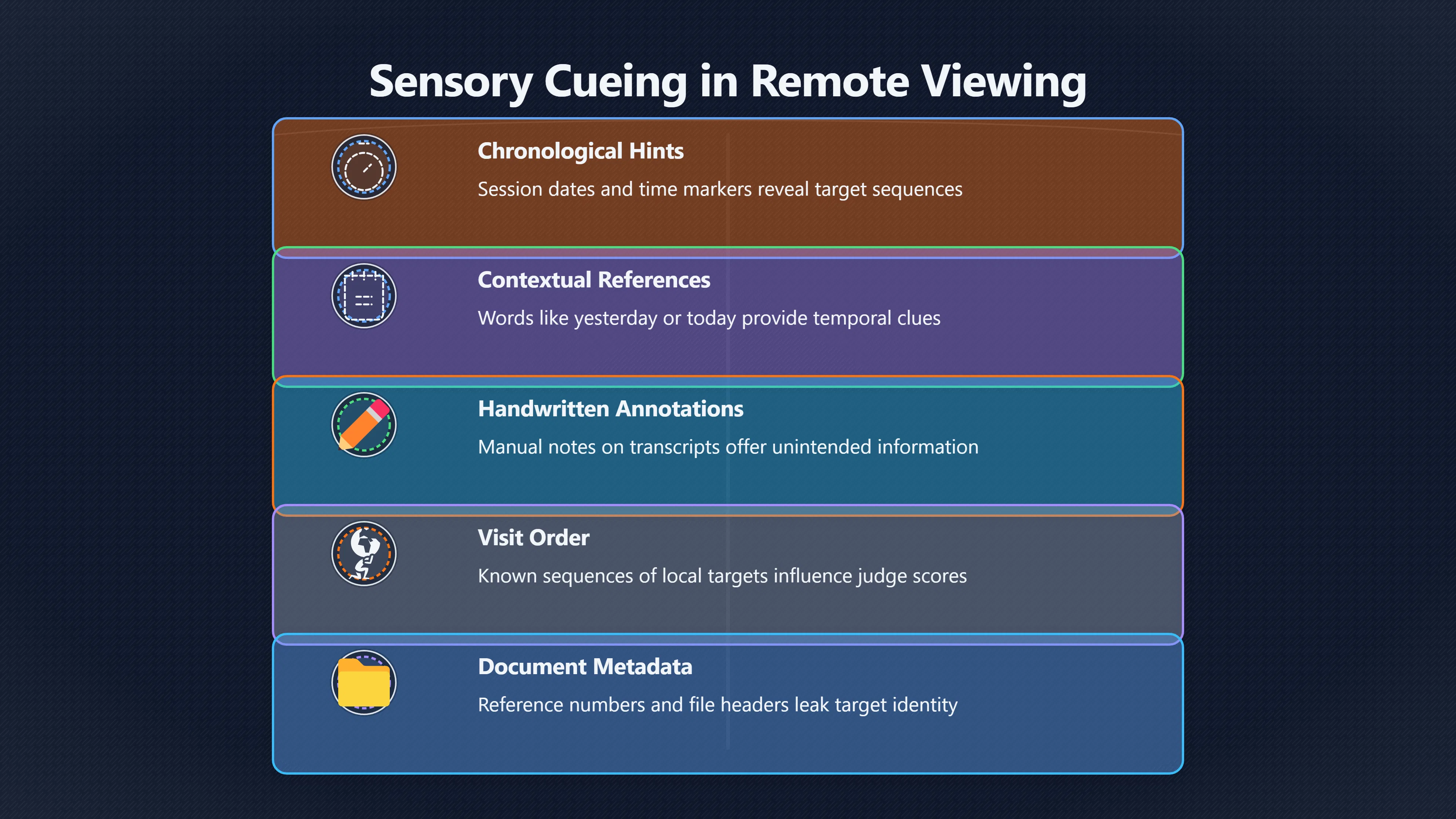
In experimental psychology, sensory cueing (or sensory leakage) refers to any unintended source of information that allows participants or judges to reach correct answers without using the process being tested. The cues may be surprisingly small. Dates on documents, references to previous sessions, handwritten annotations, or knowledge about the order in which targets were visited can all provide enough information for an attentive judge.
This concern is especially important in remote-viewing research because the experiments usually involve an open-ended description followed by a judging stage. Rather than asking whether a participant produced one correct answer from many options, judges compare a transcript with several possible targets and decide which match is best. If the transcript contains ordinary clues about timing or sequence, the judging process may reward those clues instead of the descriptive content itself. Marks argued that remote-viewing experiments therefore depended not only on keeping viewers isolated from the targets but also on ensuring that judges were completely blind to every possible source of ordinary information.[Nature]nature.comDAVID MARKS. Nature… Nature 284, 191 (1980). CAS · PubMed · Article. 2. Marks, D…Read more…
How Marks Challenged the SRI Record
Marks and Kammann originally attempted to reproduce the published SRI findings but were unable to obtain comparable results. Rather than stopping there, they examined the procedures used in the famous SRI target-matching experiments.
According to their analysis, many of the original transcripts supplied to judges contained chronological hints. Some referred to events such as “yesterday” or “today”, while others retained session dates or similar contextual information. Because the local targets had been visited in a known sequence, these details could potentially reveal which target belonged with which transcript. Marks argued that the judges therefore possessed more information than the experimental design intended.[Nature]nature.comDAVID MARKS. Nature… Nature 284, 191 (1980). CAS · PubMed · Article. 2. Marks, D…Read more…
Marks went further by testing the practical importance of these cues. He reported that he could correctly match transcripts to targets using the embedded clues rather than any claimed psychic content. His conclusion was not merely that the experiments contained imperfections, but that the reported successes could be explained by ordinary information leakage. In a widely cited Nature exchange, he argued that until experiments eliminated sensory cueing, the SRI results could not be treated as evidence for remote viewing.[Nature]nature.comDAVID MARKS. Nature… Nature 284, 191 (1980). CAS · PubMed · Article. 2. Marks, D…Read more…
The critique shifted the discussion away from whether individual descriptions sounded impressive and towards a narrower methodological question: had the experiments truly isolated the phenomenon they claimed to measure?
Why Cue Removal Did Not End the Dispute
The SRI researchers, Russell Targ and Harold Puthoff, rejected Marks’ interpretation. Together with psychologist Charles Tart, they argued that when transcripts were edited to remove the alleged cues and rejudged, performance still exceeded chance expectations. From their perspective, the descriptive content—not the chronological information—continued to support the remote-viewing hypothesis.[Nature]nature.comH. PUTHOFF; R. TARG. Nature (1981). Sensory cues invalidate remote viewing experiments.Read more…
Critics remained unconvinced for several reasons. First, they questioned whether every possible cue had actually been removed. Later examinations suggested that some edited transcript sets still contained information that could influence judging. Second, disputes arose over access to the original materials, with critics arguing that independent verification was unnecessarily difficult. These disagreements transformed what might have been a technical correction into a prolonged controversy about transparency and reproducibility.[Nature+2SciSpace]nature.comDAVID MARKS. Nature… Nature 284, 191 (1980). CAS · PubMed · Article. 2. Marks, D…Read more…
The disagreement therefore evolved into two competing interpretations:
- Supporters’ view: the cueing criticism identified procedural flaws but did not eliminate the statistically unusual matching obtained after improved judging.
- Critics’ view: once information leakage became plausible, the original evidence could no longer establish remote viewing, and later analyses failed to remove all reasonable conventional explanations.
Because both sides accepted that cueing would invalidate an experiment if present, the dispute centred on whether the safeguards were genuinely adequate rather than on the abstract possibility of cueing itself.
Why the Cueing Debate Still Matters
The Marks critique had effects well beyond the original SRI publications. It reinforced a broader principle in psychology and experimental science: whenever human judgement plays a role in scoring results, researchers must design protocols that prevent even subtle information leakage.
Subsequent remote-viewing studies increasingly adopted stricter procedures, including more rigorous blinding, independent judging, randomisation, and tighter control over experimental records. Even researchers sympathetic to remote viewing generally accepted that stronger safeguards were necessary because the Marks critique had exposed how easily unintended information could influence outcomes.[koestlerunit.wordpress.com]koestlerunit.wordpress.comExperiment One of the SAIC Remote Viewing Programby R Wiseman · Cited by 24 — Some comments on the assessment of parapsychological studie…
The debate also illustrates why methodological criticism can remain influential even when the underlying scientific question is unresolved. Marks did not claim to have disproved remote viewing in principle. Instead, he argued that the best-known evidence had not excluded an ordinary explanation. Supporters replied that later protocols addressed those weaknesses. As a result, the dispute continues to revolve less around dramatic individual “hits” than around whether any experiment has completely ruled out conventional sources of information while still producing reliable, independently replicated results.

Amazon book picks
Further Reading
Books and field guides related to Could Hidden Clues Explain the Hits?. Use these as the next step if you want deeper reading beyond the article.
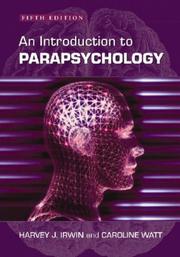
An introduction to parapsychology
Summarizes SRI studies and methodological criticisms.
eBay marketplace picks
Marketplace Samples
Live-tested eBay searches with available results related to this page.



Endnotes
1.
Source: nature.com
Link:https://www.nature.com/articles/292177a0
Source snippet
DAVID MARKS. Nature... Nature 284, 191 (1980). CAS · PubMed · Article. 2. Marks, D...Read more...
2.
Source: nature.com
Link:https://www.nature.com/articles/284191a0
Source snippet
H. PUTHOFF; R. TARG. Nature (1981). [Sensory cues]({{ 'sensory-cues/' | relative_url }}) invalidate remote viewing experiments.Read more...
3.
Source: scispace.com
Title: rebuttal of criticisms of remote viewing experiments 1j3arh0xxi
Link:https://scispace.com/pdf/rebuttal-of-criticisms-of-remote-viewing-experiments-1j3arh0xxi.pdf
Source snippet
Rebuttal of criticisms of remote viewing experiments23 Jul 1981 — Rebuttal of criticisms of remote viewing experiments. MARKS1 has argued...
4.
Source: koestlerunit.wordpress.com
Link:https://koestlerunit.wordpress.com/wp-content/uploads/2015/06/wiseman-milton-1998.pdf
Source snippet
Experiment One of the SAIC Remote Viewing Programby R Wiseman · Cited by 24 — Some comments on the assessment of parapsychological studie...
5.
Source: pubmed.ncbi.nlm.nih.gov
Link:https://pubmed.ncbi.nlm.nih.gov/7242682/
Source snippet
Nature. 1981 Jul 9;292(5819):177. doi: 10.1038/292177a0. Author. D Marks. PMID: 7242682; DOI: 10.1038...Read more...
6.
Source: Wikipedia
Title: Remote viewing
Link:https://en.wikipedia.org/wiki/Remote_viewing
Source snippet
Remote viewingDavid Marks, a critic of remote viewing, after finding sensory cues and editing in the original transcripts generated by...
Additional References
7.
Source: academia.edu
Link:https://www.academia.edu/116341239/Information_transmission_in_remote_viewing_experiments
Source snippet
Information transmission in remote viewing experimentsInformation transmission in remote viewing experiments IN a recent Jetter to Nature...
8.
Source: sk.sagepub.com
Link:https://sk.sagepub.com/book/mono/psychology-and-the-paranormal/chpt/5-remote-viewing-psychic-staring
Source snippet
SAGE KnowledgeRemote Viewing and Psychic StaringThis review begins by exploring the 'classic' remote viewing (RV) studies and the claims...
9.
Source: researchgate.net
Link:https://www.researchgate.net/profile/Harold-Puthoff/publication/15945437_Rebuttal_of_criticisms_of_remote_viewing_experiments/links/57800d8b08ae01f736e49f90/Rebuttal-of-criticisms-of-remote-viewing-experiments.pdf
Source snippet
Kammann offer criticism of the [SRI experiments]({{ 'sri-tests/' | relative_url }}) in 'remote viewing', the abil- ity of certain individuals to access...Read more...
10.
Source: centerforinquiry.s3.amazonaws.com
Title: Remote Viewing Revisitedby DF Marks · Cited by 13 — Marks, D
Link:https://centerforinquiry.s3.amazonaws.com/wp-content/uploads/sites/29/1982/07/22165420/p20.pdf
Source snippet
F. 1981a. "Sensory Cues Invalidate Remote Viewing Experiments." Nature. 292:177. 1981b. "The Assessment of Parapsychological Studies on R...
11.
Source: singularityquest.com
Link:https://singularityquest.com/why-david-marks-cues-dont-debunk-remote-viewing/
Source snippet
Why David Marks' Cues Do Not Debunk Remote Viewing4 Jan 2021 — In this essay, I will prove that the sensory cues in the Marks-Kammann inv...
12.
Source: youtube.com
Title: [Third Eye Spies]({{ ‘third-eye-spies/’ | relative_url }}) | Russell Targ
Link:http://www.youtube.com/watch?v=oZ5sPtyjauA
Source snippet
"Remote viewing" David Marks critique Does God Exist? with James P. Driscoll New Thinking Allowed with Jeffrey Mishlove...
13.
Source: youtube.com
Title: Skepticism About Remote Viewing with Paul H. Smith
Link:http://www.youtube.com/watch?v=gadka2zweUo
Source snippet
Uncovering the CIA's Secret Weapon: Psychic Spies...
14.
Source: youtube.com
Title: Third Eye Spies with Russell Targ
Link:http://www.youtube.com/watch?v=3D7A-X1nd3c
Source snippet
The CIA’s Very Real Experiments into Psychic Powers...
15.
Source: youtube.com
Title: The CIA’s Very Real Experiments into Psychic Powers
Link:http://www.youtube.com/watch?v=DVZ2P5pe0-Q
Source snippet
Third Eye Spies | Russell Targ...
16.
Source: youtube.com
Title: Uncovering the CIA’s Secret Weapon: Psychic Spies
Link:http://www.youtube.com/watch?v=cNJwV3Ksxa8
Source snippet
Third Eye Spies with Russell Targ...
Topic Tree