Within Shutdown
The Review That Made Star Gate Hard to Defend
The 1995 AIR assessment turned years of remote-viewing work into a cost-benefit question the programme could not answer.
On this page
- Why the CIA commissioned the assessment
- What the review asked the programme to prove
- Why the findings weakened institutional support
Page outline Jump by section
Introduction
The 1995 American Institutes for Research (AIR) evaluation became the decisive test of whether the U.S. government’s remote-viewing programme still justified public funding. Rather than asking whether any individual experiment or striking anecdote deserved attention, the review asked a narrower and more practical question: did remote viewing provide intelligence that decision-makers could rely on? The answer shaped the programme’s fate. While the reviewers acknowledged that some laboratory findings appeared statistically unusual, they concluded that the operational programme had not demonstrated consistent value for intelligence collection. That distinction—between scientific curiosity and operational usefulness—became the central argument against continuing the Star Gate programme.[National Security Archive]nsarchive2.gwu.eduNational Security ArchiveAn Evaluation of Remote Viewing: Research and…March 13, 2015 — by MD Mumford · 1995 · Cited by 76 — "Star Gat…

Why the CIA commissioned the assessment
The review was commissioned after responsibility for the Star Gate programme passed from the Defense Intelligence Agency (DIA) to the CIA in 1995. The transfer created an opportunity for senior officials to ask whether more than two decades of classified work had produced a capability worth retaining.
Rather than relying on internal advocates or critics, the CIA asked AIR to conduct an external evaluation. The assessment examined two related but separate questions:
- whether laboratory research provided credible evidence for an anomalous information-gathering effect;
- whether the operational programme had delivered intelligence that materially improved government decision-making.
This structure reflected a governance problem rather than a purely scientific one. Intelligence agencies routinely fund technologies that are imperfect or only partially understood, provided they generate reliable operational benefits. The review therefore focused on whether remote viewing justified continued investment under the standards expected of intelligence programmes.[National Security Archive]nsarchive2.gwu.eduNational Security ArchiveAn Evaluation of Remote Viewing: Research and…March 13, 2015 — by MD Mumford · 1995 · Cited by 76 — "Star Gat…
What the review asked the programme to prove
The AIR evaluation deliberately separated scientific evidence from operational performance. This distinction is often lost in later discussions.
The research component considered published and classified laboratory studies that attempted to measure remote viewing under controlled conditions. Statistician Jessica Utts argued that the accumulated experimental evidence showed statistically significant deviations from chance that warranted further scientific investigation. Psychologist Ray Hyman accepted that some results deserved attention but argued that methodological weaknesses, limited independent replication and unresolved questions about experimental controls prevented firm conclusions about paranormal functioning.[CIA]cia.govAN EVALUATION OF THE REMOTE VIEWING PROGRAMIn June of 1995, CIA's Office of Research and Development (ORD) then contracted with AIR fo…
For intelligence managers, however, the more important question concerned operations. Even if some laboratory effect existed, the programme still had to demonstrate that it could produce timely, specific and dependable intelligence.
The reviewers therefore examined whether remote-viewing reports:
- identified targets accurately enough for operational use;
- produced information unavailable through conventional intelligence methods;
- could be interpreted consistently by analysts;
- influenced intelligence decisions or successful operations in a documented way.
This operational emphasis reflected how intelligence programmes are normally judged: by measurable usefulness rather than theoretical possibility.[National Security Archive]nsarchive2.gwu.eduNational Security ArchiveAn Evaluation of Remote Viewing: Research and…March 13, 2015 — by MD Mumford · 1995 · Cited by 76 — "Star Gat…
Why the findings weakened institutional support
The AIR report concluded that the operational evidence fell well short of the standard required to justify continuation.
Several recurring problems emerged.
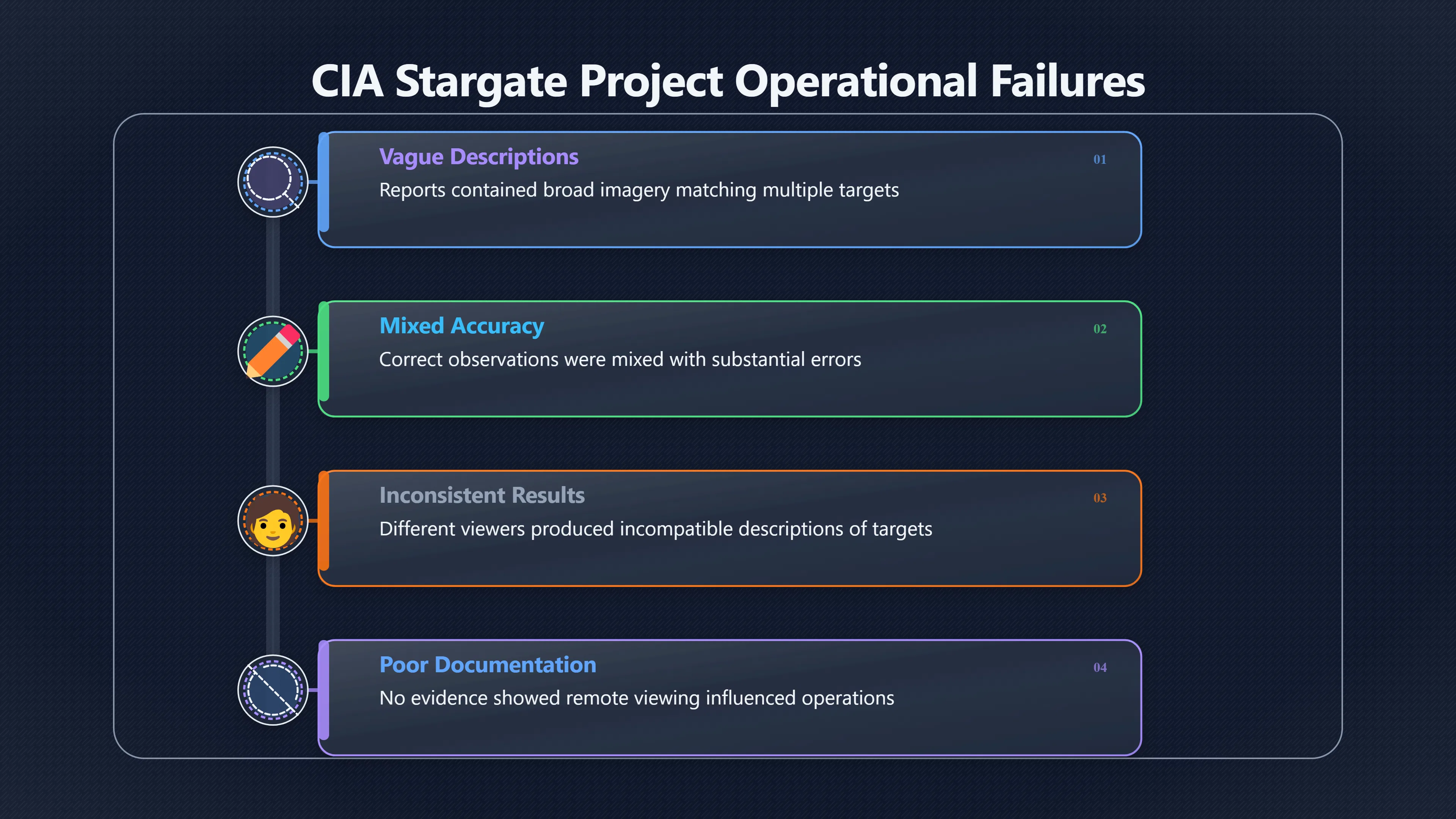
Reports were too vague. Many descriptions contained broad imagery or general characteristics that could be matched to multiple targets after the fact but rarely identified a specific intelligence objective clearly enough for immediate use.
Correct observations were mixed with substantial errors. Even sessions containing apparently accurate details also included incorrect or irrelevant material. Analysts therefore had no reliable method for separating useful information from noise before independent confirmation became available.
Results were inconsistent. Different viewers frequently produced incompatible descriptions of the same target, reducing confidence that the method could support operational planning.
Operational success was poorly documented. Perhaps the most damaging conclusion was that reviewers found no convincing documentation showing that remote viewing had directly produced actionable intelligence or materially influenced intelligence operations. This absence of demonstrable operational benefit outweighed any debate about laboratory statistics.[National Security Archive]nsarchive2.gwu.eduNational Security ArchiveAn Evaluation of Remote Viewing: Research and…March 13, 2015 — by MD Mumford · 1995 · Cited by 76 — "Star Gat…
The report therefore argued that continuing the programme could not be justified on a cost-benefit basis within the intelligence community.
The importance of the split scientific judgement
One reason the AIR review remains controversial is that it did not produce a unanimous scientific interpretation.
Jessica Utts concluded that the experimental database contained evidence for an anomalous phenomenon that merited continued scientific research. Ray Hyman disagreed that the evidence established psychic functioning, arguing that methodological uncertainties and the lack of independent replication prevented such a conclusion.
The AIR report incorporated both perspectives rather than forcing a single scientific verdict. Crucially, however, both positions converged on the operational question. Regardless of how laboratory findings were interpreted, neither review established that the intelligence programme had demonstrated practical value sufficient to justify continued funding.[CIA]cia.govAN EVALUATION OF THE REMOTE VIEWING PROGRAMIn June of 1995, CIA's Office of Research and Development (ORD) then contracted with AIR fo…
This distinction explains why supporters sometimes cite Utts’ conclusions while critics emphasise Hyman’s. The CIA’s decision ultimately depended less on resolving the scientific dispute than on determining whether the programme functioned as an effective intelligence capability.
Why the review became the case against continuation
The AIR assessment transformed years of remote-viewing research into a governance decision. Intelligence organisations are expected to allocate limited resources to methods that improve collection, analysis and operational outcomes. The review concluded that Star Gate had not met that standard.
Its findings undermined continued institutional support for several reasons:
- the programme could not demonstrate repeatable operational success;
- intelligence products derived from remote viewing lacked sufficient reliability for routine use;
- the available evidence did not show that remote viewing contributed uniquely valuable intelligence;
- continued funding could not be justified when weighed against competing intelligence priorities.
For that reason, the 1995 evaluation became the principal documentary basis for ending the programme. It did not declare every remote-viewing claim false, nor did it attempt to settle every scientific debate surrounding anomalous cognition. Instead, it answered the question that mattered most to government sponsors: whether remote viewing had proven itself as a practical intelligence tool. According to the AIR review, it had not.[National Security Archive]nsarchive2.gwu.eduNational Security ArchiveAn Evaluation of Remote Viewing: Research and…March 13, 2015 — by MD Mumford · 1995 · Cited by 76 — "Star Gat…
Amazon book picks
Further Reading
Books and field guides related to The Review That Made Star Gate Hard to Defend. Use these as the next step if you want deeper reading beyond the article.

Remote Viewers: The Secret History of America's Psychic Spies
Directly covers the reviews and institutional pressures surrounding Star Gate.
The Demon-Haunted World
Helps explain why external reviews emphasised rigorous evidence over anecdotes.
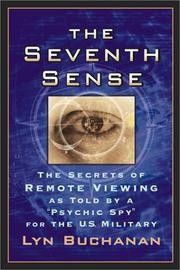
The seventh sense
Offers an insider account that readers can contrast with the AIR review's conclusions.

Endnotes
1.
Source: nsarchive2.gwu.edu
Link:https://nsarchive2.gwu.edu/NSAEBB/NSAEBB438/docs/doc_57.pdf
Source snippet
National Security ArchiveAn Evaluation of Remote Viewing: Research and...March 13, 2015 — by MD Mumford · 1995 · Cited by 76 — "Star Gat...
Published: March 13, 2015
2.
Source: cia.gov
Link:https://www.cia.gov/readingroom/docs/CIA-RDP96-00791R000200180005-5.pdf
Source snippet
AN EVALUATION OF THE REMOTE VIEWING PROGRAMIn June of 1995, CIA's Office of Research and Development (ORD) then contracted with AIR fo...
3.
Source: Wikipedia
Title: Jessica Utts
Link:https://en.wikipedia.org/wiki/Jessica_Utts
4.
Source: Wikipedia
Title: Remote viewing
Link:https://en.wikipedia.org/wiki/Remote_viewing
Source snippet
Remote viewingThe program ran from 1975 to 1995 and ended after evaluators concluded that remote viewers consistently failed to produc...
Additional References
5.
Source: greydynamics.com
Link:https://greydynamics.com/intelligence-past-the-tangible-world-cias-[stargate
Source snippet
Intelligence Past the Tangible World: CIA's Stargate ProjectThe Stargate Project is one of the most interesting and enigmatic intelligenc...
6.
Source: journalofscientificexploration.org
Link:https://journalofscientificexploration.org/index.php/jse/article/view/3865/2573
Source snippet
CIA to continue with operational RV regardless of the final evaluation (i.e. Mumford et al., 1995). The Star Gate...
7.
Source: threads.com
Link:https://www.threads.com/%40meta.ai/post/DaIbp2-AJa-/yes-cia-did-run-project-stargate-in-the-s-to-test-remote-viewing-which-is/
Source snippet
Yes — CIA did run Project Stargate in the 1970s-1995 to...5 days ago — In 1995, the program was shut down for having zero practical inte...
8.
Source: youtube.com
Link:https://www.youtube.com/watch?v=tZ1dy7dG0M4
Source snippet
Project STARGATE: Did the CIA's Declassified Psychic...CIA Project Stargate & Other Declassified Secrets - How Successful Were They?...
9.
Source: academia.edu
Link:https://www.academia.edu/95285973/The_Star_Gate_Operational_Remote_Viewing_Program_A_Human_Intelligence_HUMINT_Collection_Platform
Source snippet
ding the CIA a valid reason to terminate the program, despite the support...
10.
Source: Wikipedia
Title: Stargate Project (U.S. Army unit)
Link:https://en.wikipedia.org/wiki/Stargate_Project_%28U.S._Army_unit%29
Source snippet
Stargate Project (U.S. Army unit)The Stargate Project was terminated and declassified in 1995 after a commissioned review by the CIA c...
11.
Source: governmentattic.org
Link:https://www.governmentattic.org/57docs/ThesisAnomalousHumanCognition2023.pdf
Source snippet
Thesis: Anomalous Human Cognition: A Possible Role...20 Sept 2023 — Central Intelligence Agency's 1995 public cancellation of the U.S. R...
12.
Source: youtube.com
Link:https://www.youtube.com/watch?v=iH065Et-Uew
Source snippet
The CIA Filed a 9-Page Report Describing Pyramids on Mars. Then Classified It...
13.
Source: pmc.ncbi.nlm.nih.gov
Link:https://pmc.ncbi.nlm.nih.gov/articles/PMC10275521/
Source snippet
Central Intelligence Agency's (CIA...by Á Escolà‐Gascón · 2023 · Cited by 10 — U.S. Central Intelligence Agency (CIA) commissioned sever...
14.
Source: youtube.com
Title: Inside The Military’s Secret Psychic Unit
Link:https://www.youtube.com/watch?v=9nY3hu76SyU
Source snippet
How the CIA worked with psychics on 'Project Stargate' | Reality Check with Ross Coulthart...
Topic Tree