Within Targets
Why Hidden Objects Were Not Simple
Concealed objects looked simple as targets, but broad descriptions like hard, small, or metallic could fit too many items.
On this page
- How object targets differ from images
- Why shape and texture can be ambiguous
- Designing object pools that judges can score
Page outline Jump by section
Introduction
Hidden physical objects might appear to be ideal remote-viewing targets because they can be sealed in opaque containers, randomly selected, and kept completely out of the viewer’s sight. In practice, however, they introduced one of the most persistent methodological problems in remote-viewing research: ambiguity in scoring. A description such as “small”, “hard”, “metallic”, “round”, or “smooth” could plausibly fit many different concealed items. Unlike distinctive landscapes or unusual photographs, ordinary objects often share broad physical characteristics, making it difficult to decide whether a reported impression genuinely matches the target or merely resembles a large class of possible objects. This problem shifted attention away from simply hiding objects and towards designing target pools and judging procedures that could distinguish meaningful correspondences from chance similarities.[CIA]cia.govAN EVALUATION OF THE REMOTE VIEWING PROGRAMTypically, the remote viewers described the results of their experiences in written reports…
How object targets differ from images
Physical-object targets were intended to simplify experimental control. Researchers could place an item inside a sealed envelope, box, or container, assign it a random identification number, and ensure that neither the viewer nor the session monitor knew its identity until judging.
Despite this logistical advantage, object targets often proved harder to evaluate than photographs. A photograph presents a complete scene with relationships between colours, shapes, scale and context. Even when descriptions are imperfect, judges may recognise distinctive combinations such as a lighthouse beside water or a suspension bridge crossing a valley.
An isolated object provides much less contextual information. A viewer who reports “cold”, “silver”, “curved”, and “reflective” might equally be describing a spoon, a key, a small tool, jewellery, or countless other household items. Because many manufactured objects share common materials and shapes, broad descriptions become much less diagnostic than they first appear. Researchers therefore had to ask not only whether a description sounded plausible, but whether it uniquely identified the concealed target rather than numerous alternatives.[CIA]cia.govAN EVALUATION OF THE REMOTE VIEWING PROGRAMTypically, the remote viewers described the results of their experiences in written reports…
Why shape and texture create scoring ambiguity
The principal challenge with concealed objects was not obtaining descriptions but interpreting them consistently.
Several characteristics contributed to ambiguity:
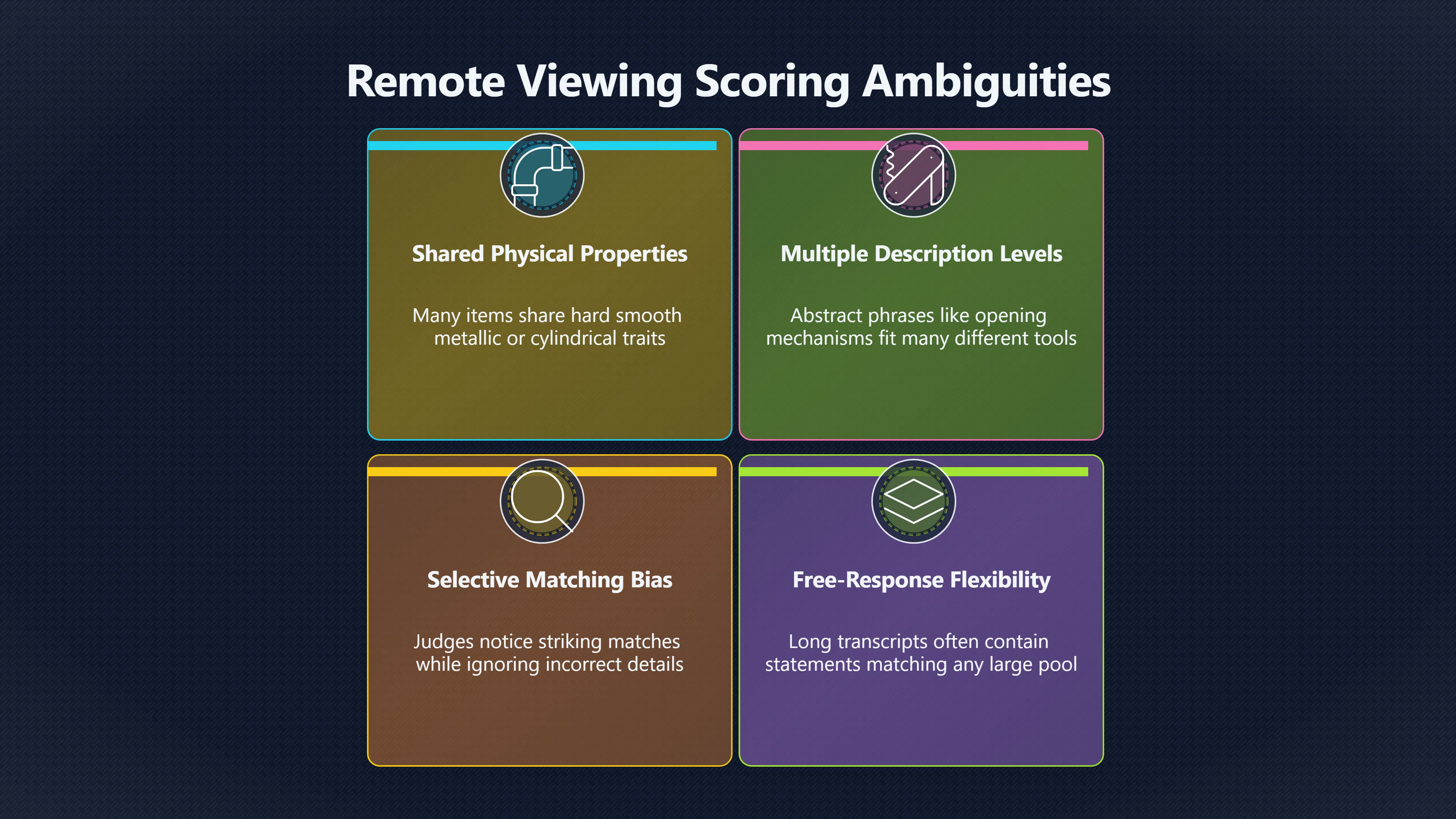
- Shared physical properties. Many everyday objects are simultaneously hard, smooth, metallic or cylindrical.
- Multiple levels of description. A statement such as “something that opens” could refer to scissors, a box, a clasp or a folding knife, depending on how abstractly it is interpreted.
- Selective matching. Judges naturally notice striking correspondences while overlooking incorrect details unless scoring rules require systematic comparison.
- Free-response flexibility. Remote-viewing sessions typically produce pages of sketches and verbal impressions. Within a long transcript, some statements will often resemble almost any sufficiently large target pool.
These issues became central to criticism of remote-viewing methodology. Critics argued that unless judges were rigorously blinded and transcripts stripped of identifying cues, subjective interpretation could inflate apparent success. Reviews of the U.S. government’s Stargate programme similarly concluded that judging procedures represented one of the most vulnerable stages of the experimental process because qualitative reports allowed considerable latitude in deciding what constituted a “match”.[CIA]cia.govAN EVALUATION OF THE REMOTE VIEWING PROGRAMTypically, the remote viewers described the results of their experiences in written reports…

Designing object pools that judges can score
Experience from remote-viewing research gradually shifted attention from individual targets to the properties of the entire target pool.
Researchers attempted to improve discrimination by:
- Choosing objects that differed substantially in material, function and overall form rather than using many visually similar household items.
- Limiting the number of generic objects that shared obvious descriptors such as “metal”, “round” or “plastic”.
- Randomising target selection independently from judging.
- Having judges compare transcripts against multiple candidate targets instead of asking whether a single description merely seemed reasonable.
Some researchers also developed structured feature lists or numerical scoring systems so that individual characteristics could be evaluated consistently instead of relying entirely on overall subjective impressions. Others recommended that independent judges—not the participants themselves—perform the final matching, reducing the influence of expectations after feedback had been revealed. A later experimental study using concealed target pictures reported that independent judges identified targets more accurately than participants’ own post-session assessments, leading the authors to argue that participant self-judging may introduce additional bias.[PubMed]pubmed.ncbi.nlm.nih.govRemote Viewing of Concealed Target Pictures Under Light…by S Krippner · 2019 · Cited by 15 — This study explored the differentia…
Lessons from later target-selection research
Although many later experiments increasingly relied on photographs rather than physical objects, the underlying lesson remained relevant: the distinctiveness of the target matters as much as concealment.
Parapsychology researchers explored whether target characteristics themselves affected judging quality. Some studies proposed that images with greater novelty, emotional impact or unusual visual structure produced clearer discriminations than ordinary, repetitive targets. This line of work reflected an acknowledgement that successful judging depends partly on how easily one target can be distinguished from all plausible alternatives, not merely on whether it is hidden from view.[PubMed]pubmed.ncbi.nlm.nih.govRemote Viewing of Concealed Target Pictures Under Light…by S Krippner · 2019 · Cited by 15 — This study explored the differentia…
Why concealed objects remained methodologically challenging
Hidden objects demonstrated that experimental security alone does not guarantee interpretable results. A perfectly concealed object can still be a poor scientific target if its defining features overlap with many other possible items.
For that reason, discussion of object targets in remote-viewing research increasingly centred on measurement rather than concealment. The key question became whether a judging procedure could reliably separate genuinely distinctive correspondences from broad descriptions that would fit numerous ordinary objects. That scoring ambiguity remains one of the principal methodological reasons why concealed-object experiments have occupied a more limited role than image-based targets in the broader history of remote-viewing research.[CIA]cia.govAN EVALUATION OF THE REMOTE VIEWING PROGRAMTypically, the remote viewers described the results of their experiences in written reports…
eBay marketplace picks
Marketplace Samples
Live-tested eBay searches with available results related to this page.


Endnotes
1.
Source: cia.gov
Link:https://www.cia.gov/readingroom/docs/CIA-RDP96-00791R000200180005-5.pdf
Source snippet
AN EVALUATION OF THE REMOTE VIEWING PROGRAMTypically, the remote viewers described the results of their experiences in written reports...
2.
Source: pubmed.ncbi.nlm.nih.gov
Link:https://pubmed.ncbi.nlm.nih.gov/30291000/
Source snippet
Remote Viewing of Concealed Target Pictures Under Light...by S Krippner · 2019 · Cited by 15 — This study explored the differentia...
Additional References
3.
Source: pure.northampton.ac.uk
Link:https://pure.northampton.ac.uk/en/publications/remote-viewing-of-concealed-target-pictures-under-light-and-dark-
Source snippet
Northampton Research ExplorerRemote viewing of concealed target pictures under light...A statistically significant difference between re...
4.
Source: scispace.com
Link:https://scispace.com/pdf/remote-viewing-of-concealed-target-pictures-under-light-and-229j8c3s0e.pdf
Source snippet
This study explored the differential effect of darkness/light on remote viewing ability alongside the effect of time and their potential...
5.
Source: researchgate.net
Link:https://www.researchgate.net/publication/327166514_Remote_Viewing_of_Concealed_Target_Pictures_Under_Light_and_Dark_Conditions
Source snippet
This exploratory experiment investigated whether the background...Read more...
6.
Source: facebook.com
Link:https://www.facebook.com/100090372200308/posts/during-the-[cold-war
Source snippet
ss of physical barriers, using nothing but mental focus and a...Read more...
7.
Source: academia.edu
Link:https://www.academia.edu/38286031/Remote_Viewing_of_Concealed_Target_Pictures_Under_Light_and_Dark_Conditions
Source snippet
Remote Viewing of Concealed Target Pictures Under Light...Dark conditions marginally favored remote viewing performance, but differences...
8.
Source: scribd.com
Title: Katz Associative Remote Viewing
Link:https://www.scribd.com/document/1005021917/KatzAssociativeRemoteViewing
Source snippet
PDF | Parapsychology17 Nov 1986 — This book explores [Associative Remote Viewing (ARV)]({{ 'associative-remote-viewing-arv/' | relative_url }}) as a method for p...
9.
Source: facebook.com
Link:https://www.facebook.com/AskImtinan/posts/project-stargate-the-cias-search-for-tabut-e-sakinahin-1972-the-cia-secretly-fun/1575907587435890/
Source snippet
, and some of the results were reportedly impressive, though...Read more...
10.
Source: youtube.com
Link:https://www.youtube.com/watch?v=71GIGzss3Zg
Source snippet
CIA Stargate figure says psychic was 'murdered' | Reality Check with Ross Coulthart...
11.
Source: youtube.com
Title: [Third Eye Spies]({{ ‘third-eye-spies/’ | relative_url }}): Learn Remote Viewing from the Masters
Link:https://www.youtube.com/watch?v=6QuB0_BW_Rs
Source snippet
NOVA: The Case of ESP (1984) | Science vs. the Psychic Frontier...
12.
Source: youtube.com
Title: Statistics in Parapsychology with Jessica Utts
Link:https://www.youtube.com/watch?v=WmYGtKB9EEA
Source snippet
Third Eye Spies: Learn Remote Viewing from the Masters...
Topic Tree