Within Anecdotes
The Hit That Hid the Misses
The famous Soviet-site story shows how a striking detail can survive in memory while incorrect or unevaluable material fades.
On this page
- What made the Semipalatinsk story memorable
- What the wider record complicates
- Why case retellings shrink uncertainty
Page outline Jump by section
Introduction
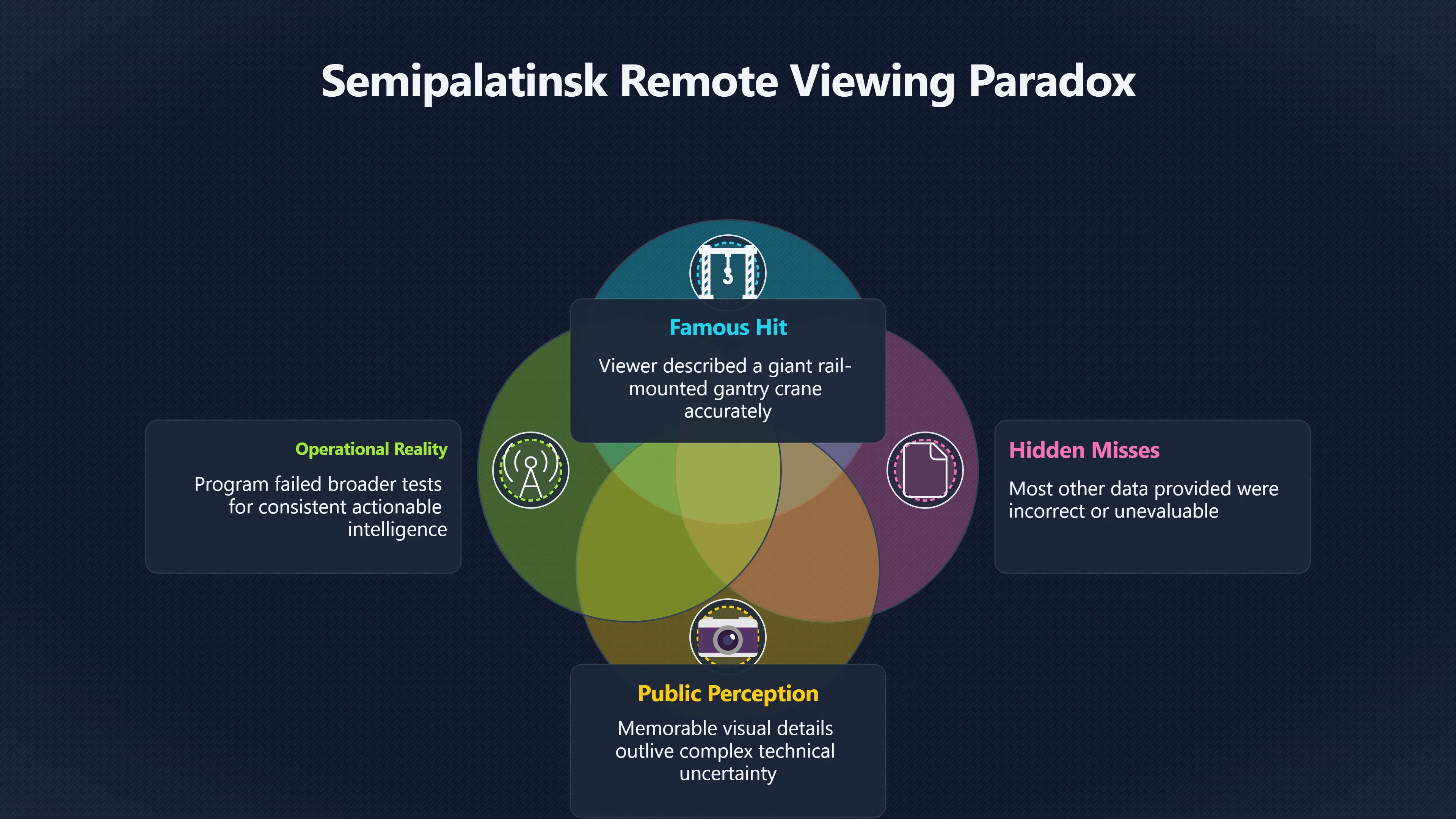
The Semipalatinsk story is one of the best-known anecdotes in the history of remote viewing because it contains a vivid image that is easy to remember: a viewer apparently described an unusual giant gantry crane at a secret Soviet nuclear site that was later confirmed by satellite imagery. Within discussions of the Stargate programme, this episode is frequently presented as evidence that remote viewing produced remarkable intelligence successes. Yet the complete historical record tells a more complicated story. The same official summaries that preserve the famous “hit” also state that most of the remaining information from the session was either wrong or impossible to evaluate. That contrast makes Semipalatinsk an unusually useful example of how memorable anecdotes can outlive the uncertainty surrounding them.
What made the Semipalatinsk story memorable
The case dates to the mid-1970s, when the United States was interested in activity around the Soviet nuclear testing complex at Semipalatinsk (now in Kazakhstan). According to declassified programme histories, remote viewer Pat Price was asked to describe a location identified only by map coordinates.
The feature that became famous was his description of an enormous rail-mounted gantry crane spanning a building. Contemporary programme supporters argued that this unusual structure matched imagery already held by intelligence agencies and that the correspondence was sufficiently striking to attract official attention. The crane became the visual centrepiece of later retellings because it was distinctive rather than generic. A statement such as “there is a large crane” is more memorable than a long list of uncertain impressions about buildings, terrain or personnel.[CIA]cia.govCIA-RDP96-00791R000200240001-0Price supplied the most positive evidence yet for the remote-viewing experiment with his sketch of the r…
This is exactly the kind of detail that survives repeated retelling. Readers can picture the crane, and the story appears to demonstrate specific knowledge of a remote, highly secret location. As the anecdote spread through books, interviews and documentaries about remote viewing, the crane often became synonymous with the entire session rather than merely one element within it.[CIAO]ciaotest.cc.columbia.eduiet Union (July 1974) This was CIA's very first operational viewing assignment…
What the wider record complicates
The official summaries released after the Stargate programme ended present a much less straightforward picture than popular retellings.
The Federation of American Scientists’ archive of declassified programme material summarises the Semipalatinsk episode by acknowledging the apparent description of the gantry crane but immediately adds an important qualification: “In general, however, most of the receiver’s data were incorrect or could not be evaluated.” That sentence rarely appears when the case is cited as evidence for remote viewing’s success.[Intelligence Resource Program]irp.fas.orgIntelligence Resource ProgramSTAR GATE [Controlled Remote Viewing]29 Dec 2005 — In general, however, most of the receiver's data were inc…
Likewise, later reviews commissioned by the CIA did not evaluate operational usefulness by asking whether isolated striking details occasionally appeared. Instead, reviewers examined whether the overall information was sufficiently accurate, consistent and actionable for intelligence work. The programme ultimately failed that broader operational test, despite containing individual stories that participants regarded as impressive.[Wikipedia]WikipediaRemote viewingRemote viewing
This distinction matters because intelligence collection depends on complete reports rather than selected fragments. If one unusual observation proves accurate while numerous accompanying claims are incorrect, analysts must still determine which statements deserve confidence before decisions can be made. A retrospective success story can ignore that problem because the audience already knows which detail eventually appeared significant.
Why case retellings shrink uncertainty
The Semipalatinsk episode illustrates several ways in which anecdotal evidence becomes more persuasive over time than the underlying documentation warrants.
First, memorable details naturally crowd out unsuccessful ones. A giant crane is easier to remember than dozens of vague descriptions that failed to correspond with anything identifiable.
Second, later narratives often benefit from hindsight. Once satellite imagery and historical information are available, readers evaluate the session knowing the answer in advance. That encourages selective matching between the transcript and confirmed features while giving less attention to statements that do not fit.
Third, uncertainty is difficult to retell. Phrases such as “incorrect”, “could not be evaluated” or “insufficient operational value” make for poor stories compared with a concrete image of a hidden Soviet installation. The result is that repeated summaries become progressively cleaner and simpler than the original evidential record.
This pattern is not unique to remote viewing, but Semipalatinsk provides an unusually clear example because the official summary itself preserves both sides of the story: a striking apparent correspondence alongside an explicit acknowledgement that much of the session failed.[Intelligence Resource Program]irp.fas.orgIntelligence Resource ProgramSTAR GATE [Controlled Remote Viewing]29 Dec 2005 — In general, however, most of the receiver's data were inc…
The hit that hid the misses
Viewed as a historical case rather than as proof for or against paranormal claims, Semipalatinsk demonstrates why anecdotes can feel more convincing than data.
The case does not collapse because one memorable observation may genuinely have resembled a real feature. Nor does it establish remote viewing as a reliable intelligence method simply because that resemblance existed. The evidential question is whether the session, considered in its entirety and alongside many other operational attempts, consistently produced information that analysts could trust.
The surviving programme evaluations answered that broader question cautiously. Individual sessions sometimes appeared impressive in retrospect, but the accumulated operational record did not persuade reviewers that remote viewing generated dependable intelligence. Semipalatinsk therefore remains memorable not only because of its famous crane, but because it reveals how a single vivid success can obscure the larger pattern of uncertainty surrounding an entire body of evidence.
Amazon book picks
Further Reading
Books and field guides related to The Hit That Hid the Misses. Use these as the next step if you want deeper reading beyond the article.
The Men Who Stare At Goats
Rating: 3.5/5 from 11 Google Books ratings
Places psychic-spying anecdotes inside a wider culture of unconventional military experimentation.
Phenomena
Discusses remote-viewing episodes within the Cold War intelligence environment that made anecdotes famous.

Remote Viewers: The Secret History of America's Psychic Spies
Covers celebrated cases, programme lore and the way striking hits became central to the legend.
How We Know What Isn't So
Rating: 4.0/5 from 6 Google Books ratings
Shows how people overvalue memorable confirmations and undercount misses.
eBay marketplace picks
Marketplace Samples
Live-tested eBay searches with available results related to this page.


Endnotes
1.
Source: cia.gov
Link:https://www.cia.gov/readingroom/docs/CIA-RDP96-00791R000200240001-0.pdf
Source snippet
CIA-RDP96-00791R000200240001-0Price supplied the most positive evidence yet for the remote-viewing experiment with his sketch of the r...
2.
Source: ciaotest.cc.columbia.edu
Link:https://ciaotest.cc.columbia.edu/olj/sa/sa_jan02srm01.html
Source snippet
iet Union (July 1974) This was CIA's very first operational viewing assignment...
Published: July 1974
3.
Source: Wikipedia
Title: Russell Targ
Link:https://en.wikipedia.org/wiki/Russell_Targ
4.
Source: Wikipedia
Title: Remote viewing
Link:https://en.wikipedia.org/wiki/Remote_viewing
5.
Source: Wikipedia
Title: Stargate Project (U.S. Army unit)
Link:https://en.wikipedia.org/wiki/Stargate_Project_%28U.S._Army_unit%29
Source snippet
Stargate Project (U.S. Army unit)The Stargate Project's work primarily involved remote viewing, the purported ability to psychically "...
6.
Source: cia.gov
Link:https://www.cia.gov/readingroom/document/cia-rdp96-00791r000200240001-0
7.
Source: irp.fas.org
Link:https://irp.fas.org/program/collect/stargate.htm
Source snippet
Intelligence Resource ProgramSTAR GATE [Controlled Remote Viewing]29 Dec 2005 — In general, however, most of the receiver's data were inc...
Additional References
8.
Source: instagram.com
Link:https://www.instagram.com/reel/DYPb3mhgnWC/
Source snippet
How Project Stargate Worked — Full Interview on YouTube...Remote viewers like Pat Price accurately described secret Soviet facilities th...
9.
Source: instagram.com
Link:https://www.instagram.com/p/DV1H4HoDkp9/?hl=en
10.
Source: facebook.com
Link:https://www.facebook.com/historyoasis/posts/from-1972-to-1995-the-united-states-military-invested-over-20-million-in-one-of-/790173214116954/
Source snippet
From 1972 to 1995, the United States military invested over...Remote viewing, the most famous aspect of Stargate, involved individuals a...
11.
Source: academia.edu
Link:https://www.academia.edu/95285973/The_Star_Gate_Operational_Remote_Viewing_Program_A_Human_Intelligence_HUMINT_Collection_Platform
Source snippet
years; efficacy of remote viewing as a HUMINT collection capability; field data...
12.
Source: facebook.com
Link:https://www.facebook.com/100090372200308/posts/during-the-[cold-war
Source snippet
for over two decades and cost millions of dollars in taxpayer...Read more...
13.
Source: youtube.com
Title: Project GRILL FLAME: The CIA’s Remote Viewing of Secret Bases
Link:http://www.youtube.com/watch?v=Z-ijNS0_6eI
Source snippet
Russell Targ remote viewing Semipalatinsk Pat Price Russell Targ: The CIA's Secret Remote Viewing Experiments at Stanford (SRI 1972) Zoha...
14.
Source: facebook.com
Link:https://www.facebook.com/61568295047693/posts/a-person-who-claims-to-be-a-former-remote-viewing-trainee-shares-an-unsettling-s/122193126044609834/
Source snippet
ng story about a mysterious Antarctica target during training…...
15.
Source: instagram.com
Link:https://www.instagram.com/p/DV1H4HoDkp9/
Source snippet
to observe Soviet bases, nuclear sites, and enemy movements...
16.
Source: instagram.com
Title: Project Stargate was a top-secret U.S
Link:https://www.instagram.com/reel/DLm2m-Etr_A/?hl=en
Source snippet
the Cold War, the CIA funded Project Stargate, exploring remote viewing as a potential intelligence tool. The progra...
17.
Source: youtube.com
Link:http://www.youtube.com/watch?v=KDYkNjPy6_4
Source snippet
Was Harold Chipman Behind Pat Price's Famous Semipalatinsk Remote Viewing?...
Topic Tree