Within 1995 Review
How a Positive Finding Still Lost Funding
Utts judged the best experiments persuasive, but that favourable reading did not rescue remote viewing as a funded intelligence tool.
On this page
- What Utts thought the laboratory evidence showed
- Why her conclusion did not settle operational value
- How supporters later quoted the finding
Page outline Jump by section
Introduction
The most enduring legacy of the 1995 evaluation of the U.S. government’s remote-viewing programme is an apparent paradox. Jessica Utts concluded that the strongest laboratory experiments provided persuasive statistical evidence for what she called “psychic functioning”, yet the programme was nevertheless closed and lost government funding. That outcome was not a contradiction so much as a reflection of two different questions being asked at once: whether unusual laboratory effects existed, and whether those effects translated into a dependable intelligence capability. Utts answered the first question positively. The American Institutes for Research (AIR) and the CIA judged that the second had not been demonstrated, making the programme unsuitable for continued operational support.[CIA+2National Security Archive]cia.govAN ASSESSMENT OF THE EVIDENCE FOR PSYCHIC…The purpose of this report is to examine a body of evidence collected over the past few d…

What Utts thought the laboratory evidence showed
Jessica Utts approached the review as a statistician rather than an intelligence officer. Her task was to assess whether the accumulated experimental record, particularly the more tightly controlled studies conducted during the Science Applications International Corporation (SAIC) period, showed effects that were unlikely to have arisen by chance.
Her report concluded that, judged by ordinary scientific standards, the laboratory evidence supported the existence of an anomalous phenomenon. She argued that:
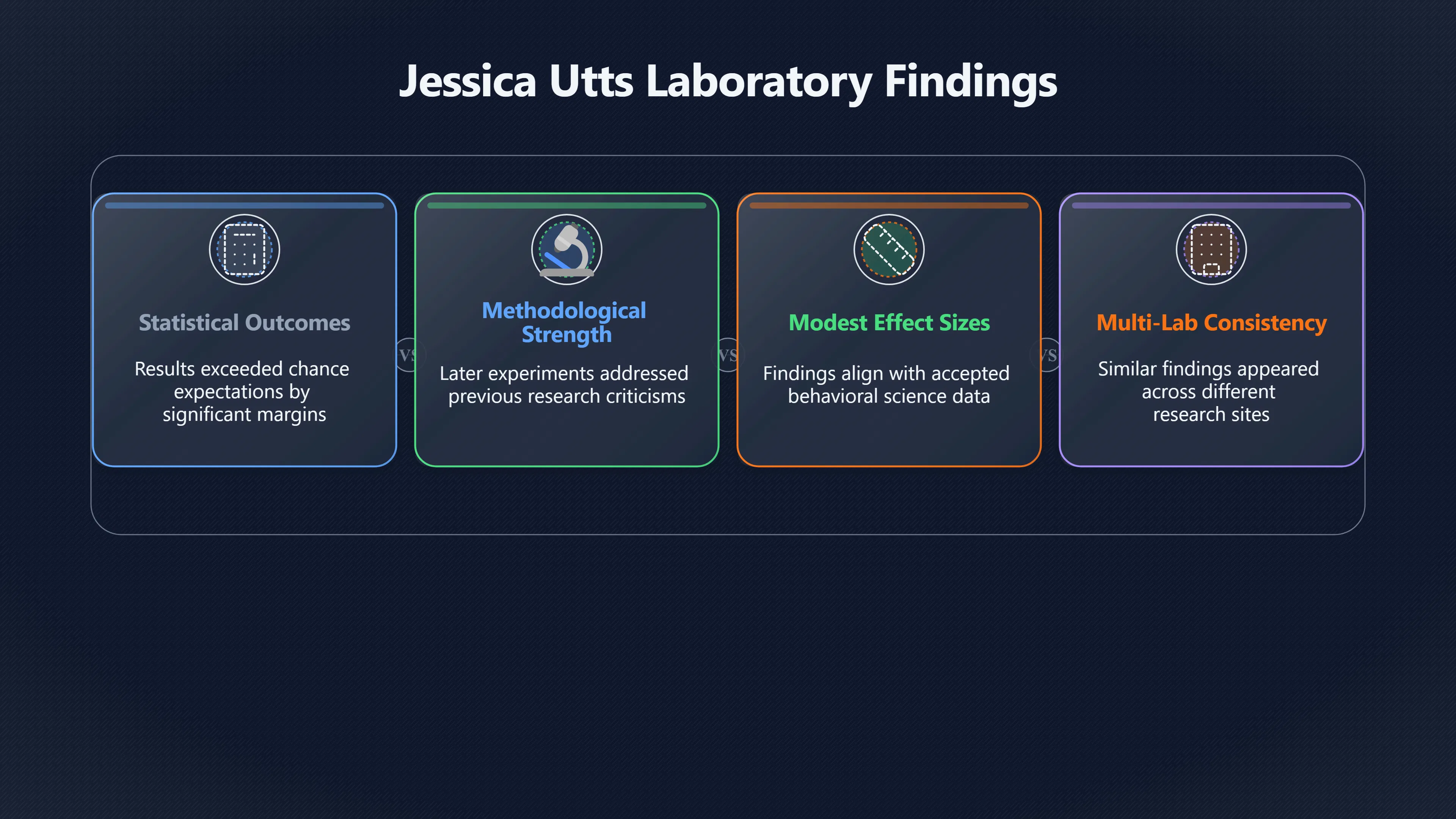
- the statistical outcomes were far beyond chance expectations;
- methodological criticisms that had undermined earlier remote-viewing research had been substantially addressed in the strongest later experiments;
- effect sizes were modest but comparable with those found in many accepted areas of behavioural science; and
- similar findings had appeared in other laboratories, making simple explanations based on fraud or isolated experimental error less persuasive.[CIA]cia.govAN ASSESSMENT OF THE EVIDENCE FOR PSYCHIC…The purpose of this report is to examine a body of evidence collected over the past few d…
Importantly, Utts did not claim that every remote-viewing session was accurate or that operational intelligence work had succeeded. Her argument was narrower: the best-controlled experiments appeared to reveal a repeatable statistical anomaly worthy of scientific acceptance and further investigation. In later publications she continued to defend that position, treating the 1995 review as evidence that research should move beyond asking whether the effect existed towards understanding its mechanisms.[ResearchGate]researchgate.netAn Assessment of the Evidence for Psychic FunctioningResearch on psychic functioning, conducted over a two-decade period, is…
Why her conclusion did not settle operational value
The closure of the programme illustrates that positive laboratory findings alone were not enough to justify an intelligence capability.
The AIR evaluation deliberately separated scientific evidence from operational performance. While Utts assessed the experimental database, the wider review also examined whether remote-viewing reports had actually provided reliable, actionable intelligence for government users. That broader assessment found little documented evidence that the programme consistently produced information valuable enough for intelligence decisions. Even if some laboratory anomaly existed, the conditions under which it appeared were not shown to translate into practical operational success.[National Security Archive]nsarchive2.gwu.eduIn this review, they were to cover four general topics: •.Read moreNational Security ArchiveAn Evaluation of Remote Viewing: Research and…by MD Mumford · 1995 · Cited by 76 — Utts and Hyman were asked…
This distinction became the decisive institutional issue. Intelligence agencies require information that is timely, specific, reproducible and sufficiently reliable to influence real-world decisions. The review concluded that remote-viewing products were generally too inconsistent, too vague or too difficult to validate against operational needs. As a result, the CIA ended the programme despite the continuing disagreement over the laboratory evidence.[National Security Archive]nsarchive2.gwu.eduIn this review, they were to cover four general topics: •.Read moreNational Security ArchiveAn Evaluation of Remote Viewing: Research and…by MD Mumford · 1995 · Cited by 76 — Utts and Hyman were asked…
Ray Hyman’s accompanying review reinforced this separation. Although he agreed that later experiments were methodologically stronger than earlier work, he argued that apparent statistical effects had not yet justified concluding that paranormal functioning had been demonstrated. He emphasised the need for stronger independent replication, greater openness and better theoretical understanding before accepting Utts’s interpretation.[CIA]cia.govAN EVALUATION OF THE REMOTE VIEWING PROGRAMUtts and Hyman were asked to prepare independent reports based on their review. In this rev…
How supporters later quoted the finding
After the programme became public, Utts’s favourable assessment acquired a cultural influence that exceeded its original role within the review.
Supporters of remote viewing frequently highlighted one sentence from her report—that the evidence for psychic functioning met the standards normally applied elsewhere in science—while giving much less attention to the operational findings that led to the programme’s closure. This selective emphasis helped create a lasting public impression that the CIA had effectively “confirmed” psychic abilities before abandoning the project for unrelated reasons. The historical record is more complicated. Utts’s report formed only one part of a broader evaluation whose final institutional judgement was based primarily on usefulness rather than statistical significance.[CIA]cia.govAN ASSESSMENT OF THE EVIDENCE FOR PSYCHIC…The purpose of this report is to examine a body of evidence collected over the past few d…
Utts herself consistently maintained that the scientific and operational questions should not be conflated. Her published assessment explicitly addressed both, arguing that the laboratory evidence supported psychic functioning while recognising that the separate question of government usefulness required independent evaluation. The AIR review therefore preserved her positive scientific interpretation in the written record even as the intelligence programme itself ended.[CIA]cia.govAN ASSESSMENT OF THE EVIDENCE FOR PSYCHIC…The purpose of this report is to examine a body of evidence collected over the past few d…
Why the distinction still matters
The 1995 review remains influential because it demonstrates how scientific and policy judgements can legitimately diverge. Utts’s analysis continues to be cited by researchers and advocates interested in claims of anomalous cognition, while critics point to the programme’s inability to deliver dependable intelligence and to continuing disputes over interpretation and replication. Both readings originate from the same review, but they answer different questions.
As a result, the memory of Stargate often preserves Utts’s positive laboratory conclusion more vividly than the administrative decision that followed. Historically, however, both are necessary to understand why a programme that contained claims of statistically unusual experimental results nevertheless failed to survive as a funded intelligence capability.[National Security Archive+2CIA]nsarchive2.gwu.eduIn this review, they were to cover four general topics: •.Read moreNational Security ArchiveAn Evaluation of Remote Viewing: Research and…by MD Mumford · 1995 · Cited by 76 — Utts and Hyman were asked…

Amazon book picks
Further Reading
Books and field guides related to How a Positive Finding Still Lost Funding. Use these as the next step if you want deeper reading beyond the article.

Parapsychology: A Handbook for the 21st Century
Reviews laboratory evidence and scientific interpretation.
eBay marketplace picks
Marketplace Samples
Live-tested eBay searches with available results related to this page.


Endnotes
1.
Source: cia.gov
Link:https://www.cia.gov/readingroom/docs/CIA-RDP96-00791R000200070001-9.pdf
Source snippet
AN ASSESSMENT OF THE EVIDENCE FOR PSYCHIC...The purpose of this report is to examine a body of evidence collected over the past few d...
2.
Source: cia.gov
Link:https://www.cia.gov/readingroom/docs/CIA-RDP96-00791R000200180005-5.pdf
Source snippet
AN EVALUATION OF THE REMOTE VIEWING PROGRAMUtts and Hyman were asked to prepare independent reports based on their review. In this rev...
3.
Source: researchgate.net
Link:https://www.researchgate.net/publication/333228024_An_Assessment_of_the_Evidence_for_Psychic_Functioning
Source snippet
An Assessment of the Evidence for Psychic FunctioningResearch on psychic functioning, conducted over a two-decade period, is...
4.
Source: nsarchive2.gwu.edu
Title: In this review, they were to cover four general topics: •.Read more
Link:https://nsarchive2.gwu.edu/NSAEBB/NSAEBB438/docs/doc_57.pdf
Source snippet
National Security ArchiveAn Evaluation of Remote Viewing: Research and...by MD Mumford · 1995 · Cited by 76 — Utts and Hyman were asked...
5.
Source: Wikipedia
Title: Remote viewing
Link:https://en.wikipedia.org/wiki/Remote_viewing
Source snippet
Remote viewing↑ Utts, Jessica (1995). An assessment of the evidence for psychic functioning. Archived from the original on 13 May 2008...
Published: May 2008
Additional References
6.
Source: facebook.com
Link:https://www.facebook.com/historyoasis/posts/from-1972-to-1995-the-united-states-military-invested-over-20-million-in-one-of-/790173214116954/
Source snippet
From 1972 to 1995, the United States military invested over...A report by Utts claimed the results were evidence of psychic functioning...
7.
Source: ucdavis.edu
Title: [psychic spying]({{ ‘psychic-spying/’ | relative_url }}) research produces credible evidence
Link:https://www.ucdavis.edu/news/psychic-spying-research-produces-credible-evidence
Source snippet
'Psychic Spying' Research Produces Credible Evidence28 Nov 1995 — Utts found the results were consistent with the small- to medium-sized...
8.
Source: pmc.ncbi.nlm.nih.gov
Title: Follow‐up on the U.S
Link:https://pmc.ncbi.nlm.nih.gov/articles/PMC10275521/
Source snippet
Central Intelligence Agency's (CIA...by Á Escolà‐Gascón · 2023 · Cited by 10 — Reports on the declassified SRI and SAIC experiments were...
9.
Source: facebook.com
Link:https://www.facebook.com/AskImtinan/posts/project-stargate-the-cias-search-for-tabut-e-sakinahin-1972-the-cia-secretly-fun/1575907587435890/
Source snippet
Jessica Utts (parapsychology supporter) and Ray Hyman (noted skeptic).... A 1995 CIA- commissioned review concluded that remote viewing...
10.
Source: youtube.com
Title: EXAMINING THE EVIDENCE FOR PSI PHENOMENA
Link:https://www.youtube.com/watch?v=UbXcCBPHUn0
Source snippet
THE EXPERIMENTER EFFECT - Garret Moddel PHD #12...
11.
Source: youtube.com
Title: Remote Viewing and Statistical Validation
Link:https://www.youtube.com/watch?v=YrwAiU2g5RU
Source snippet
EXAMINING THE EVIDENCE FOR PSI PHENOMENA - Dean Radin PHD #40...
12.
Source: youtube.com
Title: [Statistics]({{ ‘statistics/’ | relative_url }}) in Parapsychology with Jessica Utts
Link:https://www.youtube.com/watch?v=WmYGtKB9EEA
Source snippet
Remote Viewing and Statistical Validation...
13.
Source: youtube.com
Title: THE EXPERIMENTER EFFECT
Link:https://www.youtube.com/watch?v=_uzwF30C0As
Source snippet
Jessica Utts, Ph.D. Visionary Scientist...
14.
Source: youtube.com
Title: Jessica Utts, Ph.D. Visionary Scientist
Link:https://www.youtube.com/watch?v=jaUF9JiB2GU
Topic Tree