Within Protocol
How to Run a Clean First Session
A simple two-person session can test the basic rules without turning a beginner exercise into a dramatic proof claim.
On this page
- Roles, materials and target preparation
- A step by step session from number to reveal
- How to score misses without rescuing the result
Page outline Jump by section
Introduction
A first two-person remote viewing practice session is best treated as a structured recording exercise rather than a test of extraordinary ability. One person prepares and safeguards the hidden target, while the other records impressions before receiving any feedback. The aim is not to produce a dramatic “hit”, but to create a clear record that can later be compared with the target under conditions that minimise ordinary information leaks, unconscious prompting and hindsight reinterpretation. This emphasis on protocol reflects both the traditions of remote viewing research and the main criticisms of that research: if the procedures are loose, it becomes difficult to distinguish genuine correspondences from chance, suggestion or selective matching.[Psi Encyclopedia+2Koestler Unit]psi-encyclopedia.spr.ac.ukPsi Encyclopedia Remote ViewingPsi EncyclopediaRemote Viewing - Psi Encyclopedia13 Jan 2017 — A remote viewing session is basically two people making an agreement, an i…
Roles, materials and target preparation
A simple beginner session only requires two participants:
- Viewer: receives only a neutral target number or identifier and records impressions.
- Target holder: prepares the target, keeps it hidden throughout the session and reveals it only after the viewer has finished.
The target holder’s most important job is restraint. During the session they should avoid commenting on the viewer’s statements, asking leading questions, changing tone of voice in response to guesses or offering reassurance such as “you’re getting warmer”. Even subtle reactions can provide unintended cues. Concerns about experimenter influence and information leakage have repeatedly featured in discussions of remote viewing methodology, making behavioural neutrality as important as physical blinding.[Koestler Unit]koestlerunit.wordpress.comKoestler UnitExperiment One of the SAIC Remote Viewing Programby R Wiseman · Cited by 24 — any individual who records, transcribes or edi…
For a first session, keep the materials simple:
- a notebook or printed session sheets;
- pens or pencils suitable for both notes and sketches;
- a clock or timestamp;
- one concealed photograph or image selected in advance;
- a random target number written separately from the image.
Choose photographs with distinctive visual features such as a lighthouse, suspension bridge, waterfall or amusement park. Avoid abstract artwork or pictures that require specialist knowledge to interpret. The objective is to make later comparison straightforward rather than subjective.
How to run the session from number to reveal
A disciplined routine is more valuable than a long one. Twenty to thirty minutes is usually enough for a first practice session.
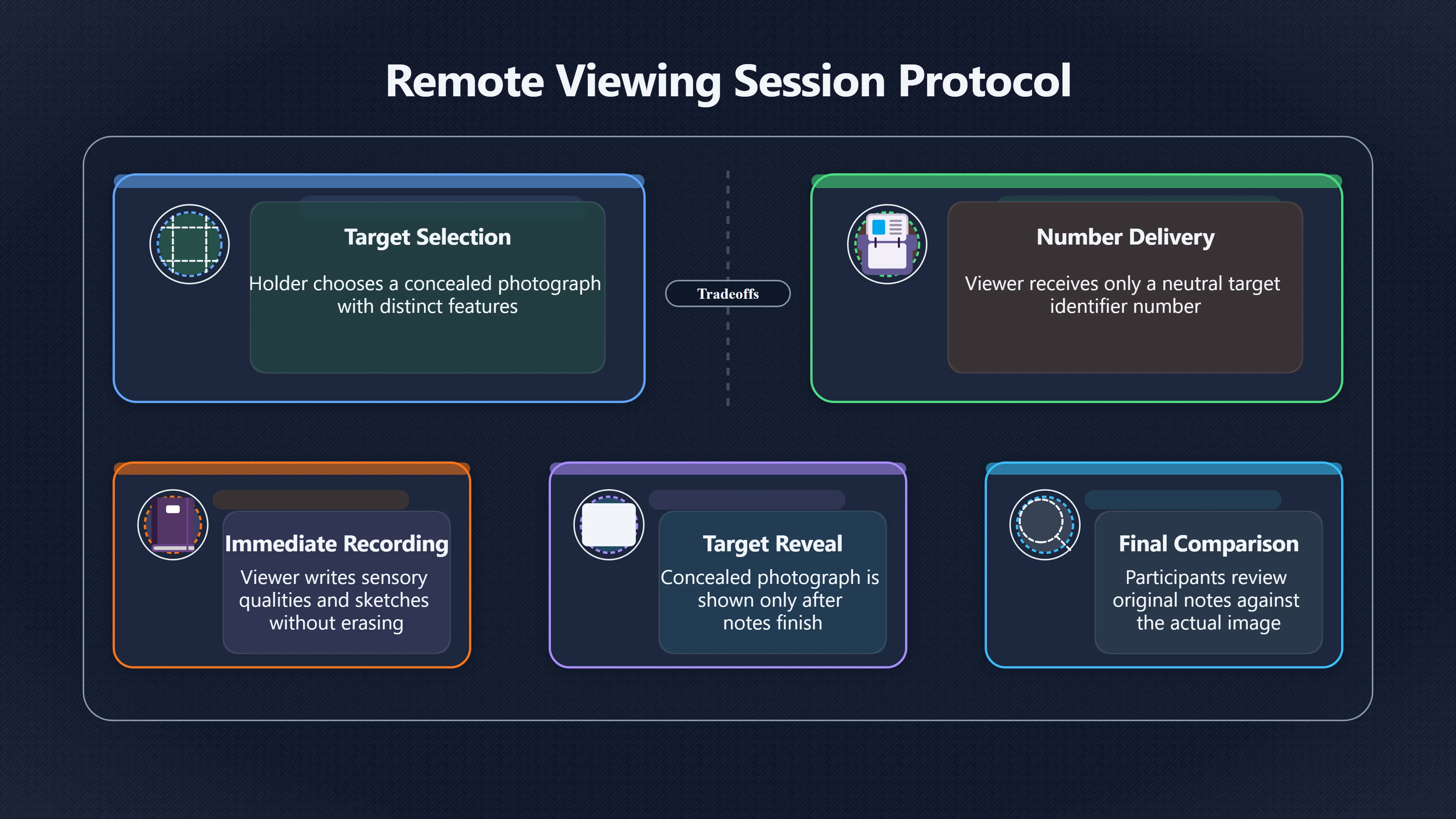
- Prepare the target. The target holder randomly selects one image from a prepared collection and records its target number.
- Provide only the number. The viewer receives the number alone, without category, hints or discussion of possible targets.
- Record immediately. The viewer writes down first impressions as they occur, including sensory qualities, simple descriptive words and sketches. Corrections should not erase earlier entries; crossed-out thoughts remain part of the original record.
- Avoid conversation. The target holder limits interaction to neutral prompts such as “Continue” or “Anything else?” if prompts are used at all.
- Finish before feedback. The viewer signs or timestamps the completed notes.
- Reveal the target. Only after the record is complete is the concealed photograph shown.
- Compare carefully. Viewer and target holder review the original notes against the actual image before discussing interpretations.
This sequence mirrors the general logic of formal remote viewing protocols, where the response is fixed before feedback becomes available. Although beginner exercises are much simpler than laboratory studies, preserving this order prevents memories from becoming mixed with later knowledge of the target.[Psi Encyclopedia+2CIA]psi-encyclopedia.spr.ac.ukPsi Encyclopedia Remote ViewingPsi EncyclopediaRemote Viewing - Psi Encyclopedia13 Jan 2017 — A remote viewing session is basically two people making an agreement, an i…
How to score misses without rescuing the result
The reveal is where beginners are most likely to overestimate success. Once the target is known, it becomes tempting to reinterpret vague phrases until they appear to fit almost anything.
Instead, compare the notes exactly as written.
Useful questions include:
- Which details clearly match the target?
- Which details clearly do not match?
- Which statements are too general to distinguish this target from many others?
- Were important target features entirely absent?
For example, if the target is a suspension bridge and the notes mention “metal framework”, that may be a reasonable correspondence. If the same notes also describe “snow-covered mountains”, “animals” and “bright red building”, those should remain recorded as misses rather than quietly ignored.
A balanced assessment preserves both successes and failures. Research discussions have repeatedly stressed that generous judging can inflate apparent accuracy, while stricter comparison gives a fairer picture of performance. Some experimental designs therefore compare the viewer’s record not only with the actual target but also with several decoy images to test whether the intended target genuinely stands out.[Koestler Unit]koestlerunit.wordpress.comKoestler UnitExperiment One of the SAIC Remote Viewing Programby R Wiseman · Cited by 24 — any individual who records, transcribes or edi…
Common mistakes during a first session
Most beginner problems arise from protocol rather than perception.
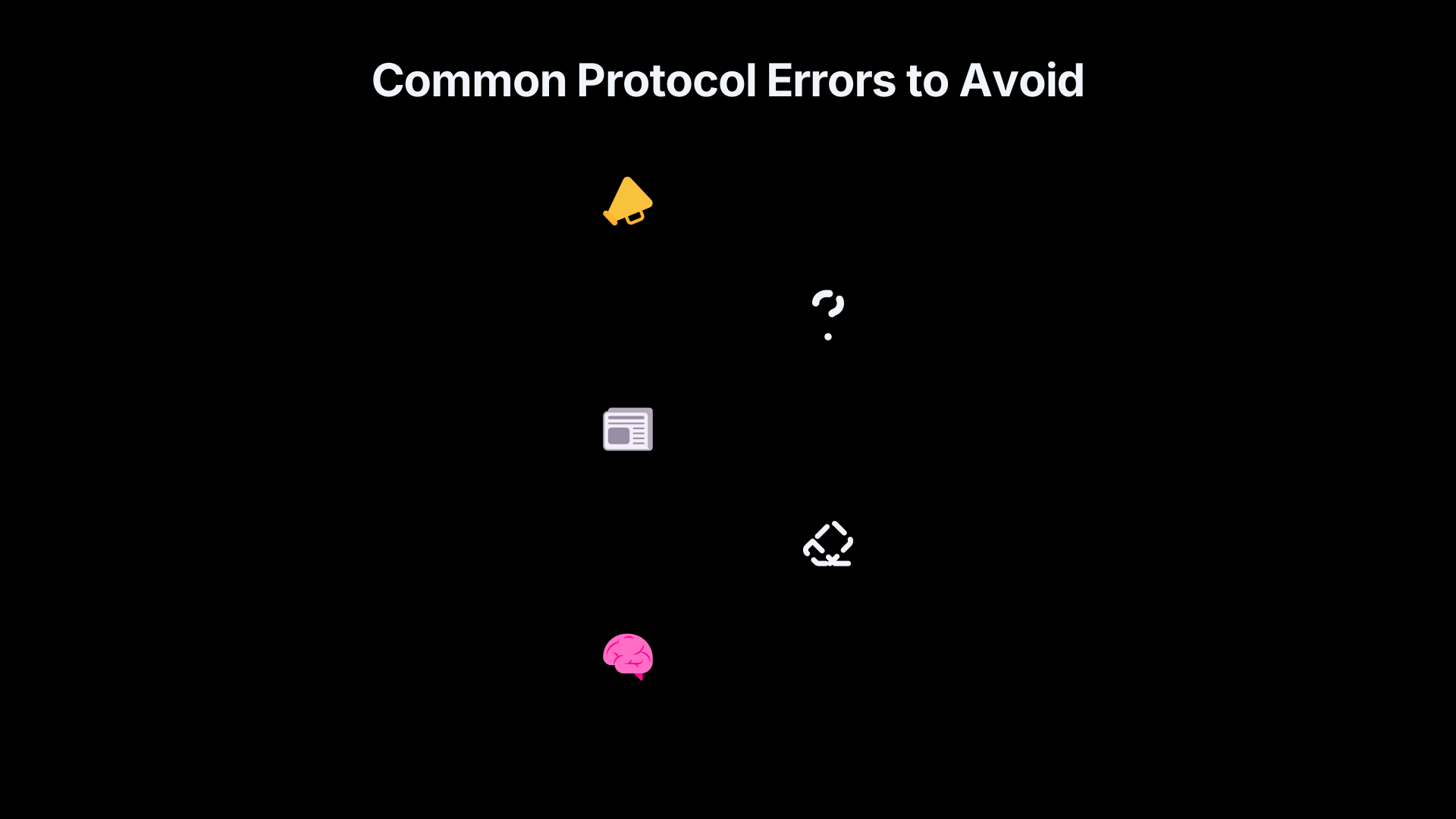
- Accidental front-loading: saying “it’s a landscape” or “it’s somewhere outdoors” gives the viewer information before the session begins.
- Leading questions: asking “Does it feel like water?” introduces suggestions that become difficult to separate from the viewer’s own impressions.
- Early feedback: facial expressions, laughter or surprise can unintentionally reward particular descriptions.
- Rewriting notes: producing a polished version after the reveal destroys the value of the original record.
- Scoring by memory: judging from recollection instead of comparing against the written session encourages hindsight bias.
Keeping the original pages unchanged is often more informative than producing an impressive-looking transcript.

What a successful first session really looks like
A successful first session is not necessarily one with dramatic correspondences. It is one in which both participants can honestly say that the viewer had no ordinary access to the target, the observations were recorded before feedback and the comparison was conducted without stretching vague statements into apparent hits.
That distinction is important because remote viewing remains scientifically controversial. While some researchers and practitioners argue that carefully controlled protocols have produced meaningful results, critics maintain that apparent successes can often be explained by information leakage, flexible judging and confirmation bias. A beginner exercise cannot resolve that wider debate, but it can demonstrate whether the participants have followed a clean protocol that allows later sessions to be evaluated consistently rather than remembered selectively.[Psi Encyclopedia+2Koestler Unit]psi-encyclopedia.spr.ac.ukPsi Encyclopedia Remote ViewingPsi EncyclopediaRemote Viewing - Psi Encyclopedia13 Jan 2017 — A remote viewing session is basically two people making an agreement, an i…



eBay marketplace picks
Marketplace Samples
Live-tested eBay searches with available results related to this page.




Endnotes
1.
Source: psi-encyclopedia.spr.ac.uk
Title: Psi Encyclopedia Remote Viewing
Link:https://psi-encyclopedia.spr.ac.uk/articles/remote-viewing/
Source snippet
Psi EncyclopediaRemote Viewing - Psi Encyclopedia13 Jan 2017 — A remote viewing session is basically two people making an agreement, an i...
2.
Source: koestlerunit.wordpress.com
Link:https://koestlerunit.wordpress.com/wp-content/uploads/2015/06/wiseman-milton-1998.pdf
Source snippet
Koestler UnitExperiment One of the SAIC Remote Viewing Programby R Wiseman · Cited by 24 — any individual who records, transcribes or edi...
3.
Source: Wikipedia
Title: Remote viewing
Link:https://en.wikipedia.org/wiki/Remote_viewing
4.
Source: cia.gov
Link:https://www.cia.gov/readingroom/docs/CIA-RDP96-00788R002000240029-4.pdf
Source snippet
less room of the Radio Physics Laboratory in the SRI complex...Read more...
5.
Source: scribd.com
Link:https://www.scribd.com/document/784925098/Psi-encyclopedia-on-remote-viewing
Source snippet
ave a very focused conversation for a specific purpose...
Additional References
6.
Source: medium.com
Link:https://medium.com/remote-viewing-community-magazine/remote-viewing-definition-protocol-and-corollaries-dca159934230
Source snippet
Remote Viewing: definition, protocol, and corollariesRemote viewing is a method created as a way to categorize and standardize innate psy...
7.
Source: youtube.com
Link:https://www.youtube.com/watch?v=Smo1aP0v4xg
Source snippet
Principles of Remote Viewing with Paul H. SmithHere he describes the experimental protocols that distinguish remote viewing from other ty...
8.
Source: koestler-parapsychology.psy.ed.ac.uk
Link:https://www.koestler-parapsychology.psy.ed.ac.uk/Documents/KPU_1055_Results.pdf
Source snippet
f both the location and physical characteristics of targets as well as variables related to...Read more...
9.
Source: researchgate.net
Title: 403180890 Experts’ Remote Viewing Guidelines
Link:https://www.researchgate.net/publication/403180890_Experts%27_Remote_Viewing_Guidelines
Source snippet
(PDF) Experts' Remote Viewing Guidelines31 Mar 2026 — Judges and analysts should be blind to targets until the remote viewers have comple...
10.
Source: youtube.com
Title: The CIA Protocol: How to Train Your Brain for Remote Viewing
Link:https://www.youtube.com/watch?v=RJrTddUkplY
Source snippet
Advanced Training in Remote Viewing with Lori Williams...
11.
Source: youtube.com
Title: Monitoring Remote Viewing Sessions with Lori Williams
Link:https://www.youtube.com/watch?v=eWSH7yYB61k
Source snippet
The CIA Protocol: How to Train Your Brain for Remote Viewing...
12.
Source: richardwiseman.com
Link:https://www.richardwiseman.com/resources/SAICreply.pdf
Source snippet
Experiment One of the SAIC Remote Viewing Programby R Wiseman · Cited by 11 — In our original paper (Wiseman & Milton, 1999), we describe...
13.
Source: youtube.com
Title: Advanced Training in Remote Viewing with Lori Williams
Link:https://www.youtube.com/watch?v=OQ01vlyHI_A
Source snippet
Beginners Remote Viewing Template + Guide...
14.
Source: youtube.com
Title: Beginners Remote Viewing Template + Guide
Link:https://www.youtube.com/watch?v=GnK6289Eau0
Source snippet
Remote Viewing Explained: How the Mind Sees Without Eyes...
15.
Source: youtube.com
Title: Remote Viewing Explained: How the Mind Sees Without Eyes
Link:https://www.youtube.com/watch?v=whpZzUwrUNU
Topic Tree