Within Remote Viewing
What the CIA Files Do Not Prove
Declassified files prove government interest, not that the CIA confirmed psychic spying worked.
On this page
- Archive Versus Validation
- Why Files Spread Online
- Reading Declassified Claims Carefully
Page outline Jump by section
Introduction
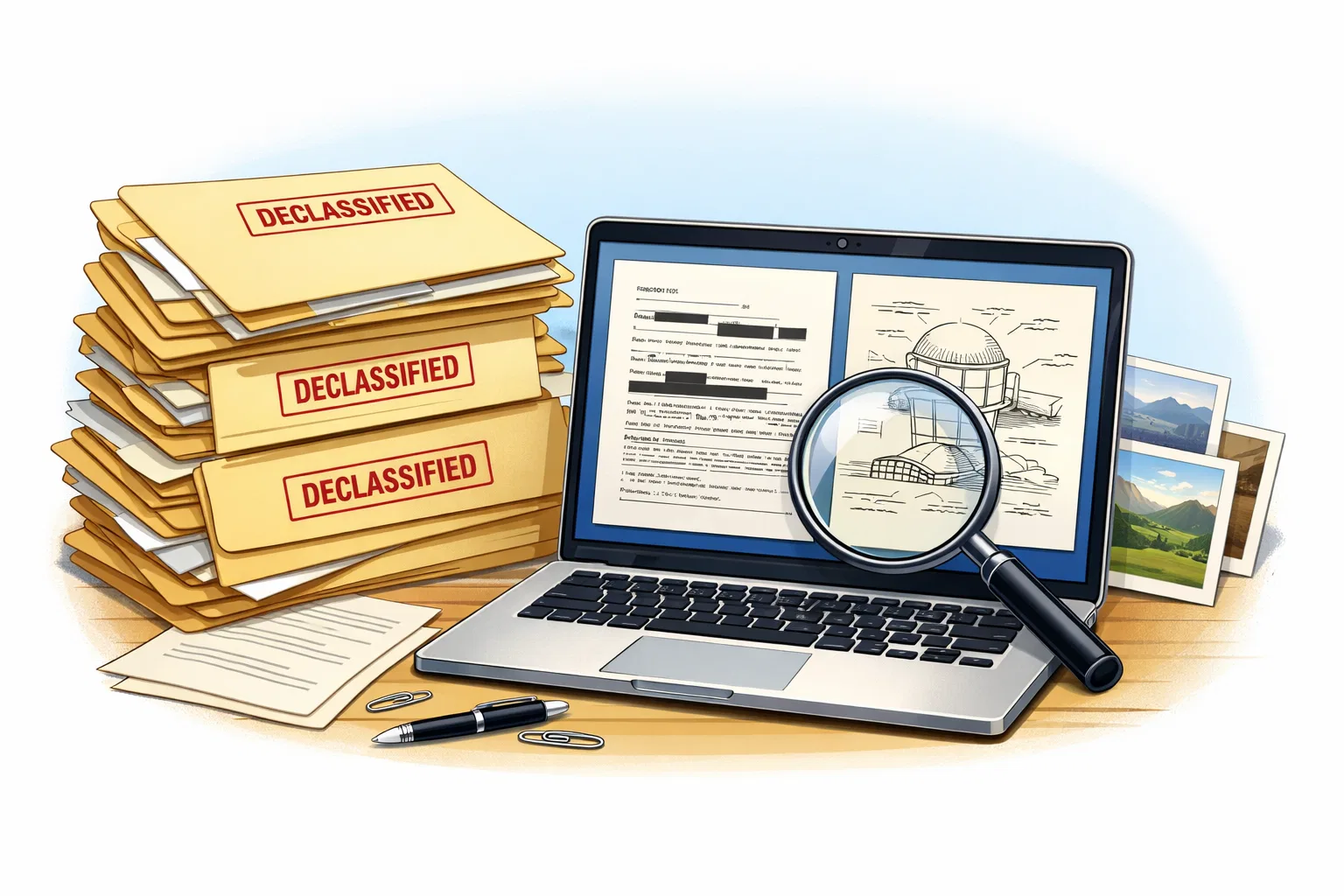
The CIA archive proves something important about remote-viewing history, but it does not prove the popular claim that the CIA “confirmed” psychic spying worked. The files show that U.S. intelligence and defence agencies funded, tested, documented and later declassified programmes involving remote viewing, especially under names associated with STAR GATE. They also show why this material is easy to misread: a declassified session note can look like an official finding when it may only be a raw claim, a training exercise, a contractor report, or a speculative assessment.
The strongest reading is narrower and more useful. The archive is real evidence of government interest, bureaucratic experimentation and Cold War uncertainty. It is not, by itself, evidence that a described target was real, that a viewer was accurate, or that the CIA endorsed every claim preserved in its files. The difference matters because remote-viewing documents now circulate online as screenshots, viral headlines and isolated PDFs, often stripped of the review conclusions that judged the programme unreliable for intelligence use. The CIA’s own public release says CREST includes STAR GATE remote-viewing files among a much larger historical archive; the later programme evaluation concluded that remote viewing had not produced actionable intelligence and had not been shown to have value in intelligence operations.[CIA+2CIA]cia.govPosts More Than 12 Million Pages of CREST Records OnlineCIA Posts More Than 12 Million Pages of CREST Records Online - CIA…
Archive Versus Validation
A declassified CIA record is not the same thing as a verified CIA conclusion. Archives preserve what agencies collected, commissioned, received, debated, filed, reviewed or inherited. That can include finished intelligence, draft memoranda, contractor material, foreign press items, research notes, operational paperwork and records of failed or speculative projects. In January 2017, the CIA moved roughly 930,000 CREST documents, totalling more than 12 million pages, into its online Electronic Reading Room; the agency described the collection as a broad historical release covering many topics, including STAR GATE remote-viewing programme files.[CIA]cia.govPosts More Than 12 Million Pages of CREST Records OnlineCIA Posts More Than 12 Million Pages of CREST Records Online - CIA…
That distinction is the core of many CIA remote-viewing myths. A document in the Reading Room means the document exists and has been released. It does not mean the CIA currently believes the claim inside it, that the claim survived later review, or that the document represents a final institutional judgement. This is especially important with remote-viewing files because many of the surviving records are raw session outputs: impressions, sketches, verbal descriptions and target notes produced before any firm ground truth was established. A raw remote-viewing transcript can sound dramatic precisely because it records a claimed perception without yet proving whether the perception was accurate.
The CIA’s own STAR GATE declassification material points to this variety. One declassification record describes reports containing raw remote-viewing input from training exercises and raw input in response to operational tasks, rather than a tidy set of validated intelligence products.[CIA]cia.govSTAR GATE RECORDS DECLASSIFICATIONThese reports contain either: raw RV inputs as a part of RV training exercises [Type 1] or raw RV in… A popular reader may see an official letterhead, a date, a project name and a viewer number and assume the contents are “CIA findings”. In many cases, the safer reading is: this is a record of what someone said during a government-associated remote-viewing process.
The later evaluation is therefore crucial. The American Institutes for Research review, commissioned when the programme was transferred to CIA oversight in the mid-1990s, did not simply ask whether strange documents existed. It examined whether the programme had demonstrated a useful intelligence capability. Its conclusion was blunt: remote viewing had failed to produce actionable intelligence, and the reviewed material did not show that the phenomenon would be useful in intelligence gathering.[CIA]cia.govAN EVALUATION OF THE REMOTE VIEWING PROGRAMIn no case had the information provided ever been used to guide intelligence operations. Th…
Why the Files Spread Online
CIA remote-viewing records travel well online because they combine three viral ingredients: official provenance, strange subject matter and missing context. A scanned government page that mentions Mars, ancient relics, psychic perception or hidden locations is far more shareable than a long review explaining research design, feedback problems and operational utility. The result is a recurring pattern: the archive is treated as a vault of suppressed confirmations, when it is better understood as a mixed historical dataset.
The 2017 online release amplified this effect. Before then, CREST was technically public but awkward to access, requiring in-person use at the U.S. National Archives in College Park, Maryland. Once the material became searchable from home, journalists, researchers, enthusiasts and social-media accounts could pull out striking individual documents without reading the programme as a whole. Contemporary coverage of the CREST release emphasised both its genuine research value and its oddities, including UFO material and psychic-experiment files; Wired also noted that the database was a huge collection of scanned records, not a neatly interpreted evidence base.[WIRED]wired.comOpen source on wired.com.
The most common misreading is the leap from “the CIA studied this” to “the CIA proved this”. Government agencies study unlikely possibilities for many reasons: adversary fears, scientific uncertainty, political pressure, contractor advocacy, bureaucratic momentum, or a desire not to miss a potential advantage. During the Cold War, the remote-viewing programme sat inside exactly that atmosphere. Interest was real; validation was disputed; operational usefulness was judged weak.
A second misreading is the “single spectacular file” problem. A viewer’s dramatic description can be quoted as if it settled the matter, while the absence of verified ground truth is ignored. The famous “Mars exploration” document, for example, records a remote-viewing session in which the target information included “The planet Mars” and a time of interest around one million years B.C.[CIA]cia.govOpen source on cia.gov. As an archival item, it is fascinating. As evidence that anyone accessed real Martian history, it is not enough. There is no ordinary way to check such a target against reliable ground truth, which makes it a poor basis for evidential claims.
A third misreading comes from the authority of classification itself. People often assume that if something was classified, it must be true. In reality, classification usually concerns sensitivity, source protection, bureaucratic caution or national-security context, not factual accuracy. Declassification removes a secrecy barrier; it does not certify that every sentence inside the released document is correct.
What Viral Examples Usually Leave Out
Recent “CIA psychic archive” stories often repeat the same evidential shortcut: they take a remote-viewing transcript and describe it as though the agency confirmed the target. The Ark of the Covenant story is a good example. In 2025, several outlets covered a resurfaced 1988 remote-viewing file in which a viewer described a hidden container with religious and protective imagery. Some headlines and social posts framed this as if the CIA had located or confirmed the Ark. The stronger caution, even from within the remote-viewing world, was that a claim about an unverified relic cannot be treated as proof unless the object itself is found and independently examined.[New York Post]nypost.comOpen source on nypost.com.
This case shows why “CIA file” is too broad a label. The key question is not just whether a document is authentic. The useful questions are: What kind of document is it? Was it a training session or an operational task? Was the target known, blind, double-blind or later revealed? Was there independent feedback? Was any information specific enough to test? Did an intelligence user act on it? Was the result later evaluated? Without those answers, the document may show that a remote-viewing session happened, but not that the session produced knowledge.
The Uri Geller files are another example of how nuance gets lost. CIA Reading Room documents preserve material from early Stanford Research Institute work in which researchers reported attempts to prevent sensory leakage and described some apparently successful results.[CIA]cia.govOpen source on cia.gov. Popular retellings often stop there. But the broader remote-viewing controversy did not end with an early positive-looking test. Critics later focused on whether protocols were tight enough, whether judging was subjective, whether cues could leak, and whether results could be independently replicated under stricter conditions. The archive contains material that helps reconstruct the controversy; it does not remove the controversy.
Even the programme’s final review is sometimes misquoted in both directions. It did not say that nobody ever reported above-chance results in laboratory settings. It did say the work had not convincingly demonstrated a paranormal mechanism and had not shown value for intelligence gathering. That is a more precise conclusion than either “the CIA proved psychic powers” or “there was nothing in the files at all”.[scribd.com]scribd.comOpen source on scribd.com.
Reading Declassified Claims Carefully
The safest way to read CIA remote-viewing files is to separate document status from claim status. The document may be authentic, declassified and historically important while the claim inside it remains unverified, weakly supported or contradicted by later evaluation. That is not debunking by reflex; it is basic source discipline.
A useful reading test starts with the document type. A raw session transcript is not an evaluation. A contractor progress report is not the same as an intelligence success. A foreign-assessment note about Soviet interest is not proof that Soviet psychic methods worked. A training record is especially risky to quote as evidence, because training targets may be chosen for practice value rather than operational verification.
The next test is ground truth. Remote viewing depends on comparison: a viewer’s impressions are only meaningful if they can be checked against a target that is independently known. Descriptions of inaccessible ancient objects, hidden sacred relics, alien ruins or events in the deep past are poor evidential anchors because there is no reliable feedback loop. By contrast, a conventional intelligence claim can usually be tested against photographs, signals, human reporting, physical recovery or later confirmed events.
The third test is specificity. Remote-viewing outputs often contain a mixture of sensory fragments, metaphors and broad impressions: shapes, colours, emotional tones, “structures”, “water”, “metal”, “people”, “energy”, “underground” and so on. Such material can feel impressive after the target is known, but it is vulnerable to subjective matching. The AIR review’s operational concern was not simply whether any description could be made to fit. It was whether the information was concrete, reliable and timely enough to guide intelligence action. The review concluded that it was not.[CIA]cia.govAN EVALUATION OF THE REMOTE VIEWING PROGRAMIn no case had the information provided ever been used to guide intelligence operations. Th…
Finally, readers should ask whether later institutional review supports the viral claim. In the remote-viewing case, the strongest institutional endpoint is not a sensational transcript but the 1995 evaluation and the programme’s cancellation. The review found no documented intelligence value; the online archive later made the underlying historical material easier to inspect. Those two facts belong together.[CIA]cia.govAN EVALUATION OF THE REMOTE VIEWING PROGRAMThere is no evidence that the phenomenon would prove useful in intelligence gathering…
What the CIA Files Actually Prove
The CIA remote-viewing archive proves that remote viewing was not merely an internet myth invented after the fact. U.S. agencies really did fund, organise, test and document programmes involving claimed psychic perception. The files also show that the subject was treated seriously enough, for a time, to receive contracts, programme names, session procedures and later formal review. That is historically significant.
But the archive does not prove the stronger claim that psychic spying worked. The files are evidence of investigation, not automatic validation. The difference is similar to reading a medical research archive: the presence of a trial record proves a treatment was studied, not that the treatment was effective. The outcome depends on controls, replication, effect size, bias, independent review and practical usefulness.
This is why the CIA archive is best read as dataset evidence for a controversy, not as a trophy cabinet of confirmed paranormal successes. It contains primary documents that can illuminate how remote-viewing programmes operated, what participants believed, what kinds of targets were attempted, how officials framed the work, and how the government eventually assessed it. It also contains the raw material from which exaggerated claims can be built when documents are isolated from their context.
The most defensible public summary is therefore modest but strong: the CIA files confirm government interest in remote viewing and preserve a remarkable record of that interest. They do not show that the CIA confirmed psychic spying as a reliable intelligence method, and the major programme evaluation points the other way. For readers, the archive is valuable precisely because it lets both claims be checked: the strange history is real, and the popular overreading of that history is real too.
Amazon book picks
Further Reading
Books and field guides related to What the CIA Files Do Not Prove. Use these as the next step if you want deeper reading beyond the article.
The Men Who Stare At Goats
Rating: 3.5/5 from 11 Google Books ratings
Introduces the culture surrounding military paranormal projects.
Remote viewing secrets
First published 2000. Subjects: Remote viewing (Parapsychology), Parapsychology, Prophecies (occultism), Astral projection.
Limitless Mind
First published 2004. Subjects: Remote viewing (Parapsychology), Extrasensory perception, Spiritual life, Peace of mind.
eBay marketplace picks
Marketplace Samples
Live-tested eBay searches with available results related to this page.


Endnotes
1.
Source: cia.gov
Title: Posts More Than 12 Million Pages of CREST Records Online
Link:https://www.cia.gov/stories/story/cia-posts-more-than-12-million-pages-of-crest-records-online/
Source snippet
CIA Posts More Than 12 Million Pages of CREST Records Online - CIA...
2.
Source: cia.gov
Link:https://www.cia.gov/readingroom/docs/CIA-RDP96-00791R000200180005-5.pdf
Source snippet
AN EVALUATION OF THE REMOTE VIEWING PROGRAMIn no case had the information provided ever been used to guide intelligence operations. Th...
3.
Source: cia.gov
Link:https://www.cia.gov/readingroom/document/cia-rdp96-00791r000200180005-5
Source snippet
AN EVALUATION OF THE REMOTE VIEWING PROGRAMThere is no evidence that the phenomenon would prove useful in intelligence gathering...
4.
Source: cia.gov
Link:https://www.cia.gov/readingroom/document/cia-rdp96-00791r000200030015-8
Source snippet
STAR GATE RECORDS DECLASSIFICATIONThese reports contain either: raw RV inputs as a part of RV training exercises [Type 1] or raw RV in...
5.
Source: wired.com
Link:https://www.wired.com/2017/01/ufos-psychics-spies-cia-just-put-12m-pages-files-online-start
6.
Source: wired.com
Link:https://www.wired.com/story/the-cia-just-dumped-13-million-declassified-pages-online
7.
Source: cia.gov
Link:https://www.cia.gov/readingroom/docs/cia-rdp96-00788r001900760001-9.pdf
8.
Source: cia.gov
Link:https://www.cia.gov/readingroom/document/cia-rdp96-00788r001900760001-9
9.
Source: cia.gov
Link:https://www.cia.gov/readingroom/docs/CIA-RDP96-00787R000700110003-2.pdf
10.
Source: cia.gov
Link:https://www.cia.gov/readingroom/document/cia-rdp79-00999a000200010008-7
11.
Source: scribd.com
Link:https://www.scribd.com/doc/92017954/Air-Report
12.
Source: cia.gov
Link:https://www.cia.gov/readingroom/collection/crest-25-year-program-archive
13.
Source: cia.gov
Link:https://www.cia.gov/readingroom/docs/CIA-RDP96-00791R000200180006-4.pdf
14.
Source: cia.gov
Link:https://www.cia.gov/readingroom/docs/CIA-RDP96-00789R002800180001-2.pdf
15.
Source: cia.gov
Link:https://www.cia.gov/readingroom/collection/[stargate
17.
Source: cia.gov
Link:https://www.cia.gov/readingroom/docs/CIA-RDP79-00999A000200010008-7.pdf
18.
Source: cia.gov
Link:https://www.cia.gov/readingroom/home
19.
Source: cia.gov
Link:https://www.cia.gov/readingroom/docs/CIA-RDP80-00630A000100050001-4.pdf
20.
Source: cia.gov
Link:https://www.cia.gov/readingroom/document/cia-rdp96-00789r001001420001-3
21.
Source: cia.gov
Link:https://www.cia.gov/readingroom/document/cia-rdp81r00560r000100010001-0
22.
Source: cia.gov
Link:https://www.cia.gov/readingroom/document/cia-rdp80-00630a000100050001-4
23.
Source: cia.gov
Link:https://www.cia.gov/readingroom/docs/CIA-RDP79-00999A000200010091-5.pdf
24.
Source: cia.gov
Link:https://www.cia.gov/readingroom/document/cia-rdp81r00560r000100010002-9
25.
Source: cia.gov
Link:https://www.cia.gov/readingroom/document/cia-rdp81-01043r002200220009-0
26.
Source: archive.org
Title: cia readingroom document cia rdp79 00999a000200010002 3
Link:https://archive.org/details/cia-readingroom-document-cia-rdp79-00999a000200010002-3
27.
Source: nypost.com
Link:https://nypost.com/2025/03/26/world-news/cia-confirmed-ark-of-the-covenants-existence-using-remote-viewing-resurfaced-declassified-docs-claim/
28.
Source: Wikipedia
Title: Remote viewing
Link:https://en.wikipedia.org/wiki/Remote_viewing
29.
Source: ics.uci.edu
Link:https://www.ics.uci.edu/~jutts/may.pdf
30. Source: citeseerx.ist.psu.edu
Additional References
31.
Source: youtube.com
Title: The CIA [Protocol]({{ ‘protocol/’ | relative_url }}): How to Train Your Brain for Remote Viewing
Link:https://www.youtube.com/watch?v=RJrTddUkplY
Source snippet
Inside Operation Stargate provides an overview of the declassified CIA records and the real context surrounding the government's military...
32.
Source: youtube.com
Title: Clairvoyance and Synesthesia: Superpower or Speculative Science?
Link:https://www.youtube.com/watch?v=yCYb_VmK3UA
Source snippet
Remote Viewing of UFOs and Other Mysteries with Paul Smith...
33.
Source: youtube.com
Title: Remote Viewing of UFOs and Other Mysteries with Paul Smith
Link:https://www.youtube.com/watch?v=vN2kjmUQQ4A
Source snippet
The CIA Protocol: How to Train Your Brain for Remote Viewing...
34.
Source: youtube.com
Title: Inside Operation Stargate: The CIA’s Psychic Spy Experiment
Link:https://www.youtube.com/watch?v=oasTnsLw_n8
Source snippet
Inside The Military's Secret Psychic Unit...
35.
Source: youtube.com
Title: Inside The Military’s Secret Psychic Unit
Link:https://www.youtube.com/watch?v=9nY3hu76SyU
Source snippet
Clairvoyance and Synesthesia: Superpower or Speculative Science?...
36.
Source: researchgate.net
Link:https://www.researchgate.net/publication/403178755_The_Star_Gate_Archives_Reports_of_the_United_States_Government_Sponsored_Psi_Program_1972-1995_Volume_4_Operational_Remote_Viewing_Memorandums_and_Reports
37.
Source: irva.org
Link:https://www.irva.org/stargate-guide
38.
Source: facebook.com
Link:https://www.facebook.com/groups/JewishGenealogyPortal/posts/1252297851485125/
39.
Source: cdn.centerforinquiry.org
Link:https://cdn.centerforinquiry.org/wp-content/uploads/sites/29/1996/03/22165045/p27.pdf
40.
Source: researchgate.net
Link:https://www.researchgate.net/publication/267978941Evaluation_of_Program_on%27Anomalous_Mental_Phenomena%27
Topic Tree