Within Marks Critique
What a Cleaner Test Would Require
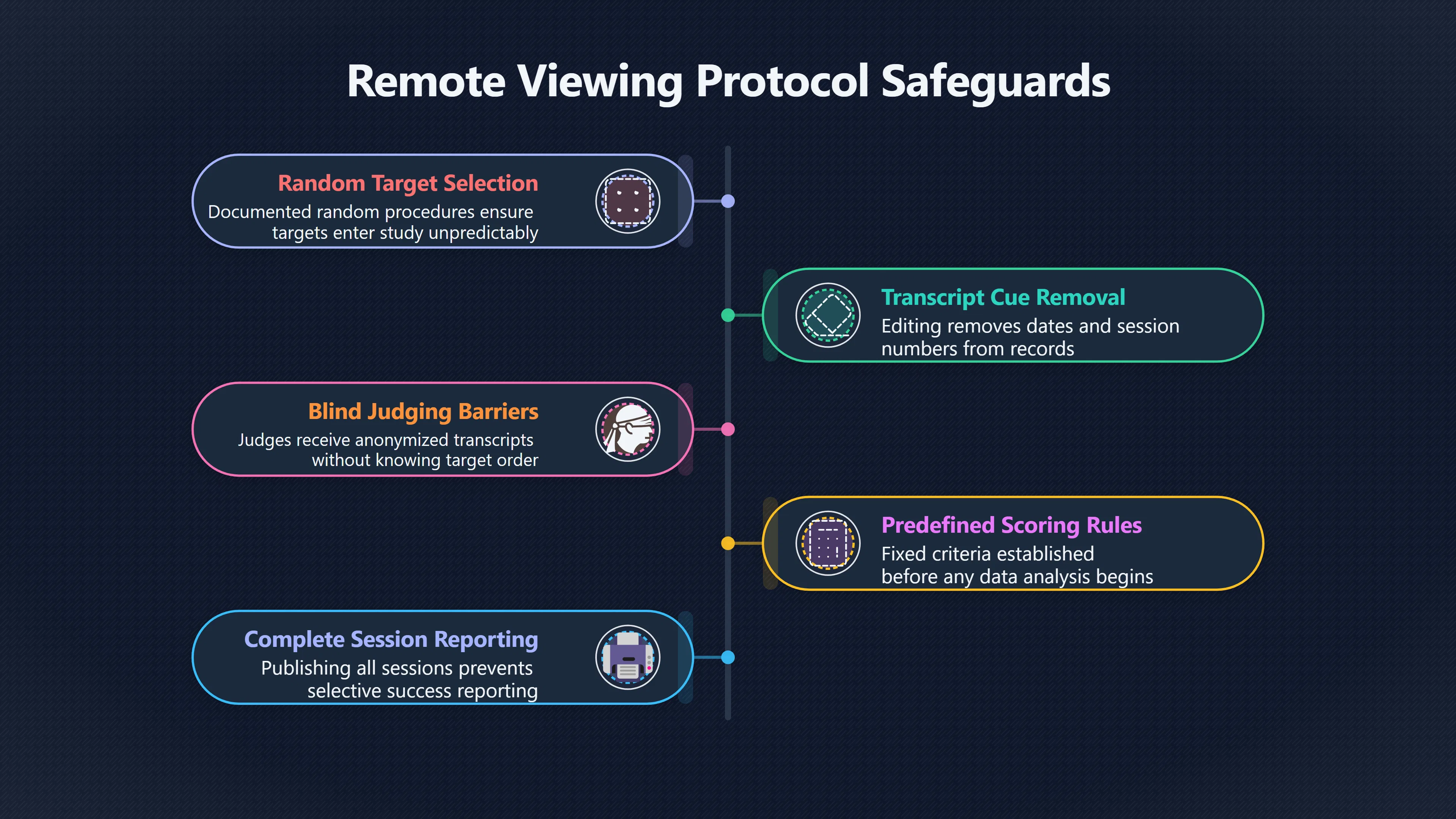
After the cueing dispute, stronger remote-viewing tests had to document random targets, cue-stripped transcripts, blind judging, and full reporting.
On this page
- Random target selection and documentation
- Cue removal before judging
- Predefined scoring and complete reporting
Page outline Jump by section
Introduction
The lasting impact of David Marks and Richard Kammann’s critique was not simply to question one set of remote-viewing results, but to redefine what counted as an acceptable experiment. Their argument shifted attention away from whether viewers were shielded from the target and towards the integrity of the entire experimental chain. If ordinary information could leak into transcripts, judging, or reporting, then positive results could no longer be interpreted as evidence for remote viewing alone. As a result, later researchers—both proponents and critics—placed much greater emphasis on documented randomisation, removal of identifying cues before judging, predefined scoring methods, and complete reporting of all sessions rather than selected successes. These procedural controls became central to evaluating remote-viewing claims, regardless of whether one believed the phenomenon itself.[PubMed]pubmed.ncbi.nlm.nih.govNature. 1981 Jul 9;292(5819):177. doi: 10.1038/292177a0. Author. D Marks. PMID: 7242682; DOI: 10.1038/…
What a Cleaner Test Would Require
Marks and Kammann’s criticism implied that protecting the viewer from sensory information was only one part of the problem. Every stage between target selection and publication had to be designed so that ordinary information could not influence the outcome.
A stronger protocol therefore needed to demonstrate, rather than merely assert, that:
- targets were chosen randomly and the selection process was documented;
- transcripts were stripped of any potentially identifying information before judging;
- judges had no access to target order, dates, experimenters, or other contextual clues;
- scoring procedures were fixed before analysing the results;
- all sessions, including unsuccessful ones, were reported.
These requirements reflected broader scientific principles of experimental control rather than rules unique to remote viewing. They addressed the possibility that unconscious bias, selective reporting, or information leakage could create apparently impressive results without requiring any paranormal explanation.[PubMed]pubmed.ncbi.nlm.nih.govNature. 1981 Jul 9;292(5819):177. doi: 10.1038/292177a0. Author. D Marks. PMID: 7242682; DOI: 10.1038/…
Random Target Selection and Documentation
One lesson from the controversy was that randomisation had to be both genuine and transparent.
If targets were selected in a predictable order, or if the sequence could later be reconstructed from records, judges might infer correct matches through ordinary reasoning. Consequently, later protocols increasingly specified that target selection should use documented random procedures and that records should preserve exactly when and how each target entered the experiment.
Equally important was maintaining a documented chain of custody. Researchers needed to show that no person who interacted with the viewer or the judge possessed information that could unintentionally influence the session. This expanded the concept of “blind” experimentation from the viewing session itself to the management of the entire study.
Supporters of later SRI work argued that replication experiments adopted these stronger procedures, including separate randomisation of targets and transcripts before judging and explicit checks for possible cueing. Critics, however, continued to argue that careful documentation remained essential because methodological claims cannot substitute for independently verifiable records.[SciSpace]scispace.cominformation transmission in remote viewing experiments 4jd6pdendvInformation transmission in remote viewing experiments13 Mar 1980 — It is also important to note that the Marks-Kam- mann critiqu…
Cue Removal Before Judging
The Marks–Kammann dispute made transcript preparation one of the most scrutinised parts of remote-viewing research.
Instead of giving judges original session records, stronger protocols required editing that removed:
- dates and session numbers;
- references to previous or future sessions;
- comments about travel or scheduling;
- experimenter notes;
- any wording that could reveal where a transcript belonged within a sequence.
The purpose was not to alter the viewer’s description but to remove administrative information that could function as an unintended clue.
This issue became especially prominent during the published exchanges that followed the original criticism. Charles Tart independently re-examined one well-known transcript set after removing phrases identified as potential cues and reported above-chance matching. Marks later argued that cue removal had not been sufficiently thorough, illustrating how the debate increasingly centred on the adequacy of control procedures rather than the content of the descriptions themselves.[SciSpace]scispace.cominformation transmission in remote viewing experiments 4jd6pdendvInformation transmission in remote viewing experiments13 Mar 1980 — It is also important to note that the Marks-Kam- mann critiqu…
Why Blind Judging Became More Demanding
The controversy broadened the meaning of “blind judging.”
Originally, the emphasis had largely been on ensuring that judges did not know which target was considered correct. After the critique, researchers recognised that judges could acquire useful information indirectly through transcript formatting, document order, experimenter comments, or subtle contextual patterns.
A cleaner design therefore required multiple independent barriers:
- judges receiving anonymised transcripts;
- targets presented in independently randomised order;
- no communication between experimenters involved in data collection and judging;
- independent judges working without knowledge of hypotheses or previous scores.
The objective was to ensure that the only information available for matching came from the descriptive content itself.
These safeguards reflected standard experimental practice in psychology and medicine, where preventing unconscious bias is often as important as preventing deliberate cheating.[PubMed]pubmed.ncbi.nlm.nih.govNature. 1981 Jul 9;292(5819):177. doi: 10.1038/292177a0. Author. D Marks. PMID: 7242682; DOI: 10.1038/…
Predefined Scoring and Complete Reporting
Marks and Kammann’s critique also encouraged greater attention to analysis after data collection.
Free-response remote-viewing transcripts are inherently open to interpretation. Without predetermined scoring rules, researchers might consciously or unconsciously favour interpretations that support a positive outcome. Stronger protocols therefore increasingly specified scoring methods before judging began, reducing opportunities to change evaluation criteria after seeing the results.
Complete reporting became equally important. Publishing only successful sessions, or omitting failed attempts, can exaggerate apparent performance. A more rigorous design therefore requires that every planned session, every transcript, and every scoring decision be included in the final analysis, allowing independent researchers to evaluate the evidence rather than relying on selected examples.
These practices align with broader scientific expectations concerning transparency, reproducibility, and protection against selective reporting. Although many of these standards later became common across experimental psychology, the remote-viewing controversy illustrated why they were particularly important in research relying on subjective interpretation.[PubMed]pubmed.ncbi.nlm.nih.govNature. 1981 Jul 9;292(5819):177. doi: 10.1038/292177a0. Author. D Marks. PMID: 7242682; DOI: 10.1038/…
The Broader Legacy for Remote-Viewing Research
The Marks critique changed the discussion from whether viewers could be isolated from ordinary sensory information to whether every stage of the experiment was insulated from information leakage.
That shift influenced both supporters and sceptics. Advocates increasingly described later studies as incorporating stronger randomisation, transcript editing, and blind judging, while critics evaluated whether those safeguards were independently documented and sufficient to exclude conventional explanations. The debate therefore became less about isolated experimental outcomes and more about governance of the research process itself.
In that sense, the most enduring contribution of the critique was methodological. It established that convincing evidence for remote viewing would require not only unusual results but also a demonstrably secure experimental design in which target selection, record keeping, judging, scoring, and reporting were all protected against ordinary sources of bias and information transfer.[PubMed]pubmed.ncbi.nlm.nih.govNature. 1981 Jul 9;292(5819):177. doi: 10.1038/292177a0. Author. D Marks. PMID: 7242682; DOI: 10.1038/…
Amazon book picks
Further Reading
Books and field guides related to What a Cleaner Test Would Require. Use these as the next step if you want deeper reading beyond the article.
The conscious universe
Contrasts laboratory evidence with practical application questions.
eBay marketplace picks
Marketplace Samples
Live-tested eBay searches with available results related to this page.




Endnotes
1.
Source: pubmed.ncbi.nlm.nih.gov
Link:https://pubmed.ncbi.nlm.nih.gov/7242682/
Source snippet
Nature. 1981 Jul 9;292(5819):177. doi: 10.1038/292177a0. Author. D Marks. PMID: 7242682; DOI: 10.1038/...
2.
Source: scispace.com
Title: information transmission in remote viewing experiments 4jd6pdendv
Link:https://scispace.com/pdf/information-transmission-in-remote-viewing-experiments-4jd6pdendv.pdf
Source snippet
Information transmission in remote viewing experiments13 Mar 1980 — It is also important to note that the Marks-Kam- mann critiqu...
3.
Source: Wikipedia
Title: Remote viewing
Link:https://en.wikipedia.org/wiki/Remote_viewing
Source snippet
Remote viewingRemote viewing (RV) is the practice of seeking impressions about a distant or unseen subject, purportedly sensing with t...
Additional References
4.
Source: researchgate.net
Title: 15839349 Information transmission in remote viewing experiments
Link:https://www.researchgate.net/publication/15839349_Information_transmission_in_remote_viewing_experiments
Source snippet
Information transmission in remote viewing experiments27 May 2016 — TARG AND PUTHOFF1-3 have described investigations of an extrasensory...
Published: May 2016
5.
Source: researchgate.net
Link:https://www.researchgate.net/publication/381233684_State_Trait_and_Target_Parameters_Associated_with_Accuracy_in_Two_Online_Tests_of_Precognitive_Remote_Viewing
Source snippet
viewing (PRV) tasks and potentially relevant trait, state, and target parameters...Read more...
6.
Source: centerforinquiry.s3.amazonaws.com
Link:https://centerforinquiry.s3.amazonaws.com/wp-content/uploads/sites/29/1982/07/22165420/p20.pdf
Source snippet
provided in the Hammid transcript together with the target lists and the...Read more...
7.
Source: singularityquest.com
Title: why david marks cues dont debunk remote viewing
Link:https://singularityquest.com/why-david-marks-cues-dont-debunk-remote-viewing/
Source snippet
Why David Marks' Cues Do Not Debunk Remote Viewing4 Jan 2021 — He edited the transcripts carefully, removing all phrases suggested as pot...
8.
Source: reddit.com
Link:https://www.reddit.com/r/remoteviewing/comments/1501do7/the_complete_skeptics_guide_to_remote_viewing_how/
Source snippet
ff's experiments contained clues as to which order they were...Read more...
9.
Source: youtube.com
Title: Remote Viewing Training, Part One: The Initial Phases, with Paul H. Smith
Link:https://www.youtube.com/watch?v=Y2Ryc196s0I
Source snippet
Operational Precognitive Remote Viewing, AI & the Science of Love with Julia Mossbridge...
10.
Source: davidfmarks.net
Title: ‘That Dude’ Strikes Again
Link:https://davidfmarks.net/that-dude-strikes-again/
Source snippet
319 of Nature can be used to invalidate the [Pat Price]({{ 'pat-price/' | relative_url }}) series of remote viewing experiments...Read more...
11.
Source: youtube.com
Title: The CIA Protocol: How to Train Your Brain for Remote Viewing
Link:https://www.youtube.com/watch?v=RJrTddUkplY
Source snippet
Remote Viewing Training, Part One: The Initial Phases, with Paul H. Smith...
12.
Source: youtube.com
Title: Remote Viewing Explained: How the Mind Sees Without Eyes
Link:https://www.youtube.com/watch?v=whpZzUwrUNU
Source snippet
The CIA Protocol: How to Train Your Brain for Remote Viewing...
13.
Source: cia.gov
Link:https://www.cia.gov/readingroom/docs/CIA-RDP96-00787R000200090017-5.pdf
Source snippet
INFORMATION TRANSMISSION IN REMOTE VIEWING...Marks and Kammann also had two judges, described as "research psychologists" try to match a...
Topic Tree