Within 1995 Review
What Did the 1995 Review Actually Examine?
AIR examined research claims, end-user feedback, interviews, and operational records rather than simply voting on whether remote viewing was real.
On this page
- Why the Senate asked for an outside evaluation
- The research and operations tracks in the review
- What evidence mattered most to decision makers
Page outline Jump by section
Introduction
The 1995 review by the American Institutes for Research (AIR) is often described as a simple verdict on whether remote viewing “worked”. That description misses the central purpose of the exercise. AIR was not asked merely to judge paranormal claims. It was commissioned to determine whether nearly two decades of government-sponsored remote-viewing research had produced an intelligence capability that justified continued funding and operational use. To answer that question, the review examined two separate but connected bodies of evidence: the scientific research programme and the operational history of the Stargate project. It also drew on interviews with the people who managed, used and performed remote-viewing tasks, alongside documentary records of intelligence applications. The resulting evaluation became the administrative basis for ending the programme because it assessed both scientific credibility and practical utility rather than treating them as the same question.[National Security Archive]nsarchive2.gwu.eduNational Security ArchiveAn Evaluation of Remote Viewing: Research and…March 13, 2015 — by MD Mumford · 1995 · Cited by 76 — Informati…

Why the Senate asked for an outside evaluation
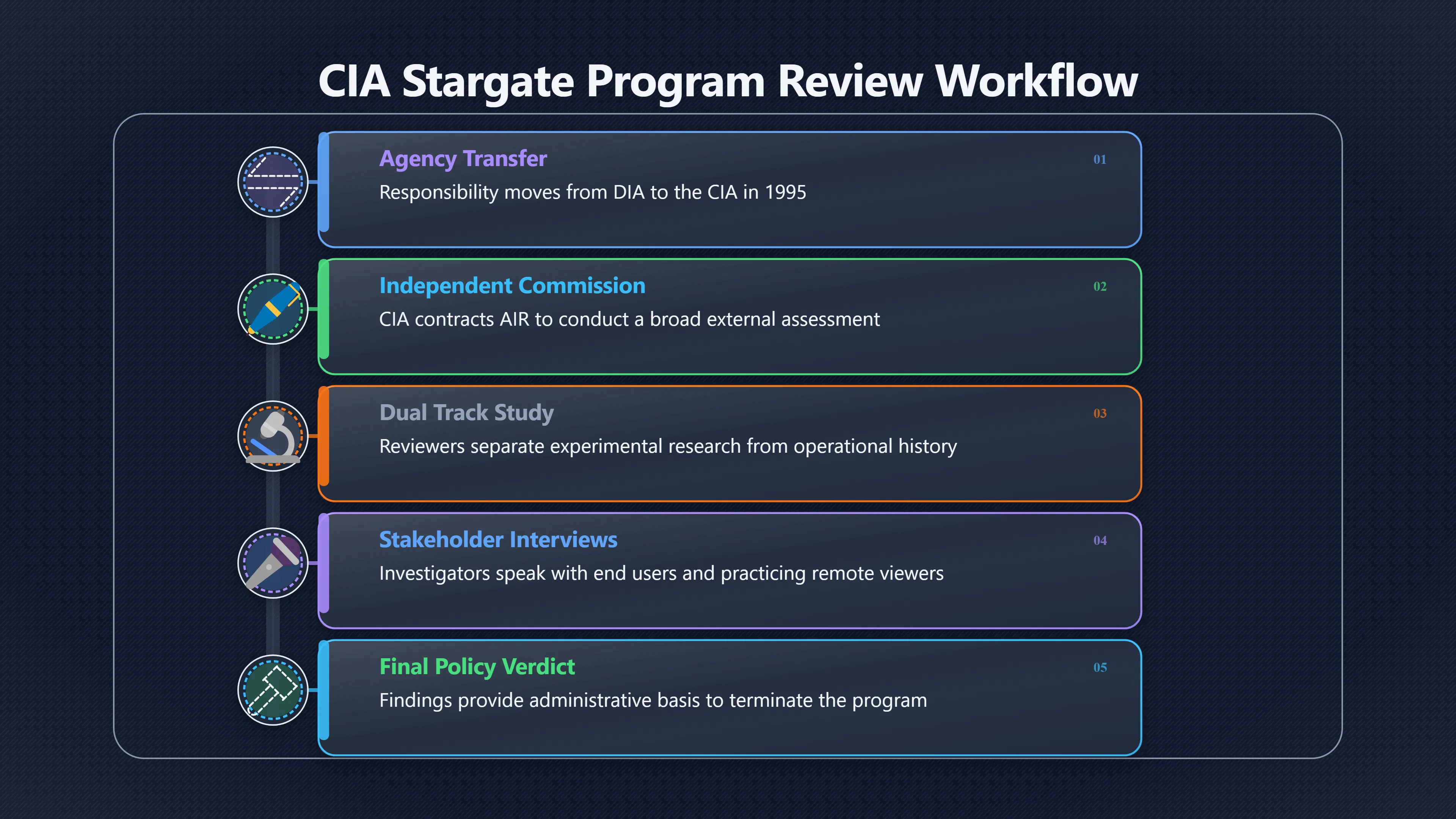
The immediate trigger for the review was not a new scientific breakthrough but a change in programme oversight. In 1995, responsibility for the Stargate programme moved from the Defence Intelligence Agency (DIA) to the CIA under congressional direction. Before deciding whether the programme should continue, the CIA commissioned AIR to conduct an independent assessment of both its research record and its operational value.[CIA]cia.govAN EVALUATION OF THE REMOTE VIEWING PROGRAMDuring. Star Gate's history, DIA pursued three basic program objectives: "Operations," usin…
AIR’s role was deliberately broader than that of a laboratory peer reviewer. The evaluation plan asked whether the accumulated evidence showed a statistically significant effect, whether any effect could reasonably be interpreted as paranormal, whether the phenomenon was understood well enough to support practical use, and whether the research justified intelligence applications. These questions meant the review addressed science, methodology, implementation and policy simultaneously rather than issuing a simple yes-or-no judgement on remote viewing itself.[scribd.com]scribd.comCIA-RDP96-00791R000200180005-5 | PDFDrs. Utts and Hyman were asked to prepare independent reports based on their review. In this review…
The review panel also reflected this structure. Statistician Jessica Utts and psychologist Ray Hyman were invited specifically because they represented contrasting interpretations of parapsychological evidence. Rather than forcing consensus, AIR asked each expert to produce an independent assessment before comparing areas of agreement and disagreement through a structured review process.[scribd.com]scribd.comCIA-RDP96-00791R000200180005-5 | PDFDrs. Utts and Hyman were asked to prepare independent reports based on their review. In this review…
The research and operations tracks in the review
AIR separated its work into two complementary investigations.
The first examined the experimental research carried out over many years at organisations including Stanford Research Institute (SRI) and later Science Applications International Corporation (SAIC). Rather than reviewing every historical experiment equally, the panel concentrated particular attention on the more recent SAIC studies because they were generally regarded as methodologically stronger than earlier work. These studies were evaluated alongside previous literature and earlier government reviews to determine whether the reported statistical effects were convincing.[ResearchGate]researchgate.netResearch Gate Evaluation of Program on 'Anomalous Mental PhenomenaEvaluation of Program on 'Anomalous Mental Phenomena'January 1, 1995 — PDF | Jessica Utts and I were commissioned to evaluate…
The second investigation examined operational use. This distinction is frequently overlooked in popular accounts but was central to AIR’s mandate. The review considered how remote viewing had actually been employed within intelligence work, how requests were generated, what products were delivered to customers, and whether those products influenced real decisions or produced useful intelligence outcomes.[National Security Archive]nsarchive2.gwu.eduNational Security ArchiveAn Evaluation of Remote Viewing: Research and…March 13, 2015 — by MD Mumford · 1995 · Cited by 76 — Informati…
Importantly, AIR did not assume that statistically unusual laboratory findings would automatically translate into operational effectiveness. The evaluation explicitly treated those as separate questions requiring different forms of evidence.[National Security Archive]nsarchive2.gwu.eduNational Security ArchiveAn Evaluation of Remote Viewing: Research and…March 13, 2015 — by MD Mumford · 1995 · Cited by 76 — Informati…

How AIR gathered operational evidence
The operational review relied on considerably more than archived reports.
According to AIR’s evaluation plan, investigators conducted interviews during July and August 1995 with:
- representatives of intelligence organisations that had requested remote-viewing support;[cia.gov]cia.govptical position. Both, however, are viewed as fair…
- the programme manager;
- practising remote viewers.
AIR interviewed seven end users, three remote viewers and the incumbent programme manager. The reviewers intentionally focused on personnel involved during the programme’s final period because recent activities could be checked against surviving documentation more reliably than recollections from the 1970s or early 1980s.[National Security Archive]nsarchive2.gwu.eduNational Security ArchiveAn Evaluation of Remote Viewing: Research and…March 13, 2015 — by MD Mumford · 1995 · Cited by 76 — Informati…
The interview sample also covered different operational contexts. End users came from organisations involved in activities such as counter-intelligence, counter-narcotics and search-and-rescue, allowing AIR to compare experiences across several kinds of operational task rather than relying on a single success story or failure.[National Security Archive]nsarchive2.gwu.eduNational Security ArchiveAn Evaluation of Remote Viewing: Research and…March 13, 2015 — by MD Mumford · 1995 · Cited by 76 — Informati…
These interviews were combined with documentary evidence, including operational records and examples of remote-viewing products. AIR therefore evaluated not only what participants believed about the programme but also whether those beliefs matched documented performance.[National Security Archive]nsarchive2.gwu.eduNational Security ArchiveAn Evaluation of Remote Viewing: Research and…March 13, 2015 — by MD Mumford · 1995 · Cited by 76 — Informati…
What evidence mattered most to decision-makers
Although public discussion often concentrates on the disagreement between Utts and Hyman over laboratory statistics, the operational portion of AIR’s work addressed the question that mattered most to intelligence managers: whether remote viewing generated dependable, actionable information.
The review found little evidence that operational products had contributed information of sufficient quality, consistency or uniqueness to justify continued intelligence use. Even where some individual cases appeared impressive, the available record did not demonstrate a reliable capability that decision-makers could incorporate into normal intelligence processes.[CIA]cia.govAN EVALUATION OF THE REMOTE VIEWING PROGRAMDuring. Star Gate's history, DIA pursued three basic program objectives: "Operations," usin…
The reviewers also considered the difficulty of evaluating anecdotal “hits”. Individual striking examples could not easily establish operational value because intelligence work requires repeatable performance across many cases rather than isolated successes. AIR therefore placed greater weight on sustained usefulness than on memorable stories.[National Security Archive]nsarchive2.gwu.eduNational Security ArchiveAn Evaluation of Remote Viewing: Research and…March 13, 2015 — by MD Mumford · 1995 · Cited by 76 — Informati…
This emphasis explains why debates over laboratory evidence did not determine the programme’s fate. Utts concluded that the experimental record supported the existence of a genuine anomalous effect, while Hyman argued that methodological uncertainties and insufficient independent replication made that conclusion premature. Yet both perspectives still had to confront the separate question of operational utility, where the documented record proved far less persuasive.[ResearchGate+2scribd.com]researchgate.netResearch Gate Evaluation of Program on 'Anomalous Mental PhenomenaEvaluation of Program on 'Anomalous Mental Phenomena'January 1, 1995 — PDF | Jessica Utts and I were commissioned to evaluate…
Why the review became the administrative turning point
AIR’s evaluation mattered because it reframed the discussion from scientific possibility to government implementation. Intelligence agencies do not fund programmes simply because an effect appears statistically interesting; they fund capabilities that consistently improve decision-making.
By reviewing research claims, interviewing users and practitioners, examining operational records and assessing practical outcomes together, AIR produced a policy-oriented evaluation rather than a purely scientific review. Its findings gave the CIA a documented basis for concluding that, regardless of continuing debate over laboratory anomalies, the Stargate programme had not demonstrated sufficient operational value to warrant continuation. That implementation-focused assessment—not simply a vote on whether remote viewing was “real”—became the decisive administrative step before the programme was ended.[National Security Archive+2CIA]nsarchive2.gwu.eduNational Security ArchiveAn Evaluation of Remote Viewing: Research and…March 13, 2015 — by MD Mumford · 1995 · Cited by 76 — Informati…
Amazon book picks
Further Reading
Books and field guides related to What Did the 1995 Review Actually Examine?. Use these as the next step if you want deeper reading beyond the article.

Parapsychology: A Handbook for the 21st Century
Explains the broader research landscape behind the AIR review.
eBay marketplace picks
Marketplace Samples
Live-tested eBay searches with available results related to this page.

Endnotes
1.
Source: cia.gov
Link:https://www.cia.gov/readingroom/docs/CIA-RDP96-00791R000200180005-5.pdf
Source snippet
AN EVALUATION OF THE REMOTE VIEWING PROGRAMDuring. [Star Gate]({{ 'star-gate/' | relative_url }})'s history, DIA pursued three basic program objectives: "Operations," usin...
2.
Source: scribd.com
Link:https://www.scribd.com/document/1031977086/CIA-RDP96-00791R000200180005-5
Source snippet
CIA-RDP96-00791R000200180005-5 | PDFDrs. Utts and Hyman were asked to prepare independent reports based on their review. In this review...
3.
Source: researchgate.net
Title: Research Gate Evaluation of Program on ‘Anomalous Mental Phenomena’
Link:https://www.researchgate.net/publication/267978941Evaluation_of_Program_on%27Anomalous_Mental_Phenomena%27
Source snippet
Evaluation of Program on 'Anomalous Mental Phenomena'January 1, 1995 — PDF | Jessica Utts and I were commissioned to evaluate...
Published: January 1, 1995
4.
Source: cia.gov
Link:https://www.cia.gov/readingroom/docs/CIA-RDP96-00791R000200180006-4.pdf
Source snippet
ptical position. Both, however, are viewed as fair...
5.
Source: cia.gov
Link:https://www.cia.gov/readingroom/docs/CIA-RDP96-00789R003100290002-5.pdf
Source snippet
STAR GATE OPERATIONAL USER INTERVIEW1995 NOTE TAKER REPORT Operational Task: Most [tasking]({{ 'tasking/' | relative_url }}) requested information about future events, usua...
6.
Source: nsarchive2.gwu.edu
Link:https://nsarchive2.gwu.edu/NSAEBB/NSAEBB438/docs/doc_57.pdf
Source snippet
National Security ArchiveAn Evaluation of Remote Viewing: Research and...March 13, 2015 — by MD Mumford · 1995 · Cited by 76 — Informati...
Published: March 13, 2015
7. Source: citeseerx.ist.psu.edu
Source snippet
American Institutes for Research Review of the...by C EDWIN · 1996 · Cited by 3 — In 1995, David Goslin assumed responsibility for the C...
Additional References
8.
Source: academia.edu
Link:https://www.academia.edu/95285973/The_Star_Gate_Operational_Remote_Viewing_Program_A_Human_Intelligence_HUMINT_Collection_Platform
Source snippet
An Evaluation of Remote Viewing: Research and Applications (a.k.a. The AIR Report) In early 1995, a Congressionally Directed Action requi...
9.
Source: govinfo.gov
Title: Central Intelligence Agency: Observations on GAO Access
Link:https://www.govinfo.gov/content/pkg/GAOREPORTS-GAO-01-975T/html/GAOREPORTS-GAO-01-975T.htm
Source snippet
Senate Foreign Relations Committee, we asked the CIA for threat assessments relevant to our review objectives. The CIA provided us with a...
10.
Source: youtube.com
Link:https://www.youtube.com/watch?v=tZ1dy7dG0M4
Source snippet
Project STARGATE: Did the CIA's Declassified Psychic...Go to channel NewsNation · How the CIA worked with psychics on 'Project St...
11.
Source: facebook.com
Link:https://www.facebook.com/AskImtinan/posts/project-stargate-the-cias-search-for-tabut-e-sakinahin-1972-the-cia-secretly-fun/1575907587435890/
Source snippet
Project Stargate: The CIA's Search for Tabut-e-Sakinah In...In 1995, the CIA commissioned an independent review that killed the program...
12.
Source: greydynamics.com
Link:https://greydynamics.com/intelligence-past-the-tangible-world-cias-stargate-project/
Source snippet
Intelligence Past the Tangible World: CIA's Stargate ProjectIn 1995, the CIA contracted the American Institute for Research (AIR) to eval...
13.
Source: Wikipedia
Title: Stargate Project (U.S. Army unit)
Link:https://en.wikipedia.org/wiki/Stargate_Project_%28U.S._Army_unit%29
Source snippet
Stargate Project (U.S. Army unit)The Stargate Project was terminated and declassified in 1995 after a commissioned review by the CIA c...
14.
Source: youtube.com
Title: Did the CIA Train Psychic Spies? | Stargate Project
Link:https://www.youtube.com/watch?v=4F5lH0SOqs0
Source snippet
5 Army Remote Viewer Looks Inside of a UFO, Consciousness & Disclosure | Maj. Paul Smith PhD...
15.
Source: pmc.ncbi.nlm.nih.gov
Link:https://pmc.ncbi.nlm.nih.gov/articles/PMC10275521/
Source snippet
Central Intelligence Agency's (CIA...by Á Escolà‐Gascón · 2023 · Cited by 10 — Scientific reviews and conclusions after the CIA declassi...
16.
Source: youtube.com
Title: Stargate’s Gatekeeper: DIA & Remote Viewing with Dale E. Graff
Link:https://www.youtube.com/watch?v=VRAsTmT_nQo
Source snippet
3 Inside Operation Stargate: The CIA's Psychic Spy Experiment...
17.
Source: archives.library.rice.edu
Title: archival objects
Link:https://archives.library.rice.edu/repositories/2/archival_objects/329954
Source snippet
CIA/American Institute for Research Evaluation, 1995-11-02. American Institute of Research Review of Stargate American Institute of Resea...
Topic Tree