Within 1995 Review
What Did Intelligence Users Say Went Wrong?
The operational review asked intelligence consumers whether remote-viewing reports helped them, not just whether sessions sounded interesting later.
On this page
- Who counted as an end user in the review
- Why background accuracy did not equal value
- How user feedback weakened the programme case
Page outline Jump by section
Introduction
One of the most important parts of the 1995 evaluation of the U.S. government’s remote-viewing programme was not the debate over laboratory experiments but the assessment of whether intelligence officers could actually use the reports they received. The review found that this operational question weakened the programme more than any statistical dispute. While some experimental results remained controversial, the people expected to turn remote-viewing sessions into usable intelligence generally reported that the material was too vague, inconsistent or difficult to act upon. That distinction shaped the CIA’s decision: a capability that occasionally produces intriguing descriptions is not the same as one that reliably supports intelligence analysis or operational decisions.[alice.id.tue.nl]alice.id.tue.nlAn Evaluation of Remote Viewing: Research and…by MD Mumford · 1995 · Cited by 75 — Utts and Hyman were asked to prepare independent re…
What Did Intelligence Users Say Went Wrong?
Who counted as an end user in the review?
The 1995 American Institutes for Research (AIR) evaluation distinguished between researchers who conducted remote-viewing experiments and the intelligence personnel who consumed the resulting reports. These end users included intelligence analysts, operations staff and government officials who received remote-viewing products alongside information from conventional collection methods. Their judgement mattered because they were responsible for determining whether a report could influence a real investigation or decision rather than merely appear interesting in retrospect.[alice.id.tue.nl]alice.id.tue.nlAn Evaluation of Remote Viewing: Research and…by MD Mumford · 1995 · Cited by 75 — Utts and Hyman were asked to prepare independent re…
Rather than asking whether viewers occasionally described distant targets in striking ways, the operational review examined how recipients experienced the information at the time it was delivered. Interviews with intelligence consumers formed an important part of this assessment, shifting attention from laboratory scoring methods to practical usefulness.[www.slideshare.net]slideshare.netEvaluation of Remote Viewing, Research and…The review consisted of evaluating past laboratory research on remote viewing and interview…
Why background accuracy did not equal value
A recurring finding was that a report could contain some correct-looking details without becoming operationally useful. Intelligence work depends on specificity, timeliness and confidence. Analysts must decide which information deserves action before the true answer is known.
The review found several reasons why apparent accuracy often failed to translate into value:
- Reports frequently contained broad or ambiguous descriptions that could fit many different situations.
- Accurate elements were mixed with incorrect or unverifiable claims, making it difficult to distinguish signal from noise.
- Products rarely provided enough precise information to guide operational planning or analytical conclusions.
- Successes were often recognised only after events had unfolded, limiting their prospective intelligence value. alice.id.tue.nl+2Center for Inquiry[alice.id.tue.nl]alice.id.tue.nlAn Evaluation of Remote Viewing: Research and…by MD Mumford · 1995 · Cited by 75 — Utts and Hyman were asked to prepare independent re…
This distinction became central to the evaluation. Intelligence organisations require information that improves decisions under uncertainty, not simply material that can later be interpreted as partially correct.

How User Feedback Weakened the Programme Case
The AIR review reported that interviews with intelligence consumers did not establish that remote viewing had produced intelligence of demonstrable operational value. Some users described individual reports as interesting or occasionally suggestive, but there was no convincing documentation that the programme consistently influenced successful intelligence operations or provided unique information unavailable from conventional sources. www.slideshare.net+2alice.id.tue.nl[slideshare.net]slideshare.netEvaluation of Remote Viewing, Research and…The review consisted of evaluating past laboratory research on remote viewing and interview…
This finding carried particular weight because it addressed the programme’s original purpose. Even if researchers continued debating whether laboratory experiments revealed an anomalous psychological effect, the government had funded remote viewing as a potential intelligence tool. The end-user evidence indicated that this objective had not been met.[alice.id.tue.nl]alice.id.tue.nlAn Evaluation of Remote Viewing: Research and…by MD Mumford · 1995 · Cited by 75 — Utts and Hyman were asked to prepare independent re…
The reviewers also noted that intelligence organisations already possess established methods for evaluating sources according to reliability, corroboration and predictive performance. Remote-viewing reports generally failed to satisfy these practical standards because recipients could not determine which statements deserved confidence before independent evidence became available.[Center for Inquiry]cdn.centerforinquiry.orgCenter for InquiryEvaluation of the Military's Twenty-Year Program on…by RAY HYMAN · 1996 · Cited by 8 — In 1995 the Central Intellige…
Why Operational Feedback Mattered More Than Laboratory Debate
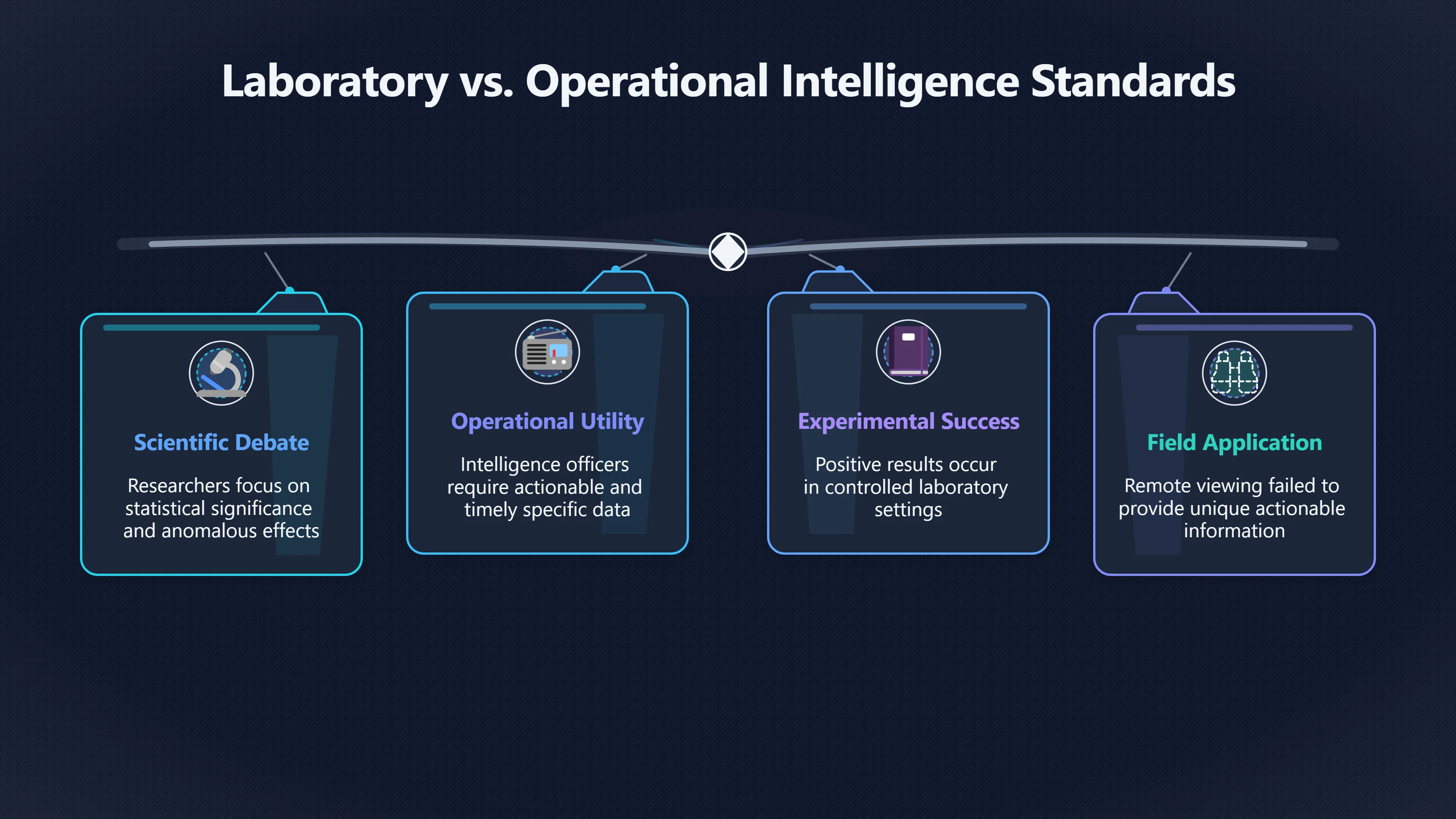
The well-known disagreement between Jessica Utts and Ray Hyman concerned the interpretation of experimental evidence. Utts argued that the statistical findings supported the existence of a genuine phenomenon, whereas Hyman maintained that methodological concerns and the lack of independent replication prevented such a conclusion. Despite their disagreement, neither position overturned the operational assessment.
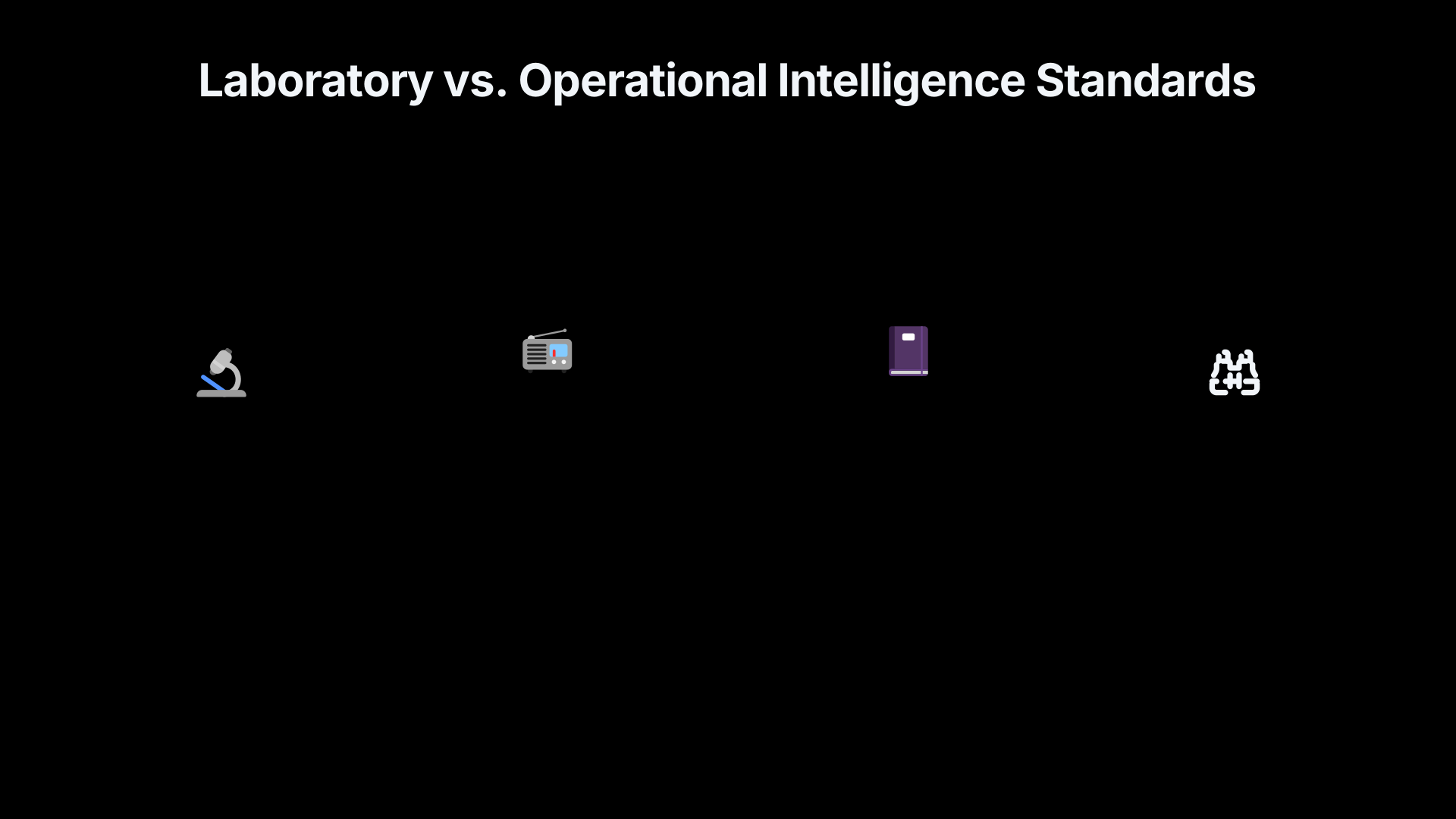
The broader AIR evaluation concluded that whatever the laboratory findings might mean scientifically, they did not establish a dependable intelligence capability. The conditions that appeared to produce positive laboratory results differed substantially from the demands of intelligence work, where information must be timely, specific and consistently useful to decision-makers.[alice.id.tue.nl+2CIA]alice.id.tue.nlAn Evaluation of Remote Viewing: Research and…by MD Mumford · 1995 · Cited by 75 — Utts and Hyman were asked to prepare independent re…
This explains why popular summaries that focus only on the scientific controversy miss the programme’s administrative outcome. The CIA was deciding whether to continue funding an intelligence programme, not whether every laboratory anomaly had been explained.
The Lasting Significance of the End-User Evidence
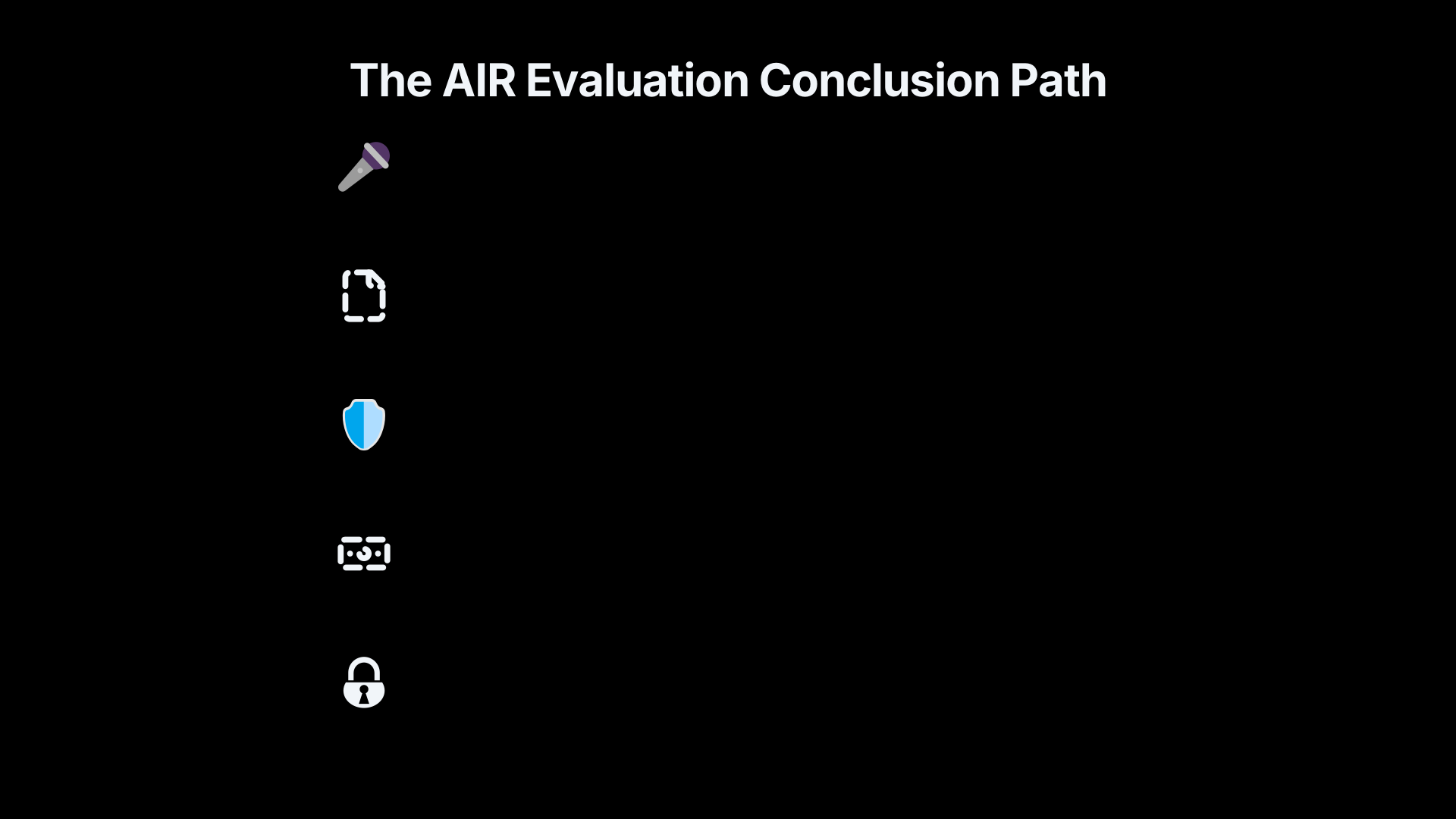
The operational review ultimately reframed the remote-viewing debate. Instead of asking, “Did some sessions contain surprisingly accurate descriptions?”, it asked, “Did intelligence professionals receive information they could reliably use?”
The available evidence pointed to the latter question receiving a negative answer. End users reported that the products were generally too uncertain, too imprecise and too difficult to integrate into intelligence analysis. As a result, the programme lacked documented operational value even if aspects of the experimental research remained disputed. That practical judgement became one of the strongest reasons for ending government sponsorship of psychic spying as an intelligence programme.[www.slideshare.net+2CIA]slideshare.netEvaluation of Remote Viewing, Research and…The review consisted of evaluating past laboratory research on remote viewing and interview…
Amazon book picks
Further Reading
Books and field guides related to What Did Intelligence Users Say Went Wrong?. Use these as the next step if you want deeper reading beyond the article.

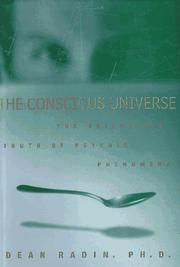
Parapsychology: A Handbook for the 21st Century
Covers evaluation of psi research in broader context.
eBay marketplace picks
Marketplace Samples
Example marketplace items related to this page. Use the search link to explore similar finds on eBay.
Endnotes
1.
Source: alice.id.tue.nl
Link:https://www.alice.id.tue.nl/references/mumford-rose-goslin-1995.pdf
Source snippet
An Evaluation of Remote Viewing: Research and...by MD Mumford · 1995 · Cited by 75 — Utts and Hyman were asked to prepare independent re...
2.
Source: cia.gov
Link:https://www.cia.gov/readingroom/docs/CIA-RDP96-00791R000200180005-5.pdf
Source snippet
, they were to cover four general topics: Was there a...Read more...
3.
Source: slideshare.net
Link:https://www.slideshare.net/slideshow/an-evaluation-of-remote-viewing-research-and-applications-air1995pdf/257460594
Source snippet
Evaluation of Remote Viewing, Research and...The review consisted of evaluating past laboratory research on remote viewing and interview...
4.
Source: cia.gov
Link:https://www.cia.gov/readingroom/docs/CIA-RDP96-00791R000200180006-4.pdf
5.
Source: cdn.centerforinquiry.org
Link:https://cdn.centerforinquiry.org/wp-content/uploads/sites/29/1996/03/22165045/p21.pdf
Source snippet
Center for InquiryEvaluation of the Military's Twenty-Year Program on...by RAY HYMAN · 1996 · Cited by 8 — In 1995 the Central Intellige...
6.
Source: Wikipedia
Title: Remote viewing
Link:https://en.wikipedia.org/wiki/Remote_viewing
Source snippet
Remote viewingIn 1995, the CIA hired the American Institutes for Research (AIR) to... [unreliable source?] However, statistical flaws...
Additional References
7.
Source: skepsis.nl
Link:https://skepsis.nl/[stargate
Source snippet
CIA onderzoekt ESP / remote viewingDe skeptische psycholoog Ray Hyman van de Universiteit van Oregon was een van de twee hiervoor benader...
8.
Source: rviewer.com
Link:https://rviewer.com/a-review-of-the-cia-air-report-on-the-star-gate-remote-viewing-program/bologna-on-wry-bread-part-1-of-a-review-of-an-evaluation-of-remote-viewing-research-and-applications/
Source snippet
Utts and Hyman agreed that the experimental portion of STAR GATE indicated some sort of phenomenon existed, but...Read more...
9.
Source: researchprofiles.herts.ac.uk
Title: experiment one of the saic remote viewing program a critical re e
Link:https://researchprofiles.herts.ac.uk/en/publications/experiment-one-of-the-saic-remote-viewing-program-a-critical-re-e
Source snippet
One of the SAIC Remote Viewing Programby R Wiseman · 1999 · Cited by 24 — This paper first outlines xx a key study in the report (referre...
10.
Source: researchgate.net
Link:https://www.researchgate.net/publication/267978941Evaluation_of_Program_on%27Anomalous_Mental_Phenomena%27
Source snippet
related phenomena which was carried out at Stanford Re-search Institute...
11.
Source: skeptics.stackexchange.com
Title: have remote viewing tests shown a positive effect 5 15 above chance
Link:https://skeptics.stackexchange.com/questions/17741/have-remote-viewing-tests-shown-a-positive-effect-5-15-above-chance
Source snippet
Utts maintained that there had been a statistically significant positive effect, with some...Read more...
12.
Source: reddit.com
Link:https://www.reddit.com/r/StargateFiles/comments/1rjeasm/structural_breakdown_of_the_1995_cia_star_gate/
Source snippet
Structural Breakdown of the 1995 CIA STAR GATE...3 Mar 2026 — Conclusion: Remote viewing did not demonstrate consistent, actionable inte...
13.
Source: popularmechanics.com
Title: cia psychic espionage secrets revealed
Link:https://www.popularmechanics.com/science/a65932697/cia-psychic-espionage-secrets-revealed/
Source snippet
The CIA Watched Him Bend Reality With Just His Mind...29 Aug 2025 — During the height of the [Cold War]({{ 'cold-war/' | relative_url }}), the CIA ran tests on people with...
14.
Source: Wikipedia
Title: Stargate Project (U.S. Army unit)
Link:https://en.wikipedia.org/wiki/Stargate_Project_%28U.S._Army_unit%29
Source snippet
Stargate Project (U.S. Army unit)According to the AIR review, no remote viewing report ever provided actionable information for any in...
15.
Source: researchgate.net
Link:https://www.researchgate.net/publication/403178755_The_Star_Gate_Archives_Reports_of_the_United_States_Government_Sponsored_Psi_Program_1972-1995_Volume_4_Operational_Remote_Viewing_Memorandums_and_Reports
Source snippet
(PDF) The Star Gate Archives: Reports of the United States...26 Apr 2026 — The Star Gate Archives: Reports of the United States Governme...
16.
Source: pmc.ncbi.nlm.nih.gov
Link:https://pmc.ncbi.nlm.nih.gov/articles/PMC10275521/
Source snippet
Central Intelligence Agency's (CIA...by Á Escolà‐Gascón · 2023 · Cited by 10 — Utts (1995, 1996, 2018) and Hyman (1996) both noted that...
Topic Tree