Within Remote Viewing
What Above Chance Results Really Mean
Statistical significance can suggest an anomaly, but it does not automatically prove psychic ability or practical usefulness.
On this page
- Chance and Effect Size
- Statistical Versus Practical Claims
- Why Interpretation Divides Experts
Page outline Jump by section
Introduction
Above-chance results in remote-viewing experiments matter, but they do not settle the biggest question. A statistically significant result can show that a set of viewing reports performed better than a specified chance model predicts. It does not automatically prove psychic ability, identify a mechanism, rule out every methodological weakness, or show that the information is reliable enough to use in real decisions. That distinction is the centre of the remote-viewing debate.
The clearest historical example is the 1995 evaluation of the U.S. government’s remote-viewing programme. Statistician Jessica Utts argued that the laboratory evidence showed a genuine anomalous effect; psychologist Ray Hyman accepted that some results looked statistically interesting but argued that this was not enough to prove paranormal functioning without stronger independent replication and theoretical clarity. The American Institutes for Research reached the practical conclusion that remote viewing had not shown value for intelligence operations, especially because the material was often vague and hard to turn into actionable information.[CIA+2National Security Archive]cia.govAN EVALUATION OF THE REMOTE VIEWING PROGRAMUtts and Hyman were asked to prepare independent reports based on their review. In this rev…
Chance and Effect Size
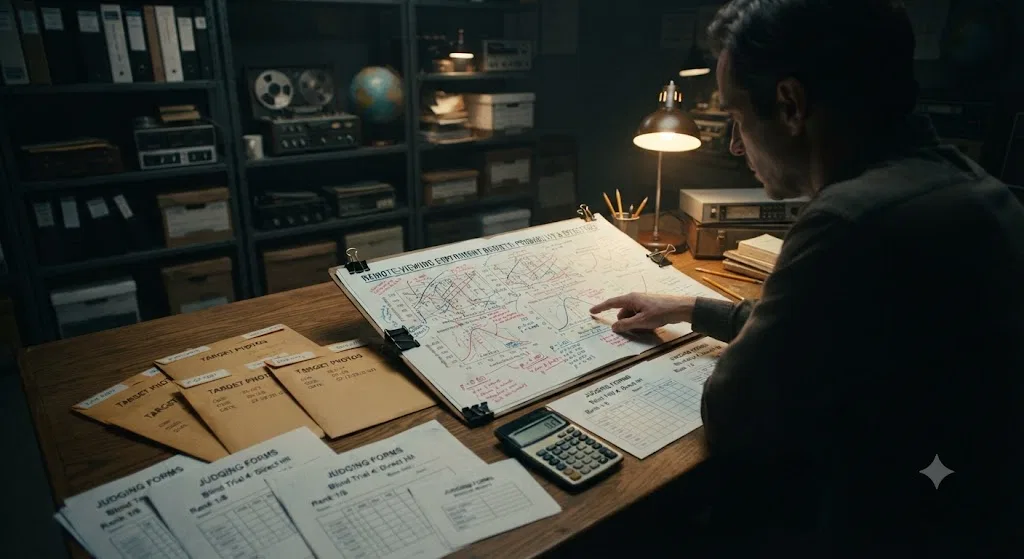
Remote-viewing experiments often use a simple statistical logic: compare a viewer’s description with several possible targets and ask whether the correct target is chosen or ranked highly more often than chance would predict. In rank-order judging, for example, a blind judge may compare the viewer’s notes with one real target and several decoys. If the real target is ranked first unusually often across many trials, the result may be called statistically significant.[CIA]cia.govAN EVALUATION OF THE REMOTE VIEWING PROGRAMUtts and Hyman were asked to prepare independent reports based on their review. In this rev…
That kind of result is not meaningless. It is designed to answer a real question: “Did this collection of sessions depart from the chance expectation under the rules of this experiment?” A remote-viewing study that repeatedly beats its pre-specified chance model deserves more attention than anecdotes or cherry-picked success stories. This is why parapsychology researchers have long emphasised blind judging, random target selection, pre-defined scoring and aggregation across trials rather than relying only on dramatic individual hits.[UC Irvine Bren School]ics.uci.eduUC Irvine Bren SchoolAn Assessment of the Evidence for Psychic Functioningby J Utts · 1995 · Cited by 103 — After the completion of a rem…
But the key phrase is “under the rules of this experiment”. A low p-value does not say that a psychic mechanism exists. The American Statistical Association’s statement on p-values warns that statistical significance does not measure the size or importance of an effect and should not, by itself, determine scientific or policy conclusions. That general statistical warning is especially relevant to remote viewing because the claim being tested is extraordinary, the proposed mechanism is unclear, and small procedural details can change how impressive a result looks.[Amstat]amstat.orgOpen source on amstat.org.
Effect size is the next question. A tiny effect can become statistically significant if there are enough trials; a large-looking effect can be unstable if the number of trials is small or the analysis choices are flexible. A 2023 systematic review and meta-analysis of remote-viewing studies reported a positive average effect size after excluding outliers, and described the results as above chance. Supporters see this as evidence that the anomaly is not confined to one laboratory or one historical programme. Critics focus on whether the underlying studies are sufficiently comparable, independent, well-controlled and free from selective publication to support that conclusion.[Journal of Scientific Exploration+2ResearchGate]journalofscientificexploration.orgOpen source on journalofscientificexploration.org.
Statistical Versus Practical Claims
The practical question is not “Can a study produce an above-chance average?” It is “Can a viewer produce information that is specific, timely and reliable enough to help someone make a decision?” Those are different standards. A remote-viewing session might contain a few details that later seem to match a target, yet still be surrounded by errors, metaphors, generic imagery and ambiguous impressions. In a laboratory, a judge may compare the whole response against a small set of possible targets. In intelligence work, there may be no neat list of decoys and no easy way to separate signal from noise.
That distinction shaped the government evaluation. The American Institutes for Research concluded that laboratory conditions had limited applicability to intelligence gathering. Its report emphasised that remote-viewing outputs were often vague and ambiguous, making it difficult or impossible to produce information of sufficient quality for actionable intelligence. It therefore found that continued operational use was not warranted, even while the statistical debate over the laboratory evidence remained unresolved.[National Security Archive]nsarchive2.gwu.eduNational Security ArchiveAn Evaluation of Remote Viewing: Research and…by MD Mumford · 1995 · Cited by 76 — Thus, we conclude that con…
This is the gap between statistical anomaly and practical proof. In experimental scoring, “better than chance” can mean a modest shift in ranking accuracy across many trials. In a practical setting, success may require naming a location, identifying a hidden object, describing a threat, or choosing one operational path over another. A method that improves odds slightly under controlled judging can still fail as a real-world tool if it produces too many false leads, too much vague material, or too little independently checkable detail.
Remote viewing is therefore vulnerable to a “translation problem”. A positive laboratory result translates cleanly into a statistical claim: the outcomes were unlikely under a stated chance model. It translates much less cleanly into a practical claim: the viewer can reliably obtain useful hidden information. For that stronger claim, the evidence would need to show not only above-chance performance, but repeatable accuracy under conditions resembling the proposed use.
Why Interpretation Divides Experts
Remote-viewing statistics divide experts partly because they are not arguing about one thing. Supporters often ask whether the probability of the observed results under chance is low enough to justify belief in an anomaly. Sceptics often ask whether all ordinary explanations have been ruled out well enough to justify belief in a paranormal process. Those questions overlap, but they are not identical.
Utts’s position in the 1995 review was that the accumulated evidence, especially from more recent controlled experiments, justified the conclusion that anomalous cognition had been demonstrated. Hyman’s response was more cautious: even if the results were statistically striking, he argued that proof required independent replication, tighter understanding of the conditions that produced the effect, and stronger reasons to exclude artefacts or methodological weaknesses.[UC Irvine Bren School]ics.uci.eduFurther assume that along with continued statistical…Read more…
One recurring problem is sensory leakage: information reaching the viewer, judge or analyst through ordinary channels. Earlier remote-viewing work was criticised on these grounds, and later disputes continued to focus on whether protocols had fully protected blinding, judging and record handling. David Marks’s 1981 critique in Nature argued that sensory cues invalidated some remote-viewing experiments, while Wiseman and Milton later re-examined a major SAIC experiment and raised concerns about possible information leakage pathways and judging safeguards.[PubMed+2Richard Wiseman]pubmed.ncbi.nlm.nih.govOpen source on nih.gov.
Another problem is subjective matching. Remote-viewing responses are often free-form: sketches, impressions, textures, colours, shapes and emotional tones. Free-response methods can be richer than forced-choice card guessing, but they also create room for generous interpretation. A viewer who writes “water, metal, tall structure, open space” may seem impressive against one target and weak against another, depending on the decoys, the judging instructions and the amount of detail considered.
This does not mean all positive scores are worthless. It means that the evidential standard must rise with the flexibility of the scoring. The more subjective the matching process, the more important it becomes to pre-register the scoring method, use genuinely blind judges, preserve raw records, report all trials, and allow hostile or independent replication. Without those safeguards, statistical significance may reflect a real anomaly, but it may also reflect unnoticed cueing, flexible analysis, target-set imbalance or selective reporting.
What Above-Chance Results Really Mean
The most careful reading is neither “remote viewing has been proven” nor “all statistics are irrelevant”. Above-chance results mean that a body of data has departed from a specified chance expectation. That is an evidential signal, but it is not the same as practical proof of psychic ability.
A useful way to read remote-viewing claims is to separate four levels:
- Statistical departure: the results are unlikely under the experiment’s chance model.
- Methodological confidence: the result survives scrutiny for cueing, judging bias, missing trials and analysis flexibility.
- Causal interpretation: the best explanation is anomalous information transfer rather than an ordinary artefact.
- Practical reliability: the method produces specific, accurate and useful information in the setting where people want to use it.
Many disputes arise because writers jump from level one to level four. A significant p-value can support the first level. It may contribute to the second if the protocol is strong. It does not, on its own, establish the third or fourth. This is why the same evidence can look compelling to a statistician focused on repeated above-chance results and insufficient to a sceptic focused on causal proof and real-world performance.
The Practical Takeaway
Statistical significance is a starting point, not a finish line. In remote viewing, it can justify continued investigation when experiments are well controlled and transparently reported. It cannot by itself prove psychic perception, explain how information is obtained, or show that the practice works as an intelligence tool, forecasting method or decision aid.
The strongest remote-viewing argument is that some controlled studies and meta-analyses report results that appear above chance. The strongest caution is that practical usefulness requires a higher bar: independent replication, robust blinding, clear scoring, full reporting, meaningful effect sizes and outputs specific enough to matter outside the laboratory. Until those standards are met consistently, above-chance statistics remain intriguing evidence of an anomaly rather than practical proof of remote-viewing ability.
Amazon book picks
Further Reading
Books and field guides related to What Above-Chance Results Really Mean. Use these as the next step if you want deeper reading beyond the article.
The Demon-Haunted World
Frames the difference between intriguing evidence and convincing proof.

The Art of Statistics
Explains evidence, uncertainty, and interpretation of research results.
Parapsychology: A Handbook for the 21st Century
Discusses statistical evidence and competing interpretations in parapsychology.
eBay marketplace picks
Marketplace Samples
Live-tested eBay searches with available results related to this page.




Endnotes
1.
Source: cia.gov
Link:https://www.cia.gov/readingroom/docs/CIA-RDP96-00791R000200180005-5.pdf
Source snippet
AN EVALUATION OF THE REMOTE VIEWING PROGRAMUtts and Hyman were asked to prepare independent reports based on their review. In this rev...
2.
Source: researchgate.net
Title: 369604750 Remote Viewing a 1974 2022 systematic review and meta analysis
Link:https://www.researchgate.net/publication/369604750_Remote_Viewing_a_1974-2022_systematic_review_and_meta-analysis
3.
Source: cia.gov
Link:https://www.cia.gov/readingroom/document/cia-rdp96-00791r000200180005-5
4.
Source: cia.gov
Link:https://www.cia.gov/readingroom/document/cia-rdp96-00791r000200180006-4
5.
Source: cia.gov
Link:https://www.cia.gov/readingroom/docs/CIA-RDP96-00791R000200180006-4.pdf
6.
Source: cia.gov
Link:https://www.cia.gov/readingroom/docs/CIA-RDP96-00788R001000410001-6.pdf
7.
Source: cia.gov
Link:https://www.cia.gov/readingroom/docs/CIA-RDP96-00789R002100030001-5.pdf
8.
Source: cia.gov
Link:https://www.cia.gov/readingroom/docs/CIA-RDP96-00789R002100350011-9.pdf
9.
Source: cia.gov
Title: [star gate]({{ ‘star-gate/’ | relative_url }}) operational tasking and evaluation By
Link:https://www.cia.gov/readingroom/docs/CIA-RDP96-00791R000200300006-8.pdf
10.
Source: cia.gov
Link:https://www.cia.gov/readingroom/docs/CIA-RDP96-00789R003800020001-8.pdf
11.
Source: cia.gov
Link:https://www.cia.gov/readingroom/docs/CIA-RDP96-00789R002200390001-5.pdf
12.
Source: nature.com
Link:https://www.nature.com/articles/d41586-019-00857-9
13.
Source: researchgate.net
Link:https://www.researchgate.net/publication/333228024_An_Assessment_of_the_Evidence_for_Psychic_Functioning
14.
Source: researchgate.net
Link:https://www.researchgate.net/publication/403178755_The_Star_Gate_Archives_Reports_of_the_United_States_Government_Sponsored_Psi_Program_1972-1995_Volume_4_Operational_Remote_Viewing_Memorandums_and_Reports
15.
Source: researchgate.net
Title: 374881423 Remote Viewing A 1974 2022 Systematic Review and Meta Analysis
Link:https://www.researchgate.net/publication/374881423_Remote_Viewing_A_1974-2022_Systematic_Review_and_Meta-Analysis
16.
Source: researchgate.net
Link:https://www.researchgate.net/publication/267978941Evaluation_of_Program_on%27Anomalous_Mental_Phenomena%27
17.
Source: researchgate.net
Link:https://www.researchgate.net/figure/b-Average-effect-size-with-corresponding-95-confidence-intervals-obtained-by-unselected_fig1_374881423
18.
Source: researchgate.net
Link:https://www.researchgate.net/publication/356109550_ASSOCIATIVE_REMOTE_VIEWING_PROJECTS_ASSESSING_RATER_RELIABILITY_AND_FACTORS_AFFECTING_SUCCESSFUL_PREDICTIONS
19.
Source: researchgate.net
Link:https://www.researchgate.net/publication/344470071_THE_ASSOCIATIVE_REMOTE_DREAMING_EXPERIMENT_A_NOVEL_APPROACH_TO_PREDICTING_FUTURE_OUTCOMES_OF_SPORTING_EVENTS
20.
Source: researchgate.net
Title: 331908769 Retire statistical significance
Link:https://www.researchgate.net/publication/331908769_Retire_statistical_significance
21.
Source: remote.com
Link:https://remote.com/en-au/
22.
Source: remote.co
Title: Work: Jobs, Companies & Virtual Teams
Link:https://remote.co/
23.
Source: nsarchive2.gwu.edu
Link:https://nsarchive2.gwu.edu/NSAEBB/NSAEBB438/docs/doc_57.pdf
Source snippet
National Security ArchiveAn Evaluation of Remote Viewing: Research and...by MD Mumford · 1995 · Cited by 76 — Thus, we conclude that con...
24.
Source: ics.uci.edu
Link:https://www.ics.uci.edu/~jutts/hyman.html
Source snippet
Further assume that along with continued statistical...Read more...
25.
Source: ics.uci.edu
Link:https://www.ics.uci.edu/~jutts/air.pdf
Source snippet
UC Irvine Bren SchoolAn Assessment of the Evidence for Psychic Functioningby J Utts · 1995 · Cited by 103 — After the completion of a rem...
26.
Source: journalofscientificexploration.org
Link:https://journalofscientificexploration.org/index.php/jse/article/view/2931
27.
Source: amstat.org
Link:https://www.amstat.org/asa/files/pdfs/p-valuestatement.pdf
28.
Source: pubmed.ncbi.nlm.nih.gov
Link:https://pubmed.ncbi.nlm.nih.gov/7242682/
29.
Source: richardwiseman.com
Link:https://www.richardwiseman.com/resources/SAICreply.pdf
30.
Source: pmc.ncbi.nlm.nih.gov
Link:https://pmc.ncbi.nlm.nih.gov/articles/PMC10275521/
31.
Source: pmc.ncbi.nlm.nih.gov
Link:https://pmc.ncbi.nlm.nih.gov/articles/PMC12203031/
32.
Source: pmc.ncbi.nlm.nih.gov
Link:https://pmc.ncbi.nlm.nih.gov/articles/PMC11219065/
33.
Source: pubmed.ncbi.nlm.nih.gov
Link:https://pubmed.ncbi.nlm.nih.gov/26186114/
34.
Source: pubmed.ncbi.nlm.nih.gov
Link:https://pubmed.ncbi.nlm.nih.gov/38956893/
35.
Source: pubmed.ncbi.nlm.nih.gov
Link:https://pubmed.ncbi.nlm.nih.gov/41626127/
36.
Source: pmc.ncbi.nlm.nih.gov
Link:https://pmc.ncbi.nlm.nih.gov/articles/PMC5187603/
37.
Source: pubmed.ncbi.nlm.nih.gov
Link:https://pubmed.ncbi.nlm.nih.gov/30894741/
38.
Source: Wikipedia
Title: Remote viewing
Link:https://en.wikipedia.org/wiki/Remote_viewing
39.
Source: richardwiseman.wordpress.com
Title: research papers and books
Link:https://richardwiseman.wordpress.com/research-papers-and-books/
40.
Source: ics.uci.edu
Link:https://www.ics.uci.edu/~jutts/may.pdf
41.
Source: dictionary.cambridge.org
Link:https://dictionary.cambridge.org/dictionary/english/remote
42.
Source: law.cornell.edu
Link:https://www.law.cornell.edu/wex/cia
43.
Source: irrodl.org
Link:https://www.irrodl.org/index.php/irrodl/article/view/5263/5550
Additional References
44.
Source: youtube.com
Link:http://www.youtube.com/watch?v=KDYkNjPy6_4
Source snippet
Project [Stargate]({{ 'stargate/' | relative_url }}), The Declassified Story of Government Psychic Spies...
45.
Source: youtube.com
Title: Project Stargate, The Declassified Story of Government Psychic Spies
Link:http://www.youtube.com/watch?v=WADoI0mL_As
Source snippet
Project Stargate's Strangest Findings Before It Was Shut Down...
46.
Source: burtthompson.net
Link:https://www.burtthompson.net/uploads/9/6/8/4/9684389/wasserstein-2016__asa_p-value_statement.pdf
47.
Source: slideshare.net
Link:https://www.slideshare.net/slideshow/an-evaluation-of-remote-viewing-research-and-applications-air1995pdf/257460594
48.
Source: dau.url.edu
Link:https://dau.url.edu/bitstream/handle/20.500.14342/3733/Brain%20and%20Behavior%20-%202023%20-%20Escol%C3%A0%E2%80%90Gasc%C3%B3n%20-%20Follow%E2%80%90up%20on%20the%20U%20S%20%20Central%20Intelligence%20Agency%20s%20%20CIA%20%20remote%20viewing%20%281%29.pdf?isAllowed=y&sequence=1
49.
Source: reddit.com
Link:https://www.reddit.com/r/remoteviewing/comments/1dazs09/creation_of_study_on_statistical_evidence_of/
50.
Source: koestlerunit.wordpress.com
Link:https://koestlerunit.wordpress.com/wp-content/uploads/2015/06/wiseman-milton-1998.pdf
51.
Source: merriam-webster.com
Link:https://www.merriam-webster.com/dictionary/remote
52.
Source: academia.edu
Link:https://www.academia.edu/38286031/Remote_Viewing_of_Concealed_Target_Pictures_Under_Light_and_Dark_Conditions
53.
Source: reddit.com
Link:https://www.reddit.com/r/remoteviewing/comments/1501do7/the_complete_skeptics_guide_to_remote_viewing_how/
Topic Tree