Within Future Targets
When Blind Judges Do Not Agree
Rater disagreement is a central weakness because the same transcript can lead blind judges to different predictions.
On this page
- What rater reliability means in ARV
- Why disagreement weakens prediction claims
- How judging rules could be made stricter
Page outline Jump by section
Introduction
In associative remote viewing (ARV), the most important step often comes after the viewing session itself: deciding which of two or more possible targets best matches the viewer’s transcript. This decision is usually made by a blind judge who does not know which target corresponds to the real future outcome. If different judges consistently reach the same conclusion from the same transcript, the method appears more objective. If they frequently disagree, the apparent predictive success may depend more on who performed the judging than on any underlying signal.

For this reason, rater reliability has become one of the central methodological issues in ARV research. Even researchers who are broadly sympathetic to remote-viewing claims have acknowledged that inconsistent judging can undermine practical forecasting. Critics likewise argue that subjective interpretation is one of the largest remaining sources of bias, especially when transcripts contain vague imagery that could plausibly fit several targets. The debate therefore focuses less on whether judges are honest than on whether the judging process itself produces repeatable decisions.
What rater reliability means in ARV
Unlike many laboratory tasks that produce a single numerical measurement, ARV usually generates free-form material: sketches, written descriptions and symbolic impressions. A judge compares this material with two or more target photographs associated with different future outcomes and decides which target fits best.
In a reliable system:
- Independent blind judges examining the same transcript should usually select the same target.
- Different judging sessions should reach similar conclusions.
- Predictions should not depend heavily on one particularly skilled or idiosyncratic judge.
If those conditions are not met, the practical value of ARV falls sharply. A forecasting method cannot easily be operational if identical evidence leads equally qualified judges to opposite predictions.
Inter-rater reliability—the degree to which independent judges agree—is therefore a standard quality measure borrowed from psychology and behavioural science. High agreement suggests that the judging criteria are sufficiently objective to produce stable decisions. Low agreement suggests that subjective interpretation is dominating the outcome.
Why disagreement weakens prediction claims
The difficulty is not merely statistical. It changes what a successful ARV trial actually means.
Remote-viewing transcripts often contain broad descriptors such as “water”, “movement”, “metal”, “crowds”, or emotional impressions. Such descriptions may legitimately resemble more than one target image. If Judge A considers one feature decisive while Judge B emphasises another, they may reach different conclusions despite following the same written protocol.
This creates several problems.
Prediction becomes judge-dependent. If changing the judge changes the prediction, the forecast cannot be regarded as a stable property of the transcript itself.
Positive results become harder to interpret. A successful prediction may reflect one judge’s interpretation rather than information objectively present in the viewing session.
Replication becomes more difficult. Independent laboratories cannot easily reproduce findings if judging standards vary between research groups.
The 1995 evaluation commissioned by the CIA and carried out by the American Institutes for Research highlighted broader concerns about the ambiguity of remote-viewing data, concluding that reports were often too vague for dependable operational use even where laboratory effects had been reported. The review argued that subjective interpretation remained a major obstacle to practical application.[CIA]cia.govAN EVALUATION OF THE REMOTE VIEWING PROGRAMIt is unclear whether the observed effects can unambiguously be attributed to the paranorma…
What published ARV work has found
One of the clearest examinations of this issue came from David Katz’s analysis of ARV projects published in 2021. Rather than assuming that judges naturally agree, the study explicitly examined rater reliability across previously completed ARV datasets.
The review found that judging agreement was far from perfect. Different judges sometimes produced different predictions from the same viewing material, indicating meaningful variability in how transcripts were interpreted. The paper argues that judge disagreement is itself an important variable influencing ARV performance rather than merely random noise.[Koestler Parapsychology Unit]koestler-parapsychology.psy.ed.ac.ukKPU 1034 Published ResultsKoestler Parapsychology Unitassociative remote viewing projects: assessing rater reliability…by DL KATZ · 2021 · Cited by 10 — Associa…
The same review also noted that previous researchers had already recognised this weakness decades earlier. Rather than treating judging as an unavoidable human judgement, several groups attempted to redesign the evaluation process to reduce subjective discretion.
Attempts to make judging more objective
Researchers have proposed several approaches intended to reduce disagreement between judges.
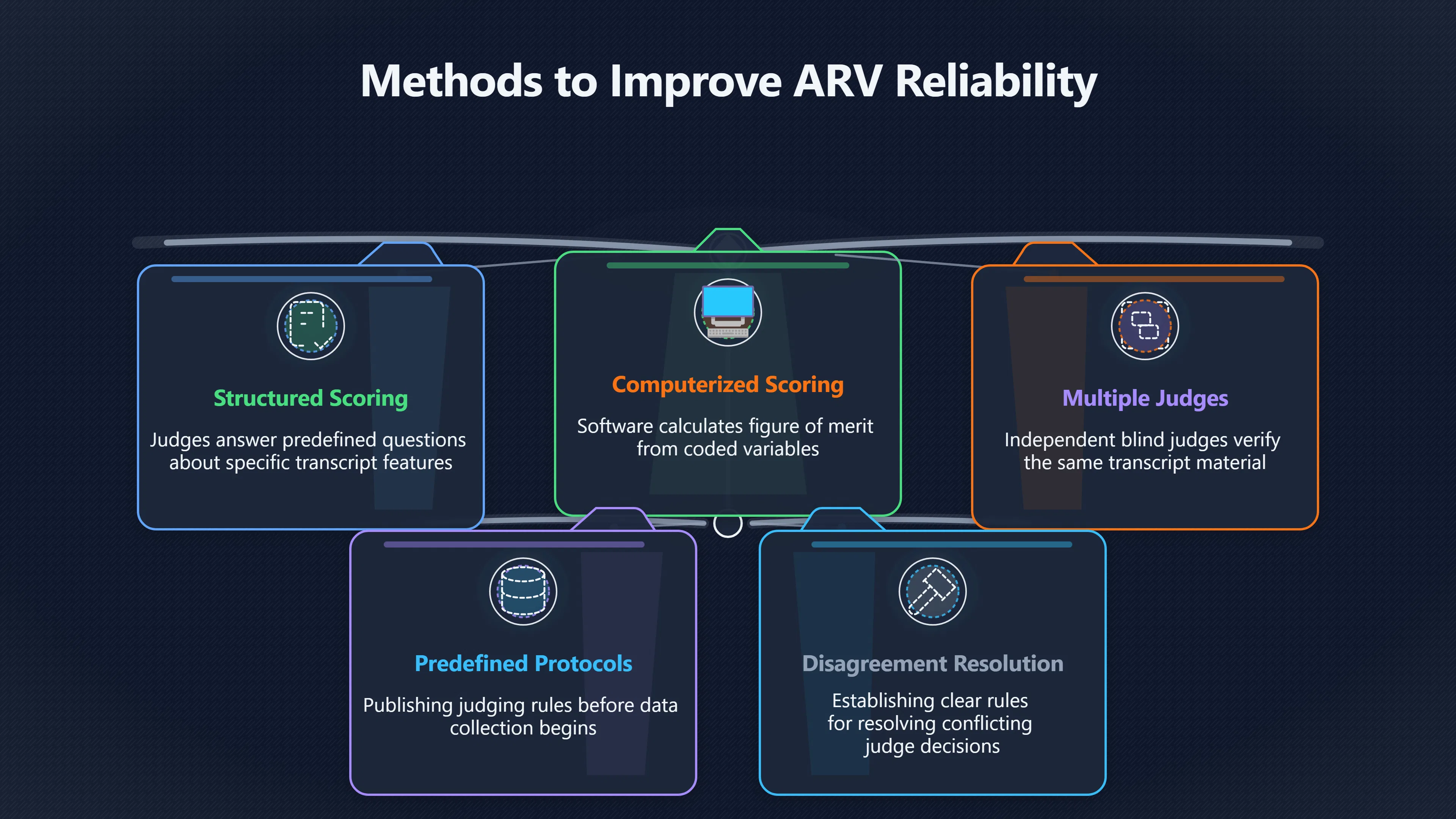
Structured scoring
Instead of asking judges simply which target “feels” like the better match, structured systems require them to answer predefined questions about specific features within the transcript.
For example, a judge may separately score the presence of:
- water
- artificial structures
- motion
- colour
- geometric forms
- living organisms
The overall prediction is then based on accumulated scores rather than an overall impression.
This approach attempts to replace intuitive matching with explicit criteria that another judge could apply in the same way.
Computer-assisted figure-of-merit systems
Edwin May and colleagues proposed reducing subjective judgement even further by converting transcript features into coded variables entered into a computer.
Instead of making the final decision directly, human coders completed structured coding sheets. Software then calculated a “figure of merit” score indicating how strongly each target matched the coded features. The goal was to minimise the influence of individual judgement styles.[ResearchGate]researchgate.netassociative remote viewing projects: assessing rater…10 Nov 2021 — Another approach to improve rater reliability developed…
Although this increased procedural consistency, it did not eliminate the initial human judgement required when coding the transcript.
Multiple independent judges
Another common safeguard is to use several blind judges rather than relying on one individual.
If several judges independently reach the same conclusion, confidence increases that the transcript genuinely favours one target.
However, this approach introduces another issue: if judges frequently disagree, researchers must decide how disagreements are resolved. Majority voting, averaging and consensus discussions each introduce different methodological assumptions.
Why this remains a difficult problem
Even carefully designed judging protocols cannot entirely remove ambiguity from natural language descriptions.
Two challenges repeatedly arise.
First, many remote-viewing impressions are symbolic rather than literal. A viewer might describe “explosion”, “brightness” or “celebration”, which could plausibly correspond to multiple photographs depending on interpretation.
Second, ARV deliberately pairs future outcomes with unrelated target photographs. The photograph associated with a sporting result or market movement often has no intrinsic connection to the event itself. Judges therefore evaluate only correspondence between transcript and image, not between transcript and the future event. Small interpretive differences can therefore reverse the resulting prediction.
These characteristics make judging fundamentally different from scoring a standard psychological test with objectively correct answers.
Practical implications for forecasting
For ARV to function as a reliable forecasting tool, two independent requirements must both hold:
- viewers must generate information related to the correct future target; and
- judges must extract that information consistently.
Failure at either stage reduces predictive performance.
This explains why some ARV practitioners regard judge training as nearly as important as viewer training. Several published analyses suggest that differences between judges can materially affect overall project success, while studies examining commercial or investment-based ARV have likewise treated judge selection as a potentially influential component of forecasting performance.[Academia+2Semantic Scholar]academia.eduAcademia(PDF) Associative Remote Viewing for Profit: Evaluating…This study examined the importance of the judge and the particular inv…
From a scientific perspective, however, this dependence also creates a challenge. If success depends heavily on particular judges whose decisions are difficult to replicate independently, it becomes harder to distinguish a genuine information signal from subjective interpretation.

How judging rules could become stricter
Researchers seeking stronger evidence generally recommend moving further away from intuitive matching and towards predefined, reproducible procedures. Possible improvements include:
- Publishing judging protocols before data collection begins.
- Using multiple fully independent blind judges.
- Measuring and reporting formal inter-rater reliability statistics rather than only prediction accuracy.
- Predefining how disagreements will be resolved.
- Separating transcript coding from final statistical analysis.
- Automating scoring wherever objective coding is possible.
These changes cannot determine whether remote viewing itself is genuine, but they can reduce one important source of uncertainty. If blind judges consistently reach the same conclusions from the same material, confidence increases that any observed effect reflects the viewing data rather than variability in human interpretation. Conversely, persistent disagreement between equally qualified judges remains a significant methodological weakness because it limits both reproducibility and the practical usefulness of ARV predictions.
Amazon book picks
Further Reading
Books and field guides related to When Blind Judges Do Not Agree. Use these as the next step if you want deeper reading beyond the article.
Statistics Done Wrong
Explains methodological pitfalls relevant to judging reliability.
The Signal and the Noise
Useful background on separating signal from subjective interpretation.


Remote Viewers: The Secret History of America's Psychic Spies
Discusses controversies over evaluating remote-viewing results.
eBay marketplace picks
Marketplace Samples
Live-tested eBay searches with available results related to this page.



Endnotes
1.
Source: cia.gov
Link:https://www.cia.gov/readingroom/docs/CIA-RDP96-00791R000200180005-5.pdf
Source snippet
AN EVALUATION OF THE REMOTE VIEWING PROGRAMIt is unclear whether the observed effects can unambiguously be attributed to the paranorma...
2.
Source: researchgate.net
Link:https://www.researchgate.net/publication/356109550_ASSOCIATIVE_REMOTE_VIEWING_PROJECTS_ASSESSING_RATER_RELIABILITY_AND_FACTORS_AFFECTING_SUCCESSFUL_PREDICTIONS
Source snippet
associative remote viewing projects: assessing rater...10 Nov 2021 — Another approach to improve rater reliability developed...
3.
Source: cia.gov
Link:https://www.cia.gov/readingroom/docs/CIA-RDP96-00789R002200660001-5.pdf
Source snippet
h as possible. Experiments in normal perception of...Read more...
4.
Source: academia.edu
Link:https://www.academia.edu/56242943/Associative_Remote_Viewing_for_Profit_Evaluating_the_Importance_of_the_Judge_and_the_Investment_Instrument
Source snippet
Academia(PDF) Associative Remote Viewing for Profit: Evaluating...This study examined the importance of the judge and the particular inv...
5.
Source: cia.gov
Link:https://www.cia.gov/readingroom/docs/CIA-RDP96-00791R000200180006-4.pdf
Source snippet
AN EVALUATION OF REMOTE VIEWINGThe second component was a review of the operational application of the remote viewing phenomenon in intel...
6.
Source: cia.gov
Link:https://www.cia.gov/readingroom/document/cia-rdp96-00791r000200180006-4
Source snippet
AN EVALUATION OF REMOTE VIEWING: RESEARCH...The rank of the correct target is the numerical score for that remote viewing.... rank-orde...
7.
Source: academia.edu
Link:https://www.academia.edu/Documents/in/associative_remote_viewing
Source snippet
associative remote viewing Research PapersTo gauge inter-rater reliability, the new scores and predictions were compared to the original...
8.
Source: academia.edu
Link:https://www.academia.edu/figures/8545451/table-5-note-this-takes-all-scores-regardless-if-the-judge
Source snippet
Figure 5 - from "Associative Remote Viewing ProjectsTo gauge inter-rater reliability, the new scores and predictions were compared to the...
9.
Source: researchgate.net
Title: 374881423 Remote Viewing A 1974 2022 Systematic Review and [Meta Analysis]({{ ‘meta-analysis/’ | relative_url }})
Link:https://www.researchgate.net/publication/374881423_Remote_Viewing_A_1974-2022_Systematic_Review_and_Meta-Analysis
Source snippet
(PDF) Remote Viewing: A 1974-2022 Systematic Review...26 Oct 2023 — This is the first meta-analysis of all studies related to remote-vie...
10.
Source: researchgate.net
Link:https://www.researchgate.net/publication/344470071_THE_ASSOCIATIVE_REMOTE_DREAMING_EXPERIMENT_A_NOVEL_APPROACH_TO_PREDICTING_FUTURE_OUTCOMES_OF_SPORTING_EVENTS
Source snippet
the associative remote dreaming experimentThis double-blind study utilised dreaming instead of remote viewing as a precognitive tool with...
11.
Source: youtube.com
Title: Learn Remote Viewing
Link:https://www.youtube.com/watch?v=i62l3aktXpo
Source snippet
Associative Remote Viewing (ARV) - Viewing Task 101...
12.
Source: youtube.com
Title: Associative Remote Viewing (ARV)
Link:https://www.youtube.com/watch?v=0yJxTpW6HAQ
Source snippet
Remote viewing judging process reliability inter-rater agreement ARV ✨Soul Land EP 01 - 130 Full Version [MULTI SUB] Anime Box...
13.
Source: koestler-parapsychology.psy.ed.ac.uk
Title: KPU 1034 Published Results
Link:https://www.koestler-parapsychology.psy.ed.ac.uk/Documents/KPU_1034_Published_Results.pdf
Source snippet
Koestler Parapsychology Unitassociative remote viewing projects: assessing rater reliability...by DL KATZ · 2021 · Cited by 10 — Associa...
14.
Source: semanticscholar.org
Link:https://www.semanticscholar.org/paper/Associative-Remote-Viewing-for-Profit%3A-Evaluating-Kruth/91382b756c8e6f59f25f2d3b497eda53507168c0
Source snippet
[PDF] Associative Remote Viewing for Profit: Evaluating the...8 Mar 2021 — This study examined the importance of the judge and the parti...
15.
Source: Wikipedia
Title: Remote viewing
Link:https://en.wikipedia.org/wiki/Remote_viewing
Source snippet
Remote viewingThe AIR report concluded that no usable intelligence data was produced in the program. [n 2] David Goslin of the America...
Additional References
16.
Source: reddit.com
Link:https://www.reddit.com/r/consciousness/comments/181s71r/the_cias_experiments_with_remote_viewing_and/
Source snippet
perimentation with Ingo Swann can provide some evidence toward “non-local...Read more...
17.
Source: parapsychologypress.org
Link:https://www.parapsychologypress.org/jparticle/jp
Source snippet
o the associative remote viewing (ARV) protocol which allows a single...Read more...
18.
Source: facebook.com
Link:https://www.facebook.com/Central.Intelligence.Agency/posts/has-cia-ever-studied-psychic-phenomena-or-remote-viewingits-a-question-we-get-as/5058607874154178/
Source snippet
ence to support its existence. The CIA's remote viewing...Read more...
19.
Source: e-space.mmu.ac.uk
Title: mmu.ac.uk Follow‐up on the U.S
Link:https://e-space.mmu.ac.uk/631983/3/Brain%20and%20Behavior%20-%202023%20-%20Escol%20%E2%80%90Gasc%20n%20-%20Follow%E2%80%90up%20on%20the%20U%20S%20%20Central%20Intelligence%20Agency%20s%20%20CIA%20%20remote%20viewing.pdf
Source snippet
Central Intelligence Agency's (CIA...by Á Escolà-Gascón · 2023 · Cited by 10 — Objectives: Since 1972, the U.S. Central Intelligence Age...
20.
Source: slideshare.net
Link:https://www.slideshare.net/slideshow/an-evaluation-of-remote-viewing-research-and-applications-air1995pdf/257460594
Source snippet
An Evaluation of Remote Viewing, Research and...Remote viewing reports provided vague and ambiguous information that was not useful for...
21.
Source: pmc.ncbi.nlm.nih.gov
Link:https://pmc.ncbi.nlm.nih.gov/articles/PMC10275521/
Source snippet
Central Intelligence Agency's (CIA...by Á Escolà‐Gascón · 2023 · Cited by 10 — Since 1972, the U.S. Central Intelligence Agency (CIA) co...
22.
Source: pmc.ncbi.nlm.nih.gov
Link:https://pmc.ncbi.nlm.nih.gov/articles/PMC10921830/
Source snippet
Scale for Assessment and Rating of Ataxia Is Reliable...by R Reoli · 2023 · Cited by 4 — The goal of this project is to evaluate the psy...
23.
Source: youtube.com
Title: The Science Behind Remote Viewing Explained
Link:https://www.youtube.com/watch?v=B9fv5diIi-Y
Source snippet
CONTROLLED REMOTE VIEWING - Lori Williams #32...
24.
Source: scribd.com
Title: RVMeta Analysis
Link:https://www.scribd.com/document/668687232/RVMetaAnalysis
Source snippet
Remote Viewing Meta-Analysis 1974-2022 | PDFThis document provides a meta-analysis of 36 studies on remote viewing conducted between 1974...
25.
Source: ciaotest.cc.columbia.edu
Title: sa jan02srm01
Link:https://ciaotest.cc.columbia.edu/olj/sa/sa_jan02srm01.html
Source snippet
Remote Viewing: The US Sponsored Psychic...This paper deals with experiments conducted in USA in which certain individuals were trained...
Topic Tree
Follow this branch
Parent topic
Future Targets Can Remote Viewing Claim the Future?Related pages 5
- Associative Remote Viewing (ARV) Why Future Predictions Become Image Matches
- Chicago Trial What the Chicago Precognition Trial Really Tested
- CIA Protocols Inside the CIA Records on Future Targets
- Selective Hits Why Winning Streaks Can Mislead
- Timing Test Can a Future Target Anchor an Earlier Session?