Within Lab vs Real
When a Lab Hit Is Not Useful
A laboratory hit can look impressive while still failing to answer the concrete question a real user needs solved.
On this page
- What a laboratory hit usually means
- Why relative matching differs from real decisions
- How wrong or vague details change practical value
Page outline Jump by section
Introduction
A laboratory “hit” in a remote-viewing experiment is not automatically a useful answer to a real-world problem. In most laboratory studies, success is measured by whether a description resembles a hidden target better than chance would predict after the fact. Outside the laboratory, however, users need information they can trust before the answer is known and before acting on it. A search team needs the correct location, an intelligence analyst needs reliable details, and a business decision-maker needs information that improves choices under uncertainty.
This distinction explains why laboratory findings and operational value are separate questions. Even reviews that acknowledged statistically significant laboratory results concluded that the available evidence did not demonstrate practical usefulness for intelligence work because the information produced was often inconsistent, ambiguous or insufficiently specific for decision-making.[CIA]cia.govAN EVALUATION OF THE REMOTE VIEWING PROGRAMEven though a statistically significant effect has been observed in the laboratory, it rema…
What a laboratory hit usually means
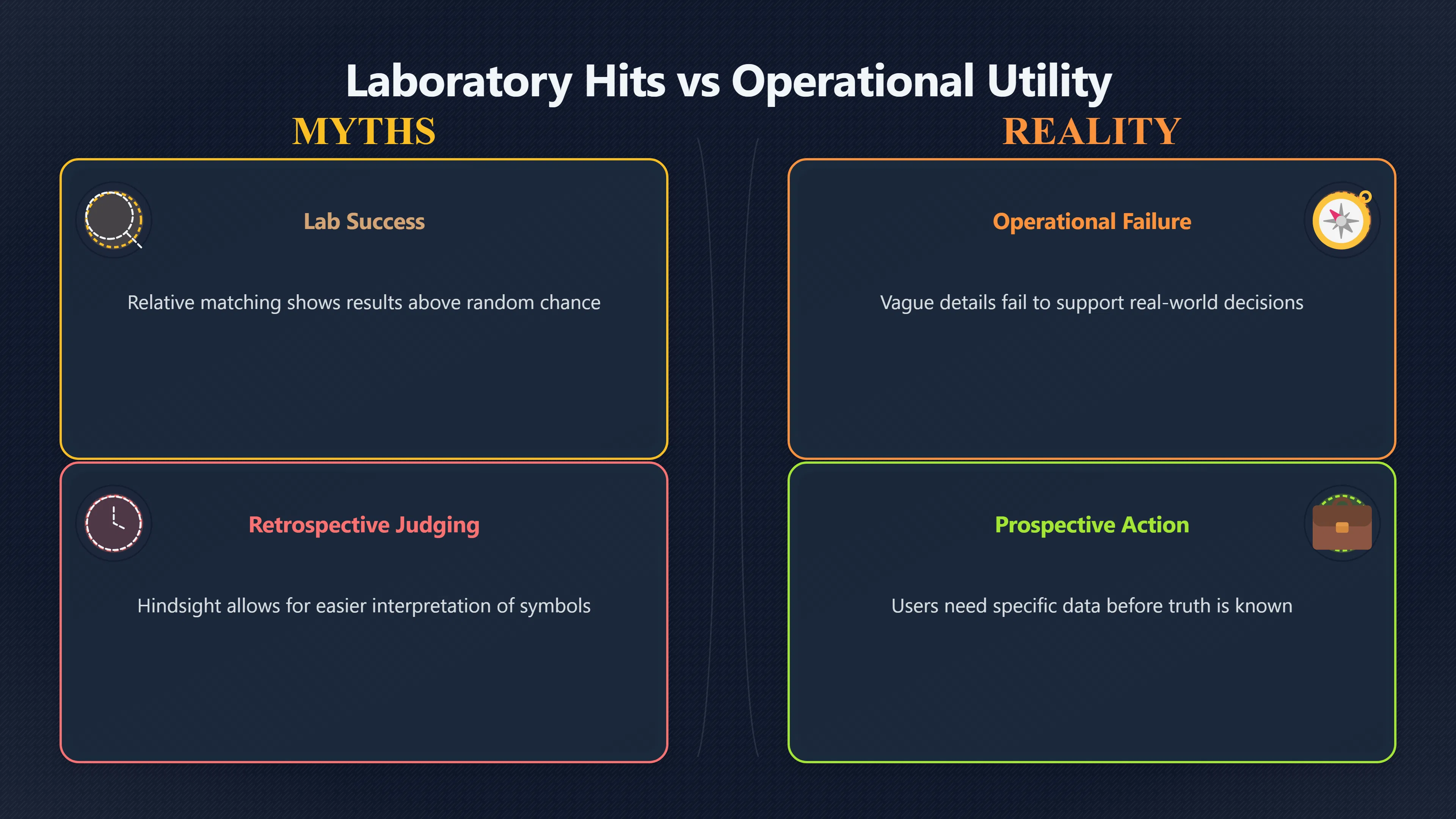
In many remote-viewing experiments, the viewer is asked to describe a concealed target such as a photograph or location. Afterwards, an independent judge compares the transcript against several candidate targets and decides which one fits best. Success is therefore often defined as relative matching: one description resembles one target more closely than the alternatives.
This is a valid way to investigate whether performance differs from random expectation, but it answers a narrower question than practical users face. The judge already knows that the correct answer exists somewhere within a limited target pool. The task is to identify the best match after all the evidence has been collected.[CIA]cia.govAN EVALUATION OF THE REMOTE VIEWING PROGRAMEven though a statistically significant effect has been observed in the laboratory, it rema…
Real decisions work differently. There is usually:
- no predefined list of possible answers;
- no opportunity to compare several known targets;
- no judge who already knows the correct solution;
- no guarantee that any part of the session is accurate.
A transcript that wins a laboratory comparison because it vaguely resembles one photograph better than three others may still fail to identify a missing object, predict an event or support an operational decision.
Why relative matching differs from real decisions
The difference is not simply statistical; it changes how information is used.
Laboratory judging rewards overall resemblance. A transcript mentioning “water”, “large structures”, “open space” and “movement” may fit one coastal photograph better than several inland alternatives. Even if many details are wrong, the overall similarity may still produce a successful ranking.
A real user cannot rely on that type of comparison. They need statements that can be interpreted directly before any outcome is known. Questions typically include:
- Where exactly is the object?
- Which individual is involved?
- What will happen?
- When will it occur?
- How confident should the decision-maker be?
Those questions require absolute rather than relative accuracy.
This implementation gap was emphasised in the American Institutes for Research review commissioned by the CIA. The reviewers distinguished between laboratory evidence suggesting statistically unusual results and operational value, concluding that there was no documented evidence that the programme had produced intelligence of practical value. They also noted that even if an anomalous effect existed, its usefulness for intelligence remained unproven.[CIA]cia.govAN EVALUATION OF THE REMOTE VIEWING PROGRAMEven though a statistically significant effect has been observed in the laboratory, it rema…

How wrong or vague details change practical value
Practical decisions are often constrained by the weakest information rather than the strongest.
Imagine a session that correctly conveys the impression of an industrial setting but incorrectly identifies the country, time or facility. From a laboratory perspective, the broad resemblance may contribute to a successful match. Operationally, those incorrect details can completely alter the conclusion.
Several characteristics reduce practical value:
- Vagueness. General impressions such as “metal”, “mountains” or “water” apply to many possible targets.
- Mixed accuracy. Correct fragments are accompanied by incorrect specifics, making it difficult to know which statements deserve confidence.
- No confidence calibration. Remote-viewing sessions rarely indicate which individual impressions are dependable before verification.
- Post hoc interpretation. After the true target is revealed, people naturally notice successful correspondences while discounting incorrect or irrelevant statements.
Because decisions must be made before feedback is available, users cannot separate genuine information from coincidence in real time. This is fundamentally different from retrospective judging.
The implementation problem
Suppose a laboratory protocol produces above-chance matching across many trials. That result alone does not tell a user how to employ remote viewing in practice.
An operational method would need to answer several implementation questions:
- When should a session be trusted?
- Which statements are reliable enough to justify action?
- How often are important details wrong?
- Can successful sessions be identified before independent confirmation?
- Does acting on the information improve outcomes compared with conventional methods?
These questions concern decision quality rather than statistical significance.
The 1995 evaluation concluded that such evidence was lacking. While the reviewers acknowledged laboratory findings that appeared statistically significant, they found that operational reports tended to contain vague and ambiguous information that was difficult to use and had not been demonstrated to contribute meaningfully to intelligence operations.[CIA]cia.govAN EVALUATION OF REMOTE VIEWINGA statistically significant laboratory effort has been demonstrated in the sense that hits occur more o…

Why hindsight can exaggerate apparent success
Another reason laboratory hits can appear more impressive than their practical value is the influence of hindsight.
Once the correct target is known, readers can reinterpret symbolic language or broad descriptions to fit the outcome. A phrase like “tower”, “energy”, “curved surface” or “crowded activity” may seem striking after the target is revealed, even though those descriptions could plausibly apply to many alternatives.
Laboratory protocols attempt to reduce this problem through blinding and independent judging. Even so, critics have argued that some historically influential studies contained methodological issues affecting judging procedures or allowing subtle cues, while proponents have responded with revised protocols and stronger controls in later work. Regardless of that debate, both supporters and sceptics generally recognise that retrospective resemblance is not the same as prospective operational usefulness.[Hertfordshire Research Profiles+2ResearchGate]researchprofiles.herts.ac.ukexperiment one of the saic remote viewing program a critical re eHertfordshire Research ProfilesExperiment One of the SAIC Remote Viewing Programby R Wiseman · 1999 · Cited by 24 — The paper demonstrate…
Why this distinction matters
The central practical question is not whether some laboratory studies report above-chance performance. It is whether those results can consistently produce information that improves real decisions before the truth is known.
Laboratory experiments are designed to detect small statistical effects under controlled conditions. Real-world users must commit resources, change plans or accept risk based on information available in advance. Unless a method reliably provides specific, independently verifiable and actionable information at that point, laboratory hits do not automatically translate into practical capability.
For remote viewing, this distinction explains why debates over statistical significance and debates over operational usefulness often reach different conclusions. A result can appear meaningful within an experimental scoring system while remaining too uncertain, too general or too inconsistent to support decisions that carry real-world consequences.[CIA+2Alice]cia.govAN EVALUATION OF THE REMOTE VIEWING PROGRAMEven though a statistically significant effect has been observed in the laboratory, it rema…
Amazon book picks
Further Reading
Books and field guides related to When a Lab Hit Is Not Useful. Use these as the next step if you want deeper reading beyond the article.
Thinking, Fast and Slow
Clarifies why statistical success may not translate into useful decisions.
The Demon-Haunted World
Explains the difference between intriguing results and reliable knowledge.

eBay marketplace picks
Marketplace Samples
Live-tested eBay searches with available results related to this page.



Endnotes
1.
Source: cia.gov
Link:https://www.cia.gov/readingroom/docs/CIA-RDP96-00791R000200180005-5.pdf
Source snippet
AN EVALUATION OF THE REMOTE VIEWING PROGRAMEven though a statistically significant effect has been observed in the laboratory, it rema...
2.
Source: cia.gov
Link:https://www.cia.gov/readingroom/docs/CIA-RDP96-00791R000200180006-4.pdf
Source snippet
AN EVALUATION OF REMOTE VIEWINGA statistically significant laboratory effort has been demonstrated in the sense that hits occur more o...
3.
Source: researchgate.net
Title: 369604750 Remote Viewing a 1974 2022 systematic review and [meta analysis]({{ ‘meta-analysis/’ | relative_url }})
Link:https://www.researchgate.net/publication/369604750_Remote_Viewing_a_1974-2022_systematic_review_and_meta-analysis
Source snippet
(PDF) Remote Viewing: a 1974-2022 systematic review...This is the first meta-analysis of all studies related to remote viewing tasks con...
4.
Source: cia.gov
Title: A N EVALUATION OF THE REMOTE VIEWING PROGRAM
Link:https://www.cia.gov/readingroom/document/cia-rdp96-00791r000200180005-5
Source snippet
laboratory studies of remote viewing indicate that a statistically significant effect has been obtained. Likewise, they agree that the cu...
5.
Source: researchgate.net
Title: 333228024 An Assessment of the Evidence for Psychic Functioning
Link:https://www.researchgate.net/publication/333228024_An_Assessment_of_the_Evidence_for_Psychic_Functioning
Source snippet
An Assessment of the Evidence for Psychic FunctioningThe significance of remote viewing is that, as alluded to above, in the 1990s Congre...
6.
Source: researchgate.net
Link:https://www.researchgate.net/publication/403178755_The_Star_Gate_Archives_Reports_of_the_United_States_Government_Sponsored_Psi_Program_1972-1995_Volume_4_Operational_Remote_Viewing_Memorandums_and_Reports
Source snippet
(PDF) The [Star Gate]({{ 'star-gate/' | relative_url }}) Archives: Reports of the United States...26 Apr 2026 — The second component was a review of the operational applicat...
7.
Source: researchgate.net
Title: 345430975 Remote Viewing Applications An Historical Overview and a New Survey
Link:https://www.researchgate.net/publication/345430975_Remote_Viewing_Applications_An_Historical_Overview_and_a_New_Survey
Source snippet
Remote Viewing Applications: An Historical Overview and...8 Nov 2020 — The main findings are that remote viewing applications are wide...
8.
Source: alice.id.tue.nl
Link:https://www.alice.id.tue.nl/references/mumford-rose-goslin-1995.pdf
Source snippet
An Evaluation of Remote Viewing: Research and...by MD Mumford · 1995 · Cited by 75 — A statistically significant effect has been ob...
9.
Source: researchprofiles.herts.ac.uk
Title: experiment one of the saic remote viewing program a critical re e
Link:https://researchprofiles.herts.ac.uk/en/publications/experiment-one-of-the-saic-remote-viewing-program-a-critical-re-e
Source snippet
Hertfordshire Research ProfilesExperiment One of the SAIC Remote Viewing Programby R Wiseman · 1999 · Cited by 24 — The paper demonstrate...
10.
Source: Wikipedia
Title: Remote viewing
Link:https://en.wikipedia.org/wiki/Remote_viewing
Source snippet
Remote viewingThe program ran from 1975 to 1995 and ended after evaluators concluded that remote viewers consistently failed to produc...
Additional References
11.
Source: greydynamics.com
Link:https://greydynamics.com/intelligence-past-the-tangible-world-cias-[stargate
Source snippet
Intelligence Past the Tangible World: CIA's Stargate ProjectRemote Viewing (RV) as a tool for intelligence gathering gained footing...
12.
Source: slideshare.net
Link:https://www.slideshare.net/slideshow/an-evaluation-of-remote-viewing-research-and-applications-air1995pdf/257460594
Source snippet
atory research, it was unclear if this was due to paranormal ability.Read more...
13.
Source: facebook.com
Title: the Stargate Project
Link:https://www.facebook.com/100090372200308/posts/for-nearly-20-years-the-us-government-secretly-funded-one-of-its-strangest-intel/842493785439687/
Source snippet
The CIA and US Army trained “remote...The evaluators found that while laboratory experiments showed statistically significant effects, t...
14.
Source: pmc.ncbi.nlm.nih.gov
Link:https://pmc.ncbi.nlm.nih.gov/articles/PMC10275521/
Source snippet
Central Intelligence Agency's (CIA...by Á Escolà‐Gascón · 2023 · Cited by 10 — Since 1972, the U.S. Central Intelligence Agency (CIA) co...
15.
Source: youtube.com
Title: Joseph Mc Moneagle, Army’s Stargate Project Remote Viewer | EOC Ep.13
Link:https://www.youtube.com/watch?v=7f5H05-4_xQ
Source snippet
Science, Telepathy And The Unexplained Power Of The Human Mind...
16.
Source: youtube.com
Title: Stargate Project: How Did the CIA Turn the Human Mind into a Weapon?
Link:https://www.youtube.com/watch?v=IDPlEXpzRoQ
Source snippet
Remote Viewing and Statistical Validation...
17.
Source: ciaotest.cc.columbia.edu
Title: sa jan02srm01
Link:https://ciaotest.cc.columbia.edu/olj/sa/sa_jan02srm01.html
Source snippet
Remote Viewing: The US Sponsored Psychic...This paper deals with experiments conducted in USA in which certain individuals were trained...
18.
Source: youtube.com
Title: [Third Eye Spies]({{ ‘third-eye-spies/’ | relative_url }}) with Russell Targ
Link:https://www.youtube.com/watch?v=k9AsG1iNAyc
Source snippet
Joseph McMoneagle, Army's Stargate Project Remote Viewer | EOC Ep.13...
19.
Source: youtube.com
Title: Remote Viewing and Statistical Validation
Link:https://www.youtube.com/watch?v=YrwAiU2g5RU
Source snippet
Third Eye Spies with Russell Targ...
20.
Source: youtube.com
Title: Science, Telepathy And The Unexplained Power Of The Human Mind
Link:https://www.youtube.com/watch?v=ZApw9RW4q4E
Topic Tree