Within Middle View
Why Vague Impressions Can Feel Accurate
Remote-viewing claims often depend on matching fragmentary descriptions to targets after the session ends.
On this page
- How free response descriptions invite interpretation
- Why judging can amplify weak matches
- Where coincidence and selective reading enter
Page outline Jump by section
Introduction
One of the central disagreements about remote viewing is not simply whether people sometimes produce striking descriptions, but how those descriptions are evaluated. Many remote-viewing sessions generate sketches, isolated words, sensory impressions and broad themes rather than precise, testable statements. Once the actual target is revealed, those fragments can appear surprisingly accurate because people naturally connect ambiguous details to information they already know. Supporters argue that careful judging procedures can detect genuine correspondences, while sceptics contend that hindsight and flexible interpretation can make weak matches look compelling. Understanding this mechanism helps explain why the same transcript can seem persuasive to one reader and unconvincing to another.[National Security Archive]nsarchive2.gwu.eduNational Security ArchiveAn Evaluation of Remote Viewing: Research and…March 13, 2015 — by MD Mumford · 1995 · Cited by 76 — The resul…

How free-response descriptions invite interpretation
Unlike a multiple-choice test, traditional remote-viewing experiments often ask participants to write or draw whatever comes to mind. A transcript may contain descriptions such as “something metallic”, “water nearby”, “a tall structure”, “movement”, or rough geometric sketches. These reports are intentionally open-ended, because proponents argue that forcing specific answers may interfere with whatever process they believe is operating.[Psi Encyclopedia]psi-encyclopedia.spr.ac.ukPsi Encyclopedia Remote ViewingPsi EncyclopediaRemote Viewing - Psi Encyclopedia13 Jan 2017 — Remote viewing replaced repetitive forced-choice tasks with free-response…
The same openness that gives participants freedom also creates interpretive flexibility. A single phrase can plausibly fit many different targets:
- “Curved shape” might later be linked to a bridge, a coastline, an arch or a bowl.
- “Blue” could refer to the sea, the sky, painted walls or clothing.
- “Power” might be interpreted as machinery, electricity, authority or emotional intensity.
When the correct target is already known, it becomes much easier to notice similarities than mismatches. Details that fit are emphasised, while statements that do not fit often receive less attention.
Psychologists describe this as a broader feature of human pattern recognition rather than something unique to remote viewing. People naturally search for coherent narratives and meaningful correspondences, particularly when presented with incomplete information. This tendency is closely related to subjective validation, in which ambiguous statements seem highly accurate because the reader supplies much of the meaning.[Wikipedia+2Wikipedia]WikipediaStargate Project (U.S. Army unitStargate Project (U.S. Army unit
Why judging can amplify weak matches
The way remote-viewing sessions are scored has long been one of the most debated aspects of the field.
Many classic experiments relied on independent judges who compared a participant’s transcript against several possible targets and ranked which target seemed to fit best. Properly blinded judging is an important safeguard and remains central to many experimental protocols. Supporters argue that if judges consistently identify the correct target more often than chance, this provides statistical evidence worth investigating.[CIA]cia.govAN EVALUATION OF THE REMOTE VIEWING PROGRAMA judge then examines the viewer's report and determines if this report matches the target…
Critics, however, argue that judging itself can unintentionally magnify weak correspondences. When a transcript contains dozens of statements and sketches, a judge may naturally focus on the handful that resemble one target while discounting contradictory material. The more information contained in both the transcript and the target, the greater the opportunity for selective matching.
The 1995 American Institutes for Research evaluation noted that earlier remote-viewing research attracted criticism over scoring methods and possible cues within transcripts. Although later studies improved their methodology, questions about subjective interpretation remained part of the continuing debate.[National Security Archive]nsarchive2.gwu.eduNational Security ArchiveAn Evaluation of Remote Viewing: Research and…March 13, 2015 — by MD Mumford · 1995 · Cited by 76 — The resul…
This issue also explains why sceptics often distinguish between statistical outcomes and practical usefulness. Even if a judging procedure identifies above-chance correspondences across many trials, that does not necessarily mean an individual transcript contains clear, actionable information that could stand on its own without interpretation.
Where coincidence and selective reading enter
Chance alone guarantees that some broad descriptions will resemble almost any sufficiently rich target. If a transcript contains dozens of observations, it becomes increasingly likely that at least a few will appear impressive after the target is revealed.
Several well-known cognitive processes contribute to this impression:
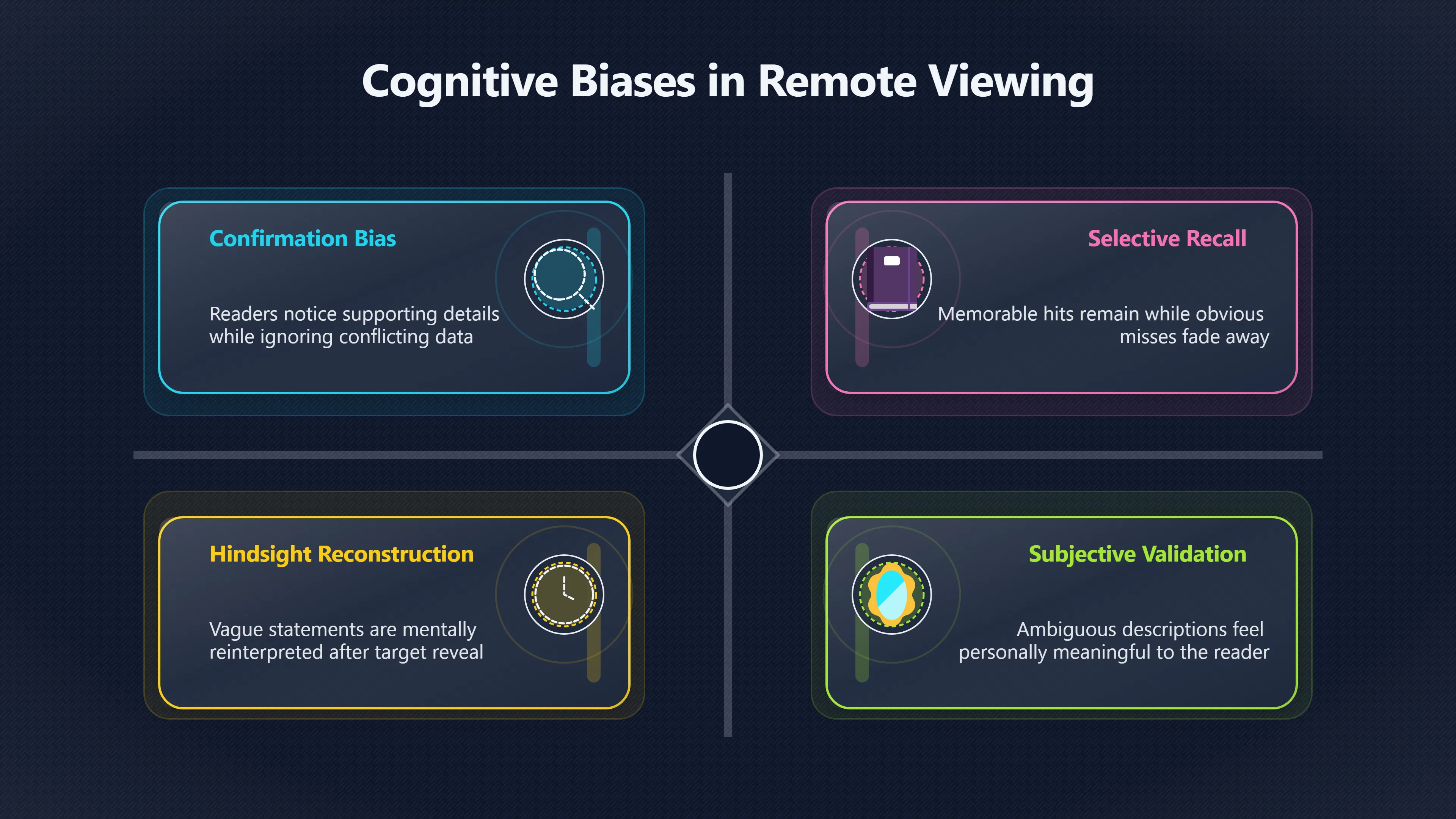
- Confirmation bias: readers notice supporting details more readily than conflicting ones.
- Selective recall: memorable “hits” are remembered, while obvious misses fade from memory.
- Hindsight reconstruction: after learning the target, vague statements are mentally reinterpreted as having predicted it.
- Subjective validation: individuals experience ambiguous descriptions as personally or contextually meaningful.[Wikipedia]WikipediaBarnum effectBarnum effect
For example, a transcript mentioning “water”, “white”, “noise” and “height” might seem remarkably descriptive once the target is known to be a waterfall. Yet the same collection of words could also plausibly fit a snowy mountain, an ocean coastline or a lighthouse. The apparent specificity often emerges only after the answer is available.
This does not automatically prove that every successful match results from coincidence. Rather, it illustrates why rigorous experiments attempt to prevent participants, judges and researchers from knowing the target until scoring is complete.
Why this remains disputed
Supporters of remote viewing generally accept that vague descriptions require careful judging, but argue that properly designed blind protocols minimise hindsight effects. Modern proponents often point to statistical analyses across many trials rather than dramatic individual examples, arguing that repeated above-chance matching cannot be explained solely by selective interpretation.[ResearchGate]researchgate.netMatching tasks are considered the gold standard across all free response-typeResearchGate(PDF) Remote Viewing: a 1974-2022 systematic review …This is the first meta-analysis of all studies related to remote viewi…
Sceptics respond that statistical claims must still be interpreted in light of how transcripts are generated, scored and analysed. Ray Hyman argued during the CIA-sponsored review that the majority of remote-viewing material was broad and imprecise, and that the apparent successes were consistent with ordinary processes such as subjective validation and reasonable guessing.[National Security Archive]nsarchive2.gwu.eduNational Security ArchiveAn Evaluation of Remote Viewing: Research and…March 13, 2015 — by MD Mumford · 1995 · Cited by 76 — The resul…
As a result, both sides often examine the same transcript through different lenses. Believers ask whether the overall correspondence exceeds what chance would predict across repeated experiments. Sceptics ask whether the individual descriptions were genuinely specific before the target was known, or whether they only appeared impressive after hindsight shaped the comparison.
For readers trying to assess remote-viewing claims, this distinction is crucial. A description that feels compelling after the fact is not necessarily evidence of paranormal perception. The key question is whether the information was sufficiently specific, independently judged and resistant to alternative interpretations before anyone knew what it was supposed to describe.

Amazon book picks
Further Reading
Books and field guides related to Why Vague Impressions Can Feel Accurate. Use these as the next step if you want deeper reading beyond the article.
Thinking, Fast and Slow
Explains why ambiguous impressions can feel convincing once interpreted after the fact.
The Demon-Haunted World
Provides a skeptical toolkit for evaluating vague or flexible claims.

Remote Viewers: The Secret History of America's Psychic Spies
Gives background on free-response remote-viewing sessions and the interpretive problems around them.
How We Know What Isn't So
Rating: 4.0/5 from 6 Google Books ratings
Focuses on how people construct mistaken beliefs from weak or ambiguous evidence.
eBay marketplace picks
Marketplace Samples
Live-tested eBay searches with available results related to this page.
Endnotes
1.
Source: cia.gov
Link:https://www.cia.gov/readingroom/docs/CIA-RDP96-00791R000200180005-5.pdf
Source snippet
AN EVALUATION OF THE REMOTE VIEWING PROGRAMA judge then examines the viewer's report and determines if this report matches the target...
2.
Source: researchgate.net
Title: Matching tasks are considered the gold standard across all free response-type
Link:https://www.researchgate.net/publication/369604750Remote_Viewing_a_1974-2022_systematic_review_and[meta-analysis
Source snippet
ResearchGate(PDF) Remote Viewing: a 1974-2022 systematic review...This is the first meta-analysis of all studies related to remote viewi...
3.
Source: Wikipedia
Title: Stargate Project (U.S. Army unit)
Link:https://en.wikipedia.org/wiki/Stargate_Project_%28U.S._Army_unit%29
4.
Source: Wikipedia
Title: Jessica Utts
Link:https://en.wikipedia.org/wiki/Jessica_Utts
5.
Source: Wikipedia
Title: Barnum effect
Link:https://en.wikipedia.org/wiki/Barnum_effect
6.
Source: Wikipedia
Title: Remote viewing
Link:https://en.wikipedia.org/wiki/Remote_viewing
Source snippet
Remote viewingRemote viewing (RV) is the practice of seeking impressions about a distant or unseen subject, purportedly sensing with t...
7.
Source: nsarchive2.gwu.edu
Link:https://nsarchive2.gwu.edu/NSAEBB/NSAEBB438/docs/doc_57.pdf
Source snippet
National Security ArchiveAn Evaluation of Remote Viewing: Research and...March 13, 2015 — by MD Mumford · 1995 · Cited by 76 — The resul...
Published: March 13, 2015
8.
Source: psi-encyclopedia.spr.ac.uk
Title: Psi Encyclopedia Remote Viewing
Link:https://psi-encyclopedia.spr.ac.uk/articles/remote-viewing/
Source snippet
Psi EncyclopediaRemote Viewing - Psi Encyclopedia13 Jan 2017 — Remote viewing replaced repetitive forced-choice tasks with free-response...
Additional References
9.
Source: koestlerunit.wordpress.com
Link:https://koestlerunit.wordpress.com/wp-content/uploads/2015/06/wiseman-milton-1998.pdf
Source snippet
(Utts, 1995a; Hyman, 1995a) and a concluding section that outlined the main points of...
10.
Source: pmc.ncbi.nlm.nih.gov
Title: PMCFollow‐up on the U.S
Link:https://pmc.ncbi.nlm.nih.gov/articles/PMC10275521/
Source snippet
Central Intelligence Agency's (CIA...by Á Escolà‐Gascón · 2023 · Cited by 10 — Hyman (1996) and other skeptical researchers criticized t...
11.
Source: reddit.com
Link:https://www.reddit.com/r/remoteviewing/comments/1501do7/the_complete_skeptics_guide_to_remote_viewing_how/
Source snippet
nd what the field needs to address in order to be legitimized...
12.
Source: youtube.com
Title: Confirmation Bias and The Scientific Method I: How to Avoid Confirmation Bias
Link:https://www.youtube.com/watch?v=tOZLL7CsHCU
Source snippet
The Hindsight Bias: Action The Illusion of Predictability...
13.
Source: youtube.com
Title: Why Psychology Tells Us What We Already Know
Link:https://www.youtube.com/watch?v=csqOL_KT4Go
Source snippet
Confirmation Bias and The Scientific Method I: How to Avoid Confirmation Bias...
14.
Source: ciaotest.cc.columbia.edu
Title: sa jan02srm01
Link:https://ciaotest.cc.columbia.edu/olj/sa/sa_jan02srm01.html
Source snippet
Remote Viewing: The US Sponsored Psychic...This paper deals with experiments conducted in USA in which certain individuals were trained...
15.
Source: youtube.com
Title: Remote Viewing Explained: How the Mind Sees Without Eyes
Link:https://www.youtube.com/watch?v=whpZzUwrUNU
Source snippet
Why Psychology Tells Us What We Already Know...
16.
Source: youtube.com
Title: Michael Shermer Remote Viewing Experiment Part 1
Link:https://www.youtube.com/watch?v=40QVp8_P0LY
Source snippet
Remote Viewing Explained: How the Mind Sees Without Eyes...
17.
Source: youtube.com
Title: The Hindsight Bias: Action The Illusion of Predictability
Link:https://www.youtube.com/watch?v=eYXh3ZCW9fs
Topic Tree