Within SRI Tests
What Did Ingo Swann Really Predict?
Ingo Swann's Jupiter episode is memorable, but delayed planetary feedback made clean validation unusually difficult.
On this page
- What the Jupiter session claimed
- Why later spacecraft findings were invoked
- Why broad descriptions make confirmation tricky
Page outline Jump by section
Introduction
Ingo Swann’s 1973 remote-viewing session on Jupiter remains one of the most frequently cited episodes in the history of remote viewing because it appears, at first glance, to contain successful predictions made years before spacecraft provided detailed observations of the planet. Supporters argue that Swann described features such as rings and unusual atmospheric characteristics before they were confirmed by later NASA missions. Critics counter that the session also contained numerous statements that proved inaccurate, and that later discussions have often highlighted the apparent successes while overlooking the misses. This pattern—remembering the parts that seem confirmed while discounting those that were not—is a classic example of selective confirmation. Understanding that process is essential to assessing what the Jupiter session can, and cannot, demonstrate.[CIAO]ciaotest.cc.columbia.eduround Jupiter and wondered if perhaps he had remote-viewed the planet Saturn by…Read more…
What the Jupiter session claimed
The Jupiter experiment was conducted at the Stanford Research Institute (SRI) on 27 April 1973 at Swann’s request. Russell Targ and Harold Puthoff initially hesitated because, unlike terrestrial remote-viewing targets, Jupiter could not be checked immediately. Any assessment would have to wait for future space missions, making the experiment unusual even by SRI standards.[CIAO]ciaotest.cc.columbia.eduround Jupiter and wondered if perhaps he had remote-viewed the planet Saturn by…Read more…
During the session Swann reported a mixture of broad impressions and specific observations. Accounts published by Swann and later reproduced in remote-viewing literature include claims that:
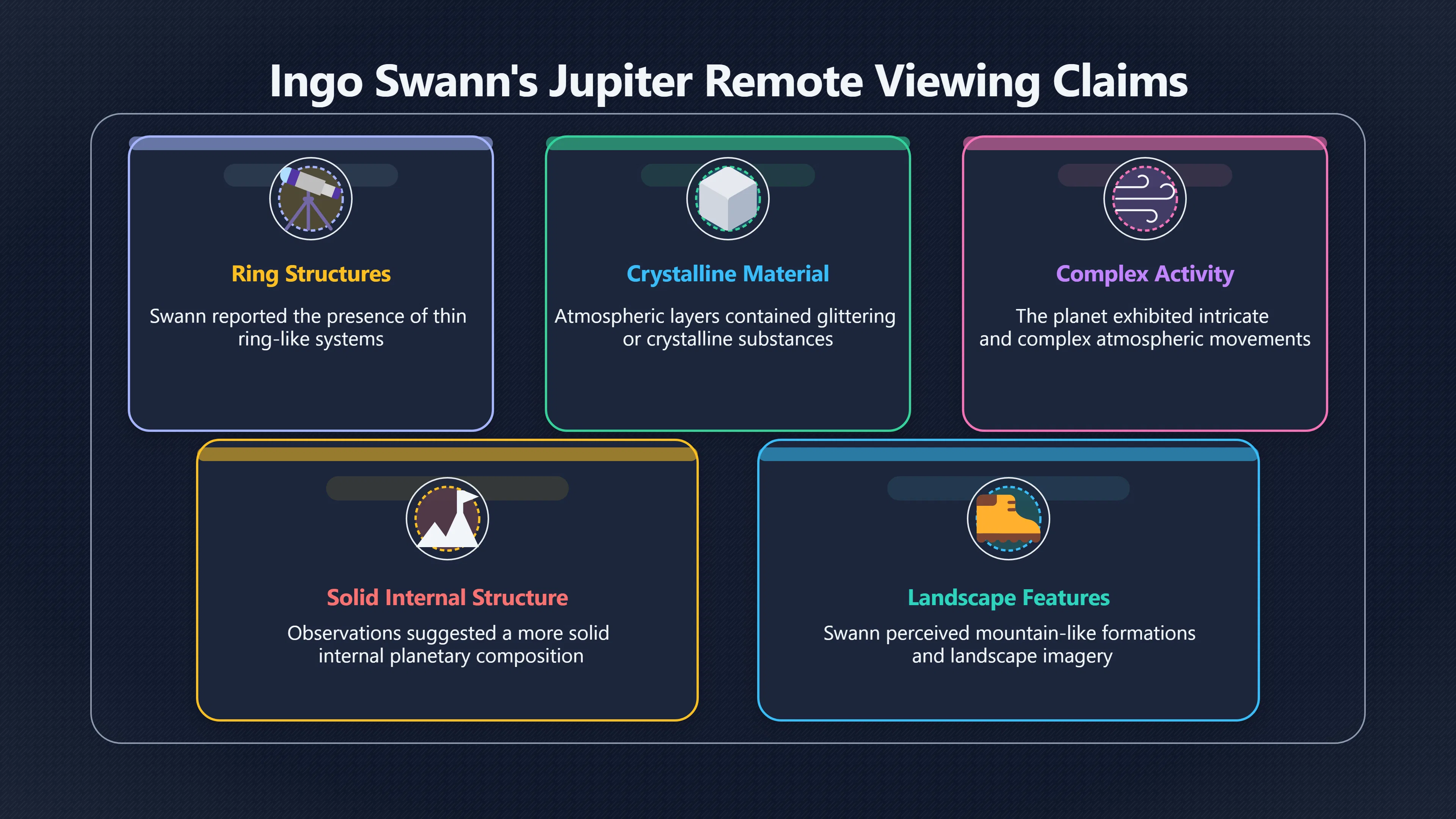
- Jupiter possessed ring-like structures.
- The atmosphere contained glittering or crystalline material.
- The planet exhibited complex atmospheric activity.
- There were features suggesting a more solid internal structure than modern planetary science accepts.
- He perceived mountain-like formations and other landscape-style imagery inconsistent with the present scientific understanding of Jupiter as a gas giant.[Wikipedia]WikipediaIngo SwannIngo Swann
Importantly, these statements were recorded together as a single session rather than emerging one by one after later discoveries.
Why later spacecraft findings were invoked
The case became famous after NASA’s planetary missions transformed scientific knowledge of Jupiter.
The strongest point repeatedly cited by supporters concerns Jupiter’s faint ring system. Voyager 1 revealed the rings in 1979, several years after Swann’s session. Because few scientists expected such rings before Voyager, advocates argue that this represented an unusually successful prediction.[CIAO]ciaotest.cc.columbia.eduround Jupiter and wondered if perhaps he had remote-viewed the planet Saturn by…Read more…
Supporters have also pointed to later observations of ammonia ice crystals within parts of Jupiter’s atmosphere, arguing that Swann’s references to glittering crystalline material anticipated features that were only characterised decades later through spacecraft observations, including findings from the Galileo mission.[Wikipedia]WikipediaIngo SwannIngo Swann
However, these comparisons are less straightforward than they sometimes appear. Swann described crystal-like structures very close within the atmosphere, whereas Jupiter’s ring system exists outside the atmosphere. Later discussions often combine these two separate ideas, making it difficult to determine precisely which statement is being treated as the successful prediction.[Wikipedia]WikipediaIngo SwannIngo Swann

Why broad descriptions make confirmation tricky
The Jupiter session illustrates a common difficulty in evaluating extraordinary claims: broad or ambiguous statements can acquire new meanings after additional evidence becomes available.
Several features of the case complicate straightforward validation.
Descriptions were interpretive rather than quantitative. Swann produced verbal imagery instead of precise measurements. Terms such as “crystals”, “rings”, “bands”, or “mountains” leave considerable room for later interpretation.
Planetary science changed dramatically after 1973. Information returned by Pioneer, Voyager, Galileo and later missions vastly expanded scientific knowledge of Jupiter. As new discoveries accumulated, it became increasingly possible to match at least some earlier statements to newly observed features.
Not every statement received equal attention. Discussions frequently emphasise the apparent ring prediction while giving much less attention to claims that conflict with modern planetary science, such as descriptions suggesting a solid surface or mountain ranges.[Wikipedia]WikipediaIngo SwannIngo Swann
This asymmetry is central to the debate.
The role of selective confirmation
Selective confirmation occurs when evidence supporting a claim receives greater attention than evidence contradicting it.
The Jupiter session offers several opportunities for this effect:
- successful-looking statements are repeatedly quoted;
- inaccurate or unverifiable statements are mentioned less often;
- vague descriptions are interpreted using knowledge unavailable when the session occurred;
- later discoveries encourage retrospective matching rather than prospective testing.
Critics argue that evaluating the session fairly requires examining the complete transcript rather than isolated passages. A prediction should ideally be assessed against all recorded claims before later knowledge influences interpretation. This approach reduces the risk of “cherry-picking” only the strongest apparent hits.[Wikipedia]WikipediaParapsychology research at SRIParapsychology research at SRI
Supporters respond that even allowing for ambiguity, the reference to Jupiter possessing rings was sufficiently unexpected in 1973 to deserve attention. They maintain that the combination of multiple apparently suggestive observations is difficult to dismiss as coincidence alone.[CIAO]ciaotest.cc.columbia.eduround Jupiter and wondered if perhaps he had remote-viewed the planet Saturn by…Read more…
What the case does—and does not—show
The Jupiter session differs from SRI’s Earth-based remote-viewing experiments because there was no possibility of immediate independent verification. That delay made retrospective interpretation almost inevitable.
For historians of remote viewing, the case is significant because it became part of the movement’s public identity, illustrating the ambition of extending remote viewing beyond hidden terrestrial targets to planetary exploration. For researchers interested in evidence, however, it demonstrates why delayed feedback creates unusual methodological challenges.
If the entire session is considered, the record is mixed rather than uniformly successful. Some statements resemble later discoveries more closely than many observers expected, while others conflict with established planetary science or remain too imprecise for decisive evaluation. The debate therefore centres less on whether one striking statement exists than on how all of the recorded claims should be weighed together.
Viewed in that broader context, the Jupiter session remains memorable not because it conclusively proves remote viewing, but because it illustrates how extraordinary claims can become intertwined with hindsight, interpretation and selective confirmation long after the original experiment has ended.[CIAO+2Wikipedia]ciaotest.cc.columbia.eduround Jupiter and wondered if perhaps he had remote-viewed the planet Saturn by…Read more…
Amazon book picks
Further Reading
Books and field guides related to What Did Ingo Swann Really Predict?. Use these as the next step if you want deeper reading beyond the article.

The Reality of ESP: A Physicist's Proof of Psychic Abilities
Provides Targ's interpretation of remote-viewing evidence and famous cases.

The Seventh Sense: The Secrets of Remote Viewing as Told by a...
Places early SRI claims within the later military remote-viewing tradition.

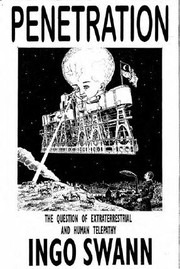
Penetration: The Question of Extraterrestrial and Human Telep...
Covers Swann's claims, including his wider views on remote viewing and extraordinary perception.
eBay marketplace picks
Marketplace Samples
Live-tested eBay searches with available results related to this page.



Endnotes
1.
Source: ciaotest.cc.columbia.edu
Link:https://ciaotest.cc.columbia.edu/olj/sa/sa_jan02srm01.html
Source snippet
round Jupiter and wondered if perhaps he had remote-viewed the planet Saturn by...Read more...
2.
Source: Wikipedia
Title: Remote viewing
Link:https://en.wikipedia.org/wiki/Remote_viewing
3.
Source: Wikipedia
Title: Parapsychology research at SRI
Link:https://en.wikipedia.org/wiki/Parapsychology_research_at_SRI
4.
Source: Wikipedia
Title: Ingo Swann
Link:https://en.wikipedia.org/wiki/Ingo_Swann
5.
Source: ingo.me
Link:https://ingo.me/
Source snippet
HomeInGo is the only platform built for event marketers, like you, to cut through the noise, deliver personalized engagement at sca...
6.
Source: Wikipedia
Title: Ingo (novel)
Link:https://en.wikipedia.org/wiki/Ingo_%28novel%29
Source snippet
Ingo (novel)Ingo is a children's novel by English writer Helen Dunmore, published in 2005 and the first of the Ingo pentalogy, followe...
Additional References
7.
Source: amazon.co.uk
Link:https://www.amazon.co.uk/Ingo-Helen-Dunmore/dp/0007204876?tag=searcht-20
Source snippet
Ingo: Dunmore, HelenA girl named Sapphire discovers an underwater world called Ingo after her father disappears at sea. She meets a merm...
8.
Source: avam.org
Link:https://www.avam.org/artists/ingo-swann
Source snippet
Ingo SwannHe famously claimed to have sent his consciousness to Jupiter prior to the arrival of NASA's Voyager satellite probe and accura...
9.
Source: capterra.co.uk
Link:https://www.capterra.co.uk/software/157042/ingo
Source snippet
InGo Pricing, Cost & ReviewsDiscover the benefits and disadvantages of InGo. Learn the software price, see the description, and read the...
10.
Source: collinsdictionary.com
Link:https://www.collinsdictionary.com/dictionary/english/ingo
Source snippet
Also: ingoing. 1. to disclose (a secret); divulge 2. to expose to view or show (something.... Click for more definitions...
11.
Source: youtube.com
Title: The CIA Psychic Who Saw Alien Bases on the Dark Side of The Moon | Ingo Swann
Link:https://www.youtube.com/watch?v=yt6mLKQh0QY
Source snippet
This Ingo Swann Jupiter Analysis examines the claims surrounding the remote viewer's specific prediction of Jupiter's rings prior to NASA...
12.
Source: pod.wave.co
Link:https://pod.wave.co/podcast/camp-gagnon/the-cia-psychic-who-saw-alien-bases-on-the-dark-side-of-the-moon-ingo-swann-4c5c55ca
Source snippet
He predicted the existence of a ring system around the planet—a feature that wasn't...Read more...
13.
Source: facebook.com
Link:https://www.facebook.com/shawnryanshow/videos/inside-ingo-swanns-project-out-of-body-to-jupiter-he-was-the-first-to-describe-a/472812622202052/
Source snippet
escribe, ahead of NASA, that Jupiter had rings like Saturn...
14.
Source: medium.com
Link:https://medium.com/%40darkenergyarticles/he-saw-jupiters-rings-with-his-mind-6-years-before-nasa-895747217df4
Source snippet
d probes arrived. During the session, he reported a thin...
15.
Source: youtube.com
Title: Alien Moon Bases & Remote Viewing (Ingo Swann’s Penetration)
Link:https://www.youtube.com/watch?v=r1-Pg3jHB8k
Source snippet
The CIA Psychic Who Saw Alien Bases on the Dark Side of The Moon | Ingo Swann...
16.
Source: open.spotify.com
Title: 02n C5Y8T3ypx Ni Vet Kbt We
Link:https://open.spotify.com/artist/02nC5Y8T3ypxNiVetKbtWe
Source snippet
and EPs · Alright · Broken · Paradise · Stay · On My Mind · Alone · Burning · Broken Dreams. Single • 2023. Featuring INGO. This Is INGO...
Topic Tree