Within Protocol
When Helping Becomes Hinting
A monitor can help a beginner stay engaged, but leading questions and subtle reactions can quietly contaminate the session.
On this page
- What a blind monitor should and should not know
- Neutral prompts that keep the session clean
- Tone, timing and enthusiasm as accidental signals
Page outline Jump by section
Introduction
A monitor can be helpful in a beginner remote viewing session, but only if they avoid becoming an unintended source of information. The purpose of a monitor is to support the viewing process by keeping the session organised, recording events accurately and encouraging the viewer to continue describing impressions without steering them towards any particular answer. As soon as the monitor’s words, tone, facial expressions or expectations begin to influence the viewer, the session becomes vulnerable to ordinary psychological effects rather than providing a fair test of remote viewing claims.[CIA]cia.govA SUGGESTED REMOTE VIEWING TRAINING…(U) Remote viewing requires a viewer, a monitor and a target. Practical definitions of these te…

This is not a concern unique to remote viewing. Across psychology and behavioural science, researchers have long recognised that experimenters can unintentionally communicate information through subtle verbal and non-verbal cues. The classic “Clever Hans” effect demonstrated that even without deliberate cheating, participants can pick up tiny signals from people who already know the answer. For that reason, modern remote viewing protocols place considerable emphasis on blinding and neutral monitoring whenever possible.[CIA]cia.govA SUGGESTED REMOTE VIEWING TRAINING…(U) Remote viewing requires a viewer, a monitor and a target. Practical definitions of these te…
When Helping Becomes Hinting
Beginners often assume that a good monitor should actively help the viewer produce. Ironically, this is where contamination frequently begins.
A monitor who says, “Look closer,” “You’re getting warmer,” or “What else do you see near the water?” may believe they are encouraging concentration. Instead, they have introduced assumptions about the target. Even comments intended as reassurance—”That sounds right,” “Interesting,” or “Keep going in that direction”—can encourage the viewer to unconsciously build on a particular interpretation rather than reporting fresh impressions.
The risk is especially high because remote viewing sessions usually involve uncertain, fragmentary impressions. When people receive even minimal feedback, they naturally adjust future responses. This tendency is well documented in psychology and is one reason why double-blind experimental designs are widely used whenever observer expectations could influence results.[CIA]cia.govA SUGGESTED REMOTE VIEWING TRAINING…(U) Remote viewing requires a viewer, a monitor and a target. Practical definitions of these te…
What a Blind Monitor Should and Should Not Know
The cleanest arrangement is for the monitor to know as little as possible about the target.
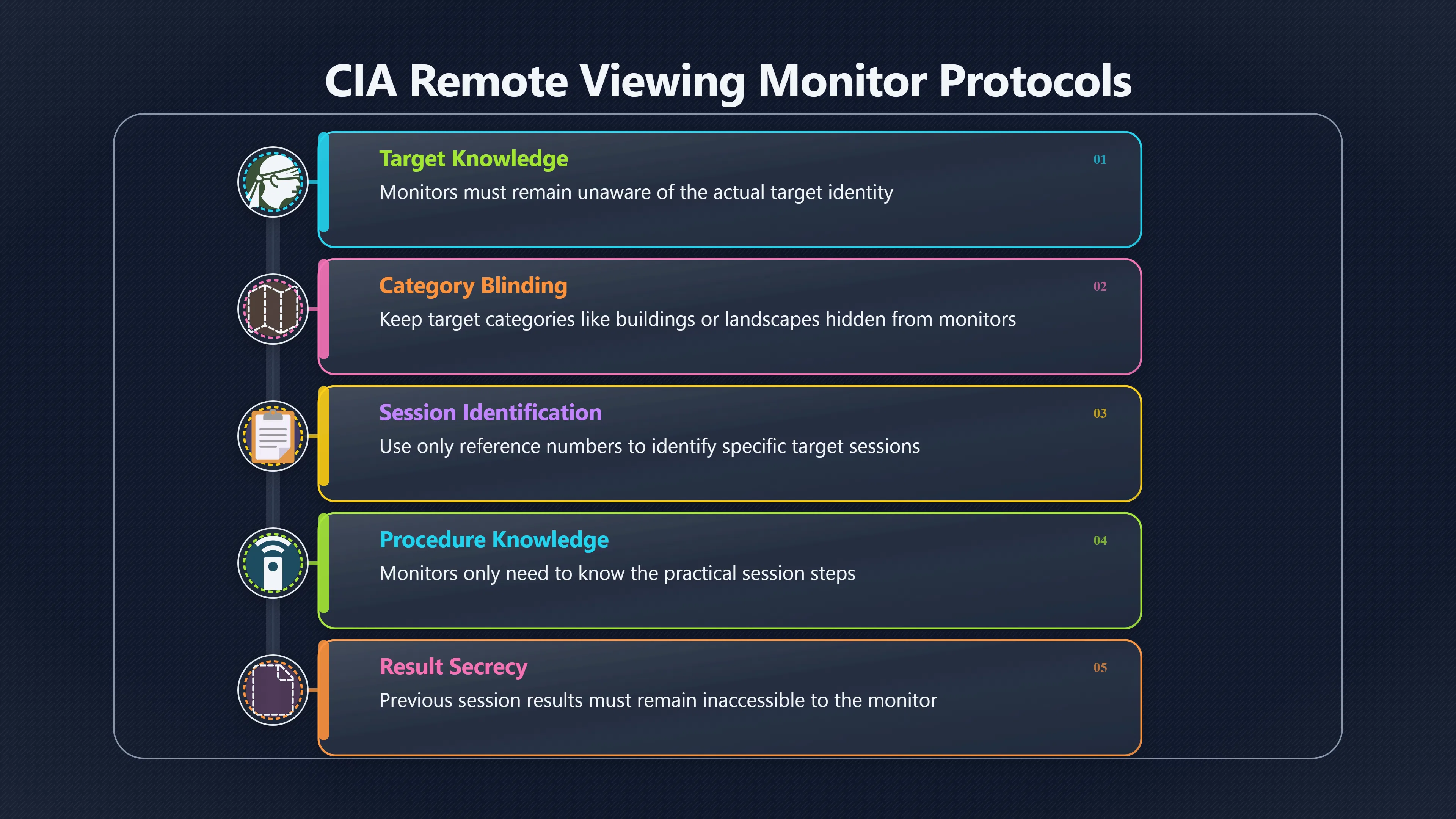
A genuinely blind monitor should ideally know:
- only that a legitimate target exists;
- the session identification or target reference number;
- the practical procedures for running the session.
The monitor should not know:
- the actual target;
- its category (such as building, person or landscape);
- where it came from;
- previous session results;
- what the organiser hopes the viewer will describe.
Some remote viewing traditions historically allowed monitors to know limited information during training so they could recognise when trainees drifted away from the prescribed structure. More recent guidance, particularly for testing purposes, generally favours stronger blinding because it removes another possible pathway for information leakage.[CIA+2ResearchGate]cia.govA SUGGESTED REMOTE VIEWING TRAINING…(U) Remote viewing requires a viewer, a monitor and a target. Practical definitions of these te…
For beginners interested in evaluating whether their descriptions genuinely match hidden targets, a double-blind arrangement—where neither viewer nor monitor knows the target—is generally regarded as the strongest safeguard against unconscious cueing.[ResearchGate]researchgate.net403180890 Experts' Remote Viewing GuidelinesSome suggested practicing meditation…Read more…
Neutral Prompts That Keep the Session Clean
A monitor does not need to remain completely silent. The key is that prompts should encourage description without suggesting content.
Examples of relatively neutral prompts include:
- “Describe your strongest impression.”
- “What are you noticing now?”
- “Record that exactly as experienced.”
- “Is there another impression?”
- “Stay with the first sensation before analysing it.”
- “Please continue.”
By contrast, prompts become increasingly problematic when they imply expectations:
- “Is it a mountain?”
- “Can you see a person?”
- “Look above the structure.”
- “You’re close.”
- “Try harder.”
- “That matches the target.”[monroeinstitute.org]monroeinstitute.organyone can learn to harness their abilities as a remote viewerMarinda explained this to me, “Double-blind means…Read more…
The distinction is subtle but important. Neutral prompts focus on the reporting process. Leading prompts introduce possible answers.

Tone, Timing and Enthusiasm as Accidental Signals
Words are only one channel through which information can leak.
A monitor who smiles after certain descriptions, pauses noticeably before asking the next question or becomes visibly excited may unintentionally reward some responses while discouraging others. Human beings are highly sensitive to emotional feedback, often without consciously recognising it.
Potential sources of unconscious cueing include:
- changes in vocal emphasis;
- longer pauses after particular statements;
- laughter or surprise;
- nodding or shaking the head;
- writing more rapidly after certain responses;
- changes in posture or attention;
- visible disappointment when the viewer changes direction.
Even if the monitor never mentions the target directly, these behaviours can encourage the viewer to favour one line of description over another.
For this reason, structured protocols often recommend that monitors use consistent wording, maintain a calm emotional tone and avoid reacting to individual statements until the session has finished.[CIA+2scribd.com]cia.govA SUGGESTED REMOTE VIEWING TRAINING…(U) Remote viewing requires a viewer, a monitor and a target. Practical definitions of these te…
Why Expectations Matter
Another source of contamination comes from shared assumptions rather than explicit hints.
Imagine both participants know that today’s target pool contains famous landmarks. Without saying anything, the monitor may become more attentive whenever the viewer mentions buildings or monuments. The viewer, consciously or unconsciously, may notice these reactions and continue describing architecture while ignoring equally vivid impressions pointing elsewhere.
Similarly, if a monitor strongly believes a particular viewer is talented, they may ask more follow-up questions after promising descriptions while letting weaker impressions pass without exploration. This introduces confirmation bias into the session, making apparent successes easier to produce than genuine blind testing would allow.
Good protocol attempts to separate expectations from observations. Every impression should receive essentially the same treatment regardless of whether it appears impressive, ordinary or completely wrong.
Practical Habits for Beginners
A beginner does not need laboratory conditions to reduce unconscious cueing. A few disciplined habits can remove many common sources of contamination.
- Use a monitor who does not know the target whenever possible.
- Prepare a short list of standard prompts before beginning.
- Avoid conversational discussion during the session.
- Record all impressions before asking clarifying questions.
- Keep facial expressions and tone deliberately neutral.
- Delay all interpretation until after the session has ended.
- Reveal the target only after the complete record has been signed or time-stamped.
These practices cannot determine whether remote viewing itself is valid, but they do make it easier to distinguish original session material from information that may have been introduced through interaction.
Why This Matters More Than It First Appears
Many reported remote viewing successes have been debated not because of the descriptions themselves but because critics questioned whether subtle information leakage could explain the results. Supporters likewise acknowledge that maintaining rigorous blinding is essential if a session is intended to have evidential value rather than serve as informal practice.[CIA]cia.govA SUGGESTED REMOTE VIEWING TRAINING…(U) Remote viewing requires a viewer, a monitor and a target. Practical definitions of these te…
For beginners, this means the monitor’s greatest contribution is often restraint rather than guidance. A session in which the monitor says very little, reacts to nothing and knows nothing about the target may feel less dramatic, but it provides a cleaner basis for judging whether the viewer’s recorded impressions genuinely preceded any opportunity for ordinary cueing or feedback.
Amazon book picks
Further Reading
Books and field guides related to When Helping Becomes Hinting. Use these as the next step if you want deeper reading beyond the article.
The Invisible Gorilla
Explains how subtle cues and perception errors influence judgments.

eBay marketplace picks
Marketplace Samples
Live-tested eBay searches with available results related to this page.



Endnotes
1.
Source: cia.gov
Link:https://www.cia.gov/readingroom/docs/CIA-RDP96-00789R002200070001-0.pdf
Source snippet
A SUGGESTED REMOTE VIEWING TRAINING...(U) Remote viewing requires a viewer, a monitor and a target. Practical definitions of these te...
2.
Source: researchgate.net
Title: 403180890 Experts’ Remote Viewing Guidelines
Link:https://www.researchgate.net/publication/403180890_Experts%27_Remote_Viewing_Guidelines
Source snippet
Some suggested practicing meditation...Read more...
3.
Source: scribd.com
Link:https://www.scribd.com/doc/80682670/CRVfull
Source snippet
The remote viewer is...Read more...
Additional References
4.
Source: academia.edu
Link:https://www.academia.edu/136849593/Experts_Remote_Viewing_Guidelines
Source snippet
Experts' Remote Viewing GuidelinesEleven remote viewing experts provide recommendations for optimizing remote viewing performance in both...
5.
Source: youtube.com
Link:https://www.youtube.com/watch?v=Y2Ryc196s0I
Source snippet
Remote Viewing Training, Part One: The Initial Phases, with...Remote Viewing Training, Part Two: The Advanced Phases, with Paul H...
6.
Source: facebook.com
Link:https://www.facebook.com/groups/710805723530028/posts/1189675578976371/
Source snippet
As mentioned, the remote viewer is kept unwitting of either the nature or...Read more...
7.
Source: pubmed.ncbi.nlm.nih.gov
Link:https://pubmed.ncbi.nlm.nih.gov/12081299/
Source snippet
viewing with the artist Ingo Swannby MA Persinger · 2002 · Cited by 62 — The artist Ingo Swann, who helped develop the process of remote...
8.
Source: monroeinstitute.org
Title: anyone can learn to harness their abilities as a remote viewer
Link:https://www.monroeinstitute.org/blogs/blog/anyone-can-learn-to-harness-their-abilities-as-a-remote-viewer?srsltid=AfmBOoqx7_KABVI5h1vN5iFgI5FWdSWSetvWlpcG9qhAXIYp17i49iv8
Source snippet
Marinda explained this to me, “Double-blind means...Read more...
9.
Source: youtube.com
Title: Clever Hans: The Smart Horse Behind Unconscious Cues
Link:https://www.youtube.com/watch?v=FZ8wCHPlar4
Source snippet
anizing Remote Viewing Projects with Lori Williams...
10.
Source: youtube.com
Title: Monitoring Remote Viewing Sessions with Lori Williams
Link:https://www.youtube.com/watch?v=NA3rUT-DjTw
Source snippet
Observer Bias: Clever Horses and Dull Rats...
11.
Source: youtube.com
Title: Observer Expectancy Effect
Link:https://www.youtube.com/watch?v=VR704WXdu6s
Source snippet
Clever Hans: The Smart Horse Behind Unconscious Cues...
12.
Source: youtube.com
Title: Observer Bias: Clever Horses and Dull Rats
Link:https://www.youtube.com/watch?v=Hhwj_G7b9M4
Source snippet
Observer Expectancy Effect...
13.
Source: youtube.com
Title: Organizing Remote Viewing Projects with Lori Williams
Link:https://www.youtube.com/watch?v=EZ9crJeFQDA
Topic Tree