Within Fort Meade
How Did a Psychic Spy Assignment Work?
Operational remote viewing depended on targets, session reports, sketches, and customer feedback that rarely matched normal intelligence needs.
On this page
- How customers framed targets
- What viewers actually produced
- Where the workflow became subjective
Page outline Jump by section
Introduction
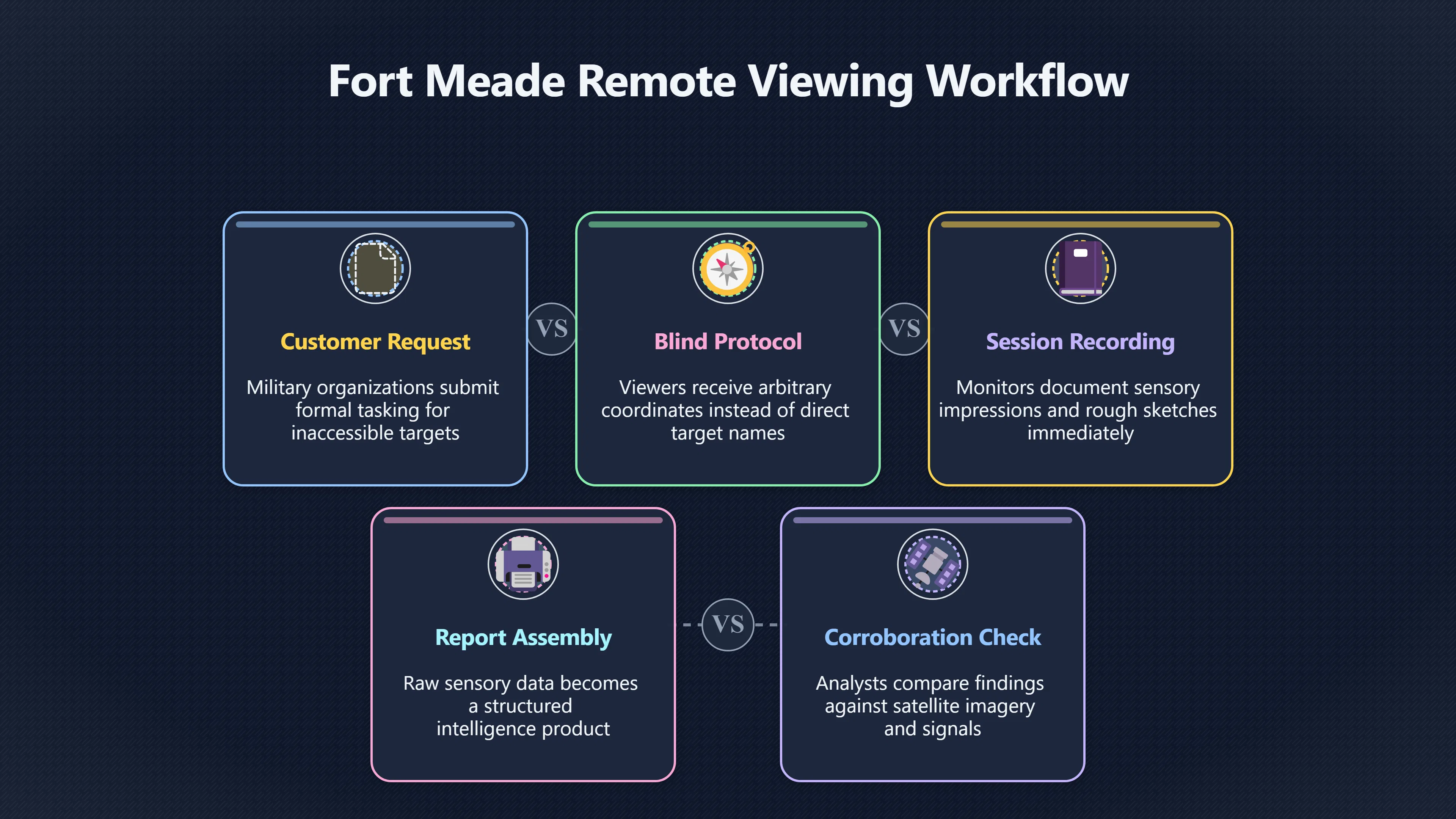
Within the Fort Meade remote-viewing programme, the most important operational question was not whether viewers claimed unusual perceptions, but how those claims were turned into something an intelligence customer could actually use. The unit developed a structured tasking process intended to reduce bias: customers submitted a request, viewers received only limited target information, session monitors recorded impressions and sketches, and analysts forwarded reports to the requesting organisation. The resulting products were then compared with conventional intelligence rather than treated as stand-alone evidence. Declassified records show that this workflow was designed to resemble other intelligence collection processes, yet the products often proved difficult to interpret because they consisted largely of subjective descriptions rather than verifiable observations. Later official evaluations concluded that this subjectivity limited their operational value despite years of experimentation.[CIA]cia.govSTAR GATE PROJECT: AN OVERVIEW(U) This document provides a broad overview of the three main activity areas, (foreign assessment, exter…
How customers framed targets
Operational requests generally originated from military or intelligence organisations rather than from the viewers themselves. A customer identified a problem—for example, an unknown facility, a missing object, a hostage situation or another inaccessible target—and submitted a formal tasking request to the remote-viewing unit. The request was translated into a target package designed to minimise unintentional clues reaching the viewer.[CIA]cia.govSTAR GATE PROJECT: AN OVERVIEW(U) This document provides a broad overview of the three main activity areas, (foreign assessment, exter…
The tasking process attempted to preserve what proponents called a “blind” protocol. Instead of being told the target directly, the viewer was commonly given an arbitrary reference or coordinate associated with the target. Session monitors knew only as much as was necessary to conduct the session, with the intention of reducing leading questions or unconscious prompting. This approach reflected methods first developed during Stanford Research Institute research and later adapted for operational use by military programmes such as CENTER LANE, SUN STREAK and STAR GATE.[CIA]cia.govSTAR GATE PROJECT: AN OVERVIEW(U) This document provides a broad overview of the three main activity areas, (foreign assessment, exter…
Customers were also expected to define what kind of information would be useful. Rather than asking for broad speculation, requests often focused on practical intelligence questions such as:
- the physical layout of a location;
- significant equipment or activities;
- distinguishing landmarks;
- the probable status or movement of a person or object; or
- features that could later be checked against satellite imagery, signals intelligence or human reporting.
Even so, many targets involved situations where conventional collection had already produced incomplete answers, meaning remote viewing was frequently used as an experimental supplementary method rather than the first source of intelligence.[CIA]cia.govSTAR GATE PROJECT: AN OVERVIEW(U) This document provides a broad overview of the three main activity areas, (foreign assessment, exter…
What viewers actually produced
A remote-viewing session did not resemble a finished intelligence report. The immediate output consisted of handwritten notes, spoken descriptions recorded by the monitor, rough sketches and fragmented sensory impressions. Viewers often described shapes, textures, temperatures, movements, emotions or symbolic images rather than complete narratives.[CIA]cia.govSTAR GATE PROJECT: AN OVERVIEW(U) This document provides a broad overview of the three main activity areas, (foreign assessment, exter…
These raw products were then assembled into a report for the customer. Depending on the session, a report might contain:
- sketches of buildings, machinery or terrain;
- estimated geographical relationships;
- descriptions of perceived activities;
- impressions of colours, sounds or environmental conditions;
- confidence statements or indications that particular impressions felt uncertain.
Importantly, the reports usually distinguished between direct perceptions and interpretive guesses. A viewer might report perceiving “a tall cylindrical structure” while separately suggesting it resembled a missile or industrial tower. This distinction was intended to allow intelligence analysts to evaluate descriptive observations independently from the viewer’s interpretation.[CIA]cia.govSTAR GATE PROJECT: AN OVERVIEW(U) This document provides a broad overview of the three main activity areas, (foreign assessment, exter…
Unlike conventional imagery or intercepted communications, however, these products rarely contained precise measurements, timestamps or independently reproducible observations. Customers therefore had to determine whether any elements matched information already collected through established intelligence disciplines.

How reports were integrated into intelligence work
Remote-viewing products were never intended to replace traditional intelligence collection. Operational guidance described them as another potential source that analysts could compare with photography, intercepted communications, human intelligence and other reporting.[CIA]cia.govSTARGATE - PROGRAM STATUS, PROPOSED OPTIONS1. 2. Star Gate is a DIA program which involves use of paranormal phenomena, primarily remo…
In practice, this comparison proved difficult because the formats differed fundamentally. Conventional intelligence normally provides evidence tied to identifiable sources and collection methods. Remote-viewing reports instead contained descriptive language requiring interpretation before they could be tested.
For example, if a viewer sketched an unusual building shape, analysts could compare that sketch with satellite imagery. If multiple details appeared consistent, the report might encourage additional collection. If no supporting evidence emerged, the information generally carried little weight.
This meant the workflow depended heavily on corroboration. The value of a report rested less on the session itself than on whether other intelligence sources independently confirmed any of its claims.
Where the workflow became subjective
The most persistent challenge arose after the session ended. Even if the viewer faithfully recorded every impression, someone still had to decide which parts were meaningful.
Several stages introduced subjectivity:
- Interpreting symbols. Viewers frequently reported metaphorical or ambiguous imagery whose intended meaning was unclear.
- Separating signal from imagination. Session notes often mixed apparently relevant details with obvious errors or unrelated impressions.
- Selecting report content. Editors had to determine which observations should appear in the finished intelligence product.
- Matching outcomes. After additional intelligence became available, analysts judged whether similarities represented genuine correspondence or coincidence.
These interpretation problems became central to later criticism of operational remote viewing. Independent reviewers noted that broad descriptions could often be matched retrospectively to many possible targets, making objective evaluation difficult.[CIA]cia.govAN EVALUATION OF THE REMOTE VIEWING PROGRAMthe evaluation. This report contains the results of our evaluation. Before presenting our r…
Some reviewers also raised concerns that, in a few well-publicised cases, viewers or evaluators may have possessed more contextual information than official descriptions suggested, potentially influencing apparently successful results. The American Institutes for Research concluded that such possibilities complicated assessments of operational performance.[CIA]cia.govAN EVALUATION OF THE REMOTE VIEWING PROGRAMthe evaluation. This report contains the results of our evaluation. Before presenting our r…
Why intelligence customers struggled to use the reports
The remote-viewing workflow attempted to mirror familiar intelligence procedures by using formal tasking, documentation and customer feedback. Yet the finished products often failed to meet the practical needs of operational consumers.
Intelligence customers generally require information that is:
- specific enough to guide action;
- traceable to identifiable sources;
- reproducible or independently confirmed;
- delivered with measurable confidence.
Remote-viewing reports frequently fell short on these criteria because they mixed accurate-seeming observations with vague, symbolic or incorrect material. Analysts therefore faced the difficult task of deciding which elements deserved follow-up without an objective method for separating reliable impressions from unreliable ones.[CIA]cia.govAN EVALUATION OF THE REMOTE VIEWING PROGRAMthe evaluation. This report contains the results of our evaluation. Before presenting our r…
The 1995 review commissioned by the CIA concluded that although some laboratory findings merited scientific interest, the operational reporting produced through this workflow had not demonstrated sufficient reliability for intelligence decision-making. The evaluators found no documented case in which remote-viewing reports had provided actionable intelligence that directly influenced an intelligence operation.[CIA]cia.govAN EVALUATION OF THE REMOTE VIEWING PROGRAMthe evaluation. This report contains the results of our evaluation. Before presenting our r…
The lasting significance of the tasking process
The Fort Meade unit’s tasking system remains historically significant because it represents one of the few sustained attempts to fit an unconventional claimed capability into the bureaucratic structure of professional intelligence collection. It featured formal customer requests, controlled target assignment, documented sessions, written reporting and post-session feedback—the same organisational elements used throughout intelligence work, but applied to a fundamentally different kind of information source.
The experiment demonstrated that creating disciplined procedures could standardise how reports were requested, recorded and delivered. It did not resolve the more difficult question of whether the information itself was dependable enough for operational use. As official evaluations ultimately concluded, the workflow succeeded in producing intelligence-style products, but not products that consistently met the evidential standards required for intelligence operations.[CIA]cia.govSTAR GATE PROJECT: AN OVERVIEW(U) This document provides a broad overview of the three main activity areas, (foreign assessment, exter…
Amazon book picks
Further Reading
Books and field guides related to How Did a Psychic Spy Assignment Work?. Use these as the next step if you want deeper reading beyond the article.

Remote Viewers: The Secret History of America's Psychic Spies
Covers Fort Meade operations, personnel, and intelligence processes.

The seventh sense
Explains operational procedures, tasking, and military remote-viewing workflow.

eBay marketplace picks
Marketplace Samples
Live-tested eBay searches with available results related to this page.

Endnotes
1.
Source: cia.gov
Link:https://www.cia.gov/readingroom/docs/CIA-RDP96-00789R002800180001-2.pdf
Source snippet
STAR GATE PROJECT: AN OVERVIEW(U) This document provides a broad overview of the three main activity areas, (foreign assessment, exter...
2.
Source: cia.gov
Link:https://www.cia.gov/readingroom/docs/CIA-RDP96-00791R000200180005-5.pdf
Source snippet
AN EVALUATION OF THE REMOTE VIEWING PROGRAMthe evaluation. This report contains the results of our evaluation. Before presenting our r...
3.
Source: cia.gov
Link:https://www.cia.gov/readingroom/docs/CIA-RDP96-00791R000100160003-8.pdf
Source snippet
STARGATE - PROGRAM STATUS, PROPOSED OPTIONS1. 2. Star Gate is a DIA program which involves use of paranormal phenomena, primarily remo...
4.
Source: cia.gov
Link:https://www.cia.gov/readingroom/document/cia-rdp96-00791r000200180005-5
Source snippet
s report contains the results of our evaluation. Before...Read more...
5.
Source: Wikipedia
Title: Remote viewing
Link:https://en.wikipedia.org/wiki/Remote_viewing
Source snippet
Remote viewingIn 1995, the CIA hired the American Institutes for Research (AIR) to perform a retrospective evaluation of the results g...
Additional References
6.
Source: cdn.centerforinquiry.org
Link:https://cdn.centerforinquiry.org/wp-content/uploads/sites/29/1996/03/22165045/p27.pdf
Source snippet
centerforinquiry.org'Remote Viewing... Has Not Been Shown to Have Value in...Michael D. Mumford, remote viewing reports were changed to...
7.
Source: linkedin.com
Link:https://www.linkedin.com/pulse/esp-files-declassified-uncovering-mysteries-project-j-manning-myedc
Source snippet
ESP Files Declassified: Uncovering the Mysteries of Project...Based on the AIR report, the CIA recommended the termination of the StarGa...
8.
Source: greydynamics.com
Link:https://greydynamics.com/intelligence-past-the-tangible-world-cias-[stargate
Source snippet
Intelligence Past the Tangible World: CIA's Stargate ProjectThe Stargate Project is one of the most interesting and enigmatic intelligenc...
9.
Source: academia.edu
Link:https://www.academia.edu/95285973/The_Star_Gate_Operational_Remote_Viewing_Program_A_Human_Intelligence_HUMINT_Collection_Platform
Source snippet
(PDF) The Star Gate Operational Remote Viewing Program...From 1973 to 1984, 54 operational projects with 127 remote viewing sessions wer...
10.
Source: ciaotest.cc.columbia.edu
Link:https://ciaotest.cc.columbia.edu/olj/sa/sa_jan02srm01.html
Source snippet
Remote Viewing: The US Sponsored Psychic...This paper deals with experiments conducted in USA in which certain individuals were trained...
11.
Source: youtube.com
Link:https://www.youtube.com/watch?v=cNJwV3Ksxa8
Source snippet
Uncovering the CIA's Secret Weapon: Psychic SpiesAn interview with Jeff Kripal on Stargate and remote viewing. Subscribe to my newsletter...
12.
Source: journalofscientificexploration.org
Link:https://journalofscientificexploration.org/index.php/jse/article/view/3865/2573
Source snippet
D., Rose, A. M., & Goslin, D. A. (1995). An evaluation of remote viewing: Research and applications. American Institutes for Research. Mö...
13.
Source: reddit.com
Link:https://www.reddit.com/r/consciousness/comments/181s71r/the_cias_experiments_with_remote_viewing_and/
Source snippet
perimentation with Ingo Swann can provide some evidence toward “non-local...Read more...
14.
Source: facebook.com
Title: During the [Cold War]({{ ‘cold-war/’ | relative_url }}), the CIA funded research into what
Link:https://www.facebook.com/100090372200308/posts/during-the-cold-war-the-cia-funded-research-into-what-they-called-remote-viewing/937678002587931/
Source snippet
AIR, which performed a review of the project, no remote viewing report ever provided actionable information for any intelligence operatio...
15.
Source: youtube.com
Title: Joe Mc Moneagle: Project Stargate, CIA Remote Viewing & The Mars Session
Link:http://www.youtube.com/watch?v=Mk9bTm4IPps
Source snippet
Paul Smith remote viewing Stargate intelligence tasking Army Remote Viewer Looks Inside of a UFO, Consciousness & Disclosure | Maj. Paul...
Topic Tree