Within Middle View
Did Secrecy Hurt the Science?
Classified research made remote viewing harder to scrutinize, replicate, and evaluate through normal scientific channels.
On this page
- Why secrecy limited peer review
- How missing procedural details weaken confidence
- What open replication would have needed
Page outline Jump by section
Introduction
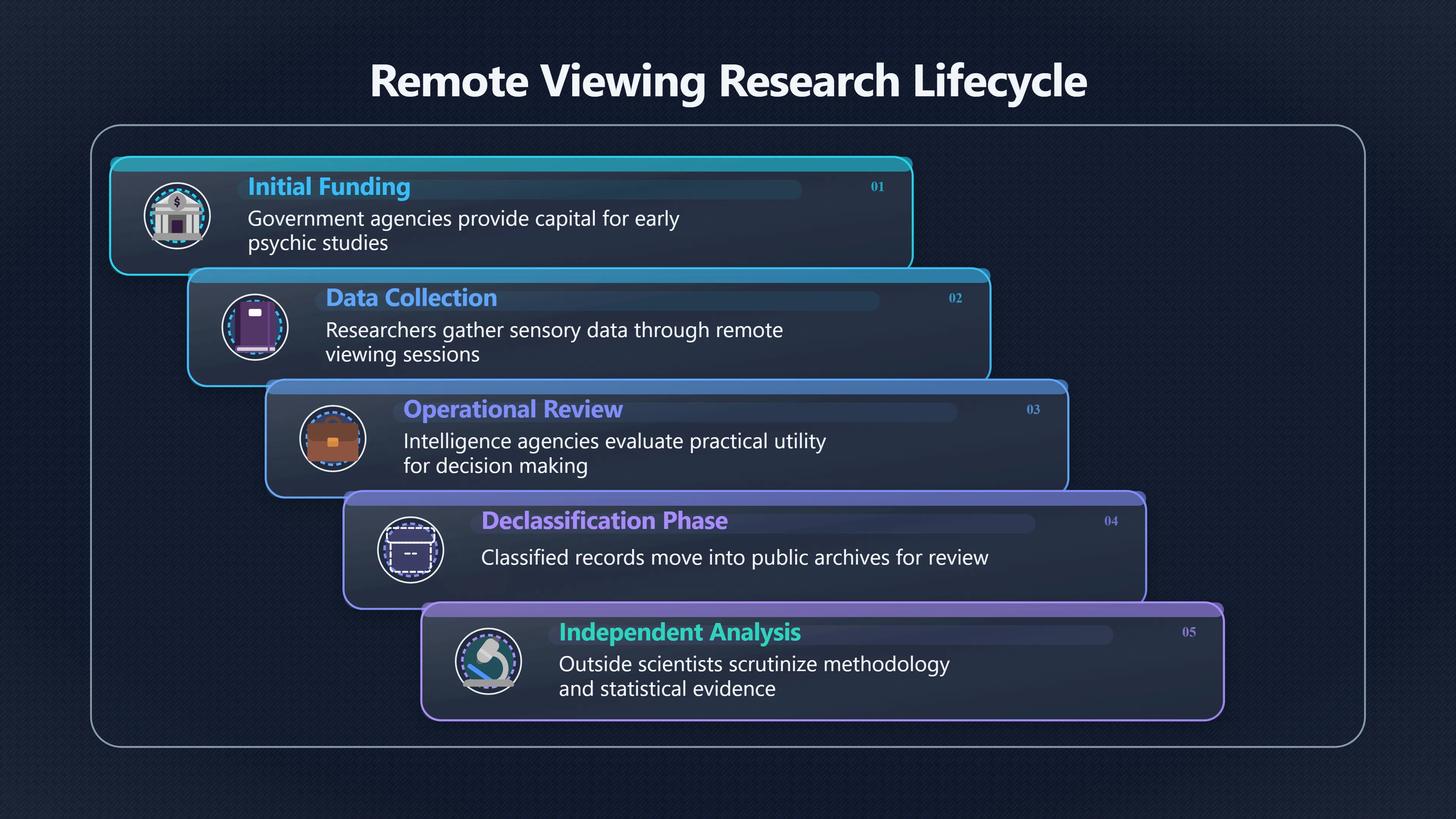
Did secrecy hurt the science of remote viewing? In one important sense, yes. Regardless of whether one believes remote viewing reflects a genuine phenomenon or a series of methodological artefacts, the fact that much of the research was conducted under military and intelligence sponsorship imposed constraints unlike those faced by ordinary scientific fields. Classification, restricted access to protocols, limited data sharing and operational secrecy made it harder for independent researchers to examine methods, reproduce findings and identify errors. At the same time, secrecy alone does not explain why remote viewing remains controversial: once substantial parts of the programme were declassified, independent reviewers still reached sharply different conclusions about what the evidence meant.[National Security Archive]nsarchive2.gwu.eduNational Security ArchiveAn Evaluation of Remote Viewing: Research and…March 13, 2015 — by MD Mumford · 1995 · Cited by 76 — "Star Gat…

This creates an important middle position. Secrecy almost certainly reduced scientific transparency, but greater openness would not automatically have validated the underlying claims. Instead, it would have made those claims easier to test, challenge and either strengthen or reject through normal scientific practice.
Why secrecy limited peer review
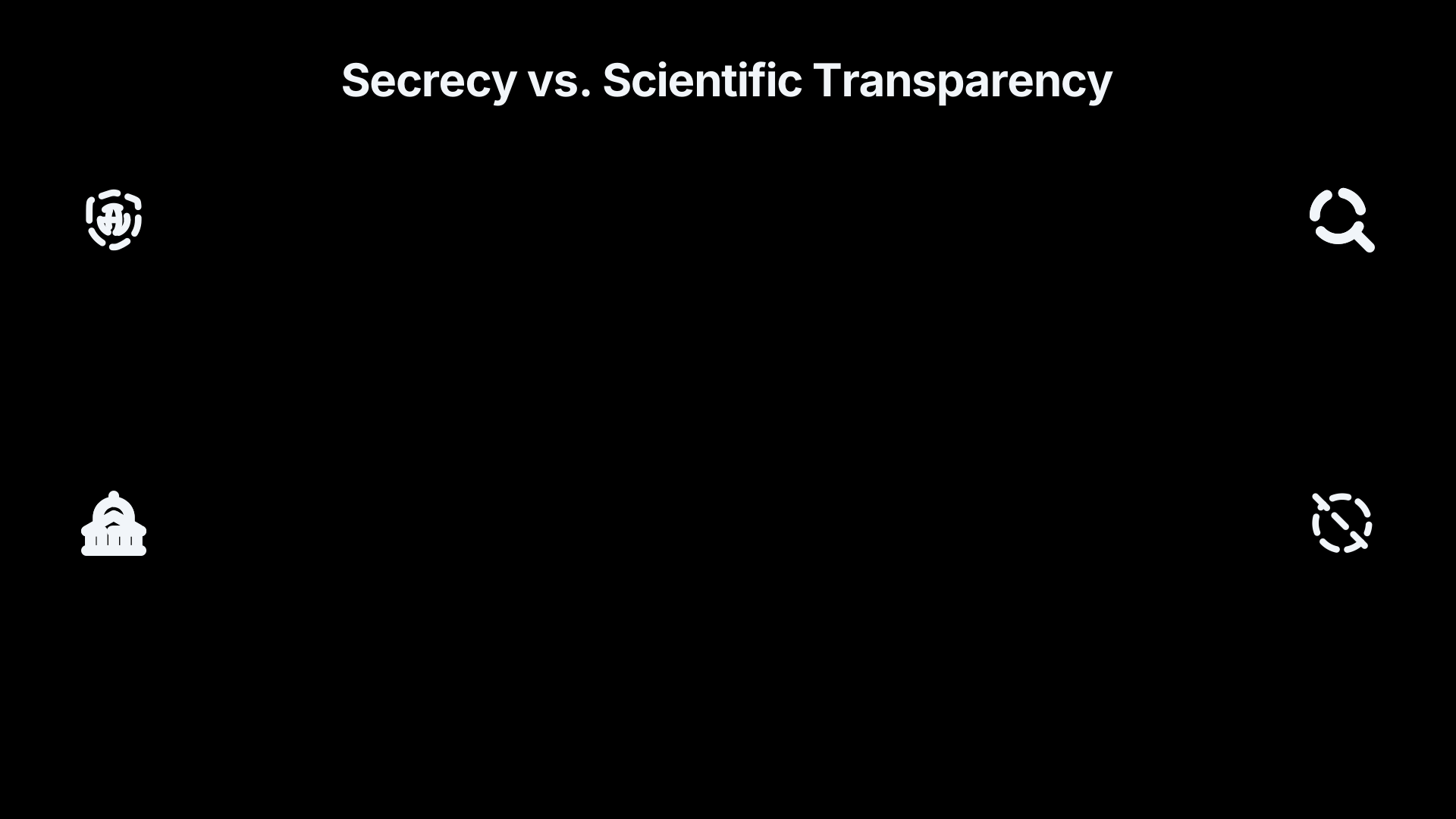
Science advances by allowing other researchers to inspect methods, analyse raw data and attempt independent replication. Intelligence programmes are organised around nearly the opposite principle: information is compartmentalised, procedures may remain classified, and operational details are deliberately withheld.
The U.S. government’s remote-viewing research illustrates this tension. From the early Stanford Research Institute work through later programmes managed by the Defense Intelligence Agency and related organisations, much of the research was funded for intelligence purposes rather than as open academic science. Until the programme was reviewed for the CIA in 1995, many reports circulated only within government channels or among a small group of contractors.[National Security Archive]nsarchive2.gwu.eduNational Security ArchiveAn Evaluation of Remote Viewing: Research and…March 13, 2015 — by MD Mumford · 1995 · Cited by 76 — "Star Gat…
This had several consequences:
- Independent laboratories often lacked access to complete experimental protocols.
- Outside statisticians could not routinely inspect the full body of positive and negative results.
- Critical methodological debates unfolded years after the original experiments had been conducted.
- Researchers who wished to replicate specific procedures frequently had to reconstruct them from incomplete descriptions after declassification.
None of these limitations proves the experiments were flawed. However, they prevented the normal cycle of criticism and refinement that strengthens—or disproves—scientific claims.
How missing procedural details weaken confidence
One of the central lessons of experimental science is that small procedural details can dramatically affect results. Randomisation methods, target preparation, judging procedures, feedback timing and information security all matter when testing claims of anomalous perception.
Because portions of the remote-viewing programme remained classified or unpublished for extended periods, outside researchers often could not determine exactly how experiments had been conducted. Even after declassification, documentation varied considerably in completeness across different projects and years.[National Security Archive]nsarchive2.gwu.eduNational Security ArchiveAn Evaluation of Remote Viewing: Research and…March 13, 2015 — by MD Mumford · 1995 · Cited by 76 — "Star Gat…
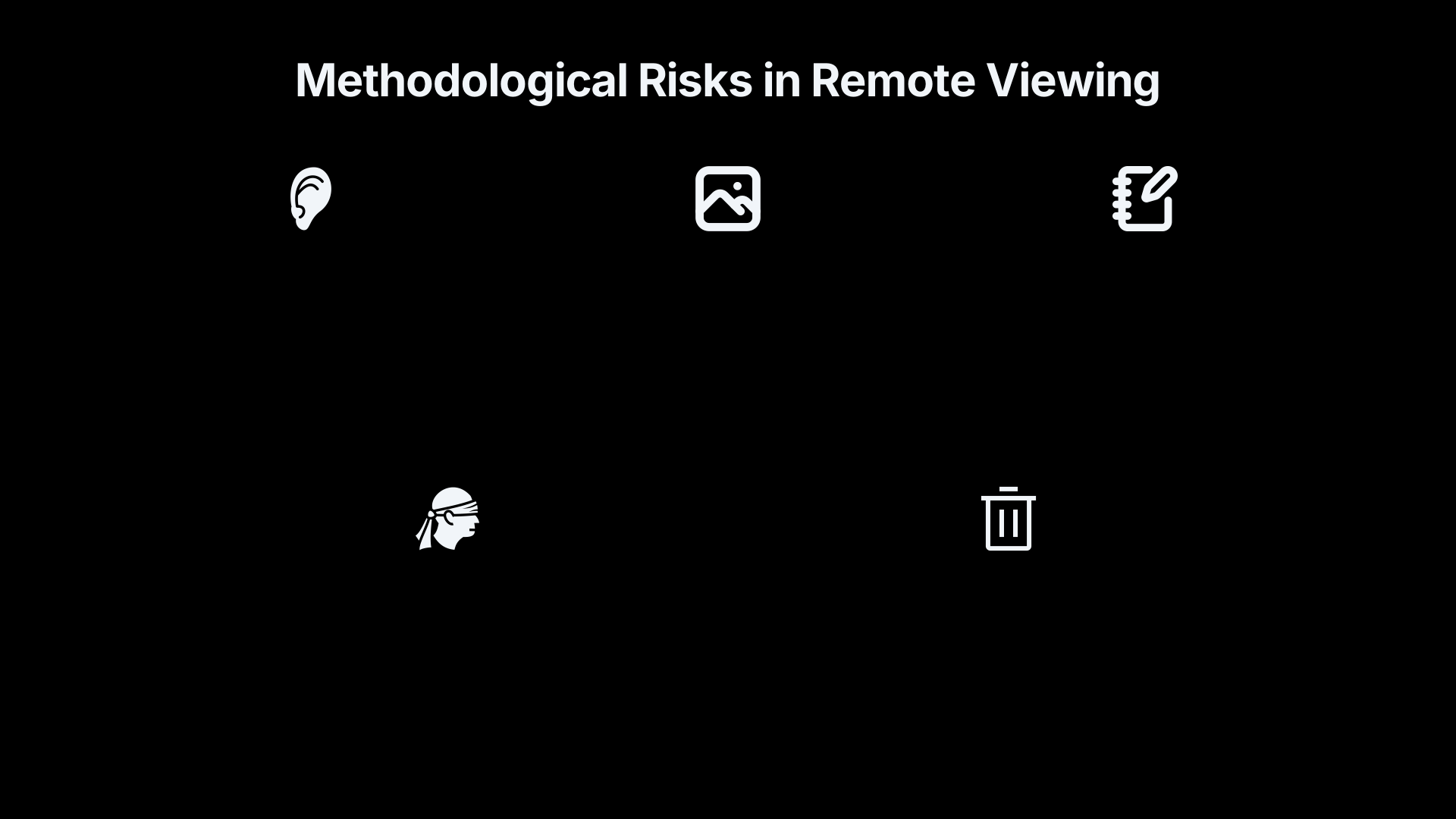
This uncertainty became particularly important because sceptics identified several methodological risks that can create apparently successful results without requiring paranormal explanations. These included:
- accidental sensory leakage through subtle cues;
- subjective matching between descriptions and targets;
- selective reporting of favourable sessions;
- inadequate blinding of judges;
- incomplete reporting of unsuccessful trials.
Ray Hyman argued that although some later studies showed methodological improvements, the evidence remained insufficient to establish psychic functioning because independent replication and tighter controls were still needed. Jessica Utts agreed that later protocols were stronger than earlier work but interpreted the statistical evidence far more positively. Their disagreement illustrates how incomplete transparency left room for fundamentally different readings of the same research record.[CIA+2CIA]cia.govAN EVALUATION OF THE REMOTE VIEWING PROGRAMUtts and Hyman were asked to prepare independent reports based on their review. In this rev…
The problem of operational success claims
Secrecy also complicated evaluation of operational remote-viewing claims.[cia.gov]cia.govAN EVALUATION OF THE REMOTE VIEWING PROGRAMUtts and Hyman were asked to prepare independent reports based on their review. In this rev…
Supporters have sometimes argued that classified successes cannot be fully assessed because the most convincing examples may never have been released. Critics respond that claims which cannot be independently examined cannot carry substantial scientific weight.
The 1995 American Institutes for Research review addressed this issue directly by separating laboratory evidence from intelligence usefulness. While reviewers acknowledged that some experimental findings deserved attention, the operational programme was judged not to have produced sufficiently specific or reliable intelligence for practical decision-making. The evaluation also noted that anecdotal “hits” were difficult to interpret because documentation was often incomplete and retrospective assessments could be influenced by prior knowledge or selective memory.[National Security Archive]nsarchive2.gwu.eduNational Security ArchiveAn Evaluation of Remote Viewing: Research and…March 13, 2015 — by MD Mumford · 1995 · Cited by 76 — "Star Gat…
This distinction remains important. Intelligence agencies routinely classify successful operations for many reasons unrelated to scientific evidence. Consequently, classification cannot itself be taken as evidence either for or against remote viewing.
Would open science have resolved the debate?
Open scientific practice would not necessarily have confirmed or refuted remote viewing immediately, but it would have changed the quality of the debate.
A fully transparent research programme would have included:
- publicly available experimental protocols before data collection;
- preregistered hypotheses to reduce selective reporting;
- independent randomisation and target generation;
- release of complete datasets, including unsuccessful trials;
- replication by laboratories with no institutional connection to the original investigators;
- independent statistical analysis using agreed evaluation criteria.
These practices are now common in many areas of psychology and behavioural science because they reduce unconscious bias and improve confidence in both positive and negative findings.
Remote-viewing research developed largely before today’s emphasis on preregistration, open datasets and reproducibility. As a result, even after declassification, many historical experiments could not easily be reassessed according to contemporary standards.[CIA]cia.govAN EVALUATION OF THE REMOTE VIEWING PROGRAMUtts and Hyman were asked to prepare independent reports based on their review. In this rev…
Secrecy as both shield and obstacle
Supporters and sceptics interpret secrecy differently.
Believers often argue that intelligence sponsorship indicates government officials considered the subject sufficiently promising to justify long-term investigation. They also contend that classified environments sometimes enabled careful work free from public ridicule or funding pressures.
Sceptics argue almost the opposite. They maintain that prolonged secrecy insulated researchers from the continuous scrutiny that normally exposes methodological weaknesses. Without frequent outside criticism, experimental practices that later proved problematic may have persisted longer than they would have in an open academic setting.
Both perspectives contain elements of truth. Intelligence agencies routinely investigate speculative possibilities with uncertain odds, especially during periods of geopolitical competition. At the same time, scientific claims generally become more reliable when exposed to broad, independent criticism rather than confined within closed programmes.
What the secrecy question ultimately tells us
The history of remote viewing demonstrates that secrecy can affect the credibility of science independently of whether the underlying phenomenon is genuine.
Classification did not invalidate every experiment, nor did declassification automatically settle the debate. Instead, secrecy delayed the ordinary process by which scientific ideas gain credibility: transparent methods, repeated independent testing, critical peer review and cumulative replication.
For readers seeking the middle position, this is the key lesson. The strongest criticism is not simply that remote-viewing research was secret, but that secrecy made it unusually difficult to distinguish genuine effects from methodological artefacts. Likewise, the strongest defence is not that classified work proves extraordinary claims, but that some studies reported results intriguing enough to justify more transparent testing than they originally received. The scientific question therefore remains tied not only to the reported outcomes, but also to how openly those outcomes could be examined.[National Security Archive+2CIA]nsarchive2.gwu.eduNational Security ArchiveAn Evaluation of Remote Viewing: Research and…March 13, 2015 — by MD Mumford · 1995 · Cited by 76 — "Star Gat…
Amazon book picks
Further Reading
Books and field guides related to Did Secrecy Hurt the Science?. Use these as the next step if you want deeper reading beyond the article.
The Men Who Stare At Goats
Rating: 3.5/5 from 11 Google Books ratings
Covers unconventional military projects where secrecy and fringe science intersect.
Phenomena
Examines government-sponsored psychic research within secretive military and intelligence programmes.
The Demon-Haunted World
Explains why openness, replication and sceptical testing matter for extraordinary scientific claims.

Remote Viewers: The Secret History of America's Psychic Spies
Shows how remote-viewing research moved through military and intelligence channels.
eBay marketplace picks
Marketplace Samples
Live-tested eBay searches with available results related to this page.

Endnotes
1.
Source: cia.gov
Link:https://www.cia.gov/readingroom/docs/CIA-RDP96-00791R000200180005-5.pdf
Source snippet
AN EVALUATION OF THE REMOTE VIEWING PROGRAMUtts and Hyman were asked to prepare independent reports based on their review. In this rev...
2.
Source: cia.gov
Link:https://www.cia.gov/readingroom/docs/CIA-RDP96-00791R000200180006-4.pdf
Source snippet
as fair and open-minded scientists...
3.
Source: cia.gov
Link:https://www.cia.gov/legacy/cia-history/
Source snippet
of CIAThe Central Intelligence Agency. The National Security Act of 1947 established CIA as an independent, civilian intelligence...
4.
Source: nsarchive2.gwu.edu
Link:https://nsarchive2.gwu.edu/NSAEBB/NSAEBB438/docs/doc_57.pdf
Source snippet
National Security ArchiveAn Evaluation of Remote Viewing: Research and...March 13, 2015 — by MD Mumford · 1995 · Cited by 76 — "Star Gat...
Published: March 13, 2015
5.
Source: Wikipedia
Title: Remote viewing
Link:https://en.wikipedia.org/wiki/Remote_viewing
Source snippet
Remote viewingThe program ran from 1975 to 1995 and ended after evaluators concluded that remote viewers consistently failed to produc...
Additional References
6.
Source: skepsis.nl
Link:https://skepsis.nl/[stargate
Source snippet
CIA onderzoekt ESP / remote viewingStargate onder het mes. Twintig jaar geheim militair onderzoek naar remote viewing. door Ray Hyman – S...
7.
Source: reddit.com
Link:https://www.reddit.com/r/HighStrangeness/comments/14x6pu0/the_cias_remote_viewing_documents_are_confusing/
Source snippet
The CIAs remote viewing documents are confusing as hellThe Stargate project produced zero evidence of remote viewing and that it's not re...
8.
Source: researchgate.net
Link:https://www.researchgate.net/publication/403178755_The_Star_Gate_Archives_Reports_of_the_United_States_Government_Sponsored_Psi_Program_1972-1995_Volume_4_Operational_Remote_Viewing_Memorandums_and_Reports
Source snippet
1995. Ray Hyman. Jessica Utts and I were commissioned to evaluate the research on remote viewing and related phenomena which was...Read...
9.
Source: facebook.com
Link:https://www.facebook.com/historyoasis/posts/from-1972-to-1995-the-united-states-military-invested-over-20-million-in-one-of-/790173214116954/
Source snippet
From 1972 to 1995, the United States military invested over...Studies found that the information obtained through "remote viewing" was n...
10.
Source: ucdavis.edu
Title: [psychic spying]({{ ‘psychic-spying/’ | relative_url }}) research produces credible evidence
Link:https://www.ucdavis.edu/news/psychic-spying-research-produces-credible-evidence
Source snippet
'Psychic Spying' Research Produces Credible Evidence28 Nov 1995 — Secret government experiments on "psychic spying" have produced the mos...
11.
Source: reddit.com
Link:https://www.reddit.com/r/AlternativeHistory/comments/1mjynec/the_cias_stargate_project_was_never_about_remote/
Source snippet
, but was a PHOENIX program to "remote view" an anti-reality.Read more...
12.
Source: researchgate.net
Link:https://www.researchgate.net/publication/267978941Evaluation_of_Program_on%27Anomalous_Mental_Phenomena%27
Source snippet
g and related phenomena which was carried out at Stanford Re-search...
13.
Source: pmc.ncbi.nlm.nih.gov
Title: PMCFollow‐up on the U.S
Link:https://pmc.ncbi.nlm.nih.gov/articles/PMC10275521/
Source snippet
Central Intelligence Agency's (CIA...by Á Escolà‐Gascón · 2023 · Cited by 10 — CIA declassification Reports on the declassified SRI and...
14.
Source: Wikipedia
Title: Stargate Project (U.S. Army unit)
Link:https://en.wikipedia.org/wiki/Stargate_Project_%28U.S._Army_unit%29
Source snippet
Stargate Project (U.S. Army unit)The Stargate Project's work primarily involved remote viewing, the purported ability to psychically "...
15.
Source: Wikipedia
Title: Central Intelligence Agency
Link:https://en.wikipedia.org/wiki/Central_Intelligence_Agency
Source snippet
Central Intelligence AgencyThe Central Intelligence Agency (CIA) /ˌsiː.aɪˈeɪ/ is a civilian foreign intelligence service of the federa...
Topic Tree