Within Utts Review
Why Photos Scored Better Than Videos
One SAIC study reported stronger results for static images while dynamic video targets landed at chance.
On this page
- How SAIC Experiment 1 was set up
- Why static targets outperformed dynamic ones
- What the split implied for reliability
Page outline Jump by section
Introduction
One of the most discussed findings in the later Science Applications International Corporation (SAIC) remote-viewing programme was an unexpected split between two kinds of targets. In the first major SAIC experiment, participants produced statistically significant results when attempting to describe hidden static photographs, but performed no better than chance when the targets were short video clips. This contrast became important because Jessica Utts regarded the SAIC programme as stronger than the earlier Stanford Research Institute work, owing to its tighter controls and improved experimental design. At the same time, the photo-versus-video discrepancy became a focal point for critics, who questioned whether such inconsistent outcomes reflected a genuine phenomenon, methodological issues, or simple statistical variation.[UC Irvine Bren School]ics.uci.eduIn these experiments, a viewer attempts to…Read more…
How SAIC Experiment 1 Was Set Up
SAIC’s first remote-viewing experiment was designed to answer two practical questions simultaneously:
- Does a remote viewer need another person (“the sender”) observing the target during the session?
- Are moving video targets easier to perceive than still photographs?
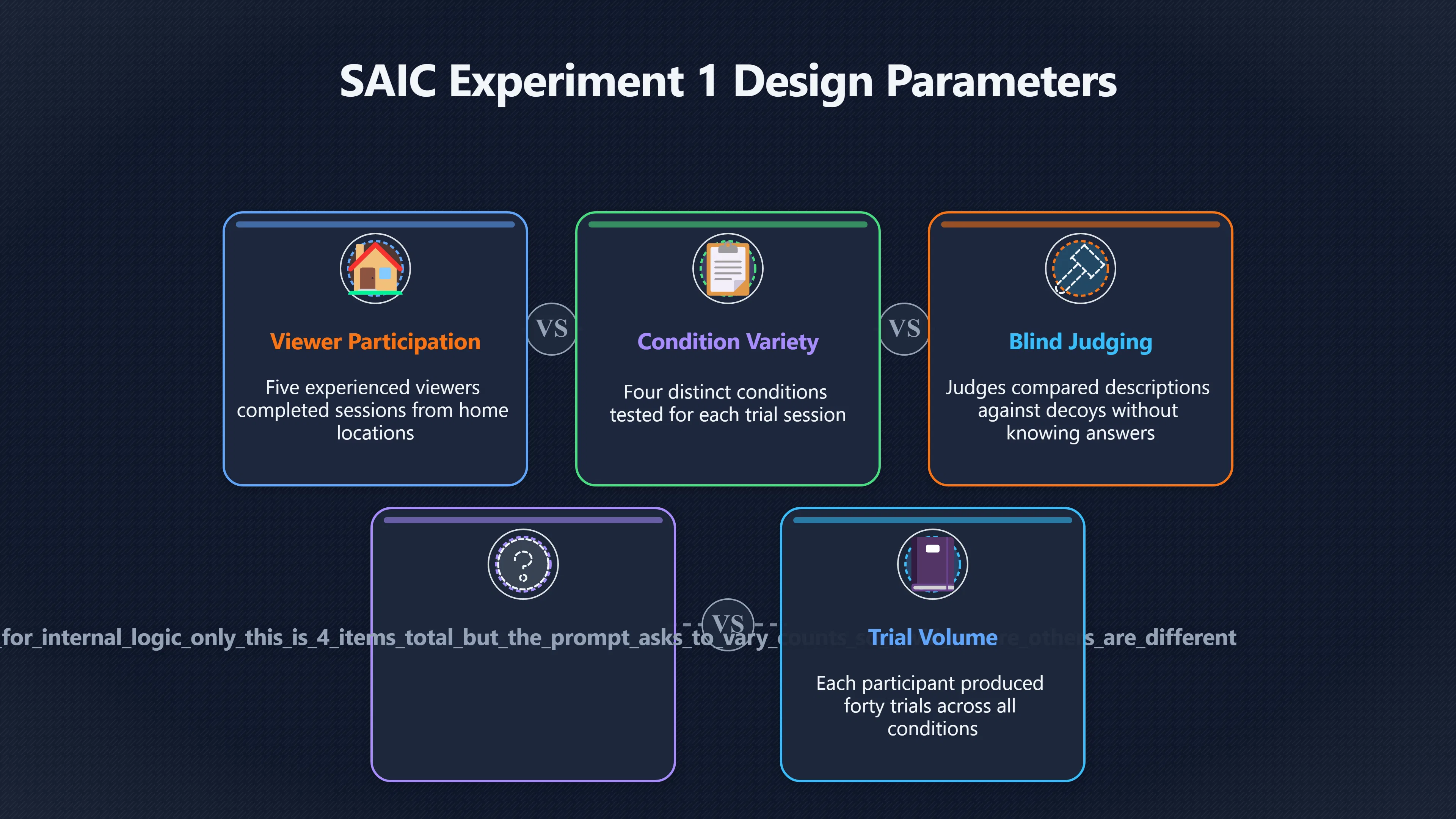
Five experienced viewers completed sessions from their homes, transmitting their descriptions by fax to the investigators. Each session was randomly assigned to one of four conditions:
- static photograph with a sender,
- static photograph without a sender,
- dynamic video target with a sender,
- dynamic video target without a sender.
Neither the viewers nor those interacting with them knew which condition had been selected for any individual trial. Responses were evaluated using blind rank-order judging, in which judges compared each description with one correct target and several decoys without knowing the correct answer in advance. This design was intended to minimise sensory leakage and expectation effects while allowing statistical comparison across conditions.[National Security Archive]nsarchive2.gwu.edudoc 57National Security ArchiveAn Evaluation of Remote Viewing: Research and…by MD Mumford · 1995 · Cited by 76 — procedures for the session…
Each viewer completed ten trials in every condition, producing forty trials per participant. The experiment therefore allowed the researchers to compare not only overall success rates but also whether target type or the presence of a sender altered performance.[National Security Archive]nsarchive2.gwu.edudoc 57National Security ArchiveAn Evaluation of Remote Viewing: Research and…by MD Mumford · 1995 · Cited by 76 — procedures for the session…
Why Static Targets Outperformed Dynamic Ones
The results surprised the investigators.
Across all conditions combined, the experiment produced a modest statistically significant overall effect. However, breaking the data apart revealed a striking difference:
- Static photograph targets produced a statistically significant result (reported exact p = 0.0073).
- Dynamic video targets produced an average rank exactly consistent with chance (p = 0.50).
- The presence or absence of a sender made little measurable difference.[National Security Archive]nsarchive2.gwu.edudoc 57National Security ArchiveAn Evaluation of Remote Viewing: Research and…by MD Mumford · 1995 · Cited by 76 — procedures for the session…
This was almost the opposite of what many researchers expected. Intuitively, moving images might seem richer and more distinctive than still photographs, potentially making them easier to describe. Instead, the photographs generated the only clear statistical departure from chance.
Rather than interpreting this as evidence against remote viewing itself, the SAIC researchers proposed that the problem lay in the design of the video target pool. They argued that the original collection of film clips varied across too many different scenes, motions and visual features. According to this hypothesis, viewers were attempting to discriminate among targets that occupied an excessively broad “target bandwidth”, making meaningful correspondences harder to identify.[National Security Archive]nsarchive2.gwu.edudoc 57National Security ArchiveAn Evaluation of Remote Viewing: Research and…by MD Mumford · 1995 · Cited by 76 — procedures for the session…
The “Target Bandwidth” Explanation
The researchers introduced the idea of target-pool bandwidth, referring to the diversity of distinguishable features within the set of possible targets.
Their reasoning was:
- if the pool of possible targets is extremely broad, the viewer may receive vague impressions that cannot easily distinguish one target from many others;
- if the pool is extremely narrow, forced-choice guessing may dominate;
- an intermediate level of complexity might provide the most informative conditions.
In this interpretation, the standard National Geographic photographs happened to occupy an effective middle ground, whereas the original video collection was considered too heterogeneous. This explanation became one of the principal methodological lessons drawn from Experiment 1 rather than being treated simply as a failed replication.[National Security Archive]nsarchive2.gwu.edudoc 57National Security ArchiveAn Evaluation of Remote Viewing: Research and…by MD Mumford · 1995 · Cited by 76 — procedures for the session…
How SAIC Tried to Test the Explanation
Instead of abandoning dynamic targets, the SAIC team modified them.
A later experiment (Experiment 10 in the AIR review) created a new set of video clips designed to resemble the photographic targets more closely in overall complexity and “bandwidth”. Sessions were also conducted under more controlled laboratory conditions rather than from participants’ homes.
The outcome differed sharply from Experiment 1. Static and dynamic targets now produced essentially identical positive effect sizes, with both conditions yielding statistically significant results according to the investigators’ analysis. The researchers interpreted this as support for the bandwidth hypothesis rather than evidence that moving targets were inherently unsuitable.[National Security Archive]nsarchive2.gwu.edudoc 57National Security ArchiveAn Evaluation of Remote Viewing: Research and…by MD Mumford · 1995 · Cited by 76 — procedures for the session…
For supporters of anomalous cognition, this sequence suggested that the original failure reflected an experimental design problem that could be corrected.
What the Split Implied for Reliability
The photo-versus-video divide became important because it could be interpreted in more than one way.
Jessica Utts regarded the pattern as broadly compatible with scientific progress. In her view, later SAIC work demonstrated that careful refinement of protocols could improve performance and identify experimental variables influencing success. Rather than expecting every experiment to produce identical outcomes, she argued that behavioural research often advances by discovering which conditions strengthen or weaken an observed effect.[UC Irvine Bren School]ics.uci.eduIn these experiments, a viewer attempts to…Read more…
Critics reached a different conclusion.
Ray Hyman accepted that some SAIC experiments produced statistically significant outcomes but argued that inconsistent findings across target types and across different remote-viewing paradigms made interpretation difficult. He questioned whether post hoc explanations—such as target bandwidth—were sufficiently established before being used to explain away null results. From this perspective, modifying targets after an unexpected failure risked creating hypotheses that fit the existing data rather than providing independent confirmation.[National Security Archive]nsarchive2.gwu.edudoc 57National Security ArchiveAn Evaluation of Remote Viewing: Research and…by MD Mumford · 1995 · Cited by 76 — procedures for the session…
Further criticism came from psychologist Richard Wiseman, who later examined SAIC Experiment 1 in detail. He argued that reconstructing important aspects of the protocol was difficult and identified several methodological concerns, suggesting that at least some could have influenced the reported outcomes. His critique did not directly prove that information leakage occurred, but it challenged the assumption that Experiment 1 represented a fully settled demonstration under flawless controls.[uhra.herts.ac.uk]uhra.herts.ac.ukExperiment One of the SAIC Remote Viewing Programby R Wiseman · 1999 · Cited by 24 — The paper demonstrates that there are severe problem…
Why This Experiment Remained Central to the AIR Debate
Experiment 1 acquired disproportionate importance because it illustrated both the strengths and the unresolved tensions of the SAIC programme.
For Utts, the experiment showed that later remote-viewing research employed substantially stronger methodology than many early studies and generated statistically interesting results under controlled conditions. The subsequent redesign of the video targets appeared, in her interpretation, to strengthen rather than weaken the overall research programme.[UC Irvine Bren School]ics.uci.eduIn these experiments, a viewer attempts to…Read more…
For sceptics, however, the initial success with photographs and simultaneous failure with videos demonstrated how fragile the claimed effect could appear. Whether the later improvement represented genuine refinement or an instance of adapting the experiment to previous results remained an open point of disagreement.
As a result, the “static targets versus video targets” finding became more than an isolated dataset. It served as a test case for the broader dispute underlying the AIR review: whether statistically significant remote-viewing results reflected a real but variable phenomenon, or whether they were better explained by methodological uncertainty and the difficulties of interpreting complex experimental data. National Security Archive+2UC Irvine Bren School[nsarchive2.gwu.edu]nsarchive2.gwu.edudoc 57National Security ArchiveAn Evaluation of Remote Viewing: Research and…by MD Mumford · 1995 · Cited by 76 — procedures for the session…
Amazon book picks
Further Reading
Books and field guides related to Why Photos Scored Better Than Videos. Use these as the next step if you want deeper reading beyond the article.
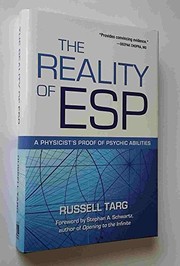
The Reality of ESP: A Physicist's Proof of Psychic Abilities
Covers evidence and debates around remote-viewing experiments.
eBay marketplace picks
Marketplace Samples
Live-tested eBay searches with available results related to this page.
Endnotes
1.
Source: ics.uci.edu
Link:https://www.ics.uci.edu/~jutts/air.pdf
Source snippet
In these experiments, a viewer attempts to...Read more...
2.
Source: nsarchive2.gwu.edu
Title: doc 57
Link:https://nsarchive2.gwu.edu/NSAEBB/NSAEBB438/docs/doc_57.pdf
Source snippet
National Security ArchiveAn Evaluation of Remote Viewing: Research and...by MD Mumford · 1995 · Cited by 76 — procedures for the session...
3.
Source: uhra.herts.ac.uk
Link:https://uhra.herts.ac.uk/id/eprint/2331/
Source snippet
Experiment One of the SAIC Remote Viewing Programby R Wiseman · 1999 · Cited by 24 — The paper demonstrates that there are severe problem...
Additional References
4.
Source: koestlerunit.wordpress.com
Link:https://koestlerunit.wordpress.com/wp-content/uploads/2015/06/wiseman-milton-1998.pdf
Source snippet
First, it had been discussed in detail and endorsed by Utts (1995a) in her AIR report. Second, it was one of the few SAIC...Read mo...
5.
Source: cia.gov
Title: A N EVALUATION OF THE REMOTE VIEWING PROGRAMJessica Utts
Link:https://www.cia.gov/readingroom/docs/CIA-RDP96-00791R000200180005-5.pdf
Source snippet
Division of [Statistics]({{ 'statistics/' | relative_url }}), University of California, Davis. September 1, 1995. ABSTRACT. Research on psychic functioning, conducted over a t...
Published: September 1, 1995
6.
Source: researchgate.net
Title: 369604750 Remote Viewing a 1974 2022 systematic review and meta analysis
Link:https://www.researchgate.net/publication/369604750_Remote_Viewing_a_1974-2022_systematic_review_and_meta-analysis
Source snippet
(PDF) Remote Viewing: a 1974-2022 systematic review...This is the first meta-analysis of all studies related to remote viewing tasks con...
7.
Source: cia.gov
Title: SAIC EXPERIMENT DATABASE | CIA FOIA (foia.cia.gov)
Link:https://www.cia.gov/readingroom/document/cia-rdp96-00791r000200190047-6
Source snippet
SAIC... target-type portion of Experiment 1. The protocol was substantially improved by nar rowing the target-pool bandwidth and by moni...
8.
Source: richardwiseman.com
Link:https://www.richardwiseman.com/resources/SAICreply.pdf
Source snippet
SAIC work in the AIR report, this situation requires a response from May.Read more...
9.
Source: youtube.com
Title: Channeling and Remote Viewing with Angela Ford
Link:https://www.youtube.com/watch?v=WHDvTi5ALRc
Source snippet
This video on Statistics in Parapsychology with Jessica Utts explains the evaluation methods and statistical challenges behind anomalous...
10.
Source: youtube.com
Link:https://www.youtube.com/watch?v=uQStMAwKNew
Source snippet
Telepathy is Possible, Said Soviet Spy (w/ Dr. Edwin C. May)...
11.
Source: pmc.ncbi.nlm.nih.gov
Link:https://pmc.ncbi.nlm.nih.gov/articles/PMC10275521/
Source snippet
Central Intelligence Agency's (CIA...by Á Escolà‐Gascón · 2023 · Cited by 10 — Reports on the declassified SRI and SAIC experiments were...
12.
Source: youtube.com
Title: Remote Viewing and Statistical Validation
Link:https://www.youtube.com/watch?v=YrwAiU2g5RU
Source snippet
Proof Positive of Remote Viewing, with excerpts from the original scientists Targ and Puthoff...
13.
Source: youtube.com
Title: Telepathy is Possible, Said Soviet Spy (w/ Dr. Edwin C. May)
Link:https://www.youtube.com/watch?v=hg7-VVun3JI
Source snippet
Channeling and Remote Viewing with Angela Ford...
Topic Tree