Within Pop Culture
Can Online Targets Really Test Viewers?
Practice target pools make remote viewing feel repeatable, but they also raise questions about loose matching and selective memory.
On this page
- How hidden target pools structure attempts
- Why feedback can encourage both learning and overmatching
- What makes a hobby test different from controlled research
Page outline Jump by section
Introduction
Online target pools are one of the main reasons remote viewing has remained an active hobby long after government programmes ended. Instead of reading about historical experiments, participants can attempt to describe a hidden photograph, location or object before it is revealed, creating a personal experience that feels repeatable and testable. This feedback loop is central to modern remote-viewing communities: make a blind attempt, compare it with the target, discuss similarities, then try again.

The same mechanism that makes target pools engaging also makes them controversial. Immediate feedback can genuinely help people refine observation and note-taking habits, but it can also encourage selective interpretation, where vague descriptions are retrospectively matched to a revealed image. Understanding how target pools work therefore helps explain why remote viewing persists as a popular pastime while remaining distinct from controlled scientific research.
Can Online Targets Really Test Viewers?
How hidden target pools structure attempts
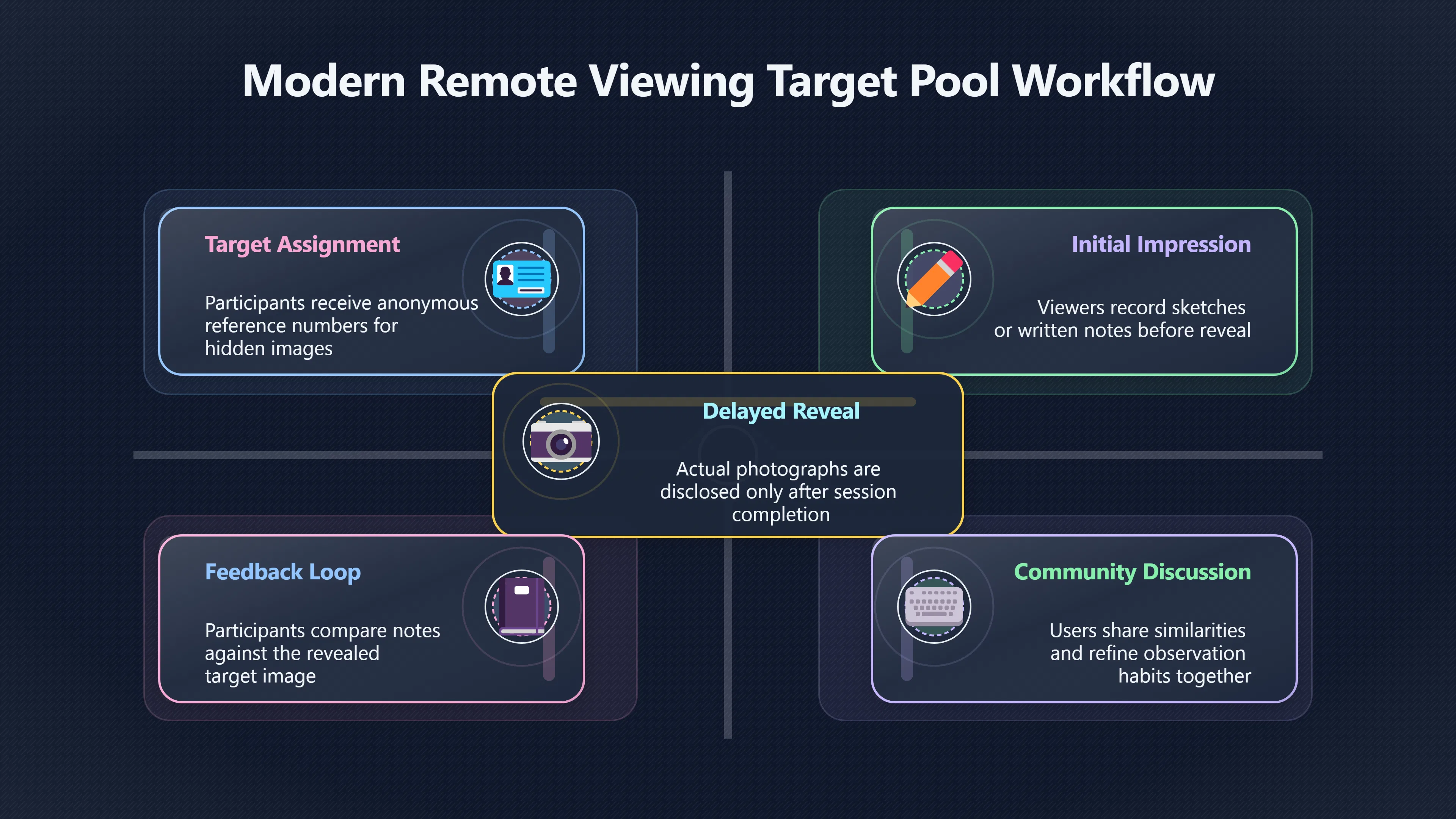
A target pool is a collection of hidden targets—typically photographs, locations or scenes—assigned anonymous reference numbers. A participant receives only the number or identifier before recording impressions. Only after the session is complete is the actual target disclosed.
This structure mirrors an important feature of historical remote-viewing protocols: the viewer should not know what the target is beforehand. Researchers at the former Stanford Research Institute (SRI) and later government-sponsored projects regarded blind target selection as essential because prior knowledge could easily influence descriptions. Experimental protocols typically kept both the viewer and, in stronger designs, the session monitor unaware of the selected target until after the session, creating a double-blind arrangement intended to minimise ordinary information leakage.[CIA+2PSI-Unit]cia.govFEEDBACK AND PRECOGNITION DEPENDENT REMOTE…(U) Protocol. (U) The viewer and the monitor were blind to both the target pool and the…
Modern hobby websites often borrow this format by presenting:
- a randomly assigned target number;[aapsglobal.com]aapsglobal.comThrough Time and Space: The Evidence for Remote viewingThese sessions were also double blind, neither the viewer nor the researcher knowi…
- instructions to write or sketch first;
- delayed access to the answer;
- optional community discussion afterwards.
For participants, this creates the feeling of conducting a miniature experiment rather than merely imagining a scene.
Why the reveal matters
The feedback stage is what distinguishes target pools from simple guessing games. Once the hidden image is revealed, viewers compare their notes against the actual target.
Enthusiasts often argue that repeated exposure to feedback helps them recognise recurring mistakes, separate confident impressions from speculative additions and improve discipline by recording impressions before interpretation. In practical terms, feedback encourages participants to keep structured notes rather than altering memories afterwards.
The experience can also be emotionally compelling. Even partial correspondences—a sketch resembling a bridge or a written impression of “water” matching a coastal photograph—can feel personally meaningful because the participant experienced the attempt before knowing the answer.
Why feedback encourages both learning and overmatching
The same reveal that makes practice satisfying also introduces an important psychological challenge.
Once people know the correct answer, it becomes much easier to notice similarities than differences. General descriptions such as “round”, “metal”, “bright”, “movement” or “natural” can often be connected to many different photographs. If participants mainly remember successful correspondences while overlooking incorrect impressions, confidence can increase even when objective accuracy has not.
This tendency is well recognised in psychology more broadly. Human pattern recognition is exceptionally good at constructing meaningful connections after the fact, especially when evaluating open-ended descriptions. Remote-viewing transcripts are usually free-response rather than multiple-choice, giving considerable scope for interpretation. Critics have long argued that this flexibility makes retrospective matching particularly vulnerable to confirmation bias and subjective scoring.[Wikipedia+2Wikipedia]WikipediaRemote viewingRemote viewing
In hobby communities, several practices can unintentionally strengthen this effect:
- focusing discussion on apparent “hits” while ignoring misses;
- allowing viewers to reinterpret earlier notes after seeing the target;
- treating symbolic or metaphorical similarities as equivalent to direct descriptions;
- giving broad credit for partially matching features without predefined scoring rules.
None of these behaviours necessarily involve deliberate deception. They arise naturally when people evaluate ambiguous information after learning the correct answer.

What makes a hobby test different from controlled research?
The outward appearance of an online target session can resemble a laboratory experiment, but important methodological differences usually remain.
Controlled research attempts to minimise opportunities for unconscious cueing and subjective judgement. Stronger remote-viewing experiments have used random target selection, independent judging, double-blind procedures and predefined scoring methods intended to reduce flexibility after the session is complete. These controls exist because earlier studies attracted criticism over potential sensory cues, judging procedures and opportunities for unintended bias.[Wikipedia+3CIA+3Psi Encyclopedia]cia.govFEEDBACK AND PRECOGNITION DEPENDENT REMOTE…(U) Protocol. (U) The viewer and the monitor were blind to both the target pool and the…
Most hobby target pools are designed primarily for practice rather than formal evidence. Common differences include:
- participants often score their own sessions;
- judging criteria may not be fixed in advance;
- targets are sometimes reused or become familiar within communities;
- discussion between viewers can influence later interpretations;
- unsuccessful sessions are less likely to be shared than memorable ones.
These differences do not make hobby practice meaningless. They simply mean that practising through online targets serves a different purpose from testing a scientific hypothesis.
Why target pools remain popular despite the debate
Target pools succeed because they transform an abstract paranormal claim into a repeatable personal activity. A participant does not need to rely on historical anecdotes or declassified intelligence files; they can perform a session immediately and judge the outcome for themselves.
That accessibility has helped sustain remote viewing as an online hobby. Forums, training groups and dedicated websites encourage regular practice through thousands of archived targets, creating communities built around experimentation rather than passive belief. The repeated cycle of anticipation, hidden target, reveal and discussion keeps participants engaged regardless of whether they interpret the experience as evidence of psychic perception, intuition, coincidence or an exercise in observation.
The popularity of target pools therefore says as much about human learning and curiosity as it does about remote viewing itself. They offer a structured experience that feels empirical on a personal level, while also illustrating why individual experience and controlled scientific evidence are not always evaluated by the same standards.
Amazon book picks
Further Reading
Books and field guides related to Can Online Targets Really Test Viewers?. Use these as the next step if you want deeper reading beyond the article.


Remote Viewers: The Secret History of America's Psychic Spies
Provides historical context for practice protocols.
eBay marketplace picks
Marketplace Samples
Live-tested eBay searches with available results related to this page.



Endnotes
1.
Source: cia.gov
Link:https://www.cia.gov/readingroom/docs/CIA-RDP96-00789R002200200001-5.pdf
Source snippet
FEEDBACK AND [PRECOGNITION]({{ 'precognition/' | relative_url }}) DEPENDENT REMOTE...(U) Protocol. (U) The viewer and the monitor were blind to both the target pool and the...
2.
Source: psi-unit.com
Link:https://psi-unit.com/wp-content/uploads/RemoteViewingReplicationEvaluatedByConceptAnalysisJpVolume58_pg259to272.pdf
Source snippet
Remote viewing replication: Evaluated with concept analysisby R TARG · 1994 · Cited by 35 — The target location selected is kept...
3.
Source: Wikipedia
Title: Remote viewing
Link:https://en.wikipedia.org/wiki/Remote_viewing
4.
Source: Wikipedia
Title: Parapsychology research at SRI
Link:https://en.wikipedia.org/wiki/Parapsychology_research_at_SRI
5.
Source: Wikipedia
Title: Sensory leakage
Link:https://en.wikipedia.org/wiki/Sensory_leakage
6.
Source: remote.co
Title: Work: Jobs, Companies & Virtual Teams
Link:https://remote.co/
Source snippet
Remote Work: Jobs, Companies & Virtual Teams - Remote.coBrowse thousands of remote and hybrid jobs tailored for you. -home jobs in wellne...
7.
Source: Wikipedia
Title: [Ganzfeld]({{ ‘ganzfeld/’ | relative_url }}) experiment
Link:https://en.wikipedia.org/wiki/Ganzfeld_experiment
Source snippet
Ganzfeld experimentA ganzfeld experiment is an assessment used by parapsychologists that they contend can test for extrasensory percep...
8.
Source: psi-encyclopedia.spr.ac.uk
Title: Psi Encyclopedia Remote Viewing
Link:https://psi-encyclopedia.spr.ac.uk/articles/remote-viewing/
Source snippet
Psi EncyclopediaRemote Viewing - Psi Encyclopedia13 Jan 2017 — Remote viewing replaced repetitive forced-choice tasks with free-response...
9.
Source: dictionary.cambridge.org
Link:https://dictionary.cambridge.org/dictionary/english/remote
Source snippet
English meaning - Cambridge Dictionary6 days ago — 1. far away in distance: A remote area, house, or village is a long way from any tow...
Additional References
10.
Source: nectar.northampton.ac.uk
Link:https://nectar.northampton.ac.uk/id/eprint/12472/1/Krippner_etal_ELS_2018_Remote_viewing_of_concealed_target_pictures_under_light_and_dark_conditions.pdf
Source snippet
viewing of concealed target pictures under light and...by S Krippner · 2019 · Cited by 15 — King Croesus' experiment was double-blind be...
11.
Source: documents.theblackvault.com
Link:https://documents.theblackvault.com/documents/remoteviewing/rvevaluation.pdf
Source snippet
The Black Vault Documentsrvevaluation.pdfSo even if the ganzfeld and the SAle remote viewing experiments have achieved significant... if...
12.
Source: researchgate.net
Title: 369604750 Remote Viewing a 1974 2022 systematic review and [meta analysis]({{ ‘meta-analysis/’ | relative_url }})
Link:https://www.researchgate.net/publication/369604750_Remote_Viewing_a_1974-2022_systematic_review_and_meta-analysis
Source snippet
(PDF) Remote Viewing: a 1974-2022 systematic review...This is the first meta-analysis of all studies related to remote viewing tasks con...
13.
Source: remoteok.com
Link:https://remoteok.com/
Source snippet
Remote OK® is the #1 Remote Job Platform and has 1134237+ remote jobs as a Developer, Designer, Copywriter, Customer Support Rep...
14.
Source: emmind.net
Link:https://emmind.net/openpapers_repos/Nonlocality_Fields/Nonlocal_Mind/Various/2014_Explicit_Anomalous_Cognition_A_Review_of_the_Best_Evidence_in_Ganzfeld%2C_Forced-choice_Remote_Viewing_and_Dream_Studies.pdf
Source snippet
A Review of the Best Evidence in Ganzfeld, Forced-choice...by J Baptista · Cited by 78 — A remote viewing pilot study using a ganzfeld...
15.
Source: aapsglobal.com
Link:https://www.aapsglobal.com/wp-content/uploads/2018/04/Schwartz-S-Through-Time-and-Space-the-evidence-for-remote-viewing.pdf
Source snippet
Through Time and Space: The Evidence for Remote viewingThese sessions were also double blind, neither the viewer nor the researcher knowi...
16.
Source: koestler-parapsychology.psy.ed.ac.uk
Title: KPU 1034 Published Results
Link:https://www.koestler-parapsychology.psy.ed.ac.uk/Documents/KPU_1034_Published_Results.pdf
Source snippet
remote viewing projects: assessing rater...by DL KATZ · 2021 · Cited by 10 — Using double-blind protocols, 10 new judges were recruited...
17.
Source: uk.indeed.com
Title: q remote working jobs
Link:https://uk.indeed.com/q-remote-working-jobs.html
Source snippet
Remote Working JobsBrowse 8164 Remote Working job openings. Discover flexible, work-from-home opportunities on Indeed in fields like tech...
18.
Source: youtube.com
Title: Guide: How to Build Targets for Remote Viewing Training
Link:https://www.youtube.com/watch?v=VRJpWBIDUOs
Source snippet
Remote Viewing Training, Part One: The Initial Phases, with Paul H. Smith...
19.
Source: youtube.com
Title: Beginners Remote Viewing Template + Guide (Free Download)
Link:https://www.youtube.com/watch?v=GnK6289Eau0
Source snippet
Remote Viewing Starter Kit - Video Course for Beginners...
Topic Tree