Within ESP Compare
How Psychic Spying Rebranded ESP
The intelligence setting made remote viewing sound operational and modern while preserving older clairvoyant assumptions.
On this page
- From occult language to intelligence language
- Why operational framing changed public interest
- What the rebrand did not prove
Page outline Jump by section
Introduction
Remote viewing did not introduce a fundamentally new paranormal claim. Instead, it repackaged older ideas about clairvoyance and extrasensory perception (ESP) into a format that appeared compatible with scientific research and intelligence work. Rather than speaking of visions, mediums or occult insight, researchers and government sponsors described viewers, targets, protocols and operational testing. This change in language proved remarkably influential. It encouraged the public to see remote viewing as something different from traditional psychic claims, even though its central assumption remained the same: that people could obtain information without using the known senses.
The transformation mattered because it shifted the debate from spiritual belief to government evaluation. The association with classified military programmes and intelligence agencies gave remote viewing a reputation for practical utility that older psychic traditions rarely enjoyed. Yet the later official reviews concluded that this operational framing did not establish that psychic functioning had been demonstrated or that the technique had intelligence value.[CIA]cia.govAN EVALUATION OF REMOTE VIEWINGIn the following section, we describe the history of the government's remote viewing program. Program H…
From occult language to intelligence language
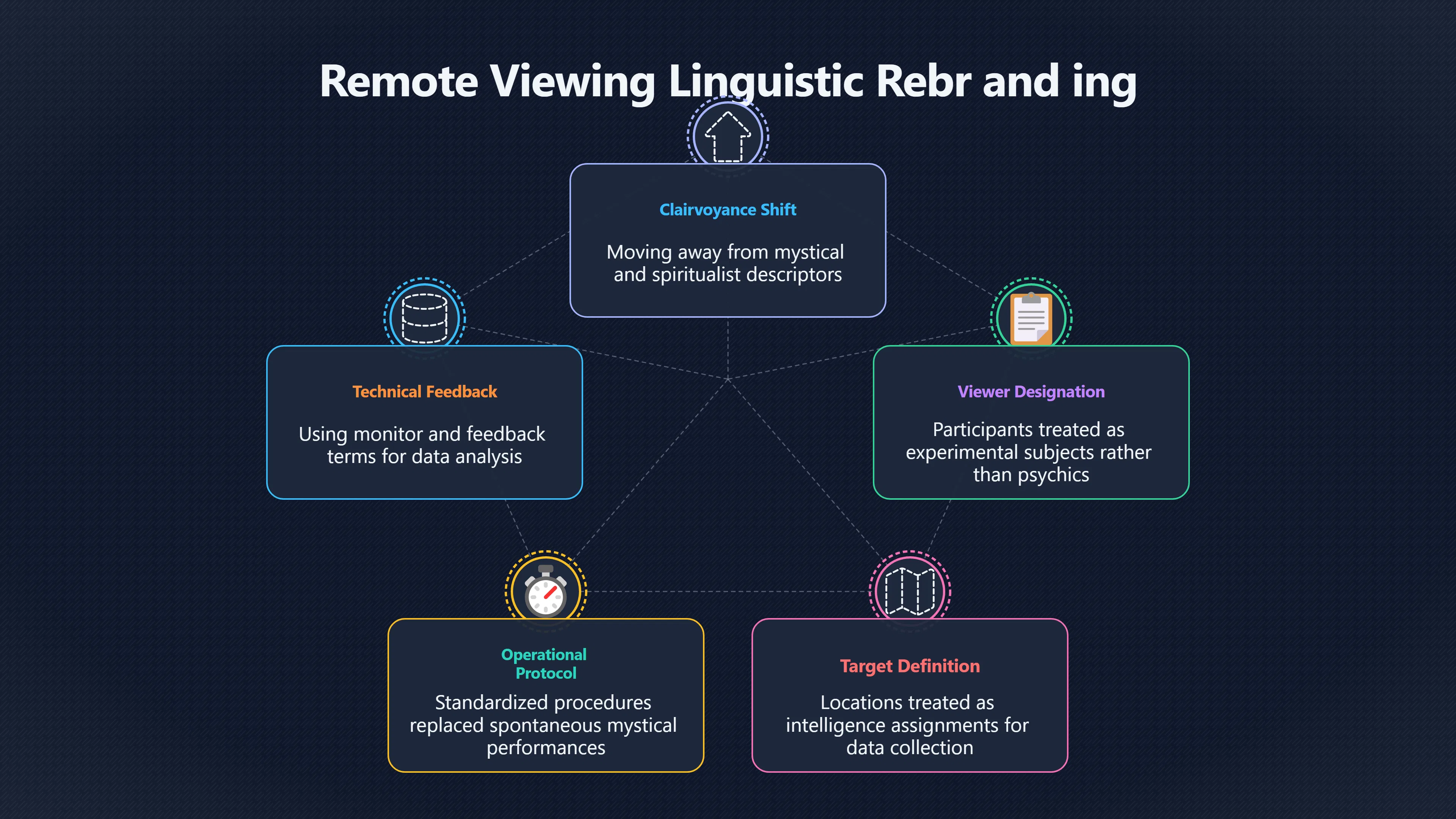
For most of the twentieth century, claims of clairvoyance were associated with spiritualism, psychical research, fortune-telling and parapsychology. These traditions described gifted individuals receiving impressions from distant places or hidden objects through mysterious mental processes. Although researchers attempted controlled experiments, the surrounding vocabulary remained closely tied to the paranormal.
During the early 1970s, researchers at the Stanford Research Institute (SRI), particularly Russell Targ, Harold Puthoff and artist-psychic Ingo Swann, deliberately adopted a different presentation. The expression “remote viewing” was introduced to distinguish the work from the culturally loaded term “clairvoyance”. Instead of emphasising supernatural gifts, the researchers described a repeatable information-gathering procedure conducted under conditions intended to reduce ordinary sensory cues. Early publications spoke of “information transfer” and “sensory shielding” rather than occult perception.[Wikipedia]WikipediaRemote viewingRemote viewing
This vocabulary made an important psychological difference. A “viewer” following a protocol sounded more like an experimental participant than a psychic. A “target” sounded like an intelligence assignment rather than a mystical vision. Session transcripts, blind judging and numerical scoring resembled laboratory methods even though the underlying claim remained that information could arrive through unknown means.
Why operational framing changed public interest
The involvement of American intelligence organisations transformed public perceptions far more than any laboratory experiment alone could have done.
When reports emerged that the CIA, Defence Intelligence Agency and earlier military organisations had funded programmes investigating remote viewing, many people assumed that governments would not spend money on such research unless compelling evidence already existed. In reality, Cold War intelligence agencies sometimes explored unconventional ideas because even a small possibility of strategic advantage could justify limited investigation. Exploring an unlikely possibility is not equivalent to confirming that it works.[CIA]cia.govAN EVALUATION OF REMOTE VIEWINGIn the following section, we describe the history of the government's remote viewing program. Program H…
The operational language also shifted expectations in several ways:
- Military relevance replaced spiritual significance. Instead of asking whether psychic perception existed in general, researchers asked whether it could locate hostages, identify military installations or support intelligence analysis.
- Procedures replaced performances. Public psychic demonstrations gave way to documented sessions, target coordinates and written reports intended for later evaluation.
- Government secrecy increased credibility for many observers. Classified programmes encouraged speculation that successful results were being concealed, even though later declassification revealed extensive documentation of both successes and failures.
- Technical terminology reduced cultural stigma. Terms such as “coordinate remote viewing”, “monitor”, “feedback” and “operational session” sounded closer to applied research than paranormal practice.[CIA]cia.govAN EVALUATION OF REMOTE VIEWINGIn the following section, we describe the history of the government's remote viewing program. Program H…
As a result, remote viewing became known as “psychic spying”—a phrase that combined paranormal claims with the prestige and intrigue of intelligence operations.
How Cold War politics encouraged the rebrand
The Cold War created an unusual environment in which unconventional research could receive official attention. American intelligence officers were aware of reports that the Soviet Union was investigating various forms of parapsychology. Whether those reports accurately reflected Soviet capabilities was less important than the possibility that a strategic rival might discover something valuable first.
This atmosphere encouraged agencies to examine remote viewing as a potential intelligence resource rather than dismissing it outright. Funding therefore reflected uncertainty management rather than endorsement. Intelligence organisations routinely investigate low-probability, high-impact possibilities because overlooking an unexpected capability could have strategic consequences.
That context helps explain why remote viewing acquired an image of official legitimacy. The existence of government research became widely interpreted as evidence that psychic functioning had been validated, even though the programmes themselves were designed to determine whether such claims could withstand systematic testing.[CIA]cia.govAN EVALUATION OF REMOTE VIEWINGIn the following section, we describe the history of the government's remote viewing program. Program H…
What the rebrand did not prove
Although the terminology changed dramatically, the central claim remained essentially identical to older ESP traditions. Remote viewing still depended on the proposition that a person could obtain accurate information without recognised sensory or conventional informational pathways.
The operational vocabulary did not itself solve the longstanding scientific problems associated with ESP research. Critics continued to question issues such as sensory leakage, subjective interpretation, statistical methodology and independent replication. Supporters argued that some experiments produced results exceeding chance expectations, while sceptics maintained that methodological weaknesses and inconsistent replication prevented firm conclusions. The debate therefore shifted from the existence of clairvoyance to the quality of experimental evidence rather than disappearing altogether.[CIA]cia.govAN EVALUATION OF THE REMOTE VIEWING PROGRAMUtts and Hyman were asked to prepare independent reports based on their review. In this rev…
The official review commissioned by the CIA in 1995 illustrates this distinction. Statistician Jessica Utts concluded that the accumulated experimental results deserved serious scientific consideration and argued that chance alone was an inadequate explanation. Psychologist Ray Hyman agreed that some findings warranted further study but argued that methodological concerns prevented concluding that ESP had been established. Both reviewers examined the same body of research yet reached different interpretations of its significance.[CIA]cia.govAN EVALUATION OF THE REMOTE VIEWING PROGRAMUtts and Hyman were asked to prepare independent reports based on their review. In this rev…
The intelligence verdict versus the public myth
Perhaps the greatest legacy of the rebranding is the gap between public memory and official conclusions.
Popular culture often remembers that intelligence agencies investigated psychic spying, treating the existence of the programmes as evidence that remote viewing worked. The historical record is more nuanced. The American Institutes for Research evaluated both the scientific evidence and the operational usefulness of the programme after more than two decades of government sponsorship.
The reviewers distinguished two separate questions:
- Was there evidence suggesting anomalous experimental effects? This remained disputed between reviewers.
- Had remote viewing demonstrated practical intelligence value? The review concluded that there was no documented evidence that it had provided sufficiently reliable or actionable intelligence for operational use.[National Security Archive]nsarchive2.gwu.eduNational Security ArchiveAn Evaluation of Remote Viewing: Research and…by MD Mumford · 1995 · Cited by 76 — In the early 1970s, the CI…
Consequently, the CIA terminated the programme after the review. The decision reflected concerns about reliability and operational usefulness rather than an acknowledgement that psychic espionage had become an established intelligence capability.[CIA]cia.govAN EVALUATION OF REMOTE VIEWINGIn the following section, we describe the history of the government's remote viewing program. Program H…

Why the rebranding still matters
Remote viewing demonstrates how changing language can reshape public understanding without necessarily changing the underlying claim. By replacing the vocabulary of clairvoyance with the language of intelligence analysis, experimental protocols and government programmes, proponents gave an old ESP concept a modern institutional identity.
That transformation proved culturally powerful. “Psychic spying” sounded less like occult belief and more like a classified technology under evaluation. The association with national security encouraged decades of speculation and helped remote viewing occupy a distinctive place between parapsychology, Cold War history and popular culture.
However, the rebranding did not itself resolve the fundamental question of whether ESP exists. It changed how the claim was presented and investigated, not the evidential standard required to demonstrate that information can genuinely be acquired without the known senses.
Amazon book picks
Further Reading
Books and field guides related to How Psychic Spying Rebranded ESP. Use these as the next step if you want deeper reading beyond the article.
The Men Who Stare At Goats
Rating: 3.5/5 from 11 Google Books ratings
Explores military interest in psychic programs.

eBay marketplace picks
Marketplace Samples
Live-tested eBay searches with available results related to this page.


Endnotes
1.
Source: cia.gov
Link:https://www.cia.gov/readingroom/docs/CIA-RDP96-00791R000200180006-4.pdf
Source snippet
AN EVALUATION OF REMOTE VIEWINGIn the following section, we describe the history of the government's remote viewing program. Program H...
2.
Source: cia.gov
Link:https://www.cia.gov/readingroom/docs/CIA-RDP96-00791R000200180005-5.pdf
Source snippet
AN EVALUATION OF THE REMOTE VIEWING PROGRAMUtts and Hyman were asked to prepare independent reports based on their review. In this rev...
3.
Source: Wikipedia
Title: Remote viewing
Link:https://en.wikipedia.org/wiki/Remote_viewing
4.
Source: Wikipedia
Title: [Stargate]({{ ‘stargate/’ | relative_url }}) Project (U.S. Army unit)
Link:https://en.wikipedia.org/wiki/Stargate_Project_%28U.S._Army_unit%29
Source snippet
Stargate Project (U.S. Army unit)The Stargate Project's work primarily involved remote viewing, the purported ability to psychically "...
5.
Source: nsarchive2.gwu.edu
Link:https://nsarchive2.gwu.edu/NSAEBB/NSAEBB438/docs/doc_57.pdf
Source snippet
National Security ArchiveAn Evaluation of Remote Viewing: Research and...by MD Mumford · 1995 · Cited by 76 — In the early 1970s, the CI...
Additional References
6.
Source: skepsis.nl
Link:https://skepsis.nl/stargate/
Source snippet
CIA onderzoekt ESP / remote viewingStargate onder het mes. Twintig jaar geheim militair onderzoek naar remote viewing. door Ray Hyman – S...
7.
Source: reddit.com
Link:https://www.reddit.com/r/HighStrangeness/comments/14x6pu0/the_cias_remote_viewing_documents_are_confusing/
Source snippet
The CIAs remote viewing documents are confusing as hellThe Stargate project produced zero evidence of remote viewing and that it's not re...
8.
Source: researchgate.net
Link:https://www.researchgate.net/publication/333228024_An_Assessment_of_the_Evidence_for_Psychic_Functioning
9.
Source: researchgate.net
Link:https://www.researchgate.net/publication/267978941Evaluation_of_Program_on%27Anomalous_Mental_Phenomena%27
Source snippet
Evaluation of Program on 'Anomalous Mental Phenomena'Jessica Utts and I were commissioned to evaluate the research on remote viewing and...
10.
Source: ucdavis.edu
Title: psychic spying research produces credible evidence
Link:https://www.ucdavis.edu/news/psychic-spying-research-produces-credible-evidence
Source snippet
'Psychic Spying' Research Produces Credible Evidence28 Nov 1995 — Secret government experiments on "psychic spying" have produced the mos...
11.
Source: youtube.com
Title: Remote Viewing Explained: How the Mind Sees Without Eyes
Link:https://www.youtube.com/watch?v=whpZzUwrUNU
Source snippet
Recovered from Copilot's visible YouTube title text and checked through public YouTube search plus the normal pipeline validation...
12.
Source: academia.edu
Link:https://www.academia.edu/95285973/The_Star_Gate_Operational_Remote_Viewing_Program_A_Human_Intelligence_HUMINT_Collection_Platform
Source snippet
(PDF) The [Star Gate]({{ 'star-gate/' | relative_url }}) Operational Remote Viewing Program...From 1973 to 1984, 54 operational projects with 127 remote viewing sessions wer...
13.
Source: youtube.com
Title: Remote Viewing: CIA’s Psychic Spy Secrets Revealed
Link:https://www.youtube.com/watch?v=Tc5QMFSI-t4
Source snippet
Recovered from Copilot's visible YouTube title text and checked through public YouTube search plus the normal pipeline validation...
14.
Source: youtube.com
Title: CIA Psychic Spies: The Stargate Project
Link:https://www.youtube.com/watch?v=CuDwaLYS5YM
Source snippet
Recovered from Copilot's visible YouTube title text and checked through public YouTube search plus the normal pipeline validation...
15.
Source: ciaotest.cc.columbia.edu
Link:https://ciaotest.cc.columbia.edu/olj/sa/sa_jan02srm01.html
Source snippet
Remote Viewing: The US Sponsored Psychic...Information regarding this top-secret programme was partly declassified by the CIA in July 19...
Topic Tree