Within Intel Value
What If the Psychic Sources Disagreed?
When different viewers produced inconsistent reports, officials had no dependable rule for deciding which claims to trust.
On this page
- Why source convergence matters
- How inconsistent impressions weakened confidence
- Why reliability profiles matter in intelligence
Page outline Jump by section
Introduction
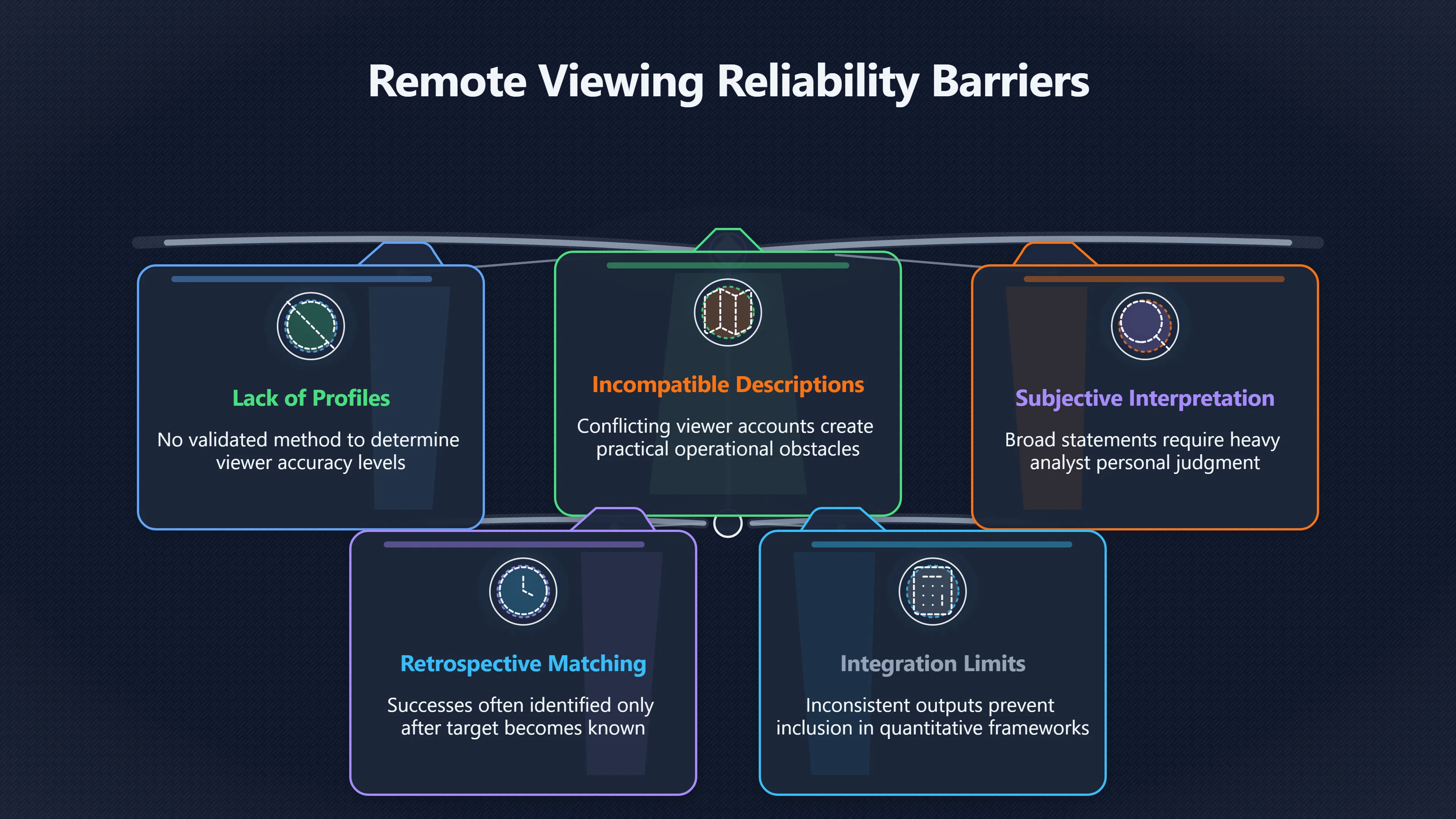
One of the least discussed operational problems in remote-viewing programmes was not whether individual sessions occasionally appeared impressive, but what happened when different viewers produced incompatible descriptions of the same target. Intelligence organisations routinely compare reports from multiple sources, yet that process only works when each source has a measurable reliability profile. In the Star Gate programme, there was no validated method for determining which viewer was likely to be correct when reports diverged, or even whether agreement between viewers reflected genuine accuracy rather than coincidence or shared interpretation. The result was a persistent obstacle to operational use: conflicting reports could not be resolved by reference to known performance characteristics, making it difficult for analysts to judge which, if any, deserved further action.[CIA]cia.govAN EVALUATION OF THE REMOTE VIEWING PROGRAMThe CIA asked AIR to address a number of key objectives during the technical review of Star…

Why source convergence matters
Intelligence analysis depends heavily on convergence. Independent reports that arrive at the same conclusion can strengthen confidence, while contradictory reports prompt analysts to seek additional evidence before committing resources.
This principle works because conventional intelligence sources accumulate track records. A satellite system has known technical limitations. A human informant develops a documented history of reliability. Signals intelligence can be evaluated according to known collection methods. Analysts therefore understand the kinds of errors each source is likely to make.
Remote viewing never acquired an equivalent profile. Even if a viewer occasionally produced information later judged accurate, intelligence managers could not reliably predict under what conditions that success would recur, what kinds of targets were suitable, or how frequently incorrect impressions would appear alongside potentially correct ones. The 1995 American Institutes for Research (AIR) evaluation concluded that operational users lacked evidence that remote-viewing reports could be trusted as dependable intelligence products.[CIA]cia.govAN EVALUATION OF THE REMOTE VIEWING PROGRAMThe CIA asked AIR to address a number of key objectives during the technical review of Star…
What happened when viewers disagreed?
Conflicting reports created a practical rather than philosophical problem.
If one viewer described a target as an industrial complex while another perceived a military installation, analysts needed an objective reason to prefer one account over the other. Unlike established intelligence disciplines, there was no validated weighting system based on demonstrated predictive performance.
Several approaches were attempted over the programme’s history, including:
- comparing reports after the fact to determine apparent accuracy;
- looking for overlapping descriptions across multiple viewers;
- relying more heavily on experienced viewers whose previous work had impressed programme managers; and
- treating repeated themes across sessions as potentially meaningful.
None of these approaches produced a generally accepted operational standard. Apparent agreement could reflect vague descriptions rather than precise matches, while disagreement offered no principled way to distinguish accurate information from error. The AIR review found that reports often contained broad, ambiguous statements requiring substantial subjective interpretation, making apparent convergence difficult to evaluate objectively.[CIA]cia.govAN EVALUATION OF THE REMOTE VIEWING PROGRAMThe CIA asked AIR to address a number of key objectives during the technical review of Star…
How inconsistent impressions weakened confidence
Conflicting reports affected confidence in several interconnected ways.
First, inconsistency complicated decision-making under time pressure. Intelligence officers rarely have the luxury of waiting indefinitely for clarification. If multiple viewers generated incompatible descriptions, the reports increased uncertainty instead of reducing it.
Second, contradictions made validation largely retrospective. After the true target became known, analysts could often identify elements that appeared successful in one report while overlooking conflicting or incorrect details in others. This retrospective matching could create the impression of success without demonstrating that the information would have supported a correct operational decision beforehand. Critics of the programme repeatedly argued that subjective validation made vague descriptions appear more accurate after the outcome was known.[Wikipedia]WikipediaRemote viewingRemote viewing
Third, inconsistent outputs limited integration with other intelligence. Analysts generally prefer sources whose confidence can be expressed quantitatively or through well-established reliability ratings. Remote-viewing reports could not readily be incorporated into these existing analytic frameworks because no accepted reliability scale existed.
Why experience alone was not enough
Supporters sometimes argued that experienced remote viewers performed better than novices, and some individual viewers developed reputations for producing especially useful sessions.
Operationally, however, reputation is not equivalent to a validated reliability profile.
A useful intelligence source should answer questions such as:
- Under what conditions does performance improve or decline?
- Which categories of targets are handled successfully?
- What types of errors occur most often?
- How frequently are reports substantially correct, partially correct or entirely wrong?
- Can independent analysts predict reliability before knowing the outcome?
The available operational evidence did not establish consistent answers to these questions. Consequently, analysts could not assign confidence to reports in the same systematic way used for conventional intelligence sources. The AIR review concluded that although some material might contain accurate elements, the programme did not demonstrate operational usefulness because reports lacked the specificity and dependability required for intelligence decision-making.[CIA]cia.govAN EVALUATION OF THE REMOTE VIEWING PROGRAMThe CIA asked AIR to address a number of key objectives during the technical review of Star…
The unresolved disagreement over evaluation
The question of reliability remains disputed because different reviewers evaluated different aspects of the programme.
Statistician Jessica Utts argued that portions of the experimental research showed evidence exceeding chance expectations and therefore merited continued scientific investigation. Psychologist Ray Hyman accepted that some statistical findings deserved attention but concluded that the evidence did not justify claims of demonstrated paranormal functioning or practical intelligence utility. Both reviewers nevertheless distinguished laboratory findings from operational effectiveness, recognising that even statistically interesting results did not automatically produce a reliable intelligence capability.[CIA]cia.govAN EVALUATION OF THE REMOTE VIEWING PROGRAMThe CIA asked AIR to address a number of key objectives during the technical review of Star…
This distinction is crucial. A phenomenon that occasionally produces above-chance experimental outcomes still requires a predictable operational profile before intelligence agencies can rely upon it in real-world decisions.
Why reliability profiles matter in intelligence
Every intelligence discipline contains uncertainty, but successful disciplines make that uncertainty measurable.
Analysts expect to know:
- the historical accuracy of a source;
- the situations in which it performs well or poorly;
- common failure modes;
- appropriate confidence levels; and
- methods for corroborating uncertain information.
Remote viewing never developed this operational framework. When viewers agreed, analysts could not determine whether the agreement genuinely increased confidence. When viewers disagreed, there was no validated basis for choosing between them. That missing reliability profile became one of the programme’s most significant practical limitations because intelligence organisations require sources whose strengths and weaknesses are understood before decisions—not only after outcomes are known.[CIA]cia.govAN EVALUATION OF THE REMOTE VIEWING PROGRAMThe CIA asked AIR to address a number of key objectives during the technical review of Star…

eBay marketplace picks
Marketplace Samples
Live-tested eBay searches with available results related to this page.

Endnotes
1.
Source: cia.gov
Link:https://www.cia.gov/readingroom/docs/CIA-RDP96-00791R000200180005-5.pdf
Source snippet
AN EVALUATION OF THE REMOTE VIEWING PROGRAMThe CIA asked AIR to address a number of key objectives during the technical review of Star...
2.
Source: Wikipedia
Title: Remote viewing
Link:https://en.wikipedia.org/wiki/Remote_viewing
3.
Source: Wikipedia
Title: Parapsychology research at SRI
Link:https://en.wikipedia.org/wiki/Parapsychology_research_at_SRI
4.
Source: cia.gov
Link:https://www.cia.gov/readingroom/docs/CIA-RDP96-00789R002800180001-2.pdf
Source snippet
STAR GATE PROJECT: AN OVERVIEW(U). This document provides a broad overview of the three main activity areas, ([foreign assessment]({{ 'foreign-watch/' | relative_url }}), externa...
Additional References
5.
Source: academia.edu
Link:https://www.academia.edu/95285973/The_Star_Gate_Operational_Remote_Viewing_Program_A_Human_Intelligence_HUMINT_Collection_Platform
Source snippet
(PDF) The Star Gate Operational Remote Viewing Program...An Evaluation of Remote Viewing: Research and Applications (a.k.a...
6.
Source: researchgate.net
Title: 369604750 Remote Viewing a 1974 2022 systematic review and [meta analysis]({{ ‘meta-analysis/’ | relative_url }})
Link:https://www.researchgate.net/publication/369604750_Remote_Viewing_a_1974-2022_systematic_review_and_meta-analysis
Source snippet
(PDF) Remote Viewing: a 1974-2022 systematic review...This is the first meta-analysis of all studies related to remote viewing tasks con...
7.
Source: scribd.com
Title: Evaluation of Remote Viewing Program | PDFThe document provides an executive
Link:https://www.scribd.com/doc/92017954/Air-Report
Source snippet
summary of a review conducted by the American Institutes for Research (AIR) to evaluate the research program and...
8.
Source: reddit.com
Link:https://www.reddit.com/r/consciousness/comments/181s71r/the_cias_experiments_with_remote_viewing_and/
Source snippet
perimentation with Ingo Swann can provide some evidence toward “non-local...
9.
Source: youtube.com
Title: CIA Project [Stargate]({{ ‘stargate/’ | relative_url }}) & Other Declassified Secrets
Link:https://www.youtube.com/watch?v=xDf7OUKpyvs
Source snippet
Project stargate remote viewing evaluation cia reliability Uncovering the CIA's Secret Weapon: Psychic Spies Johnathan Bi...
10.
Source: pmc.ncbi.nlm.nih.gov
Title: PMCFollow‐up on the U.S
Link:https://pmc.ncbi.nlm.nih.gov/articles/PMC10275521/
Source snippet
Central Intelligence Agency's (CIA...by Á Escolà‐Gascón · 2023 · Cited by 10 — Since 1972, the U.S. Central Intelligence Agency (CIA) co...
11.
Source: youtube.com
Link:https://www.youtube.com/watch?v=cooVUlF35Hw
Source snippet
The Stargate Project: When the CIA Dabbled with the Psychic...
12.
Source: youtube.com
Title: Joe Mc Moneagle: Project Stargate, CIA Remote Viewing & The [Mars Session]({{ ‘mars-session/’ | relative_url }})
Link:https://www.youtube.com/watch?v=Mk9bTm4IPps
Source snippet
CIA Project Stargate & Other Declassified Secrets - How Successful Were They?...
13.
Source: youtube.com
Title: Uncovering the CIA’s Secret Weapon: Psychic Spies
Link:https://www.youtube.com/watch?v=cNJwV3Ksxa8
Source snippet
CIA’s Psychic Program? Ex-Stargate Director Breaks Silence on Remote Viewing & Precognitive Dreams...
14.
Source: youtube.com
Title: The Stargate Project: When the CIA Dabbled with the Psychic
Link:https://www.youtube.com/watch?v=2B6-TMuudqE
Source snippet
Joe McMoneagle: Project Stargate, CIA Remote Viewing & The Mars Session...
Topic Tree