Within CIA Myths
How CREST Turned Archive Pages Viral
Putting millions of scanned records online made remote-viewing files easier to find and easier to strip of context.
On this page
- Why online search changed public access
- How screenshots detach records from reviews
- Why odd files travel faster than cautious conclusions
Page outline Jump by section
Introduction
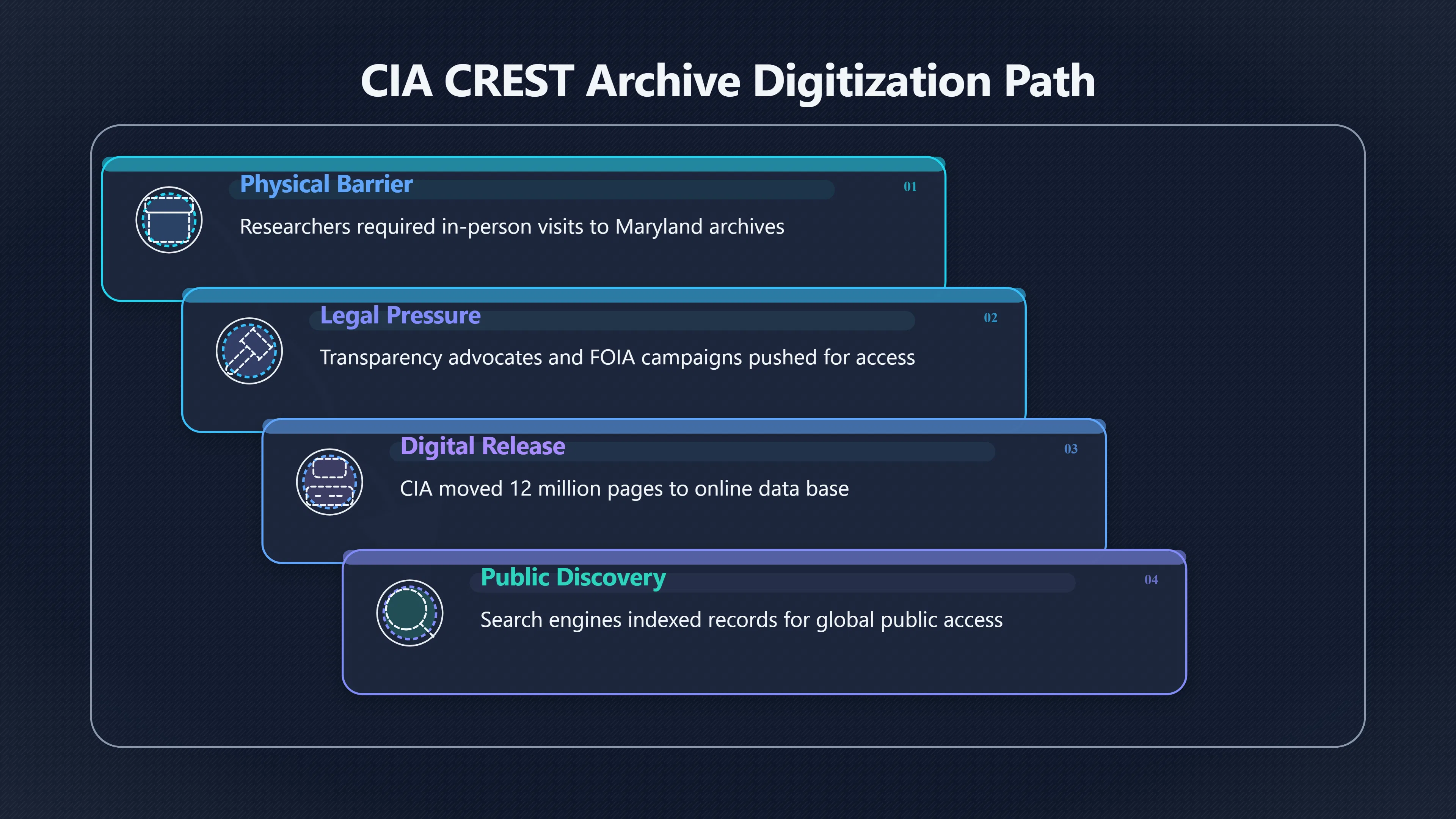
The CIA’s decision in 2017 to place its CREST (CIA Records Search Tool) archive online fundamentally changed how the public encountered remote-viewing records. Before then, researchers had to travel to the US National Archives in Maryland and use a small number of dedicated terminals to search declassified files. Once the archive became searchable on the internet, millions of pages—including STAR GATE remote-viewing material—became available to anyone with a web browser. That dramatic increase in accessibility also transformed how individual documents spread across social media, blogs and video platforms.[The Guardian+2MuckRock]theguardian.comThe Guardian CIA makes 12m pages of declassified documentsThe GuardianCIA makes 12m pages of declassified documents…January 18, 2017 — 18 Jan 2017 — The CIA has published more than 12 million…
The result was a new wave of viral claims built around authentic CIA documents but often detached from the institutional context that explains what those documents represent. The archive itself became easier to search than to interpret. Rather than proving that the CIA had endorsed psychic intelligence gathering, the online release made it easier for isolated pages, dramatic sketches and extraordinary claims to circulate independently of the reviews that questioned their intelligence value.
Why online search changed public access
The CREST online release removed an enormous practical barrier to research. For years, the database technically existed as a public resource, but access required an in-person visit to the National Archives at College Park, Maryland, where only a handful of terminals provided access. The online release placed roughly 930,000 documents—more than 12 million pages—into the CIA’s Electronic Reading Room, making keyword searches possible from anywhere in the world.[The Guardian+2MuckRock]theguardian.comThe Guardian CIA makes 12m pages of declassified documentsThe GuardianCIA makes 12m pages of declassified documents…January 18, 2017 — 18 Jan 2017 — The CIA has published more than 12 million…
This changed not only who could access the files but also how they were discovered.
Instead of historians methodically working through archive collections, internet users could search for terms such as “remote viewing”, “Mars”, “psychic”, “UFO”, or individual project names. Search engines began indexing the material, allowing unusual records to appear alongside ordinary web results. Journalists quickly highlighted the more eye-catching collections—including psychic research, UFO investigations and unusual Cold War projects—because they naturally attracted reader interest.[WIRED]wired.comUFOs, Psychics, and Spies: The CIA Just Put 12M Pages of…January 19, 2017 — 19 Jan 2017 — Here's the last five decades of CIA pap…
The online environment therefore rewarded discoverability rather than archival context. A user rarely encountered an entire programme history first. They typically found one intriguing document through a search result or social-media post.
How screenshots detach records from reviews
The biggest interpretive change did not come from the documents themselves but from the way they were shared.
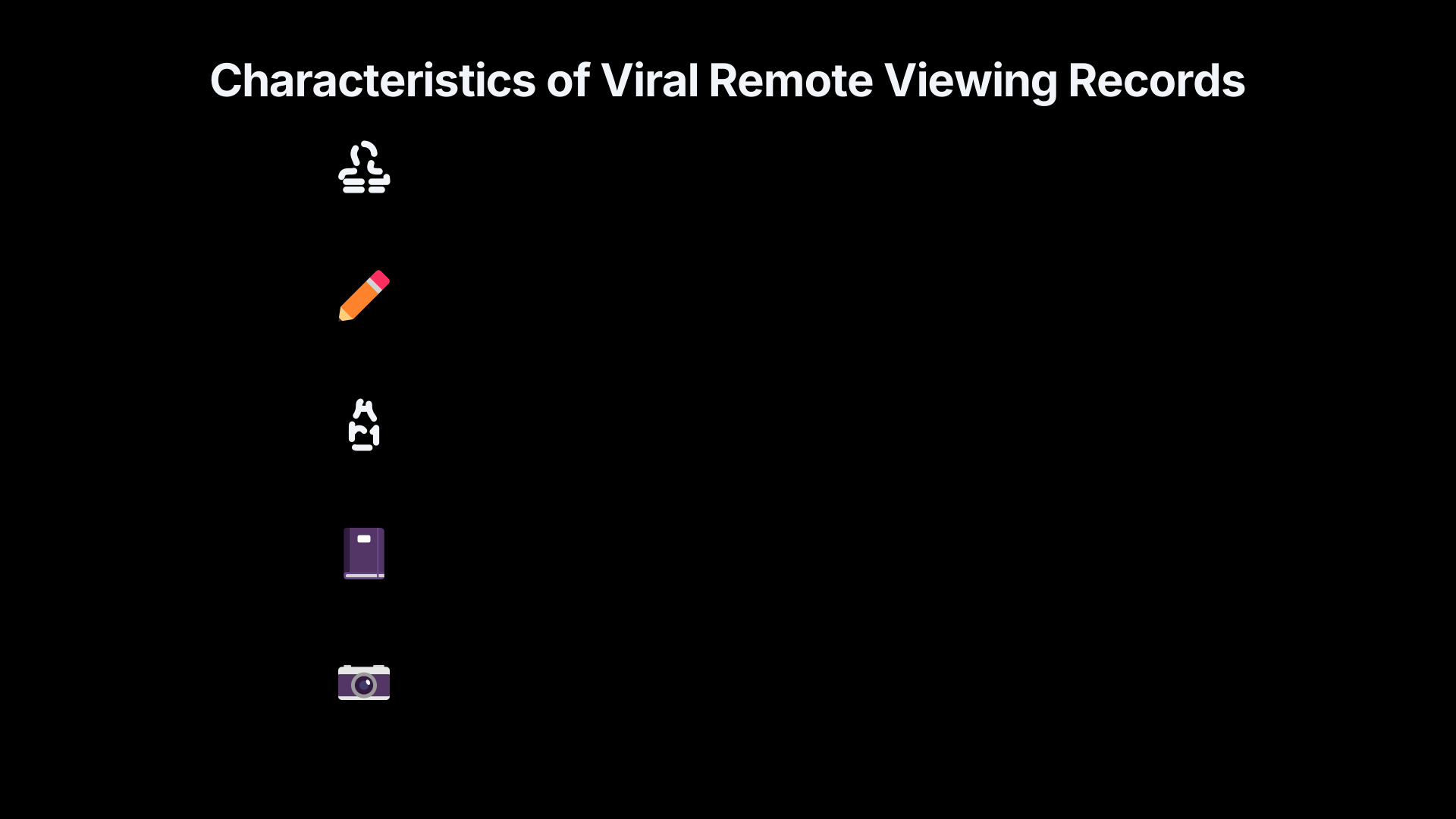
Most viral posts use cropped screenshots showing:
- a CIA letterhead;
- a project identifier;
- a viewer’s sketches or written impressions;
- selected paragraphs describing remarkable targets.
Almost never included are the surrounding pages explaining the task, evaluation procedures, reviewer comments or later programme assessments.
This matters because many remote-viewing files are working records rather than finished intelligence products. They document what a participant reported during a session, not necessarily what investigators concluded afterwards. A single page can therefore look like an official finding even when it is only a raw transcript awaiting evaluation.
Digital sharing amplifies this effect. Images travel more easily than lengthy PDF collections, and striking sketches or unusual phrases are far more likely to be reposted than cautious administrative memoranda explaining uncertainty.
The archive’s search interface also encourages document-level discovery rather than collection-level reading. Users often open a single PDF from a keyword search without seeing neighbouring files that provide methodological background or programme conclusions.[CIA]cia.govCREST: 25-Year Program ArchiveOver 11 million pages have been released in electronic format and reside on the CREST database, from whi…
Why odd files travel faster than cautious conclusions
Remote-viewing records possess several characteristics that make them unusually successful online.
First, they carry institutional credibility. A CIA stamp or declassification notice signals authenticity of origin, even though authenticity of the document does not establish accuracy of its contents.
Second, the subject matter is inherently memorable. Sketches of hidden installations, descriptions of distant locations or unusual historical targets are much easier to share than statistical programme evaluations.
Third, the archive contains genuine historical curiosities. The same CREST release included documents about invisible ink, Cold War espionage, UFO reporting and other unusual topics. Media coverage naturally highlighted these materials because they illustrated the archive’s breadth and attracted public attention. Remote-viewing documents became part of this broader “strange CIA files” narrative.[WIRED+2The Guardian]wired.comUFOs, Psychics, and Spies: The CIA Just Put 12M Pages of…January 19, 2017 — 19 Jan 2017 — Here's the last five decades of CIA pap…
The result is an imbalance in public memory. Extraordinary session transcripts circulate repeatedly, while the less dramatic documents explaining programme limitations receive comparatively little attention.
How the online archive encourages selective reading
Keyword search changes how archives are interpreted.
Traditional archival research generally begins with collections, inventories and file relationships before examining individual documents. Online search reverses that process. Users frequently begin with a specific phrase and encounter only the pages containing that phrase.
With remote-viewing records, this creates several recurring misunderstandings:
- Search results appear authoritative. Users often assume that documents returned by a CIA search represent endorsed conclusions rather than merely archived records.
- Individual sessions become representative. One successful-looking transcript may be treated as evidence for an entire programme despite thousands of pages documenting varied experiments, procedures and evaluations.
- Administrative context disappears. Programme management documents, review memoranda and later assessments are less visually compelling and therefore much less likely to be shared.
These are not flaws in the archive itself. They are consequences of moving a vast historical collection from a specialised research setting into an internet ecosystem optimised for rapid discovery and selective sharing.

The role of transparency campaigns
The online release did not occur by accident. Transparency advocates and freedom-of-information campaigners had argued for years that requiring researchers to visit the National Archives imposed an unnecessary obstacle to public access. Legal pressure, public campaigning and independent efforts to digitise documents all contributed to the CIA making the collection available online.[MuckRock]muckrock.comcias declassified database now onlineThe CIA's declassified database is now online17 Jan 2017 — Thanks to a MuckRock lawsuit and Emma Best's diligence, you can now re…
From a historical perspective, the release represents a significant improvement in public access. Researchers, journalists and historians can now examine original documents directly rather than relying on second-hand descriptions.
Ironically, however, the same openness also increased opportunities for selective quotation. The easier it became to retrieve individual pages, the easier it became to circulate them without the accompanying records needed for interpretation.
Reading viral CREST pages more carefully
The online CREST archive remains one of the most valuable primary sources for understanding the history of government interest in remote viewing. Its importance lies in documenting what agencies investigated, funded and recorded during the Cold War—not in proving that every recorded claim was accepted as true.
When encountering a widely shared remote-viewing document, several questions help restore context:
- Is this a raw session transcript, a training exercise, an operational report or a programme evaluation?
- Does the document record a participant’s impressions or an institutional conclusion?
- Are later review documents available for the same project?
- Is the page being quoted alongside the broader file from which it came?
These questions reflect the central lesson of the 2017 CREST release. Putting millions of pages online greatly improved public access to authentic historical records, but it also made it far easier for isolated documents to become viral evidence for claims they were never intended, by themselves, to establish.[CIA+2The Guardian]cia.govCREST: 25-Year Program ArchiveOver 11 million pages have been released in electronic format and reside on the CREST database, from whi…
eBay marketplace picks
Marketplace Samples
Live-tested eBay searches with available results related to this page.


Endnotes
1.
Source: muckrock.com
Title: cias declassified database now online
Link:https://www.muckrock.com/news/archives/2017/jan/17/cias-declassified-database-now-online/
Source snippet
The CIA's declassified database is now online17 Jan 2017 — Thanks to a MuckRock lawsuit and Emma Best's diligence, you can now re...
2.
Source: cia.gov
Link:https://www.cia.gov/readingroom/collection/crest-25-year-program-archive
Source snippet
CREST: 25-Year Program ArchiveOver 11 million pages have been released in electronic format and reside on the CREST database, from whi...
3.
Source: wired.com
Link:https://www.wired.com/2017/01/ufos-psychics-spies-cia-just-put-12m-pages-files-online-start/
Source snippet
UFOs, Psychics, and Spies: The CIA Just Put 12M Pages of...January 19, 2017 — 19 Jan 2017 — Here's the last five decades of CIA pap...
Published: January 19, 2017
4.
Source: cia.gov
Link:https://www.cia.gov/readingroom/home
Source snippet
Freedom of Information Act Electronic Reading RoomThis collection includes a broad sampling of articles from the National Intelligence Da...
5.
Source: theguardian.com
Title: The Guardian CIA makes 12m pages of declassified documents
Link:https://www.theguardian.com/us-news/2017/jan/18/cia-12-million-pages-declassified-documents-searchable-online
Source snippet
The GuardianCIA makes 12m pages of declassified documents...January 18, 2017 — 18 Jan 2017 — The CIA has published more than 12 million...
Published: January 18, 2017
Additional References
6.
Source: freegovinfo.info
Title: CI A’s CREST declassified database is now online
Link:https://freegovinfo.info/node/11546/
Source snippet
Thanks...17 Jan 2017 — So far over 775,000 files and over 13,000,000 pages have been declassified as part of the 25-year automatic decla...
7.
Source: youtube.com
Title: Inside The Military’s Secret Psychic Unit
Link:https://www.youtube.com/watch?v=9nY3hu76SyU
Source snippet
Uncovering the CIA's Secret Weapon: Psychic Spies...
8.
Source: youtube.com
Title: Bill Ray, Psychic Spy
Link:https://www.youtube.com/watch?v=l5XcosdhnNM
Source snippet
CIA Project [Stargate]({{ 'stargate/' | relative_url }}) & Other Declassified Secrets - How Successful Were They?...
9.
Source: youtube.com
Title: CIA Project Stargate & Other Declassified Secrets
Link:https://www.youtube.com/watch?v=xDf7OUKpyvs
Source snippet
What the CIA saw on Mars...
10.
Source: youtube.com
Title: Uncovering the CIA’s Secret Weapon: Psychic Spies
Link:https://www.youtube.com/watch?v=cNJwV3Ksxa8
Source snippet
Bill Ray, Psychic Spy...
11.
Source: youtube.com
Title: What the CIA saw on Mars
Link:https://www.youtube.com/watch?v=3ISWaIvClHE
Topic Tree