Within Judging
The Hidden Power of the Wrong Photos
A remote-viewing result can look stronger or weaker depending on whether the decoys are too easy, too similar, or unevenly dramatic.
On this page
- Easy decoys versus plausible decoys
- When similar targets make judging unstable
- How dramatic images bias comparisons
Page outline Jump by section
Introduction
In blind-judged remote-viewing experiments, the quality of the wrong photographs can matter almost as much as the correct one. A viewer’s transcript is not judged in isolation but against a set of alternative targets, commonly called decoys. Whether those decoys are too easy, too similar, or unusually dramatic can substantially influence whether the correct target is selected. This means that an apparent “hit” or “miss” may partly reflect the design of the target pool rather than the informational content of the viewer’s description. The issue is not merely statistical; it is a practical problem in experimental design. A fair blind-judging procedure requires plausible alternatives that neither hand the correct answer to the judge nor make every option equally defensible. Research reviews of remote-viewing protocols have repeatedly identified target selection and judging procedures as critical sources of uncertainty when interpreting results.[National Security Archive]nsarchive2.gwu.eduThe effect sizes for the viewers 009, 372 and 389 were 0.432 (p =.Read moreNational Security ArchiveAn Evaluation of Remote Viewing: Research and…March 13, 2015 — by MD Mumford · 1995 · Cited by 76 — RESULTS…
Why Decoy Photos Matter
Blind judging attempts to answer a comparative question: does the transcript fit the actual target better than it fits the alternatives? That comparison only works if the alternatives are genuinely comparable.
A transcript mentioning “water, bright light, open space and curved forms” could plausibly describe a marina, a fountain, a coastal monument or a lakeside park. If the four decoys instead show a living room, a dense forest, a factory interior and a mountain cave, the correct photograph stands out because the alternatives are poor matches rather than because the transcript is unusually specific.
Conversely, if every photograph depicts harbours with boats, bridges and reflective water, judges may struggle to distinguish meaningful correspondences from ordinary similarities. Both situations distort the intended test, albeit in opposite directions. The American Institutes for Research review commissioned for the CIA noted that target pools and judging procedures are integral to the statistical interpretation of remote-viewing experiments rather than incidental details.[National Security Archive]nsarchive2.gwu.eduThe effect sizes for the viewers 009, 372 and 389 were 0.432 (p =.Read moreNational Security ArchiveAn Evaluation of Remote Viewing: Research and…March 13, 2015 — by MD Mumford · 1995 · Cited by 76 — RESULTS…
Easy Decoys Versus Plausible Decoys
The strongest blind tests aim for decoys that are believable competitors without being near-duplicates.
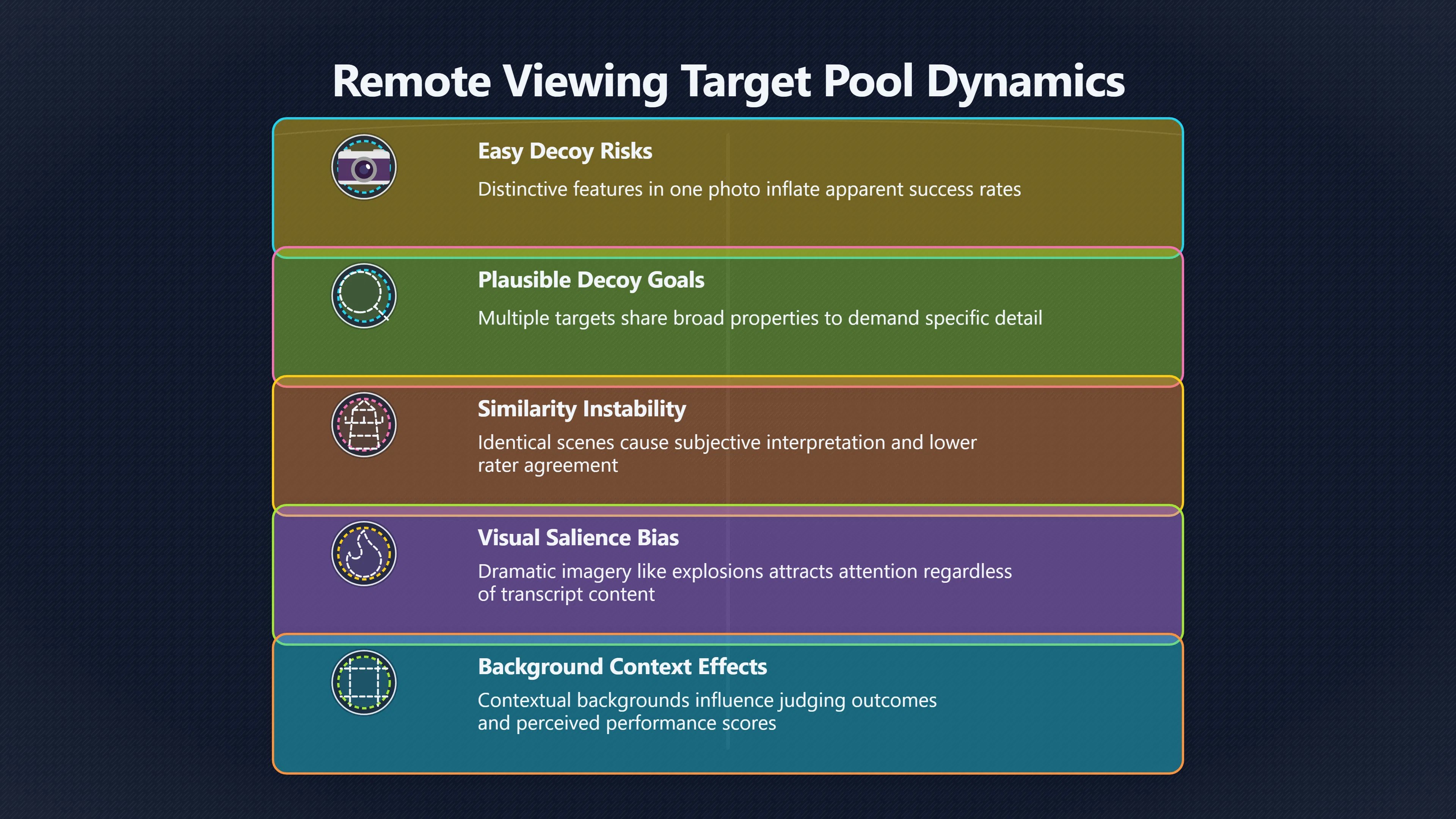
Easy decoys tend to inflate apparent success because:
- the correct photograph contains distinctive features absent from every alternative;
- judges can eliminate most options immediately;
- broad descriptions appear unusually accurate simply because only one target shares their general characteristics.
For example, if the real target is a suspension bridge and every decoy is an indoor domestic scene, references to steel, height and open air immediately narrow the choice.
Plausible decoys create a more demanding comparison by ensuring that:
- multiple targets share broad visual properties;
- only more specific details separate one image from another;
- judges must weigh the entire transcript instead of relying on one obvious feature.
Well-designed target pools therefore try to balance similarity with distinguishability. The goal is not to make judging impossible but to ensure that success depends on informative descriptions rather than on conspicuous differences between photographs.[National Security Archive]nsarchive2.gwu.eduThe effect sizes for the viewers 009, 372 and 389 were 0.432 (p =.Read moreNational Security ArchiveAn Evaluation of Remote Viewing: Research and…March 13, 2015 — by MD Mumford · 1995 · Cited by 76 — RESULTS…
When Similar Targets Make Judging Unstable
Increasing similarity is not an unlimited improvement. If decoys become too alike, judging can become unstable.
Suppose every candidate photograph depicts a lighthouse on a rocky coastline. A transcript mentioning waves, stone, wind and a tall structure may fit every image reasonably well. Different judges may legitimately choose different photographs despite using the same transcript.
This instability has several consequences:
- rankings become more sensitive to subjective interpretation;
- inter-rater agreement may decline;
- small wording differences in transcripts can change outcomes;
- chance variation becomes harder to separate from genuine discrimination.
Later work on associative remote viewing has similarly examined rater reliability, recognising that different judges do not always reach identical conclusions even when working under blind conditions. This highlights that judging performance depends not only on viewer accuracy but also on how discriminable the target set is.[Koestler Parapsychology Unit]koestler-parapsychology.psy.ed.ac.ukKPU 1034 Published ResultsKoestler Parapsychology UnitAssociative remote viewing projects: Assessing rater…by DL KATZ · 2021 · Cited by 10 — Associative Remote…

How Dramatic Images Bias Comparisons
Another overlooked problem is unequal visual salience.
Some photographs naturally attract attention because they depict:
- explosions or fires;
- vivid colours;
- famous landmarks;
- unusual machinery;
- striking geometric structures;
- large crowds or dramatic natural events.
If only one image possesses such memorable characteristics, judges may unconsciously favour it whenever a transcript contains energetic or emotionally vivid language.
The opposite bias can also occur. A spectacular target may receive a poor ranking if the transcript contains mostly ordinary environmental descriptions while another photograph better matches those generic elements. Because remote-viewing transcripts often mix broad impressions with occasional distinctive details, dramatic imagery can either exaggerate or suppress perceived correspondence depending on which features the judge emphasises.
This is one reason researchers often recommend constructing target pools with roughly comparable visual complexity rather than mixing exceptionally distinctive photographs with very ordinary ones.[National Security Archive]nsarchive2.gwu.eduThe effect sizes for the viewers 009, 372 and 389 were 0.432 (p =.Read moreNational Security ArchiveAn Evaluation of Remote Viewing: Research and…March 13, 2015 — by MD Mumford · 1995 · Cited by 76 — RESULTS…
What Research on Photographic Targets Suggests
Research exploring photographic target design illustrates how apparently minor image characteristics can influence judging.
One exploratory study investigated whether objects photographed against white backgrounds, ordinary backgrounds or unusual backgrounds produced different judging outcomes. Interestingly, the traditional rank-order matching procedure favoured one type of background, while scoring individual transcript elements suggested the opposite pattern. The authors concluded that characteristics of the photographic target itself—including contextual background—can influence apparent performance, and that different scoring methods may emphasise different aspects of the same data.[ResearchGate]researchgate.netEffects of Background Context for Objects in Photographic…January 15, 2022 — Photographic images of physical objects are c…
Although this study does not directly test decoy selection, it reinforces a broader methodological point: photographs are not interchangeable measurement tools. Their composition, context and visual content interact with judging procedures in ways that can alter reported success rates.
Why Target-Pool Balance Is Difficult
Designing a balanced target set involves competing priorities.
A useful target pool should:
- avoid obviously unique photographs;
- avoid clusters of nearly identical scenes;
- maintain similar visual richness across images;
- minimise accidental cues unrelated to the intended comparison;
- be assembled before judging begins rather than adjusted afterwards.
In practice, achieving all of these simultaneously is difficult. Natural scenes vary enormously in complexity, recognisability and emotional impact. Even careful experimenters may unintentionally create pools in which one photograph is easier to recognise or easier to eliminate than the others.
Because of these challenges, critics argue that reported hit rates should always be interpreted alongside detailed information about target construction and judging procedures rather than as standalone evidence for or against remote viewing. Supporters generally agree that stronger protocol design—including carefully balanced decoy photographs—improves the credibility of any positive findings.[National Security Archive+2ResearchGate]nsarchive2.gwu.eduThe effect sizes for the viewers 009, 372 and 389 were 0.432 (p =.Read moreNational Security ArchiveAn Evaluation of Remote Viewing: Research and…March 13, 2015 — by MD Mumford · 1995 · Cited by 76 — RESULTS…
The Practical Lesson for Blind Judging
Decoy photographs are not merely filler added to a blind test. They define the difficulty of the judgement itself.
When decoys are too easy, apparent successes can be exaggerated. When they are too similar, genuine differences become difficult to detect. When one image is unusually dramatic or visually distinctive, judges may be influenced by characteristics unrelated to the informational quality of the transcript.
For that reason, careful target matching depends not only on keeping judges blind to the correct answer but also on constructing a balanced comparison set in which every alternative is a credible competitor. In remote-viewing research, the hidden power of the wrong photographs lies in their ability to shape both hits and misses without changing a single word of the viewer’s description.[National Security Archive]nsarchive2.gwu.eduThe effect sizes for the viewers 009, 372 and 389 were 0.432 (p =.Read moreNational Security ArchiveAn Evaluation of Remote Viewing: Research and…March 13, 2015 — by MD Mumford · 1995 · Cited by 76 — RESULTS…
Amazon book picks
Further Reading
Books and field guides related to The Hidden Power of the Wrong Photos. Use these as the next step if you want deeper reading beyond the article.

The Art of Statistics
Supports understanding of fair comparisons and experimental design.
eBay marketplace picks
Marketplace Samples
Live-tested eBay searches with available results related to this page.
Endnotes
1.
Source: cia.gov
Link:https://www.cia.gov/readingroom/docs/CIA-RDP96-00787R000500250015-6.pdf
Source snippet
SUMMARY OF KNOWN REMOTE-VIEWING EXPERIMENTS.The following very brief summaries describe those remote viewing experiments, or series of ex...
2.
Source: researchgate.net
Title: 369604750 Remote Viewing a 1974 2022 systematic review and [meta analysis]({{ ‘meta-analysis/’ | relative_url }})
Link:https://www.researchgate.net/publication/369604750_Remote_Viewing_a_1974-2022_systematic_review_and_meta-analysis
Source snippet
(PDF) Remote Viewing: a 1974-2022 systematic review...This is the first meta-analysis of all studies related to remote viewing tasks con...
3.
Source: researchgate.net
Link:https://www.researchgate.net/publication/357904486_Effects_of_Background_Context_for_Objects_in_Photographic_Targets_on_Remote_Viewing_Performance
Source snippet
Effects of Background Context for Objects in Photographic...January 15, 2022 — Photographic images of physical objects are c...
Published: January 15, 2022
4.
Source: nsarchive2.gwu.edu
Title: The effect sizes for the viewers 009, 372 and 389 were 0.432 (p =.Read more
Link:https://nsarchive2.gwu.edu/NSAEBB/NSAEBB438/docs/doc_57.pdf
Source snippet
National Security ArchiveAn Evaluation of Remote Viewing: Research and...March 13, 2015 — by MD Mumford · 1995 · Cited by 76 — RESULTS...
Published: March 13, 2015
5.
Source: koestler-parapsychology.psy.ed.ac.uk
Title: KPU 1034 Published Results
Link:https://www.koestler-parapsychology.psy.ed.ac.uk/Documents/KPU_1034_Published_Results.pdf
Source snippet
Koestler Parapsychology UnitAssociative remote viewing projects: Assessing rater...by DL KATZ · 2021 · Cited by 10 — Associative Remote...
Additional References
6.
Source: yumpu.com
Title: remote viewing [stargate]({{ ‘stargate/’ | relative_url }}) discussion list archives dojo psi info
Link:https://www.yumpu.com/en/document/view/6788418/remote-viewing-stargate-discussion-list-archives-dojo-psi-info
Source snippet
Remote Viewing StarGate Discussion List Archives.....27 Dec 2012 — Remote Viewing StarGate Discussion List Archives... - Dojo Psi Info...
7.
Source: documents.theblackvault.com
Link:https://documents.theblackvault.com/documents/remoteviewing/rvevaluation.pdf
Source snippet
ULTS: Responses were blind-judged using standard rank~order...Read more...
8.
Source: pubmed.ncbi.nlm.nih.gov
Link:https://pubmed.ncbi.nlm.nih.gov/30291000/
Source snippet
Viewing of Concealed Target Pictures Under Light...by S Krippner · 2019 · Cited by 15 — This study explored the differential effect of d...
9.
Source: scribd.com
Title: Katz Associative Remote Viewing
Link:https://www.scribd.com/document/1005021917/KatzAssociativeRemoteViewing
Source snippet
PDF | Parapsychology17 Nov 1986 — This book explores [Associative Remote Viewing (ARV)]({{ 'associative-remote-viewing-arv/' | relative_url }}) as a method for p...
10.
Source: youtube.com
Title: Dr. Edwin May, Psychic Research (Remote Viewing, Telekinesis)
Link:https://www.youtube.com/watch?v=m66dX1NQ9k4
Source snippet
Edwin May, Psychic Spying (Remote Viewing, Star Gate Program)...
11.
Source: youtube.com
Title: Why All Scientists Should Take PSI Seriously
Link:https://www.youtube.com/watch?v=JFRj0DS75KQ
Source snippet
Dr. Edwin May, Psychic Research (Remote Viewing, Telekinesis)...
12.
Source: youtube.com
Title: Remote Viewing Psychology with Charles T. Tart
Link:https://www.youtube.com/watch?v=jPZwaicuiek
Source snippet
Remote Viewing and Statistical Validation...
13.
Source: youtube.com
Title: Remote Viewing and Statistical Validation
Link:https://www.youtube.com/watch?v=YrwAiU2g5RU
Source snippet
Why All Scientists Should Take PSI Seriously...
14.
Source: youtube.com
Title: Edwin May, Psychic Spying (Remote Viewing, Star Gate Program)
Link:https://www.youtube.com/watch?v=EPvrOsEXBbE
Topic Tree