Within Meaning
How Remote Viewing Tests Can Go Wrong
A monitor can help structure a session, but poor handling can accidentally cue the viewer and weaken the result.
On this page
- What monitors are supposed to do
- How cues can leak into a session
- Why clean records matter for credibility
Page outline Jump by section
Introduction
A monitor is intended to help a remote-viewing session run smoothly, not to supply information about the hidden target. In principle, the monitor keeps the viewer focused, records the session, and ensures that the protocol is followed while remaining blind to the target whenever possible. If the monitor knows the target or inadvertently communicates clues, however, the session can become contaminated by ordinary information transfer rather than whatever process the experiment is attempting to test. This issue has become one of the central methodological debates in remote-viewing research because even subtle cues can make apparently successful results difficult to interpret. Critics have argued that many early positive findings can be explained by information leakage, while proponents have responded by tightening protocols with stronger blinding, automated target selection, and independent judging.[CIA+2koestlerunit.wordpress.com]cia.govAN EVALUATION OF THE REMOTE VIEWING PROGRAMUtts and Hyman were asked to prepare independent reports based on their review. In this rev…

What monitors are supposed to do
In many remote-viewing protocols, the monitor acts as a facilitator rather than an evaluator. The monitor may remind the viewer to describe impressions rather than interpret them, ask neutral prompts such as “Describe what you perceive now,” ensure that sketches and notes are recorded in sequence, and help maintain the timing of the session. The ideal monitor does not know the identity of the target, because ignorance removes one of the most obvious pathways for accidental cueing. CIA training documents describe distinct roles for viewers, monitors and later evaluation, reflecting the importance placed on separating responsibilities within the protocol.[CIA]cia.govAN EVALUATION OF REMOTE VIEWING: RESEARCH…A remote viewer is asked to visualize a place, location, or object being viewed by a "bea…
The distinction matters because the monitor occupies a position of influence. A viewer may unconsciously look for approval, hesitation or correction. Even if no explicit information is spoken, facial expressions, tone of voice, pauses, changes in questioning, or reactions to sketches can unintentionally guide the session. In experimental psychology this is recognised more generally as an experimenter-expectancy problem rather than a phenomenon unique to remote viewing.
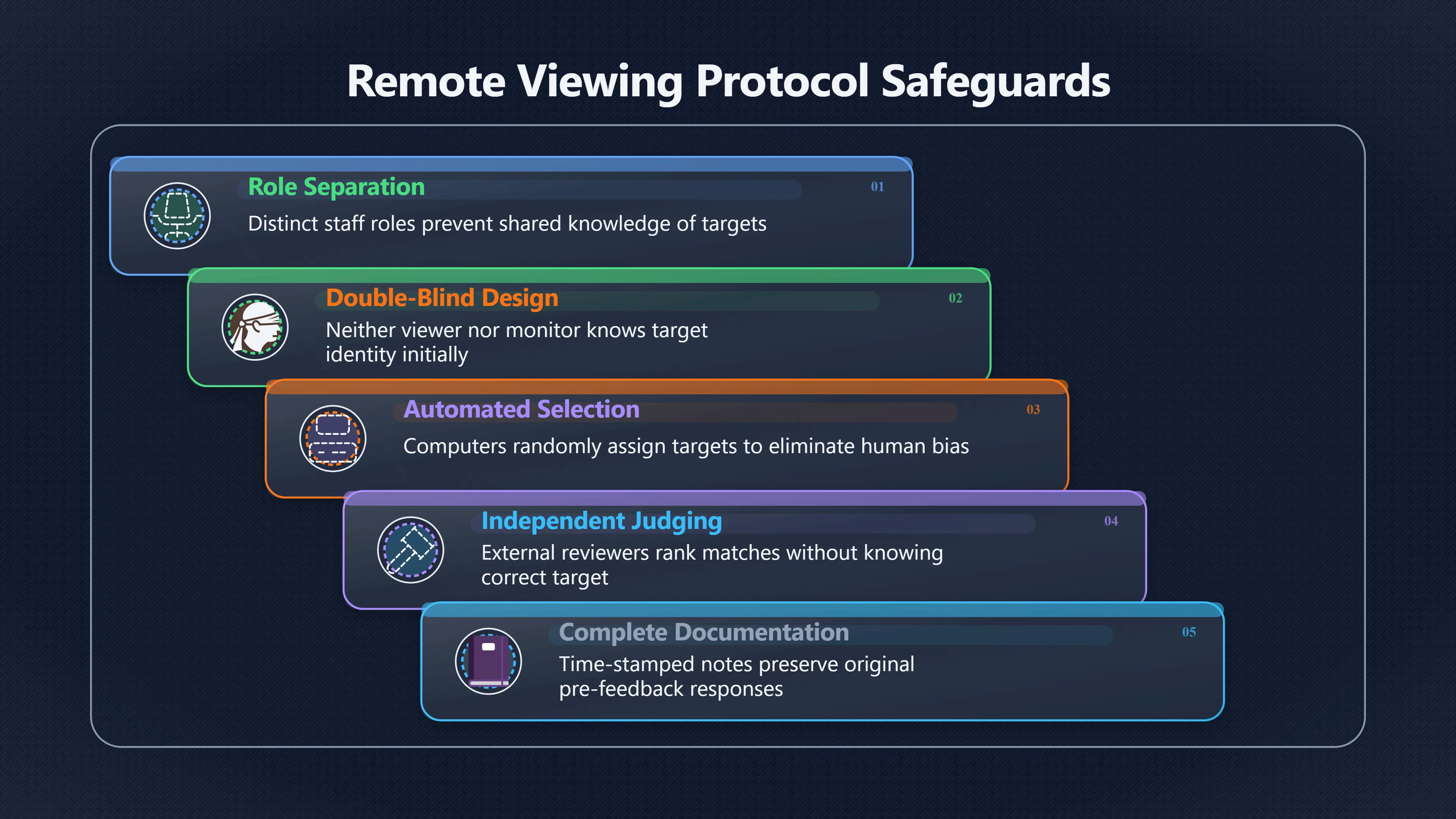
For this reason, stronger experimental designs increasingly favour double-blind procedures in which neither the viewer nor the monitor knows the target until the session has been completed and permanently recorded. If a monitor must know the target for operational reasons, researchers generally regard additional safeguards as necessary to reduce the possibility of contamination.[CIA]cia.govAN EVALUATION OF THE REMOTE VIEWING PROGRAMUtts and Hyman were asked to prepare independent reports based on their review. In this rev…
How cues can leak into a session
Information leakage does not require deliberate cheating. Small pieces of information can accumulate into meaningful guidance without anyone intending it.
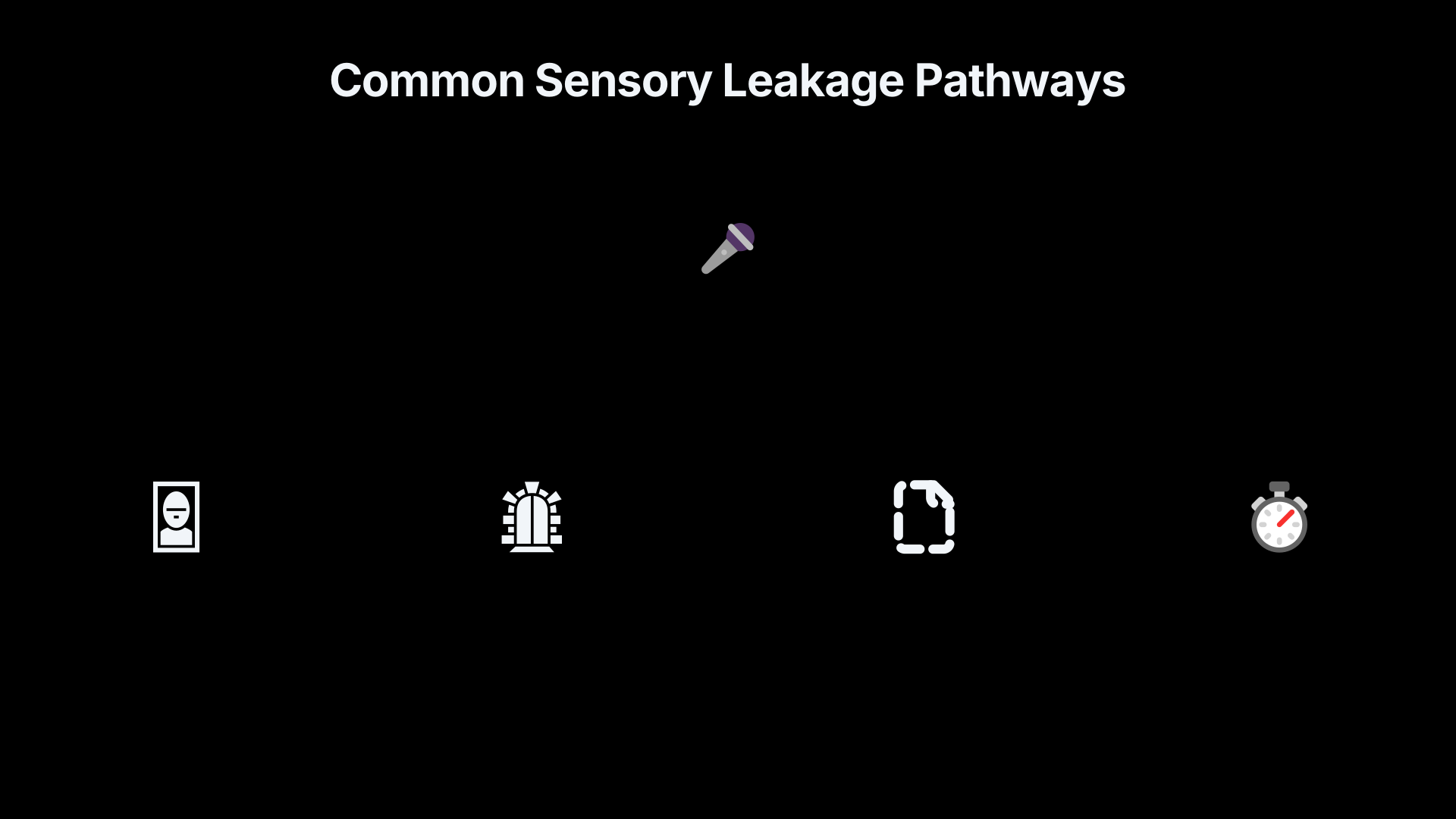
Common contamination pathways include:
- Verbal prompting. Questions that differ depending on the hidden target, even subtly, can encourage particular descriptions.
- Non-verbal reactions. Changes in posture, facial expression, breathing or enthusiasm may reward certain responses and discourage others.
- Knowledge carried by staff. If anyone interacting with the viewer knows the target, unconscious signalling becomes possible.
- Target handling. Labelling, filing order, physical marks or administrative paperwork can unintentionally identify targets.
- Feedback timing. Premature confirmation before the session is fully documented can alter later notes or sketches.
These risks are familiar across many behavioural sciences. Remote-viewing experiments face the same need to eliminate ordinary communication channels before any unusual explanation can be considered.
Why clean records matter for credibility
A complete session record allows later reviewers to determine exactly what was recorded before feedback and what may have been added afterwards. Time-stamped notes, original sketches, audio or video recordings, and preserved session materials make it easier to distinguish genuine pre-feedback responses from later reinterpretation.
Equally important is independent judging. Rather than asking whether a transcript resembles the target in isolation, many protocols compare it against multiple possible targets. Judges who do not know which target is correct attempt to rank the best match. This reduces the influence of hindsight and selective interpretation, although it does not by itself eliminate earlier information leakage if the session was already contaminated.[CIA]cia.govAN EVALUATION OF REMOTE VIEWING: RESEARCH…A remote viewer is asked to visualize a place, location, or object being viewed by a "bea…
Transparent documentation also allows independent researchers to examine whether procedures were genuinely blind, whether targets were randomised correctly, and whether statistical analyses matched the protocol established before data collection.
Lessons from methodological disputes
Some of the most influential criticisms of remote-viewing research have focused not on the statistical analyses themselves but on opportunities for ordinary information transfer.
A well-known example concerns the early Stanford Research Institute experiments. Psychologists David Marks and Richard Kammann argued that transcripts contained inadvertent clues that allowed targets to be identified without invoking paranormal perception. They reported that students could successfully match some targets using these ordinary cues alone. Later exchanges over revised judging continued to centre on whether all sensory information had truly been removed before evaluation.[Wikipedia]WikipediaSensory leakageSensory leakage
Similar concerns appeared in later assessments of the SAIC programme. Richard Wiseman and Julie Milton argued that although procedures had improved, several opportunities remained for information to pass from non-blind personnel to judges, and they recommended stronger safeguards before interpreting positive results as evidence for anomalous cognition.[koestlerunit.wordpress.com]koestlerunit.wordpress.comhave identified involve some form of information leakage from non-blind personnel to the judge.Read more…
These criticisms influenced later protocol design. Researchers increasingly adopted automated target selection, stricter separation between staff roles, independent judging, improved documentation and more rigorous double-blind procedures in an effort to address the identified weaknesses. Even researchers who argue that remote-viewing experiments produce above-chance statistical results generally acknowledge that preventing sensory leakage is essential for interpreting those findings.[ResearchGate]researchgate.net374881423 Remote Viewing A 1974 2022 Systematic Review and Meta AnalysisResearchGate(PDF) Remote Viewing: A 1974-2022 Systematic Review…October 19, 2023 — 26 Oct 2023 — This is the first meta-analysis of al…

Why leakage remains central to the debate
Monitor leakage occupies an unusual position in discussions of remote viewing because both supporters and sceptics agree that it must be prevented. The disagreement concerns whether existing safeguards are sufficient.
Sceptics argue that whenever conventional information transfer cannot be confidently excluded, apparently successful sessions provide no compelling evidence for paranormal perception. The 1995 American Institutes for Research evaluation commissioned by the CIA reflected this divide: statistician Jessica Utts concluded that the accumulated data warranted serious attention, whereas psychologist Ray Hyman argued that methodological concerns, including the possibility of information leakage and inadequate independent replication, prevented stronger conclusions.[CIA]cia.govAN EVALUATION OF THE REMOTE VIEWING PROGRAMUtts and Hyman were asked to prepare independent reports based on their review. In this rev…
As a result, the credibility of any individual remote-viewing test depends not only on its reported success rate but also on how convincingly it demonstrates that monitors, experimenters and judges could not have transmitted ordinary information. Clean blinding, careful role separation and complete records are therefore not peripheral details—they are fundamental requirements for evaluating whether a session tests remote viewing rather than the effects of subtle human communication.
Amazon book picks
Further Reading
Books and field guides related to How Remote Viewing Tests Can Go Wrong. Use these as the next step if you want deeper reading beyond the article.
Phenomena
Covers the military and intelligence context behind remote viewing and the lab-to-operations gap.
Phenomena: The Secret History of the U.S. Government's Invest...
Explores controversies surrounding government research.
The Reality of ESP: A Physicist's Proof of Psychic Abilities
Discusses criticisms and protocol improvements.
Mind-Reach: Scientists Look at Psychic Ability
Describes monitoring and session procedures.
eBay marketplace picks
Marketplace Samples
Live-tested eBay searches with available results related to this page.



Endnotes
1.
Source: cia.gov
Link:https://www.cia.gov/readingroom/docs/CIA-RDP96-00791R000200180005-5.pdf
Source snippet
AN EVALUATION OF THE REMOTE VIEWING PROGRAMUtts and Hyman were asked to prepare independent reports based on their review. In this rev...
2.
Source: koestlerunit.wordpress.com
Link:https://koestlerunit.wordpress.com/wp-content/uploads/2015/06/wiseman-milton-1998.pdf
Source snippet
have identified involve some form of information leakage from non-blind personnel to the judge.Read more...
3.
Source: cia.gov
Link:https://www.cia.gov/readingroom/document/cia-rdp96-00791r000200180006-4
Source snippet
AN EVALUATION OF REMOTE VIEWING: RESEARCH...A remote viewer is asked to visualize a place, location, or object being viewed by a "bea...
4.
Source: Wikipedia
Title: Sensory leakage
Link:https://en.wikipedia.org/wiki/Sensory_leakage
5.
Source: Wikipedia
Title: Remote viewing
Link:https://en.wikipedia.org/wiki/Remote_viewing
6.
Source: researchgate.net
Title: 374881423 Remote Viewing A 1974 2022 Systematic Review and [Meta Analysis]({{ ‘meta-analysis/’ | relative_url }})
Link:https://www.researchgate.net/publication/374881423_Remote_Viewing_A_1974-2022_Systematic_Review_and_Meta-Analysis
Source snippet
ResearchGate(PDF) Remote Viewing: A 1974-2022 Systematic Review...October 19, 2023 — 26 Oct 2023 — This is the first meta-analysis of al...
Published: October 19, 2023
7.
Source: cia.gov
Link:https://www.cia.gov/readingroom/docs/CIA-RDP96-00791R000200180006-4.pdf
Source snippet
onal application of the remote viewing phenomenon in...Read more...
Additional References
8.
Source: ia600501.us.archive.org
Link:https://ia600501.us.archive.org/20/items/FritjofCapraTheTurningPoint/Dean%20Radin%20-%20The%20Conscious%20Universe%20-%20The%20Scientific%20Truth%20of%20Psychic%20Phenomena%20%5BOCR%5D.pdf
Source snippet
CONSCIOUS UNIVERSEported a secret team of remote viewers, that those viewers had participated in hundreds of remote-viewing missions, and...
9.
Source: academia.edu
Link:https://www.academia.edu/31098436/Superpowers_of_the_Human_Biomind_New_Content_in_Section_6_Ingo_Swann_Honor_Roll_for_Remote_Viewing
Source snippet
h remote viewing which was commenced in 1973 by the Central Intelligence Agency...
10.
Source: pmc.ncbi.nlm.nih.gov
Link:https://pmc.ncbi.nlm.nih.gov/articles/PMC10275521/
Source snippet
Central Intelligence Agency's (CIA...by Á Escolà‐Gascón · 2023 · Cited by 10 — Since 1972, the U.S. Central Intelligence Agency (CIA) co...
11.
Source: repositories.lib.utexas.edu
Link:https://repositories.lib.utexas.edu/bitstreams/b28b85e6-7a05-40f4-8370-254217289a75/download
Source snippet
by Paul Hamilton Smith 2009by PH Smith · 2009 · Cited by 5 — remote viewers each worked with an interviewer under double blind conditions...
12.
Source: youtube.com
Title: [Third Eye Spies]({{ ‘third-eye-spies/’ | relative_url }}) with Russell Targ
Link:https://www.youtube.com/watch?v=k9AsG1iNAyc
Source snippet
Inside Operation Stargate: The CIA's Psychic Spy Experiment...
13.
Source: philpapers.org
Link:https://philpapers.org/archive/BULPEL-2.pdf
Source snippet
HARNESSING INFORMATIONAL FIELDS FOR ENERGY...by M Bulaqueña · 2026 — Hyman's conclusion: The remote viewing data are statistically anom...
14.
Source: youtube.com
Title: Advanced Training in Remote Viewing with Lori Williams
Link:https://www.youtube.com/watch?v=OQ01vlyHI_A
Source snippet
Third Eye Spies with Russell Targ...
15.
Source: youtube.com
Title: Inside Operation Stargate: The CIA’s Psychic Spy Experiment
Link:https://www.youtube.com/watch?v=oasTnsLw_n8
Source snippet
How To Remote View...
16.
Source: youtube.com
Title: How To Remote View
Link:https://www.youtube.com/watch?v=92Hz3MBjl7M
Topic Tree