Within Pop Culture
When Remote Viewing Becomes Insider History
Third Eye Spies shows how advocate documentaries frame remote viewing as hidden Cold War history and human potential.
On this page
- How the documentary frames Russell Targ's story
- Why declassification language matters in marketing
- Where advocate storytelling differs from skeptical accounts
Page outline Jump by section
Introduction
Third Eye Spies (2019) occupies a distinctive place in the popular culture of remote viewing because it presents the subject not primarily as an unresolved scientific question, but as an insider history that has supposedly been hidden by bureaucracy, secrecy and scepticism. Directed by Lance Mungia and produced with extensive participation from physicist Russell Targ, the film argues that Cold War research into psychic functioning produced genuine results which were later misunderstood, ignored or suppressed. Rather than attempting a balanced survey of the evidence, it adopts an advocate documentary style in which former participants, sympathetic scientists and declassified government material combine to tell a coherent narrative of discovery and institutional resistance.[IMDb]imdb.comThird Eye Spies (2019)' The true story of Russell Targ and America's cold war psychic spies, disclosed and declassified for the first…
This framing matters because documentaries often shape public understanding more effectively than academic literature. For many viewers, Third Eye Spies becomes the primary lens through which the history of remote viewing is interpreted. The film therefore illustrates how documentary storytelling can transform contested research into a compelling historical narrative while leaving important scientific disagreements largely outside the frame.
How the documentary frames Russell Targ’s story
At the centre of Third Eye Spies is Russell Targ, the Stanford Research Institute physicist who, together with Harold Puthoff, helped establish the laboratory programme that coined the term “remote viewing” in the early 1970s. The documentary presents Targ as both scientist and witness: someone who entered the field with technical credentials and became convinced by experimental results rather than prior belief.[Wikipedia]WikipediaRussell TargRussell Targ
The film structures his account as a personal and institutional journey rather than a scientific debate. Key elements include:
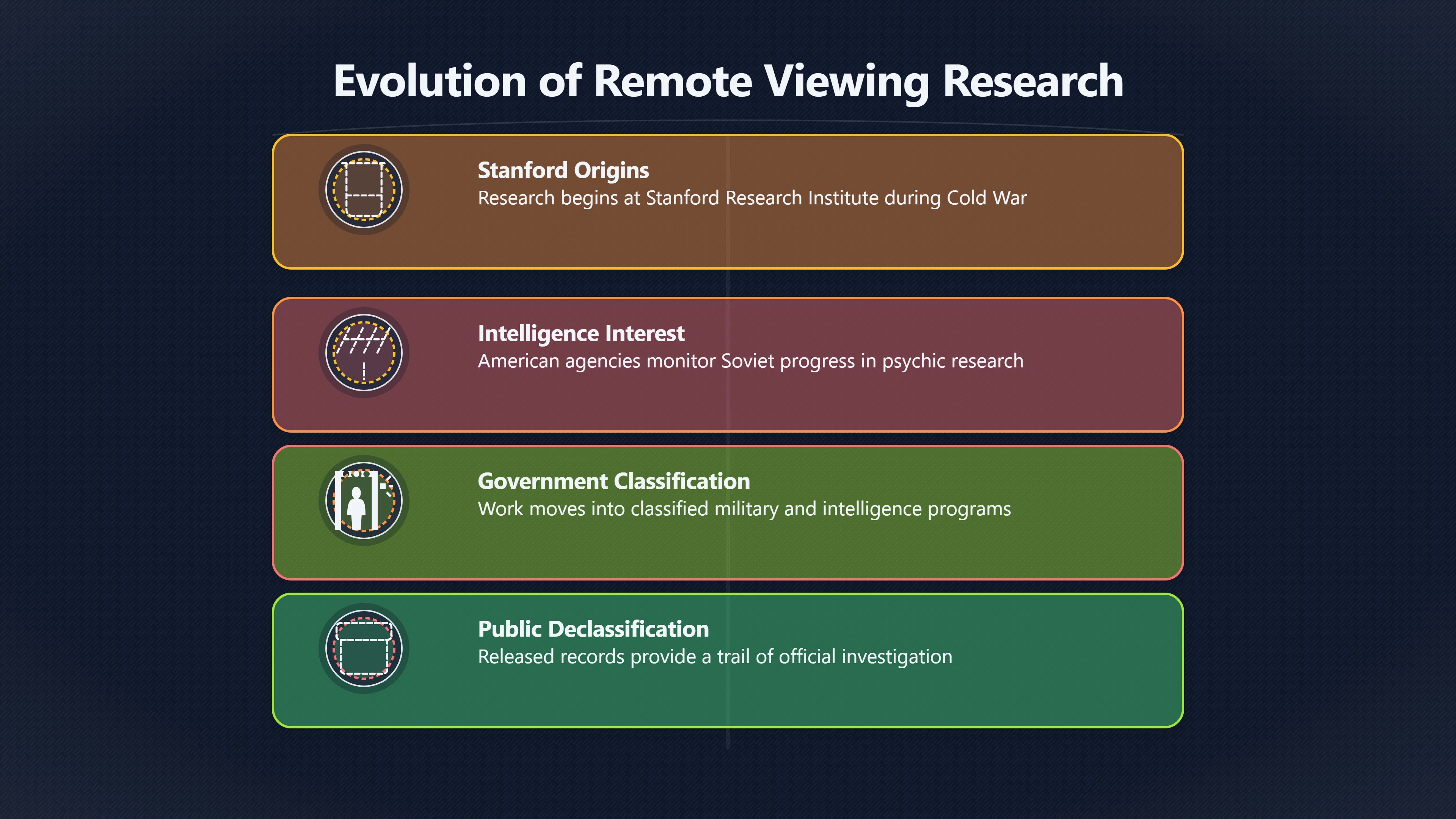
- the emergence of remote-viewing experiments at Stanford Research Institute during the Cold War;
- growing interest from American intelligence agencies after concerns that the Soviet Union might be pursuing similar research;
- movement of the work into classified government programmes;
- later efforts to declassify documents and preserve what participants regard as an overlooked chapter of scientific history.[Apple TV]tv.apple.comTVThird Eye SpiesApple TVThird Eye SpiesFebruary 26, 2019 — The newly declassified true story of America's psychic spies. The implications of their succes…
Supporting interviews reinforce this perspective. The documentary features former military personnel associated with the programme alongside sympathetic researchers such as Dean Radin and Nobel Prize-winning physicist Brian Josephson. Their presence lends authority through professional status while reinforcing the film’s central claim that respected individuals found the evidence persuasive. Critics note, however, that credentialed interviewees are not themselves evidence that the underlying claims are correct; expertise in one field does not automatically validate extraordinary claims in another.[IMDb]imdb.comThird Eye Spies (2019)' The true story of Russell Targ and America's cold war psychic spies, disclosed and declassified for the first…
The result is an “insider” narrative in which participants recount experiences largely in their own words. Rather than placing those recollections alongside extensive critical analysis, the documentary encourages viewers to regard them as testimony from people finally able to speak after decades of secrecy.
Why declassification language matters in marketing
One of the documentary’s most effective rhetorical devices is its repeated emphasis on words such as “declassified”, “secret”, “CIA”, “psychic spies” and “hidden history”. Promotional material describes the story as one that has been concealed for decades and only recently revealed through released government records.[Apple TV]tv.apple.comTVThird Eye SpiesApple TVThird Eye SpiesFebruary 26, 2019 — The newly declassified true story of America's psychic spies. The implications of their succes…
This language has genuine historical foundations. Government agencies did sponsor programmes investigating remote viewing, and many documents were eventually released into the public record. That documentary trail distinguishes remote viewing from many paranormal claims, because the existence of official programmes is not in dispute.
However, declassification itself does not resolve the scientific question. Government records demonstrate that agencies investigated the phenomenon, not that they established its reality. The widely cited 1995 review commissioned by the CIA concluded that the research had not produced sufficiently reliable intelligence value for operational use, even while acknowledging that some laboratory findings appeared statistically unusual and warranted discussion. The programme was subsequently terminated.[Wikipedia]WikipediaRussell TargRussell Targ
Third Eye Spies tends to present declassification as evidence that important truths were hidden from the public. Sceptics instead argue that the released archive shows precisely the opposite: governments eventually disclosed the material, including assessments questioning its practical usefulness. The same archive therefore supports very different narratives depending on which documents receive emphasis.

Where advocate storytelling differs from sceptical accounts
The documentary is best understood as an advocate film rather than an investigative one. Its purpose is persuasive: to convince viewers that remote viewing deserves recognition as a genuine human capability and that institutional history has obscured this conclusion.
Several storytelling choices distinguish this approach from sceptical treatments.
Personal testimony over methodological critique. Former participants describe successful sessions, memorable operational cases and their own confidence in the phenomenon. Far less attention is devoted to methodological criticisms raised over decades by psychologists and statisticians concerning experimental controls, sensory leakage and replication difficulties.[Wikipedia]WikipediaRussell TargRussell Targ
Narrative coherence over scientific uncertainty. Scientific literature on remote viewing contains competing interpretations, mixed experimental results and continuing disagreement. The documentary instead organises events into a familiar dramatic arc of discovery, suppression and eventual vindication.
Institutional conflict as dramatic tension. Rather than treating debate primarily as a dispute over evidence, the film often frames it as conflict between open-minded pioneers and resistant institutions. This framing makes criticism appear partly political or cultural rather than methodological.
By contrast, sceptical accounts generally focus less on motives and more on reproducibility. Reviews of the programme frequently cite independent evaluations concluding that reported successes did not translate into consistently reliable intelligence and that apparent positive findings could often be explained by weaknesses in experimental design or statistical interpretation.[Wikipedia]WikipediaRussell TargRussell Targ
Why the film remains influential despite the scientific dispute
The continuing influence of Third Eye Spies stems less from presenting new empirical evidence than from reshaping familiar material into an emotionally satisfying historical narrative.
Several features explain its cultural appeal:
- A recognisable Cold War setting, where intelligence agencies genuinely explored unconventional ideas.
- Named participants who speak directly about experiences that were once classified.
- Official documents that provide tangible historical artefacts rather than purely anecdotal claims.
- A hopeful message that remote viewing reflects untapped human potential rather than an isolated military curiosity.[Apple TV]tv.apple.comTVThird Eye SpiesApple TVThird Eye SpiesFebruary 26, 2019 — The newly declassified true story of America's psychic spies. The implications of their succes…
These elements make the documentary especially persuasive for audiences encountering the subject for the first time. At the same time, they illustrate an important distinction between historical documentation and scientific validation. A compelling documentary can accurately portray the existence of a government programme while advancing interpretations of its success that remain strongly disputed within the broader scientific community.
Within the wider popular culture of remote viewing, Third Eye Spies therefore functions less as a neutral history than as a defining example of the insider documentary: a film that asks viewers to reinterpret declassified Cold War research as evidence of overlooked human abilities, while critics continue to argue that the historical record documents sustained investigation rather than demonstrated proof.

Amazon book picks
Further Reading
Books and field guides related to When Remote Viewing Becomes Insider History. Use these as the next step if you want deeper reading beyond the article.

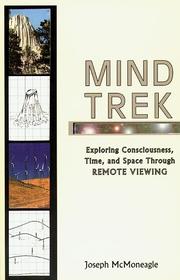
Remote Viewers: The Secret History of America's Psychic Spies
Provides historical context beyond the documentary.
The Reality of ESP: A Physicist's Proof of Psychic Abilities
Expands the historical claims featured in the documentary.
eBay marketplace picks
Marketplace Samples
Live-tested eBay searches with available results related to this page.

Endnotes
1.
Source: imdb.com
Link:https://www.imdb.com/title/tt5112424/
Source snippet
Third Eye Spies (2019)' The true story of Russell Targ and America's cold war psychic spies, disclosed and declassified for the first...
2.
Source: Wikipedia
Title: Russell Targ
Link:https://en.wikipedia.org/wiki/Russell_Targ
3.
Source: tv.apple.com
Title: TVThird Eye Spies
Link:https://tv.apple.com/us/movie/third-eye-spies/umc.cmc.ud25iyzjhpq942qaihhfp27j
Source snippet
Apple TVThird Eye SpiesFebruary 26, 2019 — The newly declassified true story of America's psychic spies. The implications of their succes...
Published: February 26, 2019
4.
Source: Wikipedia
Title: [Stargate]({{ ‘stargate/’ | relative_url }}) Project (U.S. Army unit)
Link:https://en.wikipedia.org/wiki/Stargate_Project_%28U.S._Army_unit%29
5.
Source: youtube.com
Title: Third Eye Spies w/ Russell Targ: Remote Viewing IS real!
Link:http://www.youtube.com/watch?v=82rZruM6Ymo
Source snippet
Third Eye Spies | Russell Targ...
6.
Source: youtube.com
Title: Third Eye Spies | Russell Targ
Link:http://www.youtube.com/watch?v=oZ5sPtyjauA
Source snippet
RUSSELL TARG - THIRD EYE SPIES...
7.
Source: youtube.com
Title: RUSSELL TARG
Link:http://www.youtube.com/watch?v=X77Sh0jw3f8
Source snippet
Third Eye Spies (2019) | Official Trailer HD...
8.
Source: youtube.com
Link:http://www.youtube.com/watch?v=iBokQomPr_g
Source snippet
Russell Targ "Third Eye Spies" interview remote viewing Russell Targ: Third Eye Spies: Learn Remote Viewing From The Masters | ASMAL ep...
9.
Source: rottentomatoes.com
Title: third eye spies
Link:https://www.rottentomatoes.com/m/third_eye_spies
Source snippet
6 Feb 2019 — Discover reviews, ratings, and trailers for Third Eye Spies on Rotten Tomatoes. Stay updated with critic and audience scores...
10.
Source: letterboxd.com
Title: third eye spies
Link:https://letterboxd.com/film/third-eye-spies/
Source snippet
(2019) directed by Lance MungiaThis is the true story of Russell Targ and America's Cold War psychic spies, disclosed and declassified fo...
Additional References
11.
Source: facebook.com
Link:https://www.facebook.com/groups/mysterysciencetheater3000fans/posts/2956594004494091/
Source snippet
Documentary on Remote Viewing Third Eye SpiesSitting here watching a documentary on remote viewing called Third Eye Spies. There was a se...
12.
Source: amazon.de
Title: Third Eye Spies: Learn Remote Viewing from the Masters Editorial Reviews
Link:https://www.amazon.de/-/en/Third-Eye-Spies-Viewing-Masters/dp/163748013X?tag=searcht-20
Source snippet
“Russell Targ's Third Eye Spies is a masterwork in the history and practice of remote viewing.” —Dean Radin, MS, PhD, chief scientist at...
13.
Source: cybersecurityventures.com
Title: hackers movie guide review third eye spies
Link:https://cybersecurityventures.com/hackers-movie-guide-review-third-eye-spies/
Source snippet
Hackers Movie Guide Review: Third Eye Spies17 Jun 2025 — The true story of Russell Targ and America's cold war psychic spies, disclosed a...
14.
Source: youtube.com
Link:http://www.youtube.com/watch?v=ZTs4sT1Aj1c
Source snippet
Third Eye Spies w/ Russell Targ: Remote Viewing IS real...
15.
Source: reddit.com
Link:https://www.reddit.com/r/skeptic/comments/1f7ed9e/can_anyone_debunk_the_quite_popular_documentary/
Source snippet
periments into remote viewing.Read more...
16.
Source: youtube.com
Link:https://www.youtube.com/watch?v=3D7A-X1nd3c
Source snippet
LAh. Third Eye Spies with Russell Targ...
Topic Tree