Within Judging
Why Rich Impressions Are So Easy to Match
Long free-response reports can contain enough mixed imagery for later readers to notice hits while overlooking misses.
On this page
- The problem of vague but over complete reports
- Hits, misses, and ignored details
- Why scoring rules must weight evidence in advance
Page outline Jump by section
Introduction
One of the central challenges in evaluating remote-viewing claims is that successful-looking matches can emerge simply because viewer transcripts are long, varied and open to interpretation. A typical session may include sketches, sensory impressions, emotional reactions, abstract shapes, textures, colours and speculative labels. Such richness can make the transcript feel compelling, but it also increases the number of possible ways it can be connected to a target after the correct answer is known. For this reason, blind judging is intended to compare a transcript against multiple candidate targets rather than asking whether any part of the report resembles the correct one. The concern is not merely that some statements are vague, but that a lengthy report contains enough different elements that selective attention can emphasise apparent “hits” while quietly ignoring the larger number of statements that do not fit. This matching problem has been a recurring topic in methodological critiques of remote-viewing research and has shaped the development of more structured judging procedures.[National Security Archive]nsarchive2.gwu.eduNational Security ArchiveAn Evaluation of Remote Viewing: Research and…March 13, 2015 — by MD Mumford · 1995 · Cited by 76 — The resul…

The Problem of Vague but Over-Complete Reports
Free-response protocols were introduced partly to overcome the limitations of repetitive forced-choice guessing tasks. Instead of selecting from a fixed set of symbols, viewers are encouraged to record everything that comes to mind. The resulting transcript is therefore intentionally unconstrained and often much richer than a simple right-or-wrong answer.[Psi Encyclopedia]psi-encyclopedia.spr.ac.ukPsi Encyclopedia Remote ViewingPsi EncyclopediaRemote Viewing - Psi Encyclopedia13 Jan 2017 — Remote viewing replaced repetitive forced-choice tasks with free-response…
This richness, however, creates a statistical and psychological difficulty. A report might contain observations such as:
- water
- movement
- curved shapes
- metal
- brightness
- noise
- feelings of height
- people
- coldness
- circular forms
Individually, many of these impressions could plausibly fit numerous different locations or photographs. Collectively they provide many opportunities for later matching. If a target happens to include a bridge, a harbour, a fountain or an industrial site, different parts of the transcript may appear impressively accurate even if many other descriptions fail to correspond.
The issue becomes more pronounced as transcript length increases. A report containing fifty or one hundred separate impressions naturally offers more potential matching points than one containing only a few carefully defined statements. Unless every statement is evaluated systematically, longer reports may appear more successful simply because they provide more opportunities for retrospective interpretation rather than because they contain more accurate information. This concern has featured prominently in methodological reviews of the remote-viewing literature.[National Security Archive]nsarchive2.gwu.eduNational Security ArchiveAn Evaluation of Remote Viewing: Research and…March 13, 2015 — by MD Mumford · 1995 · Cited by 76 — The resul…
Hits, Misses and Ignored Details
A common criticism of informal judging is that readers rarely weigh every element equally. Instead, striking correspondences tend to attract attention while contradictory details fade into the background.
For example, imagine a transcript that includes:
- “large body of water”
- “vertical structure”
- “red object”
- “animals”
- “underground feeling”
- “snow”
- “crowd”
- “rotating machinery”
If the actual target is a lighthouse beside the sea, attention may naturally focus on “water” and “vertical structure”. The remaining impressions may receive little discussion or be dismissed as symbolic, metaphorical or simply unimportant.
This is an example of selective matching rather than necessarily evidence of accurate perception. The evaluator effectively performs two tasks simultaneously:
- searching for correspondences; and
- deciding which discrepancies matter.
Without predetermined rules, those decisions can drift towards the known answer once the target is revealed.
Psychologists have long documented related tendencies, including subjective validation and confirmation bias, in which people preferentially notice information supporting an expected conclusion while discounting conflicting evidence. Although these psychological findings are not specific to remote viewing, they illustrate why free-form reports require carefully controlled evaluation procedures rather than intuitive inspection.[Wikipedia]WikipediaStargate Project (U.S. Army unitStargate Project (U.S. Army unit
Why Rich Reports Encourage Multiple Plausible Matches
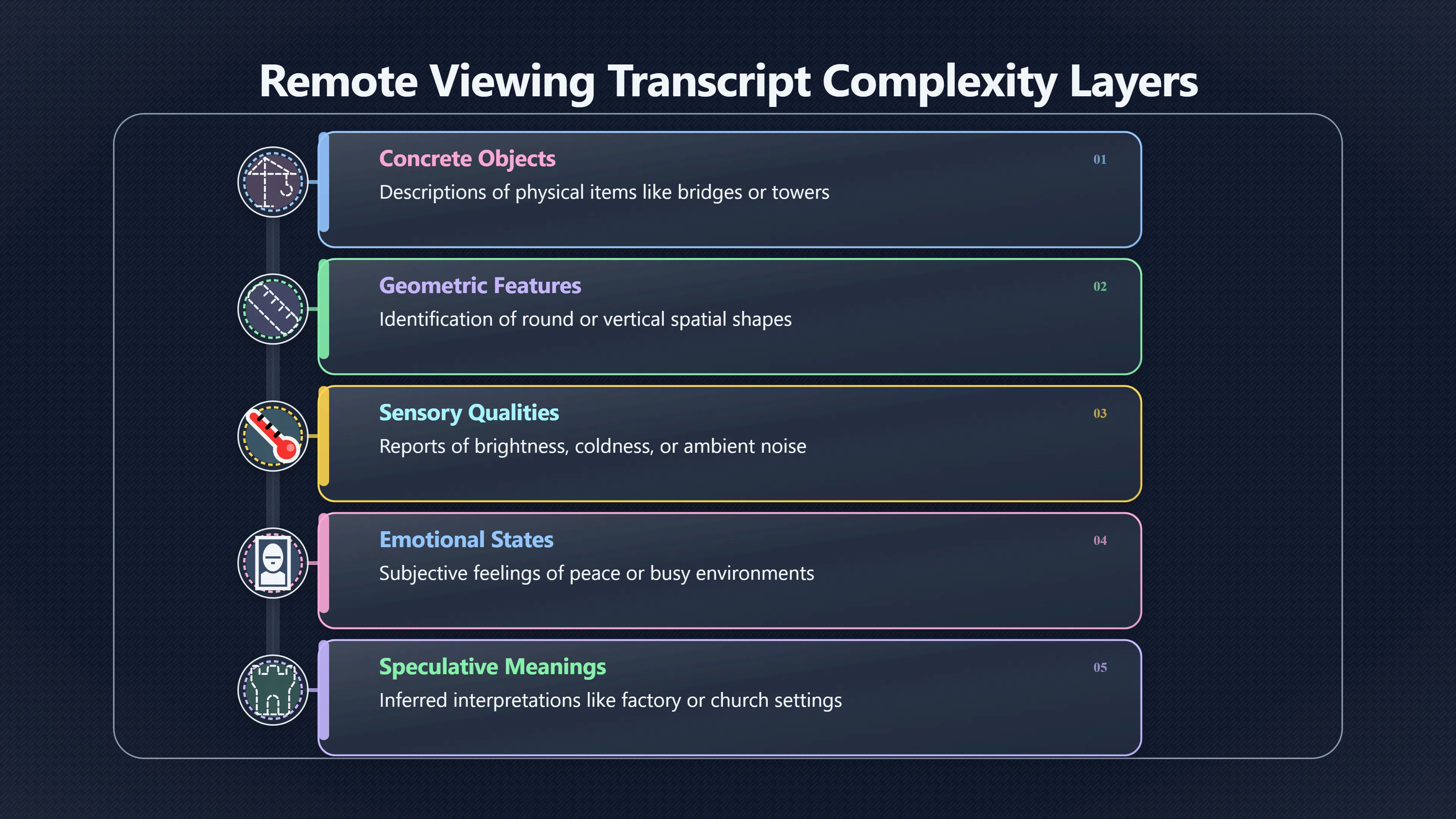
Long transcripts often contain descriptions operating at several levels simultaneously:
- concrete objects (“bridge”, “tower”)
- geometric features (“round”, “vertical”)
- sensory qualities (“bright”, “cold”)
- emotions (“busy”, “peaceful”)
- inferred meanings (“important”, “ceremonial”)
- speculative interpretations (“factory”, “church”)
This mixture increases flexibility during judging. If one interpretation fails, another may succeed. A geometric description might substitute for an object, an emotional description for an environmental feature, or a symbolic interpretation for a literal one.
Consequently, a single transcript may appear compatible with several targets in the judging pool. Rather than producing one uniquely identifiable description, it produces numerous partial overlaps distributed across multiple candidates. This is precisely why comparative blind judging was developed: the important question is not whether any similarities exist, but whether the intended target consistently matches better than carefully chosen alternatives.[National Security Archive]nsarchive2.gwu.eduNational Security ArchiveAn Evaluation of Remote Viewing: Research and…March 13, 2015 — by MD Mumford · 1995 · Cited by 76 — The resul…
Why Scoring Rules Must Weight Evidence in Advance
The principal safeguard against selective matching is to establish scoring procedures before anyone knows which target is correct.
Methodological reviews have emphasised several practices designed to reduce subjective interpretation:
- judges remain blind to the correct target;
- transcripts are compared with multiple decoy targets rather than a single revealed answer;
- ranking or scoring criteria are specified in advance;
- all relevant transcript elements contribute to the evaluation rather than only memorable correspondences;
- statistical analysis is based on predefined outcomes instead of post hoc impressions.[National Security Archive+2CIA]nsarchive2.gwu.eduNational Security ArchiveAn Evaluation of Remote Viewing: Research and…March 13, 2015 — by MD Mumford · 1995 · Cited by 76 — The resul…
Predefined weighting matters because otherwise evaluators may unconsciously adjust standards during scoring. A vivid sketch may be treated as highly important in one trial but ignored in another. Likewise, an incorrect specific statement might be discounted as “analytic overlay” while a broadly similar impression is counted as a successful hit. Fixed scoring rules reduce this flexibility and make different trials more comparable.
Some remote-viewing researchers have proposed more detailed scoring systems that assign numerical values to individual correspondences instead of relying solely on overall subjective matching. Supporters argue that this preserves more information from complex transcripts, while critics caution that increasingly elaborate scoring schemes can themselves introduce additional judgement calls if not tightly specified beforehand.[ResearchGate]researchgate.netMatching tasks are considered the gold standard across all free response-typeResearchGate(PDF) Remote Viewing: a 1974-2022 systematic review …This is the first meta-analysis of all studies related to remote viewi…
Why Transcript Length Is a Methodological Risk Rather Than Proof
Long reports are not inherently evidence for or against remote viewing. They simply change the judging problem.
Supporters often value extensive transcripts because they preserve subtle impressions that might otherwise be lost and provide richer material for comparison. Critics respond that the same richness enlarges the search space for apparent correspondences, making selective matching more likely unless evaluation procedures are rigorously controlled.
The methodological question therefore becomes straightforward: does a detailed transcript identify the intended target more convincingly than equally plausible alternatives under blind conditions, using scoring rules established before judging begins? That comparative approach is intended to distinguish genuinely informative descriptions from matches that arise because lengthy, mixed reports contain enough varied material for readers to find persuasive similarities after the fact.[National Security Archive+2CIA]nsarchive2.gwu.eduNational Security ArchiveAn Evaluation of Remote Viewing: Research and…March 13, 2015 — by MD Mumford · 1995 · Cited by 76 — The resul…
eBay marketplace picks
Marketplace Samples
Live-tested eBay searches with available results related to this page.



Endnotes
1.
Source: cia.gov
Link:https://www.cia.gov/readingroom/docs/CIA-RDP96-00791R000200180005-5.pdf
Source snippet
alternatively, a set of decoys...
2.
Source: researchgate.net
Title: Matching tasks are considered the gold standard across all free response-type
Link:https://www.researchgate.net/publication/369604750Remote_Viewing_a_1974-2022_systematic_review_and[meta-analysis
Source snippet
ResearchGate(PDF) Remote Viewing: a 1974-2022 systematic review...This is the first meta-analysis of all studies related to remote viewi...
3.
Source: Wikipedia
Title: Stargate Project (U.S. Army unit)
Link:https://en.wikipedia.org/wiki/Stargate_Project_%28U.S._Army_unit%29
4.
Source: Wikipedia
Title: Barnum effect
Link:https://en.wikipedia.org/wiki/Barnum_effect
5.
Source: Wikipedia
Title: Remote viewing
Link:https://en.wikipedia.org/wiki/Remote_viewing
Source snippet
Remote viewingRemote viewing (RV) is the practice of seeking impressions about a distant or unseen subject, purportedly sensing with t...
6.
Source: nsarchive2.gwu.edu
Link:https://nsarchive2.gwu.edu/NSAEBB/NSAEBB438/docs/doc_57.pdf
Source snippet
National Security ArchiveAn Evaluation of Remote Viewing: Research and...March 13, 2015 — by MD Mumford · 1995 · Cited by 76 — The resul...
Published: March 13, 2015
7.
Source: psi-encyclopedia.spr.ac.uk
Title: Psi Encyclopedia Remote Viewing
Link:https://psi-encyclopedia.spr.ac.uk/articles/remote-viewing/
Source snippet
Psi EncyclopediaRemote Viewing - Psi Encyclopedia13 Jan 2017 — Remote viewing replaced repetitive forced-choice tasks with free-response...
Additional References
8.
Source: koestlerunit.wordpress.com
Link:https://koestlerunit.wordpress.com/wp-content/uploads/2015/06/wiseman-milton-1998.pdf
Source snippet
(Utts, 1995a; Hyman, 1995a) and a concluding section that outlined the main points of...
9.
Source: reddit.com
Link:https://www.reddit.com/r/remoteviewing/comments/1501do7/the_complete_skeptics_guide_to_remote_viewing_how/
Source snippet
nd what the field needs to address in order to be legitimized...
10.
Source: pmc.ncbi.nlm.nih.gov
Link:https://pmc.ncbi.nlm.nih.gov/articles/PMC10275521/
Source snippet
Central Intelligence Agency's (CIA...by Á Escolà‐Gascón · 2023 · Cited by 10 — Hyman (1996) and other skeptical researchers criticized t...
11.
Source: ciaotest.cc.columbia.edu
Title: sa jan02srm01
Link:https://ciaotest.cc.columbia.edu/olj/sa/sa_jan02srm01.html
Source snippet
Remote Viewing: The US Sponsored Psychic...This paper deals with experiments conducted in USA in which certain individuals were trained...
12.
Source: youtube.com
Title: Correlates of [Anomalous Cognition]({{ ‘not-clairvoyance/’ | relative_url }}) with Edwin C. May
Link:https://www.youtube.com/watch?v=Y5X4_DXGX60
Source snippet
Researching Anomalous Cognition with Edwin C. May...
13.
Source: youtube.com
Title: Training Anomalous Cognition with Edwin C. May
Link:https://www.youtube.com/watch?v=MAnEiItzEXk
Source snippet
Correlates of Anomalous Cognition with Edwin C. May...
14.
Source: youtube.com
Title: Remote Viewing 3.0 with Jana Rogge
Link:https://www.youtube.com/watch?v=GtyyaV5n6aA
Source snippet
Training Anomalous Cognition with Edwin C. May...
15.
Source: youtube.com
Title: Remote Viewing and Statistical Validation
Link:https://www.youtube.com/watch?v=YrwAiU2g5RU
Source snippet
Remote Viewing 3.0 with Jana Rogge...
16.
Source: youtube.com
Title: Researching Anomalous Cognition with Edwin C. May
Link:https://www.youtube.com/watch?v=sT_tbmB4J5I
Topic Tree