Within Utts Review
Why Ganzfeld Studies Entered the Debate
Utts used similarities with ganzfeld results to argue that the effect was not confined to one lab protocol.
On this page
- What ganzfeld experiments added to the comparison
- Why similar effect sizes mattered to Utts
- Why cross protocol evidence was still disputed
Page outline Jump by section
Introduction
One of the more distinctive features of Jessica Utts’ 1995 assessment of the U.S. government’s remote-viewing research was that she did not treat the reported statistical effects as an isolated result confined to a single laboratory or experimental protocol. Instead, she argued that broadly similar findings had appeared in a related body of parapsychology research known as ganzfeld experiments. In her view, this comparison strengthened the case that the observed deviations from chance reflected a genuine, though poorly understood, phenomenon rather than a peculiarity of one research group or one testing method.[Wikipedia]WikipediaJessica UttsJessica Utts

The comparison, however, became one of the most disputed parts of the wider debate. Supporters regarded converging evidence from different experimental traditions as an important sign of robustness. Critics responded that similar statistical results across different protocols did not eliminate common methodological weaknesses, publication bias, selective reporting, or subtle forms of information leakage. As a result, ganzfeld studies became an important point of comparison in discussions of remote viewing without resolving the underlying controversy.
Why Ganzfeld Studies Entered the Debate
Ganzfeld experiments were developed as a free-response test of extrasensory perception (ESP). Rather than asking participants to guess cards or symbols, researchers attempted to reduce ordinary sensory stimulation—typically by using translucent eye covers, diffuse light and white noise—while one participant attempted to describe a hidden target image or video being viewed elsewhere. Independent judges later compared the descriptions with several possible targets to determine whether the correct one was matched better than expected by chance.[Wikipedia]WikipediaGanzfeld experimentGanzfeld experiment
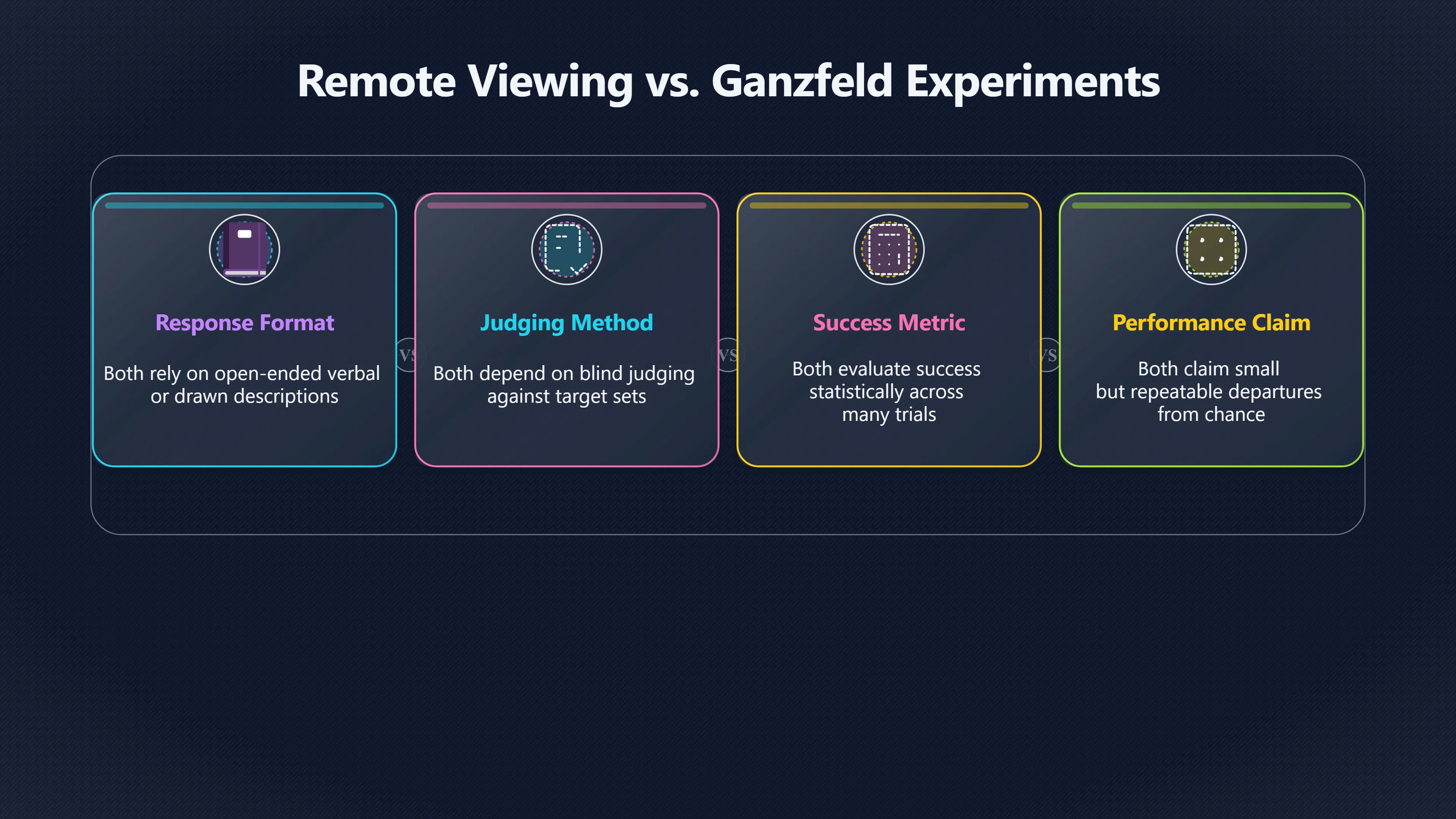
Although the procedures differed from laboratory remote viewing, the two approaches shared several important features:
- both relied on open-ended verbal or drawn descriptions rather than fixed-choice answers;
- both depended on blind judging against target sets;
- both evaluated success statistically across many trials rather than by dramatic individual demonstrations; and
- both claimed small but repeatable departures from chance performance.
For Utts, these similarities meant that ganzfeld research provided an independent line of evidence relevant to the broader question of anomalous cognition. If two substantially different experimental paradigms produced comparable statistical outcomes, she argued, it became less plausible that one particular laboratory protocol alone explained the findings.[ResearchGate]researchgate.net280019566 Revisiting the Ganzfeld ESP Debate A Basic Review and AssessmentRevisiting the Ganzfeld ESP Debate: A Basic Review and…30 May 2026 — Results summary for the 30 ganzfeld ESP studies analy…
What Ganzfeld Experiments Added to the Comparison
The value of the comparison was not that ganzfeld studies proved remote viewing, but that they addressed a common criticism directed at the Stargate laboratory work: that positive findings originated primarily from a small group of investigators using specialised procedures.
By pointing to the ganzfeld literature, Utts argued that positive statistical effects had appeared outside the Stanford Research Institute and SAIC remote-viewing programmes. This broadened the empirical landscape from one government-funded research tradition to another, academically oriented line of experimentation employing different personnel, different target materials and somewhat different protocols.[Wikipedia]WikipediaJessica UttsJessica Utts
This distinction mattered because replication in science is usually evaluated across changing circumstances rather than through exact duplication. Utts argued that if modest effects persisted despite procedural variation, this suggested the underlying signal—if genuine—was not tied to one specific experimental design.
Why Similar Effect Sizes Mattered to Utts
Utts’ statistical reasoning focused less on whether every individual experiment achieved conventional significance than on whether estimated effect sizes remained broadly consistent across studies.
Her general position was that replication should be judged by whether repeated investigations estimate roughly the same underlying magnitude of effect rather than by requiring every individual experiment to produce identical levels of statistical significance. Small effects naturally fluctuate because of sampling variation, making consistency of estimated effect size more informative than isolated successes or failures.[ResearchGate]researchgate.net280019566 Revisiting the Ganzfeld ESP Debate A Basic Review and AssessmentRevisiting the Ganzfeld ESP Debate: A Basic Review and…30 May 2026 — Results summary for the 30 ganzfeld ESP studies analy…
Applying this reasoning, she viewed the similarities between remote-viewing databases and the ganzfeld literature as evidence that:
- the reported effects were generally modest rather than spectacular;
- positive outcomes appeared under more than one experimental paradigm;
- average deviations from chance remained of comparable order across repeated investigations; and
- replication should be evaluated across cumulative evidence rather than single studies.
This statistical perspective reflected Utts’ broader argument in the AIR review: laboratory evidence should be assessed in the same way behavioural scientists evaluate other weak but repeatable effects.
Why Cross-Protocol Evidence Was Still Disputed
Critics accepted neither the inference nor the weight Utts placed on the comparison.
One objection was conceptual. Similar statistical results across different paradigms do not necessarily imply a common underlying cause. If multiple experimental traditions share comparable vulnerabilities—such as optional stopping, experimenter influence, publication bias or subjective judging—then similar effect sizes might arise from shared methodological features rather than from anomalous information transfer.[Wikipedia]WikipediaRay HymanRay Hyman
A second objection concerned the ganzfeld literature itself. Earlier ganzfeld experiments had been criticised for weaknesses involving randomisation, sensory leakage and incomplete documentation. Following a joint methodological review by Ray Hyman and Charles Honorton, later “autoganzfeld” studies introduced stronger automation and tighter controls. Even so, disagreement continued over whether these improvements fully eliminated alternative explanations.[Wikipedia]WikipediaGanzfeld experimentGanzfeld experiment
The replication record also remained contested. Some later meta-analyses concluded that ganzfeld results continued to show statistically significant positive effects, while others argued that successful replication across independent laboratories had not been convincingly demonstrated. Much of the disagreement centred on which studies should be included, how methodological quality should be assessed, and whether effect sizes remained stable after stricter selection criteria were applied.[Studieinfo+2Academia]studieinfo.liu.seWiseman concluded that a significant communication anomaly for the ganzfeld had not been replicated by a “broader range of researchers” (…

What the Comparison Ultimately Contributed
Within Utts’ overall argument, ganzfeld studies served a specific purpose rather than functioning as independent proof of psychic functioning.
They reinforced her claim that remote-viewing results should not be interpreted as an isolated anomaly produced by one Cold War research programme. Instead, she presented them as part of a broader pattern of free-response experiments reporting modest but statistically detectable departures from chance.
The debate therefore shifted from a narrow question—whether one remote-viewing protocol generated unusual statistics—to a broader scientific question: whether comparable findings emerging from different experimental traditions represented converging evidence for an unexplained phenomenon or reflected recurring methodological and statistical problems that had not yet been fully resolved. That disagreement remains central to historical assessments of Utts’ interpretation of the remote-viewing evidence.[Wikipedia+2Wikipedia]WikipediaJessica UttsJessica Utts
Amazon book picks
Further Reading
Books and field guides related to Why Ganzfeld Studies Entered the Debate. Use these as the next step if you want deeper reading beyond the article.
The conscious universe
Directly addresses statistical comparisons across psi protocols.
The Reality of ESP: A Physicist's Proof of Psychic Abilities
Discusses multiple experimental paradigms including ESP research.
eBay marketplace picks
Marketplace Samples
Live-tested eBay searches with available results related to this page.



Endnotes
1.
Source: Wikipedia
Title: Jessica Utts
Link:https://en.wikipedia.org/wiki/Jessica_Utts
2.
Source: Wikipedia
Title: Remote viewing
Link:https://en.wikipedia.org/wiki/Remote_viewing
3.
Source: Wikipedia
Title: Ganzfeld experiment
Link:https://en.wikipedia.org/wiki/Ganzfeld_experiment
4.
Source: researchgate.net
Title: 280019566 Revisiting the Ganzfeld ESP Debate A Basic Review and Assessment
Link:https://www.researchgate.net/publication/280019566_Revisiting_the_Ganzfeld_ESP_Debate_A_Basic_Review_and_Assessment
Source snippet
Revisiting the Ganzfeld ESP Debate: A Basic Review and...30 May 2026 — Results summary for the 30 ganzfeld ESP studies analy...
Published: May 2026
5.
Source: Wikipedia
Title: Ray Hyman
Link:https://en.wikipedia.org/wiki/Ray_Hyman
6.
Source: Wikipedia
Title: Sensory leakage
Link:https://en.wikipedia.org/wiki/Sensory_leakage
7.
Source: academia.edu
Link:https://www.academia.edu/19060222/Meta_Analysis_in_Parapsychology_I_The_Ganzfeld_Domain1
Source snippet
ound that significant results were obtained in all but one ganzfeld...
8.
Source: studieinfo.liu.se
Link:https://studieinfo.liu.se/download/coursedocument/cb8cd12c-95a9-4147-a5e6-b14b8dd6eac6/Storm%202010%20Meta-analysis%20of%20free-response%20studies%2C%201992%E2%80%932008%20Assessing%20the%20noise%20reduction%20model%20in%20parapsychology.pdf
Source snippet
Wiseman concluded that a significant communication anomaly for the ganzfeld had not been replicated by a “broader range of researchers” (...
Additional References
9.
Source: emmind.net
Link:https://emmind.net/openpapers_repos/Nonlocality_Fields/Nonlocal_Mind/Various/2014_Explicit_Anomalous_Cognition_A_Review_of_the_Best_Evidence_in_Ganzfeld%2C_Forced-choice_Remote_Viewing_and_Dream_Studies.pdf
Source snippet
presented a [meta-analysis]({{ 'meta-analysis/' | relative_url }}) of their own, arguing that the reason for Milton and Wiseman's. (MW's) effect size plunge was that many...Read...
10.
Source: scispace.com
Title: journal of parapsychology 3bui9b1c
Link:https://scispace.com/journals/journal-of-parapsychology-3bui9b1c/1999
Source snippet
Top 26 Journal of Parapsychology papers published in 1999In this paper, it is shown that replication of effect size in the recent ganzfel...
11.
Source: jessegalef.com
Title: rs episode 53 parapsychology
Link:https://jessegalef.com/2012/01/29/rs-episode-53-parapsychology/
Source snippet
RS episode #53: Parapsychology29 Jan 2012 — (1) You mentioned that some Ganzfeld meta-analyses showed positive and significant effects, a...
12.
Source: youtube.com
Title: Peter Bancel | Psi@Home: A Platform for Collaborative Psi Research
Link:https://www.youtube.com/watch?v=87LtZIuhU9Q
Source snippet
This discussion with statistician Jessica Utts explains her evaluation of parapsychological data, including the statistical convergence b...
13.
Source: pmc.ncbi.nlm.nih.gov
Link:https://pmc.ncbi.nlm.nih.gov/articles/PMC7883320/
Source snippet
by PE Tressoldi · 2021 · Cited by 9 — This meta-analysis is an investigation into anomalous perception (i.e., conscious identification...
14.
Source: ejp.wyrdwise.com
Title: EJP v24 1
Link:https://ejp.wyrdwise.com/EJP%20v24-1.pdf
Source snippet
24.1, 2009meta-analytic effect sizes of the Bem and Honorton (1994), Milton and. Wiseman (1999) and Storm and Ertel (2001) served as init...
15.
Source: youtube.com
Title: Why All Scientists Should Take PSI Seriously
Link:https://www.youtube.com/watch?v=JFRj0DS75KQ
Source snippet
Peter Bancel | Psi@Home: A Platform for Collaborative Psi Research...
16.
Source: youtube.com
Title: Remote Viewing and Statistical Validation
Link:https://www.youtube.com/watch?v=YrwAiU2g5RU
Source snippet
Statistics in Parapsychology with Jessica Utts...
17.
Source: youtube.com
Title: Science and the taboo of psi
Link:https://www.youtube.com/watch?v=qw_O9Qiwqew
Source snippet
Why All Scientists Should Take PSI Seriously...
18.
Source: youtube.com
Title: Statistics in Parapsychology with Jessica Utts
Link:https://www.youtube.com/watch?v=WmYGtKB9EEA
Source snippet
Science and the taboo of psi...
Topic Tree