Within Replication
Why Rules Must Come Before Results
Pre-registration matters because flexible target choices, scoring rules and analysis decisions can turn weak signals into impressive-looking results.
On this page
- Why post hoc changes weaken evidence
- What pre declared scoring would need to specify
- How transparent trial reporting changes interpretation
Page outline Jump by section
Introduction
For remote viewing to gain mainstream scientific acceptance, positive results are not enough. Researchers must also show that those results were produced under rules fixed before any data were collected or analysed. This principle, often called pre-registration or the use of pre-declared methods, is designed to prevent researchers from unconsciously or deliberately finding patterns that emerge only after examining the data. In areas where judging is subjective and statistical effects are often small, this distinction becomes especially important.

Within remote-viewing research, many debates have centred not simply on whether statistically significant findings exist, but on whether experimental procedures leave enough flexibility to produce apparently successful outcomes through post-hoc choices. The demand for pre-declared methods therefore acts as one of the principal gateways between intriguing experimental findings and broader scientific acceptance.[CIA]cia.govAN EVALUATION OF REMOTE VIEWING: RESEARCH…A remote viewer is asked to visualize a place, location, or object being viewed by a "bea…
Why Post-Hoc Changes Weaken Evidence
Many remote-viewing experiments involve open-ended descriptions rather than simple right-or-wrong answers. A participant may produce pages of impressions, sketches and descriptive language, while judges later compare those materials against one or more possible targets. This creates opportunities for legitimate scientific judgement—but also opportunities for unconscious bias if important decisions are made only after the data are visible.
Without pre-declared rules, researchers may unknowingly introduce flexibility by changing:
- which trials are included or excluded;
- how ambiguous statements are interpreted;
- how many targets are compared;
- which scoring method is preferred;
- whether multiple judges are combined or selected individually;
- which statistical analysis is reported.
Each decision may appear reasonable in isolation. Collectively, however, they increase the probability of obtaining apparently impressive results by chance alone. Across many scientific disciplines this problem is known as “researcher degrees of freedom” and is one of the reasons pre-registration has become increasingly important in experimental science.
For extraordinary claims such as remote viewing, mainstream scientists generally expect these decisions to be fixed before testing begins rather than developed after promising-looking results emerge.[CIA]cia.govAN EVALUATION OF REMOTE VIEWING: RESEARCH…A remote viewer is asked to visualize a place, location, or object being viewed by a "bea…
What Pre-Declared Scoring Would Need to Specify
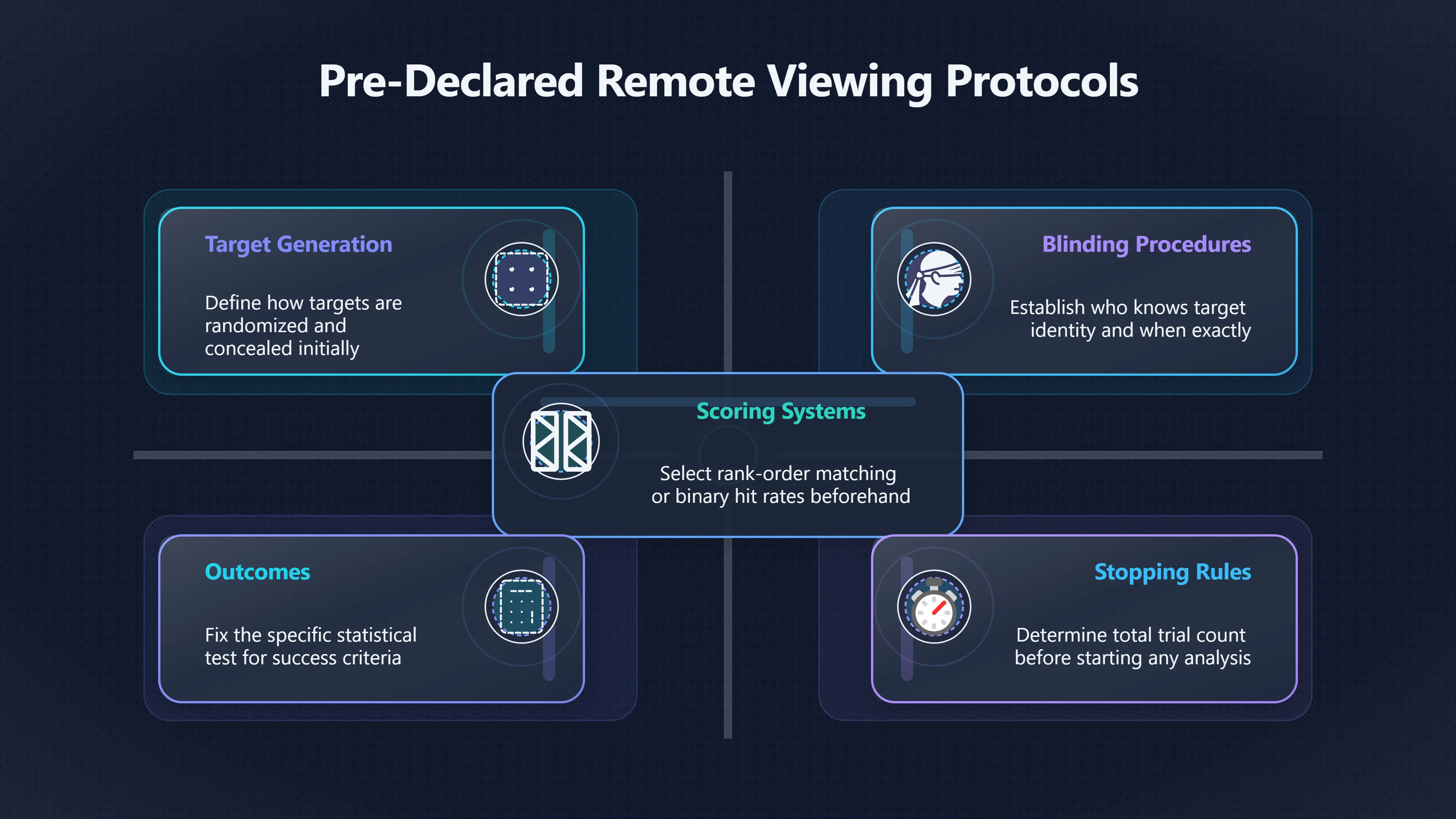
A genuinely pre-declared remote-viewing protocol would need to define far more than the viewing procedure itself. The protocol should specify in advance exactly how success will be measured.
Key elements include:
- Target selection: how targets are generated, randomised and concealed.
- Blinding: who knows the target identity and when that information becomes available.
- Scoring method: whether judging uses rank-order matching, binary hit rates, numerical similarity scores or another predefined system.
- Primary outcome: which statistical test determines success.
- Participant inclusion: whether all sessions are analysed or whether exclusion criteria apply.
- Stopping rule: how many trials will be conducted before analysis begins.
- Handling missing data: how incomplete sessions or procedural failures are treated.
Pre-defining these elements prevents researchers from selecting whichever analytical approach happens to produce the strongest apparent effect after viewing the results.
The principle is not unique to paranormal research. Modern clinical trials, psychology experiments and many areas of biomedical science increasingly require publicly registered protocols for exactly the same reason: preventing hindsight from influencing evidence.
Why Judging Rules Matter Especially in Remote Viewing
Remote viewing presents an unusual methodological challenge because much of the evidence depends on interpretation rather than direct measurement.
Consider a transcript containing phrases such as “something metallic”, “large structure”, “water nearby” and “movement”. Depending on the available targets, different judges may legitimately see different degrees of similarity. If judging criteria evolve after examining both transcripts and targets, even experienced judges can unintentionally favour apparent matches.
Research within associative remote viewing has demonstrated that different judging teams can produce noticeably different outcomes from the same underlying session material, illustrating how scoring methodology itself influences reported success rates. Such findings do not automatically invalidate remote-viewing research, but they reinforce the importance of fixing judging procedures before the experiment begins rather than adapting them afterwards.[ResearchGate]researchgate.net369604750 Remote Viewing a 1974 2022 systematic review and meta analysisResearchGate(PDF) Remote Viewing: a 1974-2022 systematic review…March 20, 2023 — This is the first meta-analysis of all studies relate…
How Transparent Trial Reporting Changes Interpretation
Pre-declared methods become much stronger when combined with complete reporting of every planned trial.
Selective reporting creates a distorted picture if unsuccessful sessions remain unpublished while successful ones receive detailed attention. Transparent reporting instead allows independent researchers to determine:
- whether all planned experiments were reported;
- whether outcome measures changed during the study;
- whether excluded sessions materially affected conclusions;
- whether secondary analyses were presented as primary findings.
This transparency enables later reviewers and meta-analysts to distinguish between confirmatory testing—where predictions were specified beforehand—and exploratory analyses that generate hypotheses for future research.
Exploratory work remains scientifically valuable, but it carries less evidential weight than successful tests conducted under prospectively defined rules.
Why This Standard Matters More for Extraordinary Claims
Scientific standards become stricter as claims become more surprising. A small procedural weakness that might receive limited attention in a conventional laboratory study attracts much greater scrutiny when researchers propose phenomena that challenge established understanding of perception.
This explains why critics such as psychologist Ray Hyman have consistently argued that statistically interesting findings alone are insufficient. His position has been that independently replicated experiments using rigorous, predefined protocols are required before paranormal interpretations become persuasive. By contrast, statistician Jessica Utts concluded that some laboratory findings exceeded chance expectation while also acknowledging the need for continued methodological improvement and independent replication. Their differing interpretations illustrate that statistical significance and scientific acceptance are not identical questions.[CIA]cia.govAN EVALUATION OF REMOTE VIEWING: RESEARCH…A remote viewer is asked to visualize a place, location, or object being viewed by a "bea…
The Governance Role of Pre-Declared Rules
Pre-declared methods function less as a technical detail than as a governance mechanism for scientific credibility. They reduce opportunities for conscious or unconscious bias, make independent replication more meaningful, and allow disagreements to focus on the evidence itself rather than on whether analytical choices shifted during the study.
Supporters of remote viewing increasingly emphasise rigorous blinding and structured protocols, and recent reviews describe protocol quality as an important moderator when evaluating the literature. Nevertheless, mainstream acceptance depends not simply on adopting stronger procedures, but on demonstrating that those procedures consistently produce reliable results across independent laboratories under prospectively specified methods. Until that standard is met, pre-declared rules remain one of the principal thresholds separating intriguing experimental findings from broadly accepted scientific evidence.[ResearchGate]researchgate.net369604750 Remote Viewing a 1974 2022 systematic review and meta analysisResearchGate(PDF) Remote Viewing: a 1974-2022 systematic review…March 20, 2023 — This is the first meta-analysis of all studies relate…

eBay marketplace picks
Marketplace Samples
Live-tested eBay searches with available results related to this page.




Endnotes
1.
Source: cia.gov
Link:https://www.cia.gov/readingroom/document/cia-rdp96-00791r000200180006-4
Source snippet
AN EVALUATION OF REMOTE VIEWING: RESEARCH...A remote viewer is asked to visualize a place, location, or object being viewed by a "bea...
2.
Source: researchgate.net
Title: 369604750 Remote Viewing a 1974 2022 systematic review and [meta analysis]({{ ‘meta-analysis/’ | relative_url }})
Link:https://www.researchgate.net/publication/369604750_Remote_Viewing_a_1974-2022_systematic_review_and_meta-analysis
Source snippet
ResearchGate(PDF) Remote Viewing: a 1974-2022 systematic review...March 20, 2023 — This is the first meta-analysis of all studies relate...
Published: March 20, 2023
3.
Source: Wikipedia
Title: Remote viewing
Link:https://en.wikipedia.org/wiki/Remote_viewing
Additional References
4.
Source: scribd.com
Title: RVMeta Analysis Tressoldi Katz
Link:https://www.scribd.com/document/859542014/RVMeta-Analysis-Tressoldi-Katz
Source snippet
Remote Viewing: 1974-2022 Review | PDFThis document presents a systematic review and meta-analysis of remote viewing studies conducted fr...
5.
Source: youtube.com
Title: [Preregistration]({{ ‘preregistration/’ | relative_url }}): Benefits, challenges, and practical tips
Link:https://www.youtube.com/watch?v=SqF6fQhPURY
Source snippet
Pre-registration parapsychology Charles Tart on 60 Years of Parapsychology Research | CTT Chats Closer To Truth...
6.
Source: youtube.com
Title: The Replication Crisis: Crash Course Statistics #31
Link:https://www.youtube.com/watch?v=vBzEGSm23y8
Source snippet
Preregistration: Benefits, challenges, and practical tips...
7.
Source: youtube.com
Title: Preregistration: Improve Research Rigor, Reduce Bias
Link:https://www.youtube.com/watch?v=PboPpcg6ik4
Source snippet
The Replication Crisis: Crash Course Statistics #31...
8.
Source: youtube.com
Title: Daryl Bem‘s ESP methodology
Link:https://www.youtube.com/watch?v=BfLgE67kvhU
Source snippet
Preregistration: Improve Research Rigor, Reduce Bias...
9.
Source: youtube.com
Title: The scandal that shook psychology to its core
Link:https://www.youtube.com/watch?v=QGWeVbYduOI
Source snippet
Daryl Bem‘s ESP methodology...
Topic Tree