Within Targ Puthoff
Did Physics Credentials Make Remote Viewing Credible?
Targ and Puthoff's technical backgrounds helped remote viewing sound scientific before its evidence was settled.
On this page
- Why their technical backgrounds mattered
- How SRI amplified scientific authority
- Where credentials could not settle the evidence
Page outline Jump by section
Introduction
Russell Targ and Harold Puthoff did not become influential in the remote-viewing debate because they were well-known occultists. They became influential because they were physicists and engineers working in a respected research environment. Their technical backgrounds, combined with their work at Stanford Research Institute (SRI), gave remote viewing an unusual degree of scientific credibility during the 1970s, before there was broad agreement about the quality of the evidence. This created what can be called an authority problem: many observers treated the researchers’ scientific credentials as indirect evidence for the phenomenon itself, while critics argued that expertise in physics could not substitute for convincing experimental proof.
Understanding this distinction is essential to understanding the legacy of Targ and Puthoff. Their credentials helped remote viewing gain access to government funding, scientific journals and public attention. At the same time, later evaluations concluded that neither impressive résumés nor prestigious institutional affiliations could resolve questions about experimental reliability and reproducibility.[CIA]cia.govAN EVALUATION OF REMOTE VIEWING: RESEARCH…… Reviews Review 1 (Dr. Jessica Utts) Review 2 (Dr. Ray Hyman) The Reply (Dr. Jessica U…
Why Their Technical Backgrounds Mattered
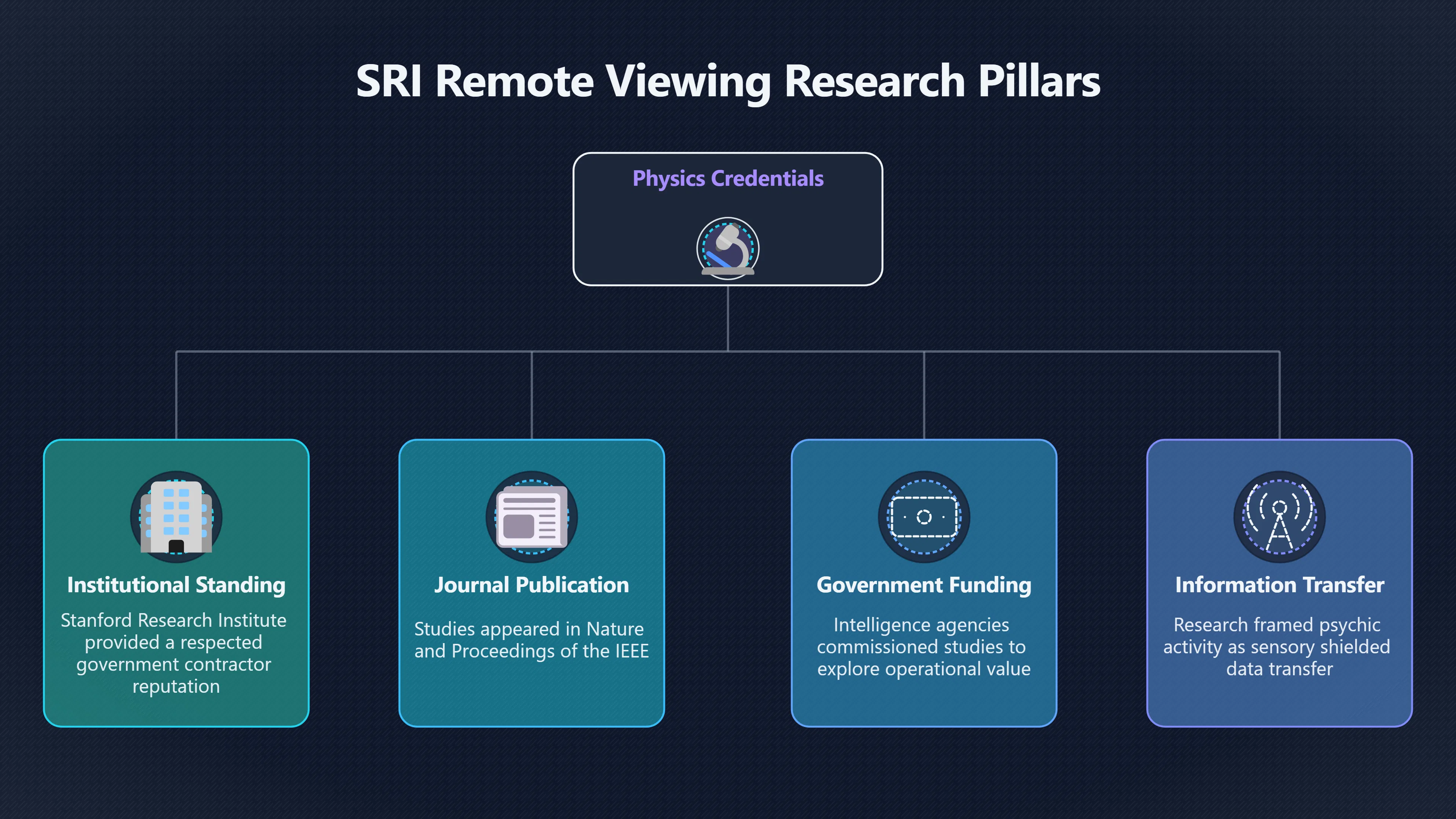
Harold Puthoff and Russell Targ entered parapsychology from careers that looked conventional by scientific standards rather than from spiritualist or occult movements.
Puthoff held a doctorate in electrical engineering from Stanford University and had worked in laser physics and quantum electronics before leading SRI’s investigations into psychic functioning. Targ had established a reputation in laser and electro-optical research and later returned to mainstream defence-related optics work after his period in parapsychology. Their publications outside psychic research demonstrated genuine technical expertise rather than honorary or self-described credentials.[Government Attic]governmentattic.orgGovernment Attic Thesis: Anomalous Human Cognition: A Possible RoleGovernment AtticThesis: Anomalous Human Cognition: A Possible Role…January 4, 2025 — 20 Sept 2023 — Throughout the first four months o…
This background mattered for several reasons.
- It lowered the social barrier to considering extraordinary claims. Readers who might have ignored claims from spiritual organisations were more willing to consider work coming from professional physicists.
- It shaped the language of the research. Rather than discussing clairvoyance or psychic powers in traditional terms, Targ and Puthoff framed remote viewing as a possible channel of “information transfer” operating under conditions of sensory shielding.
- It encouraged institutional engagement. Government agencies were more willing to commission exploratory studies from researchers already embedded within a respected research organisation than from paranormal advocacy groups.
The result was not that physics validated remote viewing, but that physicists were seen as credible investigators of an unconventional question.
How SRI Amplified Scientific Authority
The authority of Targ and Puthoff was strengthened considerably by the institutional setting in which they worked.
Stanford Research Institute, despite being independent from Stanford University, carried a reputation as a serious research contractor with longstanding government and defence relationships. Its name, location and history made remote-viewing experiments appear connected to mainstream scientific research rather than fringe investigation. This distinction proved especially important once intelligence agencies became interested in exploring whether any operational value existed.[Government Attic]governmentattic.orgGovernment Attic Thesis: Anomalous Human Cognition: A Possible RoleGovernment AtticThesis: Anomalous Human Cognition: A Possible Role…January 4, 2025 — 20 Sept 2023 — Throughout the first four months o…
Publication also reinforced this perception.
Their 1974 paper in Nature and later work in Proceedings of the IEEE gave the impression that remote viewing had crossed an important scientific threshold. Publication in respected journals is often interpreted by both scientists and the public as evidence that claims have survived rigorous scrutiny. In reality, publication means that a specific paper has passed editorial and peer-review standards appropriate to its journal; it does not establish that extraordinary findings have become accepted scientific knowledge.
This distinction became increasingly important because supporters often cited the existence of these publications as evidence that remote viewing had already been scientifically validated, whereas critics viewed them as the beginning of a testing process rather than its conclusion.[Wikipedia]WikipediaParapsychology research at SRIParapsychology research at SRI
Where Credentials Could Not Settle the Evidence
The authority created by scientific credentials eventually encountered the central norm of science: claims stand or fall on evidence rather than on the status of the people making them.
As independent reviewers examined the SRI experiments, discussion shifted away from the researchers’ backgrounds and towards methodological questions. Critics focused on issues including possible sensory cueing, inadequate blinding, subjective judging procedures and incomplete reporting of experimental controls. These criticisms did not depend on whether Targ and Puthoff were competent physicists; they depended on whether the experiments excluded ordinary explanations convincingly enough.[Wikipedia]WikipediaParapsychology research at SRIParapsychology research at SRI
The 1995 American Institutes for Research review commissioned by the CIA illustrates this distinction clearly. Statistician Jessica Utts argued that the accumulated statistical evidence deserved serious scientific attention, while psychologist Ray Hyman accepted that some studies showed intriguing statistical effects but maintained that methodological weaknesses prevented firm conclusions about psychic functioning. Their disagreement centred on evidential standards rather than on the scientific qualifications of the original investigators.[CIA]cia.govAN EVALUATION OF REMOTE VIEWING: RESEARCH…… Reviews Review 1 (Dr. Jessica Utts) Review 2 (Dr. Ray Hyman) The Reply (Dr. Jessica U…
The review therefore highlighted an important lesson: respected scientists can produce controversial research, and respected critics can disagree with them without questioning their professional credentials.
Physics Expertise and the Limits of Authority
The remote-viewing controversy also illustrates a broader issue in the philosophy and sociology of science.
Expertise is often domain-specific. A physicist possesses considerable authority when discussing laser systems or quantum electronics, but that authority does not automatically transfer to questions in psychology, perception or anomalous cognition. Scientific communities routinely evaluate interdisciplinary claims by examining experimental methods rather than relying on the reputation of investigators.
This distinction became especially visible in debates over remote viewing because supporters sometimes appealed to the researchers’ physics backgrounds as evidence that they would not have been fooled by methodological errors. Critics responded that expertise in one scientific discipline does not eliminate the possibility of confirmation bias, inadequate controls or mistaken interpretation when investigating highly unusual phenomena.[Wikipedia]WikipediaRay HymanRay Hyman
The same reasoning applies throughout science. Nobel Prize winners and distinguished physicists have occasionally advanced ideas outside their specialties that later failed experimental testing. Scientific authority can justify taking a claim seriously enough to investigate; it cannot determine whether the claim is ultimately correct.

The Lasting Lesson of the Authority Problem
The enduring importance of Targ and Puthoff lies partly in demonstrating how scientific authority influences public perception.
Their technical careers helped remote viewing move from the margins into laboratories, government contracts and prominent scientific publications. Without those credentials and the institutional standing of SRI, remote viewing would probably have remained a much smaller subject within parapsychology.
At the same time, the subsequent history shows why modern science distinguishes between credibility of investigators and credibility of evidence. Credentials may justify careful attention, funding or publication, but they cannot replace independent replication, transparent methodology and reproducible results. Decades after the original SRI work, debate continues not because Targ and Puthoff lacked scientific qualifications, but because the empirical evidence has remained disputed despite extensive review.[CIA+2PMC]cia.govAN EVALUATION OF REMOTE VIEWING: RESEARCH…… Reviews Review 1 (Dr. Jessica Utts) Review 2 (Dr. Ray Hyman) The Reply (Dr. Jessica U…
Amazon book picks
Further Reading
Books and field guides related to Did Physics Credentials Make Remote Viewing Credible?. Use these as the next step if you want deeper reading beyond the article.
The Demon-Haunted World
Directly addresses why credentials alone cannot establish extraordinary claims.
Limitless Mind
Illustrates how authority and personal credibility continued to shape the topic.
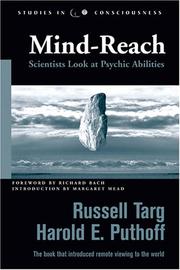
Phenomena
From the author of Nuclear War: A Scenario, this is the gripping story of how a select group of scientists, under the watchful eye of the...
eBay marketplace picks
Marketplace Samples
Live-tested eBay searches with available results related to this page.
Endnotes
1.
Source: cia.gov
Link:https://www.cia.gov/readingroom/document/cia-rdp96-00791r000200180006-4
Source snippet
AN EVALUATION OF REMOTE VIEWING: RESEARCH...... Reviews Review 1 (Dr. Jessica Utts) Review 2 (Dr. Ray Hyman) The Reply (Dr. Jessica U...
2.
Source: pmc.ncbi.nlm.nih.gov
Title: PMCFollow‐up on the U.S
Link:https://pmc.ncbi.nlm.nih.gov/articles/PMC10275521/
Source snippet
Central Intelligence Agency's (CIA...by Á Escolà‐Gascón · 2023 · Cited by 10 — Scientific reviews and conclusions after the CIA declassi...
3.
Source: Wikipedia
Title: Russell Targ
Link:https://en.wikipedia.org/wiki/Russell_Targ
4.
Source: Wikipedia
Title: Parapsychology research at SRI
Link:https://en.wikipedia.org/wiki/Parapsychology_research_at_SRI
5.
Source: Wikipedia
Title: Ray Hyman
Link:https://en.wikipedia.org/wiki/Ray_Hyman
6.
Source: cia.gov
Link:https://www.cia.gov/readingroom/document/cia-rdp96-00791r000200180005-5
Source snippet
d Targ (1975) the scientific research endeavor at SRI may...Read more...
7.
Source: Wikipedia
Title: Remote viewing
Link:https://en.wikipedia.org/wiki/Remote_viewing
Source snippet
Remote viewingPhysicists Russell Targ and Harold Puthoff, parapsychology researchers at Stanford Research Institute (SRI)... Reviewer...
8.
Source: governmentattic.org
Title: Government Attic Thesis: Anomalous Human Cognition: A Possible Role
Link:https://www.governmentattic.org/57docs/ThesisAnomalousHumanCognition2023.pdf
Source snippet
Government AtticThesis: Anomalous Human Cognition: A Possible Role...January 4, 2025 — 20 Sept 2023 — Throughout the first four months o...
Published: January 4, 2025
Additional References
9.
Source: skepsis.nl
Link:https://skepsis.nl/[stargate
Source snippet
CIA onderzoekt ESP / remote viewingHet programma bestond uit laboratoriumonderzoek uitgevoerd aan het Stanford Research Institute (SRI) o...
10.
Source: reddit.com
Link:https://www.reddit.com/r/UFOs/comments/1cd3bnd/what_does_scientific_evidence_of_psionics_look/
Source snippet
What does scientific evidence of "psionics" look like?: r/UFOsIn Coulthart's AMA, he says the 'one word' we should be looking into is "p...
11.
Source: researchgate.net
Link:https://www.researchgate.net/publication/333228024_An_Assessment_of_the_Evidence_for_Psychic_Functioning
12.
Source: facebook.com
Link:https://www.facebook.com/100090372200308/posts/during-the-[cold-war
Source snippet
During the Cold War, the CIA funded research into what...Experiments at SRI: Swann worked with physicists Russell Targ and Harold Puthoff...
13.
Source: youtube.com
Link:https://www.youtube.com/watch?v=uQStMAwKNew
Source snippet
Remote Viewing Magic, Russel Targ: EP 319...
14.
Source: youtube.com
Title: Nature Published It… And They Couldn’t Explain Why
Link:https://www.youtube.com/watch?v=ZI_eq5RGrR0
Source snippet
Proof Positive of Remote Viewing, with excerpts from the original scientists Targ and Puthoff...
15.
Source: youtube.com
Title: Remote Viewing Magic, Russel Targ: EP 319
Link:https://www.youtube.com/watch?v=WF_PyqbQZRE
Source snippet
Remote Viewing From the Inside Out with Russell Targ...
16.
Source: youtube.com
Title: Remote Viewing From the Inside Out with Russell Targ
Link:https://www.youtube.com/watch?v=V6Pn6WGahYI
Source snippet
Exclusive [Third Eye Spies]({{ 'third-eye-spies/' | relative_url }}) Clip...
17.
Source: youtube.com
Title: Exclusive Third Eye Spies Clip
Link:https://www.youtube.com/watch?v=KAT_3CBBOk0
Topic Tree