Within Pop Culture
How Psychic Spies Became Characters
Memoirs and insider histories gave remote viewing recognizable characters, origin stories, and repeatable success narratives.
On this page
- Why named viewers matter to the public story
- How memoirs turn sessions into narrative scenes
- Where personal testimony meets disputed evidence
Page outline Jump by section
Introduction
Remote viewing entered popular culture not simply because governments investigated it, but because a handful of participants transformed classified programmes into compelling personal stories. Memoirs by self-described “psychic spies” gave readers named protagonists, dramatic missions and insider perspectives that made an otherwise abstract claim feel tangible. These books and interviews remain among the most influential sources shaping public understanding of remote viewing, even though many of their central claims remain scientifically disputed and difficult to verify independently.[Wikipedia]WikipediaRemote viewingRemote viewing
Rather than presenting statistical evidence or laboratory data, these memoirs invite readers into a narrative world of hidden targets, intelligence briefings, training exercises and Cold War secrecy. The result is a distinctive form of paranormal storytelling in which the authority of government service, first-person testimony and declassified documents combine to create enduring cultural legends.
Why named viewers matter to the public story
Most paranormal movements revolve around anonymous witnesses. Remote viewing is different because its history became attached to identifiable personalities whose biographies are inseparable from the subject itself.
Several figures dominate the literature:
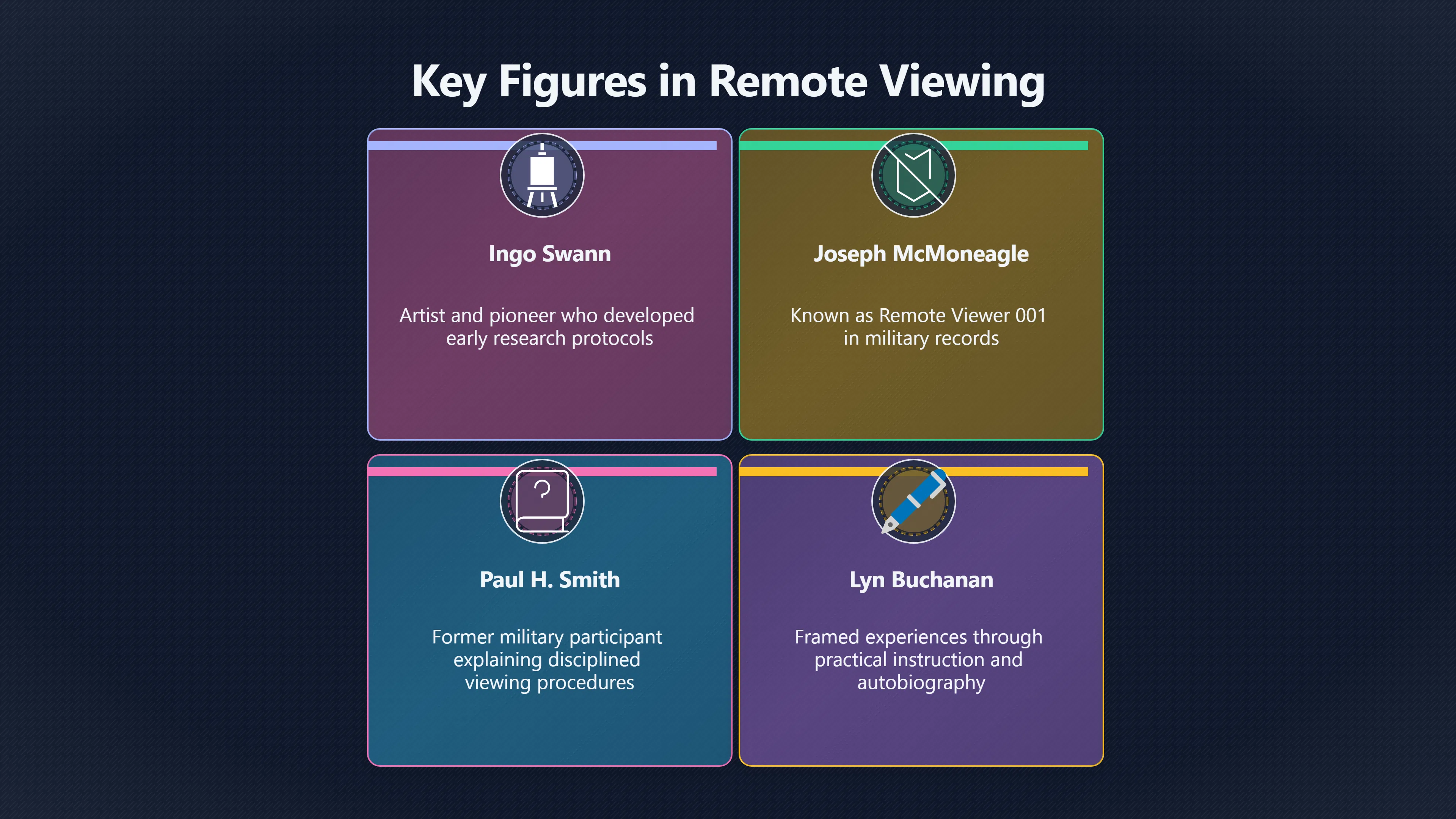
- Ingo Swann became known as the artist and psychic who helped develop the protocols that researchers at the Stanford Research Institute called “remote viewing”. He was also an exceptionally prolific author whose later books expanded beyond government research into broader claims about consciousness, extraterrestrials and psychic perception.[Wikipedia]WikipediaIngo SwannIngo Swann
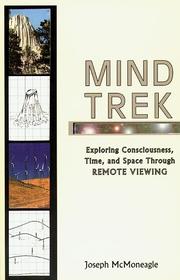
- Joseph McMoneagle, frequently identified as “Remote Viewer 001”, presented himself as an operational military viewer whose work supported intelligence agencies. His memoirs remain among the best-known insider accounts of Project Stargate.[Wikipedia]WikipediaJoseph Mc MoneagleJoseph Mc Moneagle
- Paul H. Smith, another former military participant, focused on explaining how the programme functioned from the inside while arguing that many public misunderstandings arose after the programme’s declassification. His writing helped present remote viewing as a disciplined procedure rather than spontaneous psychic intuition.[Wikipedia]WikipediaIngo SwannIngo Swann
- Lyn Buchanan likewise framed his experiences through practical instruction and autobiography, reinforcing the image of trained government personnel rather than mystical psychics.[Wikipedia]WikipediaIngo SwannMarch 30, 2026 — Buchanan, Lyn, The Seventh Sense: The Secrets Of Remote Viewing As Told By A "Psychic Spy" for the U.S. Military, ISBN 0…
These recurring names gave journalists, filmmakers and podcast hosts recognisable characters around whom stories could be built. Instead of discussing anonymous statistical experiments, audiences encountered veterans, artists and intelligence officers describing extraordinary experiences in their own voices.
How memoirs turn sessions into narrative scenes
The memoir tradition changes the way remote viewing is understood because it converts procedural work into dramatic episodes.
Instead of describing experimental methodology, memoirs often focus on scenes: receiving a sealed envelope, entering a quiet viewing room, sketching unexpected impressions and later discovering what the target supposedly represented. This narrative structure creates suspense regardless of whether readers accept the underlying paranormal claim.
Joseph McMoneagle’s Memoirs of a Psychic Spy and The Stargate Chronicles illustrate this approach. Rather than arguing primarily through scientific evidence, they recount operational anecdotes involving military targets, intelligence requests and notable successes, interwoven with the author’s military career and personal experiences. The books present remote viewing as skilled professional work carried out within bureaucratic institutions rather than as stage magic or fortune telling.[Internet Archive+2Google Books]archive.orgInternet Archivethe remarkable life of U.SGovernment remote viewer 001:…11 Jun 2023 — Memoirs of a psychic spy: the remarkable life of U.S. Government remote viewer 001. by…
Ingo Swann’s writing serves a different narrative function. His books frequently portray him as both experimental subject and explorer of consciousness. Early works discuss research collaborations and psychic experimentation, while later publications move into more speculative territory, including claims about extraterrestrial contact and unusual remote-viewing experiences. As a result, his personal legend extends well beyond the documented government programme itself.[Wikipedia]WikipediaIngo SwannIngo Swann
Because these stories are written in the first person, readers experience uncertainty alongside the narrator. The technique resembles espionage memoirs more than academic reports, encouraging identification with the individual viewer rather than detached evaluation of evidence.
Where personal testimony meets disputed evidence
The popularity of these memoirs depends on a tension that has never been fully resolved: first-person testimony is vivid, but it is not the same as independently verified evidence.
Former viewers frequently cite individual operational successes that they regard as convincing demonstrations of remote viewing. Some accounts describe locating facilities, identifying military equipment or contributing useful intelligence. These episodes are often presented as memorable highlights rather than comprehensive performance records.[Google Books]books.google.comThe Stargate ChroniclesGoogle BooksThe Stargate Chronicles: Memoirs of a Psychic Spy24 Feb 2015 — Joseph McMoneagle is now known as the best Operational Remote…
Official evaluations reached more cautious conclusions. The programme’s final reviews acknowledged that some individual sessions appeared intriguing, but found insufficient evidence that remote viewing produced consistently reliable intelligence suitable for operational decision-making. Scientific critics likewise argue that anecdotal successes, confirmation bias, selective reporting and methodological weaknesses provide more conventional explanations than paranormal perception.[Wikipedia]WikipediaRemote viewingRemote viewing
This disagreement has an important cultural consequence. Supporters often interpret memoirs as insider testimony suppressed or overlooked by official scepticism, while critics regard the same books as compelling personal narratives that exceed what the evidence can support.
The making of viewer legends
The most enduring legends share several characteristics that distinguish them from ordinary autobiographies.
Government credentials. Military ranks, intelligence assignments and programme code names lend an appearance of institutional credibility that paranormal literature often lacks.
Specific memorable cases. Stories involving Soviet facilities, hostage situations or hidden installations provide concrete episodes that readers can remember and retell.
Claims of secrecy. References to classified work naturally limit independent verification while simultaneously increasing dramatic appeal.
Personal transformation. Many memoirs combine intelligence history with accounts of altered consciousness, spiritual development or life-changing experiences, making the books attractive to audiences interested in both espionage and personal exploration.
Together these elements produce figures who function almost like recurring fictional protagonists, despite being real individuals recounting their own experiences.
Why these stories outlast the programme
Remote viewing’s official history effectively ended when government sponsorship ceased, but the memoirs ensured that its cultural life continued.
Books by former participants inspired later documentaries, podcasts, internet discussions and instructional courses. Readers who encounter remote viewing today are often introduced first through McMoneagle’s recollections, Swann’s writings or similar insider accounts rather than through technical reports or laboratory publications.[Wikipedia]WikipediaJoseph Mc MoneagleJoseph Mc Moneagle
This shift has important consequences. Public memory increasingly centres on individual heroes rather than institutional research. The “psychic spy” becomes a recognisable cultural archetype: disciplined yet mysterious, positioned between soldier and mystic, operating within real government organisations while describing experiences that remain outside scientific consensus.
The result is that remote viewing survives less as a settled scientific question than as a collection of memorable human stories. Whether readers regard those stories as credible testimony, sincere belief or imaginative self-interpretation, the memoirs have become the principal mechanism through which remote viewing acquired its enduring cast of legendary characters.
Amazon book picks
Further Reading
Books and field guides related to How Psychic Spies Became Characters. Use these as the next step if you want deeper reading beyond the article.

Remote Viewers: The Secret History of America's Psychic Spies
Explains the personalities and memoir tradition surrounding remote viewing.
Phenomena: The Secret History of the U.S. Government's Invest...
Places psychic-spy memoirs within the larger government ESP story.
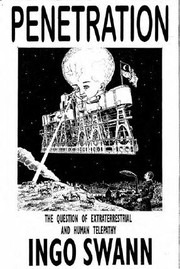
Penetration: The Question of Extraterrestrial and Human Telep...
Illustrates how a key remote-viewing figure shaped public narratives.
eBay marketplace picks
Marketplace Samples
Live-tested eBay searches with available results related to this page.




Endnotes
1.
Source: Wikipedia
Title: Remote viewing
Link:https://en.wikipedia.org/wiki/Remote_viewing
2.
Source: Wikipedia
Title: Stargate Project (U.S. Army unit)
Link:https://en.wikipedia.org/wiki/Stargate_Project_%28U.S._Army_unit%29
Source snippet
Stargate Project (U.S. Army unit)The Stargate Project's work primarily involved remote viewing, the purported ability to psychically "...
3.
Source: Wikipedia
Title: Ingo Swann
Link:https://en.wikipedia.org/wiki/Ingo_Swann
4.
Source: Wikipedia
Title: Joseph Mc Moneagle
Link:https://en.wikipedia.org/wiki/Joseph_McMoneagle
5.
Source: Wikipedia
Title: Ingo Swann
Link:https://de.wikipedia.org/wiki/Ingo_Swann
Source snippet
March 30, 2026 — Buchanan, Lyn, The Seventh Sense: The Secrets Of Remote Viewing As Told By A "Psychic Spy" for the U.S. Military, ISBN 0...
Published: March 30, 2026
6.
Source: archive.org
Title: Internet Archivethe remarkable life of U.S
Link:https://archive.org/details/memoirsofpsychic0000mcmo
Source snippet
Government remote viewer 001:...11 Jun 2023 — Memoirs of a psychic spy: the remarkable life of U.S. Government remote viewer 001. by...
7.
Source: books.google.com
Title: The Stargate Chronicles
Link:https://books.google.com/books/about/The_Stargate_Chronicles.html?id=fwD5rQEACAAJ
Source snippet
Google BooksThe Stargate Chronicles: Memoirs of a Psychic Spy24 Feb 2015 — Joseph McMoneagle is now known as the best Operational Remote...
8.
Source: archive.org
Link:https://archive.org/details/unset0000unse_u1c2
Source snippet
The Stargate chronicles: memoirs of a psychic spy12 Aug 2018 — The inside story of the US government's military counterintelligence prog...
9.
Source: books.google.com
Title: Remote Viewing Secrets
Link:https://books.google.com/books/about/Remote_Viewing_Secrets.html?id=n4ZcjHyEuzIC
Source snippet
Hampton Roads Pub., 2000 - Biography & Autobiography - 296 pages. Remote viewing is not simply using psychic ability to obtain informatio...
10.
Source: books.google.com
Title: The Stargate Chronicles
Link:https://books.google.com/books/about/The_Stargate_Chronicles.html?id=7vNRPQAACAAJ
Source snippet
Stargate Chronicles: Memoirs of a Psychic SpyJoseph McMoneagle is now known as the best Operational Remote Viewer in the history of the U...
11.
Source: visualmelt.com
Title: Ingo Swann
Link:https://visualmelt.com/Ingo-Swann
Source snippet
(1933 - 2013) was a visionary artist and renowned for being a pioneer of the technique of 'remote viewing' (awareness of distant objects...
Additional References
12.
Source: reddit.com
Link:https://www.reddit.com/r/remoteviewing/comments/1gf3944/book_recomendations/
Source snippet
Book Recomendations: r/remoteviewingMcMoneagle's book is limited by the nature of his work. It's all classified. The anecdotes he shared...
13.
Source: steemit.com
Link:https://steemit.com/life/%40neilstrauss/i-was-a-psychic-spy-for-the-cia-and-i-found-god-a-true-story
Source snippet
I Was a Psychic Spy for the CIA, and I Found GodFor years, agents in the remote-viewing program posed as civilians to attend the institut...
14.
Source: avam.org
Link:https://www.avam.org/artists/ingo-swann
Source snippet
Ingo SwannIngo Swann is best known as a pioneer in the field of remote viewing. His high rate of success in this field led him to co-crea...
15.
Source: scribd.com
Link:https://www.scribd.com/document/843125814/Remote-Viewing-With-the-Artist-Ingo-Swann-by-Persinger
Source snippet
Ingo Swann's Remote Viewing Study | PDF | PerceptionThe study investigates the phenomenon of remote viewing through the experiences of ar...
16.
Source: bookfinder.com
Link:https://www.bookfinder.com/author/joseph-mcmoneagle/
Source snippet
Joseph McMoneagle: used books, rare...Joseph McMoneagle (McMoneagle, Joseph); Memoirs of a Psychic Spy: The Remarkable Life Of U.S. Gov...
17.
Source: medium.com
Link:https://medium.com/the-peculiar-truth/the-peculiar-truth-about-the-cias-project-stargate-61ac0534d2f4
Source snippet
The Peculiar Truth about the CIA's Project StargateMost of Project Stargate's assessments came with the caveat that remote viewing inform...
18.
Source: facebook.com
Link:https://www.facebook.com/OMGTheWhyFiles/posts/the-man-who-saw-alien-bases-on-the-mooningo-swann-claimed-to-be-a-psychic-who-wa/495442988976748/
Source snippet
The Why FilesTHE MAN WHO SAW ALIEN BASES ON THE MOON Ingo Swann claimed to be a psychic who was employed by the CIA to remote-view the da...
19.
Source: goodreads.com
Link:https://www.goodreads.com/author/show/1719.Joseph_McMoneagle
Source snippet
Joseph McMoneagle (Author of Remote Viewing Secrets)Along with colleague Ingo Swann, McMoneagle is best known for claims surrounding the...
20.
Source: amazon.com.be
Link:https://www.amazon.com.be/-/nl/Joseph-McMoneagle/dp/1571744827?tag=searcht-20
Source snippet
He started out with the definition of "remote-viewing" and then goes for 19 chapters in telling his story, including his near-death...Re...
21.
Source: goodreads.com
Link:https://www.goodreads.com/book/show/42552390-the-stargate-chronicles
Source snippet
Army Chief Warrant Officer. He was involved in remote viewing (RV) operations and experiments conducted by U.S. Army...Read more...
Topic Tree