Within SAIC Tests
Why Experiment One Became So Contested
SAIC's first major test showed why cleaner statistics still depended on fragile practical controls around home sessions and response handling.
On this page
- How the home sessions were arranged
- Where response handling could matter
- What later critics said could explain the result
Page outline Jump by section
Introduction
Experiment One became the most closely examined study in the Science Applications International Corporation (SAIC) remote-viewing programme because it appeared to combine stronger statistical results with tighter laboratory procedures than many earlier experiments. Yet it also introduced a practical complication that became central to later criticism: some viewing sessions were conducted in participants’ homes rather than entirely inside the laboratory. Critics argued that this seemingly modest operational decision made it harder to demonstrate that the reported statistical effect could only have arisen from remote viewing rather than from subtle information transfer or weaknesses in response handling. As a result, Experiment One evolved into a debate not simply about statistics, but about whether practical safeguards were sufficient to exclude ordinary explanations.[CIA]cia.govAN EVALUATION OF REMOTE VIEWING: RESEARCH…The remote viewer experimenters believe that external judges provide much better hit rate…

Why Experiment One Became So Contested
Experiment One formed part of SAIC’s effort in the early 1990s to answer longstanding methodological criticisms directed at earlier Stanford Research Institute work. Rather than relying on informal judging, the study used blind rank-order judging in which an independent judge compared each viewer’s transcript against one genuine target and several decoys. Across the experiment, the correct targets ranked significantly better than expected by chance, making the study one of the strongest statistical findings highlighted during the CIA-commissioned review in 1995.[CIA]cia.govAN EVALUATION OF REMOTE VIEWING: RESEARCH…The remote viewer experimenters believe that external judges provide much better hit rate…
The controversy emerged because methodological strength depends on more than statistical significance. A remote-viewing experiment must also ensure that no ordinary information about the target can reach either the viewer or the judge before scoring is complete. Even a small uncertainty about how responses moved between people, or who had access to them before judging, can complicate interpretation. This issue became especially important because Experiment One mixed laboratory procedures with sessions conducted away from the laboratory.[CIA]cia.govAN EVALUATION OF REMOTE VIEWING: RESEARCH…The remote viewer experimenters believe that external judges provide much better hit rate…
How the Home Sessions Were Arranged
Unlike a fully laboratory-based protocol, Experiment One allowed some experienced viewers to conduct sessions from home. The intention was practical rather than theoretical: participants could work in familiar surroundings while target selection and judging remained under experimental control.
In principle, conducting a session at home does not automatically invalidate an experiment. If the target remains unknown to everyone interacting with the participant, the completed transcript is securely preserved, and judging is conducted blindly, then the physical location of the viewer should not itself create a statistical bias. This was broadly the reasoning presented by the experimenters when defending the design.[CIA]cia.govAN EVALUATION OF REMOTE VIEWING: RESEARCH…The remote viewer experimenters believe that external judges provide much better hit rate…
However, home sessions reduce direct oversight. Instead of every stage occurring under continuous laboratory supervision, researchers must rely on documented procedures showing exactly when transcripts were completed, who handled them, and when they entered the formal judging process. That shift from direct observation to procedural assurance became one of the central issues in later evaluations.[Hertfordshire Research Profiles]researchprofiles.herts.ac.ukexperiment one of the saic remote viewing program a critical re eThe paper demonstrates that there are severe problems associted with…
Where Response Handling Could Matter
The practical handling of viewers’ responses became more important than the location itself.
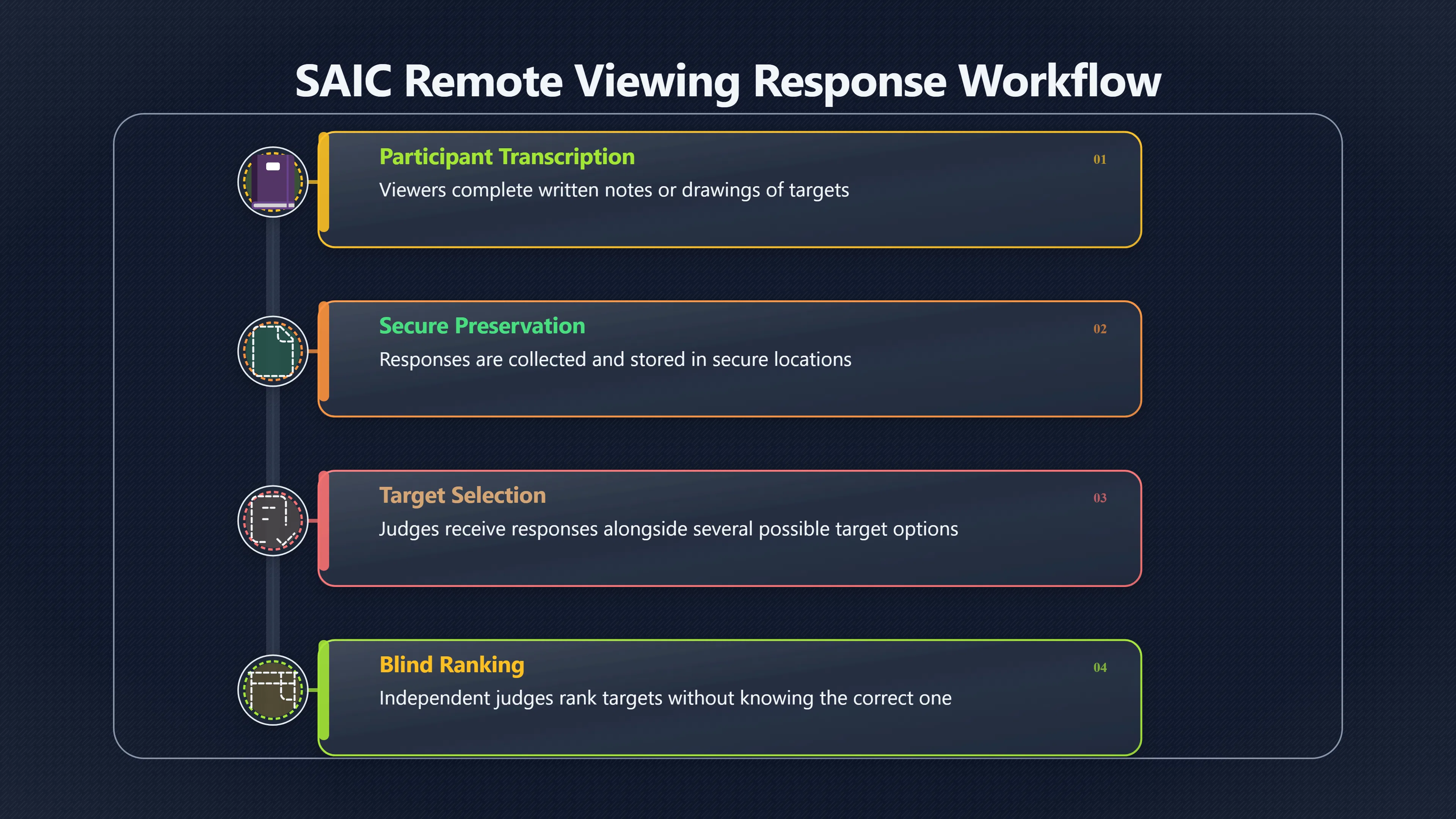
For free-response remote-viewing studies, a transcript typically passes through several stages:
- the participant completes written notes or drawings;
- the response is collected and preserved;
- an independent judge receives the response together with several possible targets;
- the judge ranks the targets without knowing which is correct.
If anyone who already knows the true target can alter, annotate, select, or even unintentionally influence the handling of a response before judging, critics argue that an opportunity for information leakage exists. The issue is not necessarily deliberate misconduct. Experimental psychology recognises that subtle cueing can occur unintentionally when proper separation between informed and uninformed personnel is not maintained.[ResearchGate]researchgate.netResearch Gate An Assessment of the Evidence for Psychic FunctioningAn Assessment of the Evidence for Psychic FunctioningMay 14, 2019 — The SAIC remote-viewing experiments and all but the early…
Jessica Utts’ methodological review listed precisely these kinds of safeguards as essential requirements for remote-viewing experiments: no target-informed individual should interact with viewers or judges before responses are secured and judging completed, and target randomisation and document handling should be tightly controlled.[ResearchGate]researchgate.netResearch Gate An Assessment of the Evidence for Psychic FunctioningAn Assessment of the Evidence for Psychic FunctioningMay 14, 2019 — The SAIC remote-viewing experiments and all but the early…
What Later Critics Said Could Explain the Result
The most influential criticism came from psychologist Richard Wiseman and John Milton, who re-examined Experiment One after the CIA review had described the SAIC work as largely free from obvious methodological flaws.
Their critique argued that published descriptions of Experiment One left important procedural details insufficiently documented. In particular, they questioned whether a non-blind experimenter might have handled viewers’ responses before they reached the independent judge. If so, they argued, the experiment contained a possible pathway for inadvertent sensory cueing that was not fully excluded by the published record. They also noted that later attempts to reconstruct exactly who performed different procedural roles produced inconsistent recollections, making retrospective verification difficult.[Hertfordshire Research Profiles]researchprofiles.herts.ac.ukexperiment one of the saic remote viewing program a critical re eThe paper demonstrates that there are severe problems associted with…
Importantly, Wiseman and Milton did not claim to have demonstrated that information leakage actually occurred. Their argument was narrower: if the available documentation cannot rule out an ordinary explanation, then the statistical outcome alone cannot establish paranormal perception with confidence. They concluded that at least some of the observed effect could potentially be explained by methodological weaknesses rather than anomalous cognition.[Hertfordshire Research Profiles]researchprofiles.herts.ac.ukexperiment one of the saic remote viewing program a critical re eThe paper demonstrates that there are severe problems associted with…
Why the Debate Persisted
Experiment One illustrates why the SAIC programme remained scientifically controversial despite producing statistically significant findings.
Both Jessica Utts and Ray Hyman agreed that the SAIC studies generated results unlikely to be dismissed as simple statistical accidents. Their disagreement concerned interpretation. Utts regarded the accumulated evidence as supporting the existence of an anomalous information-transfer process. Hyman argued that statistical significance does not automatically identify the mechanism responsible and that unresolved methodological questions, including those raised about Experiment One, prevented a firm conclusion that psychic functioning had been demonstrated.[CIA+2UC Irvine Bren School]cia.govAN EVALUATION OF REMOTE VIEWING: RESEARCH…The remote viewer experimenters believe that external judges provide much better hit rate…
Experiment One therefore became a defining example of the broader challenge facing late-stage remote-viewing research. The study showed how laboratory statistics and practical experimental control are inseparable. Even when numerical results appear impressive, uncertainty about seemingly routine procedures—such as conducting sessions at home or documenting the movement of response materials—can become the decisive factor in determining whether the findings persuade the wider scientific community.[CIA]cia.govAN EVALUATION OF REMOTE VIEWING: RESEARCH…The remote viewer experimenters believe that external judges provide much better hit rate…
Amazon book picks
Further Reading
Books and field guides related to Why Experiment One Became So Contested. Use these as the next step if you want deeper reading beyond the article.
Phenomena
Covers the military and intelligence context behind remote viewing and the lab-to-operations gap.
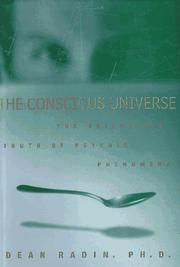
The conscious universe
Provides the pro-psi interpretation of statistical findings similar to those discussed.
Statistics Done Wrong
Relevant to evaluating disputed statistical claims in controversial experiments.
Parapsychology: A Handbook for the 21st Century
Places the SAIC work within the wider experimental literature.
eBay marketplace picks
Marketplace Samples
Live-tested eBay searches with available results related to this page.




Endnotes
1.
Source: cia.gov
Link:https://www.cia.gov/readingroom/document/cia-rdp96-00791r000200180006-4
Source snippet
AN EVALUATION OF REMOTE VIEWING: RESEARCH...The remote viewer experimenters believe that external judges provide much better hit rate...
2.
Source: researchgate.net
Title: Research Gate An Assessment of the Evidence for Psychic Functioning
Link:https://www.researchgate.net/publication/333228024_An_Assessment_of_the_Evidence_for_Psychic_Functioning
Source snippet
An Assessment of the Evidence for Psychic FunctioningMay 14, 2019 — The SAIC remote-viewing experiments and all but the early...
Published: May 14, 2019
3.
Source: researchprofiles.herts.ac.uk
Title: experiment one of the saic remote viewing program a critical re e
Link:https://researchprofiles.herts.ac.uk/en/publications/experiment-one-of-the-saic-remote-viewing-program-a-critical-re-e/
Source snippet
The paper demonstrates that there are severe problems associted with...
4.
Source: ics.uci.edu
Link:https://www.ics.uci.edu/~jutts/hyman.html
Source snippet
She does not...Read more...
5.
Source: Wikipedia
Title: Remote viewing
Link:https://en.wikipedia.org/wiki/Remote_viewing
Source snippet
Remote viewingRemote viewing (RV) is the practice of seeking impressions about a distant or unseen subject, purportedly sensing with t...
Additional References
6.
Source: koestlerunit.wordpress.com
Link:https://koestlerunit.wordpress.com/wp-content/uploads/2015/06/wiseman-milton-1998.pdf
Source snippet
Experiment One it appeared possible that a non-blind experimenter may have handled receivers' responses before passing them on...
7.
Source: ucdavis.edu
Title: [psychic spying]({{ ‘psychic-spying/’ | relative_url }}) research produces credible evidence
Link:https://www.ucdavis.edu/news/psychic-spying-research-produces-credible-evidence
Source snippet
'Psychic Spying' Research Produces Credible Evidence28 Nov 1995 — The main psychic ability tested in the research program is called "remo...
8.
Source: youtube.com
Title: Dr. Edwin May, Psychic Theories (Precognition, Remote Viewing)
Link:http://www.youtube.com/watch?v=fk3f47jOAFs
Source snippet
Edwin May, Psychic Spying (Remote Viewing, Star Gate Program) - Jimmy Akin's Mysterious World...
9.
Source: youtube.com
Title: Classic Reboot: Training Anomalous Cognition with Edwin C. May
Link:http://www.youtube.com/watch?v=6vbb7E7UD30
Source snippet
Dr. Edwin May, Psychic Theories (Precognition, Remote Viewing) - Jimmy Akin's Mysterious World...
10.
Source: pmc.ncbi.nlm.nih.gov
Link:https://pmc.ncbi.nlm.nih.gov/articles/PMC10275521/
Source snippet
Central Intelligence Agency's (CIA...by Á Escolà‐Gascón · 2023 · Cited by 10 — Utts determined that the evidence from the SRI and SAIC e...
11.
Source: richardwiseman.com
Link:https://www.richardwiseman.com/resources/SAICreply.pdf
Source snippet
Experiment One of the SAIC Remote Viewing Programby R Wiseman · Cited by 11 — May (1998) presents a number of arguments against the exist...
12.
Source: youtube.com
Title: [Stargate]({{ ‘stargate/’ | relative_url }}) Revisited with Edwin C. May
Link:http://www.youtube.com/watch?v=ait61fuy_B8
Source snippet
Classic Reboot: Training Anomalous Cognition with Edwin C. May...
13.
Source: youtube.com
Title: CLASSIC REBOOT: Lessons Learned From the Stargate Program with Edwin C. May
Link:http://www.youtube.com/watch?v=lz1OdX4UxxI
Source snippet
Stargate Revisited with Edwin C. May...
14.
Source: youtube.com
Title: Edwin May, Psychic Spying (Remote Viewing, Star Gate Program)
Link:http://www.youtube.com/watch?v=xd6diALBBZw
Topic Tree