Within SRI Tests
Why One Nature Paper Changed Remote Viewing
The 1974 Nature paper turned remote viewing into a laboratory claim that supporters and critics still argue over.
On this page
- What the 1974 paper claimed
- Why publication venue mattered
- How later critics challenged the interpretation
Page outline Jump by section
Introduction
The 1974 Nature paper by Russell Targ and Harold Puthoff occupies a unique place in the history of remote viewing. More than any other single publication, it transformed claims of extrasensory perception from a niche parapsychology topic into a subject of mainstream scientific discussion. The paper, titled Information transmission under conditions of sensory shielding, argued that carefully selected participants could describe distant targets without access to ordinary sensory information, and that these effects were measurable under laboratory conditions.[Nature]nature.comRUSSELL TARG &; HAROLD PUTHOFF. Nature volume 251, pages 602–607 (…Read more…

Its influence came not because it settled the question, but because it raised it in one of the world’s most prestigious scientific journals. For supporters, publication in Nature suggested that remote viewing deserved serious investigation. For critics, the paper became an example of why extraordinary claims require exceptionally rigorous experimental controls. Nearly fifty years later, the article remains cited both as the beginning of modern remote-viewing research and as a case study in scientific controversy.[Nature]nature.comRUSSELL TARG &; HAROLD PUTHOFF. Nature volume 251, pages 602–607 (…Read more…
What the 1974 paper claimed
Targ and Puthoff reported experiments conducted at the Stanford Research Institute (SRI) in which participants attempted to describe distant locations or hidden targets while shielded from conventional sources of information. Rather than presenting remote viewing as mystical or spiritual, they framed it as a question of experimental psychology and perception.
The paper concluded that the results suggested the existence of “one or more perceptual modalities” through which people might obtain information unavailable through the recognised senses. Importantly, the authors did not claim to have identified a physical mechanism. Instead, they argued that the reported effects justified continued scientific investigation under laboratory conditions.[Nature]nature.comRUSSELL TARG &; HAROLD PUTHOFF. Nature volume 251, pages 602–607 (…Read more…
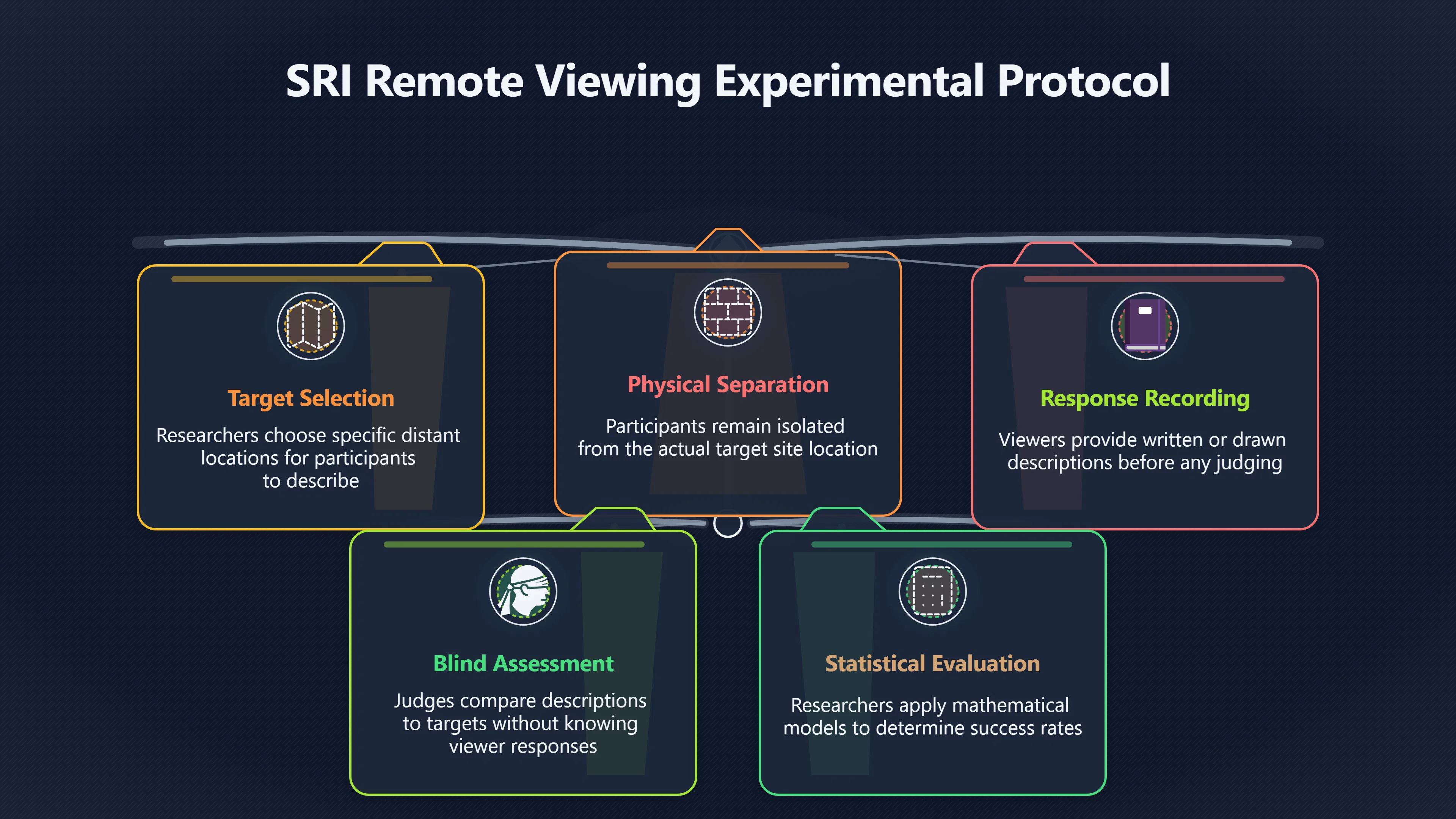
Several features distinguished the work from earlier parapsychology reports:
- participants were separated from the target location;
- experiments attempted to minimise direct sensory contact;
- responses were recorded before comparison with the targets;
- judging procedures were used to compare descriptions with possible locations.
Although later remote-viewing programmes expanded and modified these methods, this basic experimental structure became the template for much subsequent research.
Why publication in Nature mattered
The venue proved almost as influential as the findings themselves.
By appearing in Nature, the paper reached readers who would normally never engage with parapsychology. Publication also meant that remote viewing entered ordinary scientific citation networks instead of remaining confined to specialist paranormal journals.
However, publication did not mean endorsement. Contemporary editorial commentary made clear that Nature viewed publication as an opportunity for scientific scrutiny rather than validation. The journal acknowledged substantial reservations raised during peer review but argued that the work, coming from qualified scientists at a respected research institution, was appropriate for open scientific examination. The editor explicitly emphasised that publication should not be interpreted as a seal of approval.[Wikipedia]WikipediaParapsychology research at SRIParapsychology research at SRI
That distinction has often been lost in popular retellings. Advocates sometimes cite the Nature publication as evidence that remote viewing was scientifically established, while critics point out that peer-reviewed publication simply indicates that a study is worthy of discussion, not that its conclusions have been accepted.
Why later critics challenged the interpretation
The scientific debate shifted rapidly from whether the reported matches appeared impressive to whether the experimental procedures could reliably exclude ordinary explanations.
Psychologists David Marks and Richard Kammann attempted to replicate aspects of the work and then closely examined the original judging procedures. They argued that experiment transcripts contained unintended clues—such as dates, references to previous sessions and other contextual information—that could allow judges to match descriptions with targets without invoking paranormal perception.
Marks reported that when these identifying cues were removed, the apparent success rates disappeared. He later demonstrated that individuals with no claimed psychic ability could correctly match transcripts to targets using only the inadvertent information embedded in the records. Marks and Kammann therefore concluded that sensory cueing provided a sufficient conventional explanation for the published results.[Wikipedia]WikipediaSensory leakageSensory leakage
Their criticism centred on methodology rather than accusing the researchers of fraud. The principal concerns included:
- inadequate elimination of unintended information leakage;
- judging procedures vulnerable to unconscious bias;
- incomplete blinding of experimental materials;
- insufficient protection against post hoc interpretation.
These criticisms became some of the most frequently cited methodological objections in the history of parapsychology.[Wikipedia]WikipediaSensory leakageSensory leakage
The debate over replication
The 1974 paper did not end scientific investigation; instead, it prompted attempts both to replicate and to improve the experiments.
Supporters argued that later SRI studies incorporated stronger controls and continued to produce statistically unusual results. Charles Tart, Harold Puthoff and Russell Targ published follow-up correspondence defending aspects of the original work and disputing the claim that sensory cues entirely explained the findings.[PubMed]pubmed.ncbi.nlm.nih.govOpen source on nih.gov.
Critics responded that improved protocols either failed to reproduce the strongest early effects or still left unresolved questions about judging procedures and statistical interpretation. The resulting exchange extended over several years in Nature and other scientific publications, making the paper part of an unusually public methodological dispute rather than a single isolated experiment.[Wikipedia]WikipediaSensory leakageSensory leakage
This pattern illustrates an important feature of the paper’s afterlife: its significance lies not only in the reported data but also in the continuing disagreement over how those data should be interpreted.
How the paper shaped later remote-viewing research
Regardless of whether one accepts its conclusions, the article established many conventions that later researchers retained.
Subsequent remote-viewing programmes typically adopted:
- formal target selection;
- physical separation between viewer and target;
- written or drawn responses recorded before judging;
- attempts at blind assessment;
- increasing attention to statistical evaluation.
In this sense, the paper helped redefine remote viewing as a laboratory protocol rather than simply a collection of anecdotal psychic experiences. Later government-funded programmes, including those that evolved into the Stargate project, inherited many elements of this experimental framework while continuing to modify procedures in response to methodological criticism.[Nature]nature.comRUSSELL TARG &; HAROLD PUTHOFF. Nature volume 251, pages 602–607 (…Read more…
The paper’s scientific legacy
Today, few scientists regard the 1974 article as conclusive evidence that remote viewing exists. Equally, it remains difficult to dismiss historically because of its unusual impact.
Its legacy includes several lasting contributions:
- it introduced remote viewing into mainstream scientific literature;
- it stimulated decades of replication attempts and methodological debate;
- it influenced government-sponsored investigations during the Cold War;
- it became a widely discussed example in debates over experimental design, replication and extraordinary claims.
For historians of science, the paper demonstrates how controversial research can gain lasting visibility through publication in a major journal while remaining scientifically disputed. For researchers interested in anomalous cognition, it remains a foundational document. For sceptics, it illustrates the importance of eliminating subtle sources of information leakage before drawing conclusions about extraordinary phenomena.
The enduring significance of Targ and Puthoff’s Nature paper therefore lies less in establishing remote viewing as a proven ability than in creating one of the best-known and longest-running methodological controversies in modern parapsychology.[Nature+2Wikipedia]nature.comRUSSELL TARG &; HAROLD PUTHOFF. Nature volume 251, pages 602–607 (…Read more…

Amazon book picks
Further Reading
Books and field guides related to Why One Nature Paper Changed Remote Viewing. Use these as the next step if you want deeper reading beyond the article.
eBay marketplace picks
Marketplace Samples
Live-tested eBay searches with available results related to this page.
Endnotes
1.
Source: nature.com
Link:https://www.nature.com/articles/251602a0
Source snippet
RUSSELL TARG &; HAROLD PUTHOFF. Nature volume 251, pages 602–607 (...Read more...
2.
Source: Wikipedia
Title: Parapsychology research at SRI
Link:https://en.wikipedia.org/wiki/Parapsychology_research_at_SRI
3.
Source: Wikipedia
Title: Sensory leakage
Link:https://en.wikipedia.org/wiki/Sensory_leakage
4.
Source: Wikipedia
Title: Harold E. Puthoff
Link:https://en.wikipedia.org/wiki/Harold_E._Puthoff
5.
Source: youtube.com
Title: Mind and Matter with Russell Targ (4K Reboot)
Link:https://www.youtube.com/watch?v=EhZ_ty3f4-M
Source snippet
Russell Targ - Remote Viewing & [Third Eye Spies]({{ 'third-eye-spies/' | relative_url }})...
6.
Source: youtube.com
Title: Russell Targ
Link:https://www.youtube.com/watch?v=E_cLp15CaPE
Source snippet
Scientific and Spiritual Implications of Psychic Abilities - Russell Targ...
7.
Source: pubmed.ncbi.nlm.nih.gov
Link:https://pubmed.ncbi.nlm.nih.gov/4423858/
Source snippet
Nature. 1974 Oct 18;251(5476):602-7. doi: 10.1038/251602a0. Authors. R Targ, H Puthoff. PMID...Read more...
8.
Source: pubmed.ncbi.nlm.nih.gov
Link:https://pubmed.ncbi.nlm.nih.gov/7360248/
9.
Source: pmc.ncbi.nlm.nih.gov
Link:https://pmc.ncbi.nlm.nih.gov/articles/PMC10275521/
Source snippet
Central Intelligence Agency's (CIA...by Á Escolà‐Gascón · 2023 · Cited by 10 — Targ, R., & Puthoff, H. (1974). Information transmission...
Additional References
10.
Source: goremoteviewing.com
Link:https://www.goremoteviewing.com/research/[targ-puthoff
Source snippet
Information transmission under conditions of sensory shieldingA neutral research summary of the 1974 Nature paper on sensory shielding an...
11.
Source: academia.edu
Link:https://www.academia.edu/74804595/Information_transmission_under_conditions_of_sensory_shielding
Source snippet
sion accuracy by up to 40%, highlighting the role of sensory input in cognitive...Read more...
12.
Source: cia.gov
Link:https://www.cia.gov/readingroom/docs/CIA-RDP96-00787R000200090024-7.pdf
Source snippet
are in the paper published this week in. Nature.Read more...
13.
Source: fr.scribd.com
Title: Information Transmission Under Conditions of Senso
Link:https://fr.scribd.com/document/900977492/Information-Transmission-Under-Conditions-of-Senso
Source snippet
Shielding and Information Transmission | PDFThe article titled 'Information Transmission Under Conditions of Sensory Shielding' was publi...
14.
Source: semanticscholar.org
Link:https://www.semanticscholar.org/paper/Information-transmission-under-conditions-of-Targ-Puthoff/c1a4db03518167f6b5df3ecea132f6cd7cb0db2e
Source snippet
off · Published in Nature 18 October 1974 · Psychology.Read more...
Published: October 1974
15.
Source: cambridge.org
Link:https://www.cambridge.org/core/journals/behavioral-and-brain-sciences/article/parapsychologys-critics-a-link-with-the-past/9B9DC4002546BA3747A8BF4AB01554CC
Source snippet
& Puthoff, H. E. (1974) Information transfer under conditions of sensory shielding. Nature 251:602–7. [aJEA]CrossRefGoogle Scholar.Read more...
16.
Source: researchgate.net
Title: 15839349 Information transmission in remote viewing experiments
Link:https://www.researchgate.net/publication/15839349_Information_transmission_in_remote_viewing_experiments
Source snippet
Article. Full-text available. Nov 1974. Russell Targ · Harold E. Puthoff.Read more...
17.
Source: youtube.com
Title: Remote Viewing Magic, Russel Targ: EP 319
Link:https://www.youtube.com/watch?v=WF_PyqbQZRE
Source snippet
Russell Targ Interview features the co-founder of the SRI remote viewing program discussing the laboratory research that formed the basis...
18.
Source: journals.sagepub.com
Title: s15328023top1803 6
Link:https://journals.sagepub.com/doi/10.1207/s15328023top1803_6
Source snippet
(1974). Information transmission under conditions of sensory shielding. Nature, 252, 602–607. Crossref · PubMed · Web of Science · Google...
19.
Source: youtube.com
Title: Scientific and Spiritual Implications of Psychic Abilities
Link:https://www.youtube.com/watch?v=zgyYms376Mg
Source snippet
Remote Viewing Psychology with Charles T. Tart...
Topic Tree