Within Fort Meade
Why Striking Impressions Still Failed Analysts
Fort Meade reports could sound suggestive after the fact, but evaluators found them too broad and ambiguous for action.
On this page
- The difference between resemblance and usable intelligence
- Why broad details created false confidence
- What the 1995 review concluded
Page outline Jump by section
Introduction
The central question for the U.S. military’s Fort Meade remote-viewing programme was never whether some reports contained striking descriptions. Intelligence organisations instead asked a harder question: did the reports help people make operational decisions? By the time the programme was independently reviewed in 1995, evaluators concluded that the answer was largely no. Although some sessions appeared to contain broad similarities to real targets, the reports were generally too vague, inconsistent and difficult to verify before the fact to guide military or intelligence operations. The programme’s most persistent weakness was therefore not a lack of interesting anecdotes, but a failure to produce information that analysts could reliably translate into action.[CIA]cia.govAN EVALUATION OF THE REMOTE VIEWING PROGRAMThe end users indicating that, although some accuracy was observed with regard to broad bac…
The difference between resemblance and usable intelligence
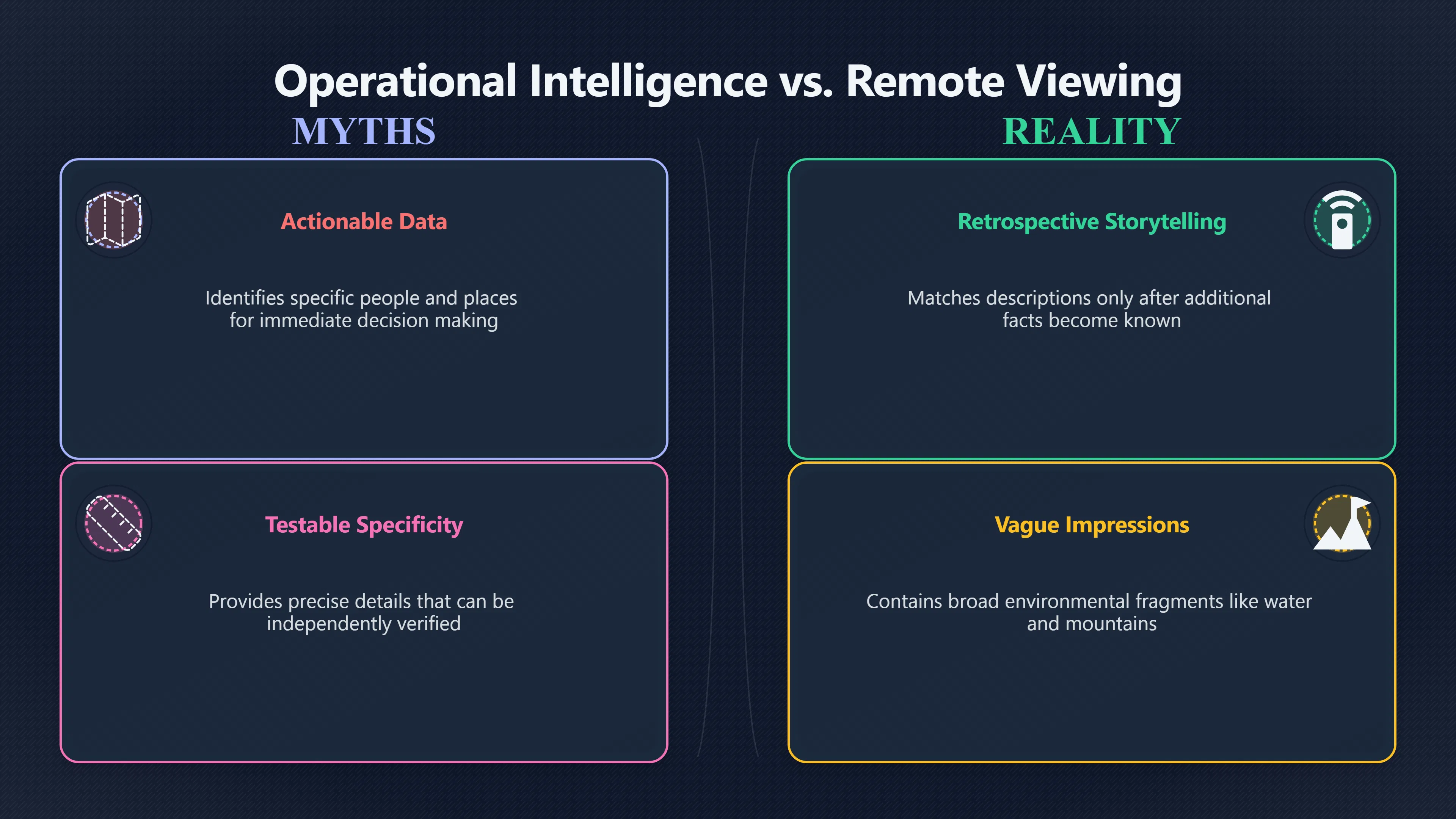
Operational intelligence is judged by standards that differ sharply from retrospective storytelling. Analysts need information that identifies specific people, places, objects or activities in time to influence a decision. Reports that merely resemble a target after additional facts become known have limited operational value because they cannot easily be distinguished from coincidence, educated guessing or multiple possible interpretations.
The Fort Meade remote-viewing reports frequently contained impressions, sketches and descriptive fragments rather than precise, testable intelligence. Evaluators found that these products often captured broad environmental characteristics—such as references to water, mountains, industrial structures or military activity—but lacked the specificity needed to direct reconnaissance, plan operations or warn commanders of concrete threats. According to the American Institutes for Research (AIR) review commissioned by the CIA, intelligence customers reported that while some descriptions appeared broadly accurate, the reports failed to provide information that could be used operationally.[CIA]cia.govAN EVALUATION OF THE REMOTE VIEWING PROGRAMThe end users indicating that, although some accuracy was observed with regard to broad bac…
This distinction became the key issue in evaluating the programme. A report that seems impressive after analysts already know the answer is fundamentally different from one that enables them to discover something previously unknown.
Why broad details created false confidence
A recurring problem was that many remote-viewing reports contained descriptions broad enough to fit numerous real-world locations or situations. References to large buildings, machinery, water, roads, hills, security personnel or industrial activity were common features of many military installations. Because such descriptions could match many targets, they created opportunities for subjective interpretation.
Psychologist Ray Hyman, one of the principal reviewers in the 1995 evaluation, argued that this pattern encouraged what psychologists call subjective validation: people naturally notice apparent matches while overlooking statements that were incorrect, contradictory or too general to test. In large collections of narrative descriptions, a handful of striking correspondences can appear far more meaningful than the overall accuracy justifies.[CIA]cia.govAN EVALUATION OF THE REMOTE VIEWING PROGRAMThe end users indicating that, although some accuracy was observed with regard to broad bac…
For intelligence professionals, this presented a practical risk. Analysts might unintentionally emphasise dramatic similarities while discounting numerous inaccurate elements. Rather than reducing uncertainty, ambiguous reports could reinforce existing expectations or encourage confirmation bias, especially if recipients already possessed background knowledge about the target.
Another operational difficulty was that remote-viewing reports rarely expressed confidence in a form compatible with intelligence analysis. Conventional intelligence products identify sources, assess reliability and distinguish between confirmed facts, assumptions and speculation. Remote-viewing narratives often blurred these distinctions, making it difficult for recipients to judge which elements deserved attention and which should be ignored.[CIA]cia.govAN EVALUATION OF THE REMOTE VIEWING PROGRAMThe end users indicating that, although some accuracy was observed with regard to broad bac…

Why analysts struggled to act on the reports
Even when intelligence officers considered a remote-viewing report intriguing, they still faced the problem of deciding what practical action it justified. Military planning requires information that can be independently checked or combined with other collection methods such as satellite imagery, signals intelligence or human sources.
Several characteristics limited the usefulness of the reports:
- They frequently contained multiple possible interpretations rather than a single clear conclusion.
- Accurate details often appeared alongside obvious errors, making it difficult to determine which portions, if any, deserved confidence.
- Reports rarely identified locations, dates or individuals with sufficient precision for immediate operational use.
- Because evaluation often depended on later interpretation, success could usually only be judged after independent intelligence had already answered the question.[CIA]cia.govAN EVALUATION OF THE REMOTE VIEWING PROGRAMThe end users indicating that, although some accuracy was observed with regard to broad bac…
These shortcomings meant that analysts could seldom justify committing surveillance assets, altering operational plans or informing senior decision-makers solely on the basis of a remote-viewing session.
What the 1995 review concluded
The CIA commissioned the American Institutes for Research in 1995 to conduct an independent assessment of both the scientific evidence and the operational record of the programme. The review deliberately separated two questions: whether laboratory experiments suggested anomalous effects, and whether the programme had demonstrated practical intelligence value.
The reviewers reached different opinions on the laboratory research, with statistician Jessica Utts arguing that some experimental findings deserved further scientific attention, while Ray Hyman remained unconvinced that paranormal functioning had been demonstrated. However, they were much closer in their assessment of operational usefulness. The review concluded that the available evidence did not show that remote viewing had produced intelligence of sufficient quality or reliability to justify operational use. Intelligence customers reported that although some descriptions occasionally matched broad characteristics of targets, the reports had not provided actionable intelligence for operations.[CIA+2CIA]cia.govAN EVALUATION OF THE REMOTE VIEWING PROGRAMThe end users indicating that, although some accuracy was observed with regard to broad bac…
That conclusion proved decisive. Intelligence agencies exist to reduce uncertainty for decision-makers, not merely to generate intriguing narratives. Without consistent evidence that remote-viewing reports improved operational outcomes, the programme no longer met the practical standard expected of an intelligence collection method.

Why this distinction still matters
The Fort Meade programme remains controversial because discussions often focus on memorable “hits” while overlooking the operational context in which intelligence products are judged. A vivid description that resembles a target may be fascinating, but intelligence organisations require information that is timely, specific, reliable and capable of influencing real decisions before the outcome is known.
The 1995 review therefore shifted the debate away from isolated successes and towards the broader question of utility. Its conclusion was not simply that some sessions failed, but that the accumulated operational record did not demonstrate a dependable capability that intelligence users could rely upon in practice.[CIA]cia.govAN EVALUATION OF THE REMOTE VIEWING PROGRAMThe end users indicating that, although some accuracy was observed with regard to broad bac…
Amazon book picks
Further Reading
Books and field guides related to Why Striking Impressions Still Failed Analysts. Use these as the next step if you want deeper reading beyond the article.
Phenomena: The Secret History of the U.S. Government's Invest...
Examines why the program ultimately failed to satisfy intelligence requirements.
The Men Who Stare At Goats
Rating: 3.5/5 from 11 Google Books ratings
Explores the cultural legacy of military psychic experiments and public perception.

Remote Viewers: The Secret History of America's Psychic Spies
Discusses operational evaluations and skepticism surrounding remote viewing.

eBay marketplace picks
Marketplace Samples
Live-tested eBay searches with available results related to this page.



Endnotes
1.
Source: cia.gov
Link:https://www.cia.gov/readingroom/docs/CIA-RDP96-00791R000200180005-5.pdf
Source snippet
AN EVALUATION OF THE REMOTE VIEWING PROGRAMThe [end users]({{ 'end-users/' | relative_url }}) indicating that, although some accuracy was observed with regard to broad bac...
2.
Source: cia.gov
Link:https://www.cia.gov/readingroom/document/cia-rdp96-00791r000200180006-4
Source snippet
" or sender. A judge then examines the viewer's report...
3.
Source: Wikipedia
Title: Remote viewing
Link:https://en.wikipedia.org/wiki/Remote_viewing
Source snippet
Remote viewingThe program ran from 1975 to 1995 and ended after evaluators concluded that remote viewers consistently failed to produc...
Additional References
4.
Source: journalofscientificexploration.org
Link:https://journalofscientificexploration.org/index.php/jse/article/view/3865/2573
Source snippet
United States government sponsored psi program, 1972–1995. Volume 4: Operational remote viewing: Memo- randums and...
5.
Source: academia.edu
Title: (PDF) The [Star Gate]({{ ‘star-gate/’ | relative_url }}) Operational Remote Viewing Program
Link:https://www.academia.edu/95285973/The_Star_Gate_Operational_Remote_Viewing_Program_A_Human_Intelligence_HUMINT_Collection_Platform
Source snippet
1995, remote viewing produced actionable intelligence prompting 89% of the customers to return with additional missions. The Star Gate da...
6.
Source: researchgate.net
Title: Volume 4: Operational Remote Viewing
Link:https://www.researchgate.net/publication/403178755_The_Star_Gate_Archives_Reports_of_the_United_States_Government_Sponsored_Psi_Program_1972-1995_Volume_4_Operational_Remote_Viewing_Memorandums_and_Reports
Source snippet
(PDF) The Star Gate Archives: Reports of the United States...18 Jun 2026 — The Star Gate Archives: Reports of the United States Governme...
7.
Source: governmentattic.org
Link:https://www.governmentattic.org/57docs/ThesisAnomalousHumanCognition2023.pdf
Source snippet
Thesis: Anomalous Human Cognition: A Possible Role...20 Sept 2023 — Also examined is the American Institutes of Research (AIR) report wh...
8.
Source: facebook.com
Title: Based on these findings, the CIA
Link:https://www.facebook.com/historyoasis/posts/from-1972-to-1995-the-united-states-military-invested-over-20-million-in-one-of-/790173214116954/
Source snippet
From 1972 to 1995, the United States military invested over...The final AIR report concluded that no remote viewing report ever provided...
9.
Source: youtube.com
Link:http://www.youtube.com/watch?v=cooVUlF35Hw
Source snippet
Uncovering the CIA's Secret Weapon: Psychic Spies...
10.
Source: youtube.com
Title: Joe Mc Moneagle
Link:http://www.youtube.com/watch?v=XRTon6qgVws
Source snippet
CIA’s Psychic Program? Ex-[Stargate]({{ 'stargate/' | relative_url }}) Director Breaks Silence on Remote Viewing & Precognitive Dreams...
11.
Source: youtube.com
Title: The CIA Experiments With Remote Viewing
Link:http://www.youtube.com/watch?v=4Nb4zCeEKRk
Source snippet
AIR report CIA remote viewing evaluation 1995 Joe McMoneagle - CIA's Project Stargate | SRS #95 Shawn Ryan Show...
12.
Source: pmc.ncbi.nlm.nih.gov
Link:https://pmc.ncbi.nlm.nih.gov/articles/PMC10275521/
Source snippet
Central Intelligence Agency's (CIA...by Á Escolà‐Gascón · 2023 · Cited by 10 — Since 1972, the U.S. Central Intelligence Agency (CIA) co...
13.
Source: youtube.com
Title: Uncovering the CIA’s Secret Weapon: Psychic Spies
Link:http://www.youtube.com/watch?v=cNJwV3Ksxa8
Source snippet
Project Stargate: The CIA's Secret Psychic Spies (1972-1995)...
Topic Tree