Within Fort Meade
Who Were the Military Viewers?
Names like Joseph McMoneagle became famous, but the unit also depended on monitors, analysts, trainers, and managers.
On this page
- Viewer roles versus public reputations
- Monitors, trainers, analysts, and managers
- How role confusion shaped the legend
Page outline Jump by section
Introduction
The public story of the Fort Meade remote-viewing programme often centres on a handful of famous names, especially Joseph McMoneagle, whose later books and media appearances helped define the image of the military psychic spy. That picture is incomplete. The operational unit depended on a wider group of people performing recognisable intelligence jobs: session monitors, trainers, analysts, administrators, tasking officers and managers. The “viewer” was only one part of a structured workflow designed to produce reports for intelligence customers, however controversial the underlying method remained.
Understanding those roles matters because many later accounts blurred them together. Some individuals became well-known despite spending much of their time supervising sessions or managing the programme rather than acting as operational viewers, while others who contributed to training or evaluation became almost invisible in popular histories. The result is a legend focused on extraordinary personalities instead of an experimental intelligence organisation.
Who Were the Military Viewers?
The Fort Meade programme employed both military personnel and civilians over its lifetime. Numbers fluctuated as funding and organisational responsibility changed, but former participants have estimated that more than twenty military and civilian viewers were active at the programme’s peak before staffing declined sharply during its final years.[Wikipedia]WikipediaStargate Project (U.S. Army unitStargate Project (U.S. Army unit
Several figures became especially prominent:
- Joseph McMoneagle was a retired Army Chief Warrant Officer and one of the programme’s earliest operational viewers. His later memoirs and public interviews made him the best-known face of the project.
- Paul H. Smith served as an Army intelligence officer and later wrote extensively about operational procedures and controlled remote viewing.
- Lyn Buchanan participated during the later INSCOM and DIA years and became one of the principal public instructors after declassification.
- David Morehouse later claimed participation in numerous operational missions, although some aspects of his published accounts have been disputed by other former programme members.
- Ed Dames became one of the most visible media personalities associated with remote viewing, despite colleagues describing his principal military responsibilities as monitoring sessions and supporting operations rather than serving as a formally trained viewer.[Wikipedia]WikipediaStargate Project (U.S. Army unitStargate Project (U.S. Army unit
These individuals were genuine members or associates of the broader programme, but their public reputations differ significantly from the documented duties they performed while assigned to the unit.
Viewer Roles Versus Public Reputations
Popular culture often portrays remote viewers as lone psychics producing remarkable intelligence breakthroughs. The surviving operational records instead describe a tightly controlled process intended to minimise suggestion and document every stage of a session.
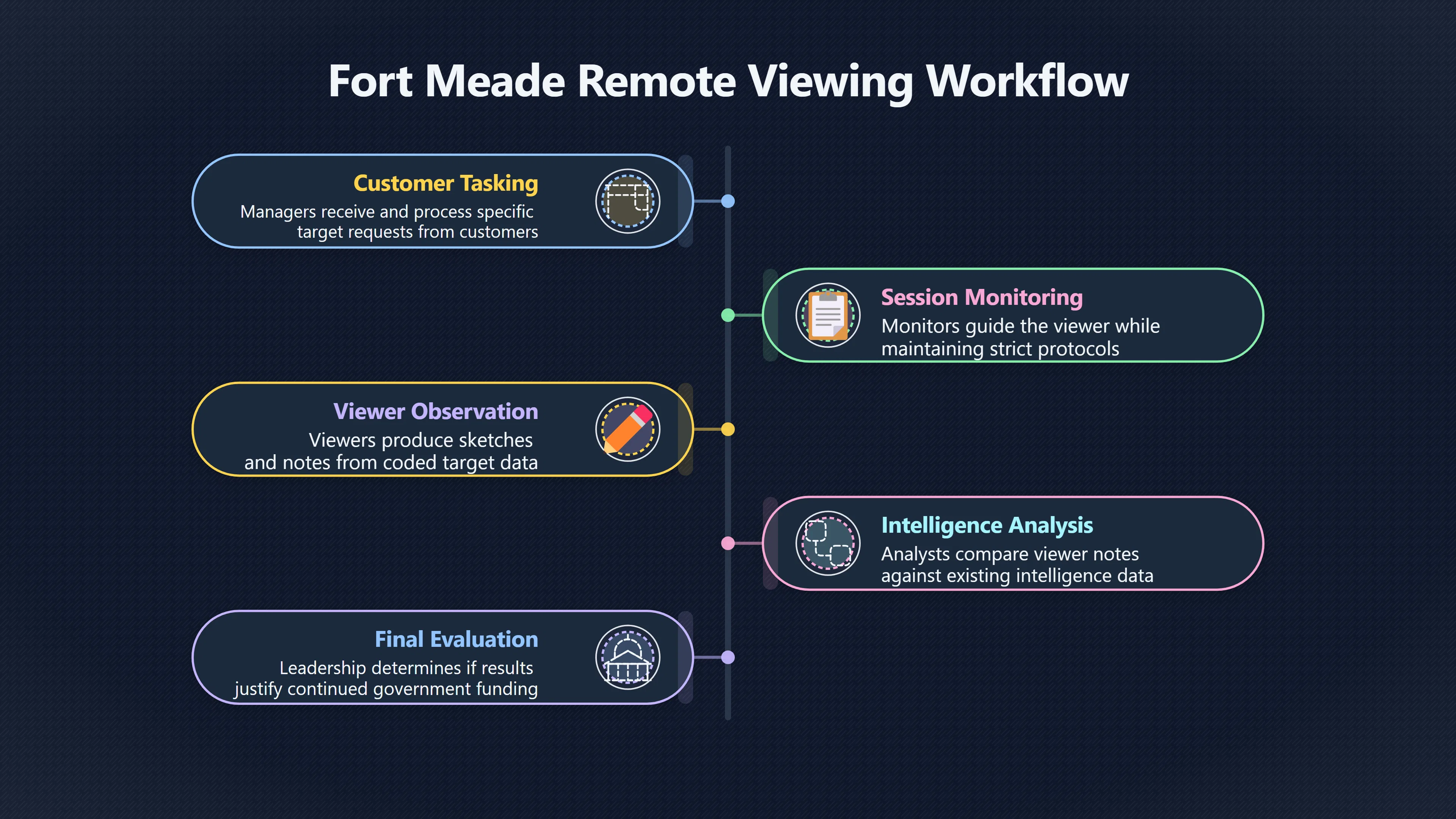
A viewer’s task was deliberately narrow. Presented with a coded target rather than a detailed briefing, the viewer produced sketches, written impressions and descriptive notes. Those materials were recorded rather than interpreted during the session. The viewer was not normally expected to analyse military significance or recommend operational action. That work fell to others after the session ended.[CIA]cia.govAN EVALUATION OF THE REMOTE VIEWING PROGRAMTypically, the remote viewers described the results of their experiences in written reports…
This distinction became blurred after declassification because many former participants wrote memoirs, taught remote viewing commercially or appeared in documentaries. Public audiences often assumed that the best-known personalities had performed every function inside the programme, when the historical record shows a division of labour much closer to a conventional intelligence office than to the image of isolated psychic operatives.
Monitors, Trainers, Analysts and Managers
Session monitors
The monitor was arguably the viewer’s closest operational partner. Rather than attempting to perceive the target, the monitor guided the session, maintained the protocol, encouraged the viewer to continue describing impressions and attempted to avoid introducing accidental clues.
Because monitors shaped the conduct of each session, they could influence consistency without directly contributing target information. Former participants have repeatedly described monitoring as a specialised skill distinct from viewing itself.[Wikipedia]WikipediaStargate Project (U.S. Army unitStargate Project (U.S. Army unit
Trainers
Training occupied a surprisingly large share of the programme’s activity. Personnel were expected to practise repeatedly using increasingly formal methods developed from earlier work at the Stanford Research Institute and later refinements such as Controlled Remote Viewing.
Training involved teaching structured reporting habits as much as developing claimed psychic ability. Participants learned standardised note-taking, sketching conventions and procedures intended to separate immediate impressions from conscious interpretation. Whether those methods improved genuine remote viewing remains disputed, but they reflected an effort to impose discipline on an inherently subjective process.[Wikipedia]WikipediaStargate Project (U.S. Army unitStargate Project (U.S. Army unit
Analysts
Once sessions finished, intelligence personnel had to determine whether any information might be useful.
Analysts compared viewer reports with existing intelligence, looked for recurring themes across multiple sessions and judged whether any details deserved further attention. They were expected to treat remote-viewing reports as one possible source among many rather than as independent proof.
The later American Institutes for Research evaluation found little evidence that these products consistently generated actionable intelligence, illustrating the difficult position analysts occupied. Even if individual reports appeared striking in retrospect, distinguishing meaningful information from coincidence proved extremely challenging.[CIA]cia.govAN EVALUATION OF THE REMOTE VIEWING PROGRAMTypically, the remote viewers described the results of their experiences in written reports…
Managers and programme leaders
The programme also required ordinary administrative leadership.
Managers secured funding, handled security clearances, responded to sceptical oversight bodies, selected personnel and maintained relationships with military and intelligence customers. Officers such as Frederick Holmes Atwater, often known as Skip Atwater, supervised operational activities during important periods, while senior intelligence officers determined whether the programme survived successive reviews and organisational restructurings.[Wikipedia]WikipediaStargate Project (U.S. Army unitStargate Project (U.S. Army unit
Without this management layer, the programme could not have operated inside the military bureaucracy regardless of any claimed viewing successes.
How Role Confusion Shaped the Legend
One reason the Fort Meade story became mythologised is that later media coverage compressed many specialised jobs into the single label “remote viewer”.
This simplification created several misconceptions:
- Famous participants were often assumed to have spent all of their time conducting operational viewing, although many alternated between monitoring, administration, training and evaluation.
- Public interviews frequently focused on dramatic missions instead of the routine administrative work that occupied much of the programme.
- Later commercial remote-viewing schools sometimes presented former military personnel primarily as elite viewers, even when their documented military assignments included substantial supervisory or instructional responsibilities.
The case of Ed Dames illustrates this pattern. Although he became one of the most recognisable public advocates of remote viewing, historical accounts from former colleagues describe much of his military contribution as monitoring sessions and assisting operations rather than serving as a formally trained operational viewer from the outset.[Wikipedia]WikipediaStargate Project (U.S. Army unitStargate Project (U.S. Army unit
What the Division of Labour Reveals
The organisation of the Fort Meade unit makes clear that remote viewing was treated internally as an intelligence collection experiment rather than a collection of gifted individuals working independently.
Every operational report depended upon multiple people: someone to receive customer tasking, someone to prepare the target, a monitor to conduct the session, a viewer to produce observations, analysts to compare those observations with other information and managers to decide whether the product justified further effort.
Ironically, this conventional bureaucratic structure strengthened the programme’s historical credibility as a genuine government activity while also highlighting its central weakness. Despite employing experienced intelligence professionals in familiar organisational roles, later official reviews concluded that the resulting reports did not demonstrate reliable operational value sufficient to justify continued government funding.[CIA]cia.govAN EVALUATION OF THE REMOTE VIEWING PROGRAMTypically, the remote viewers described the results of their experiences in written reports…
Amazon book picks
Further Reading
Books and field guides related to Who Were the Military Viewers?. Use these as the next step if you want deeper reading beyond the article.
Phenomena: The Secret History of the U.S. Government's Invest...
Profiles major personalities and organizations involved in the program.

Remote Viewers: The Secret History of America's Psychic Spies
Covers the participants and organizational development of the military viewers.

Mind trek
Directly addresses the people, roles and experiences within the Fort Meade program.
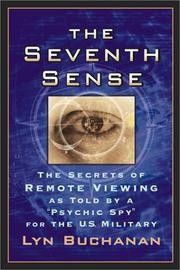
The Seventh Sense: The Secrets of Remote Viewing as Told by a...
Explains the responsibilities of viewers, trainers and operational staff.
eBay marketplace picks
Marketplace Samples
Live-tested eBay searches with available results related to this page.


Endnotes
1.
Source: Wikipedia
Title: Stargate Project (U.S. Army unit)
Link:https://en.wikipedia.org/wiki/Stargate_Project_%28U.S._Army_unit%29
2.
Source: cia.gov
Link:https://www.cia.gov/readingroom/docs/CIA-RDP96-00791R000200180005-5.pdf
Source snippet
AN EVALUATION OF THE REMOTE VIEWING PROGRAMTypically, the remote viewers described the results of their experiences in written reports...
Additional References
3.
Source: bialfoundation.com
Link:https://bialfoundation.com/en-GB/beyondthebrain/interviews/joseph-mcmoneagle
Source snippet
Joseph McMoneagleCurrently, he serves as a Residential Trainer in remote viewing at the Monroe Institute and as a Consultant at The Labor...
4.
Source: instagram.com
Link:https://www.instagram.com/reel/DYkr6rZyje6/?hl=en
Source snippet
View allIt ran for 22 years across multiple agencies. It conducted hundreds of intelligence missions involving thousands of remote viewin...
5.
Source: ciaotest.cc.columbia.edu
Link:https://ciaotest.cc.columbia.edu/olj/sa/sa_jan02srm01.html
Source snippet
Remote Viewing: The US Sponsored Psychic...This paper deals with experiments conducted in USA in which certain individuals were trained...
6.
Source: facebook.com
Link:https://www.facebook.com/historyoasis/posts/from-1972-to-1995-the-united-states-military-invested-over-20-million-in-one-of-/790173214116954/
Source snippet
Army unit at Fort Meade, Maryland, active from the 1970s to 1995, focused on remote viewing—psychically...Read more...
7.
Source: youtube.com
Title: Joe Mc Moneagle
Link:http://www.youtube.com/watch?v=XRTon6qgVws
Source snippet
Interview Lyn Buchanan remote viewing operational role I WAS A PSYCHIC SPY - Art Bell & Lyn Buchanan on Military Remote Viewing ART BELL...
8.
Source: youtube.com
Title: “I Operated a UFO… It’s Not What You Think” -Army Sergeant Lyn Buchanan
Link:http://www.youtube.com/watch?v=1sxmSMzqnmA
Source snippet
DISCLOSURE: Army Remote Viewer Prepares Us For What’s Coming | Sgt. Lyn Buchanan (retd.)...
9.
Source: behindgreatness.org
Title: joe mcmoneagle pt 5
Link:https://behindgreatness.org/episode/joe-mcmoneagle-pt-5/
Source snippet
Joe McMoneagle Pt.527 May 2025 — He became known as “Remote Viewer No. 1″ within Project Stargate. Project Stargate was the United States...
Published: May 2025
10.
Source: youtube.com
Link:http://www.youtube.com/watch?v=UemU2TYKo_0
Source snippet
Joe McMoneagle - CIA's Project Stargate | SRS #95...
11.
Source: pmc.ncbi.nlm.nih.gov
Link:https://pmc.ncbi.nlm.nih.gov/articles/PMC10275521/
Source snippet
Central Intelligence Agency's (CIA...by Á Escolà‐Gascón · 2023 · Cited by 10 — Since 1972, the U.S. Central Intelligence Agency (CIA) co...
12.
Source: youtube.com
Title: I WAS A PSYCHIC SPY
Link:http://www.youtube.com/watch?v=3Ns60yoVODI
Source snippet
Advances in Remote Viewing with Lyn Buchanan...
Topic Tree