Within Remote Viewing
How a Remote Viewing Session Is Supposed to Work
A basic remote viewing protocol records impressions before feedback and tries to block normal sources of information.
On this page
- Target Selection
- Recording Impressions
- Feedback and Comparison
Page outline Jump by section
Introduction
A beginner remote viewing protocol is not just “having a go” at guessing a hidden picture. In its stricter form, it is a simple testing routine: choose a target without letting the viewer know what it is, record impressions before any feedback is given, then compare the notes against the actual target and plausible decoys. The point is not to prove the ability in one dramatic session, but to reduce ordinary information leaks, wishful interpretation and after-the-fact storytelling.
That distinction matters because remote viewing has always lived or died by protocol. Supporters point to laboratory and government-funded work in which viewers were shielded from target information and asked to produce free-response descriptions. Critics point out that weak blinding, loose judging and feedback contamination can make ordinary guesses look more impressive than they are. A beginner protocol is therefore best understood as a disciplined record-making exercise: it gives claims about remote viewing a fairer test, while also making mistakes easier to spot.[Psi Encyclopedia+2CIA]psi-encyclopedia.spr.ac.ukPsi Encyclopedia Remote Viewing – Psi EncyclopediaPsi Encyclopedia Remote Viewing – Psi Encyclopedia
What a Beginner Protocol Is Trying to Control
The central rule is simple: the viewer must make a time-stamped record before learning the answer. Remote viewing differs from casual intuition because the session creates a document — notes, sketches, sensory impressions and guesses — that can later be compared with a real target. In research descriptions, the target may be a location, photograph, object or video clip, and the viewer is meant to describe it while normal routes to information are blocked.[Psi Encyclopedia]psi-encyclopedia.spr.ac.ukPsi Encyclopedia Remote Viewing – Psi EncyclopediaPsi Encyclopedia Remote Viewing – Psi Encyclopedia
For beginners, the most important controls are not exotic. They are the same kinds of controls used whenever people are prone to unconscious cueing or generous interpretation:
- Blind targeting: the viewer should not know the target, the target category or the pool of possible answers.
- Clean recording: the session notes should be written before feedback, not reconstructed afterwards.
- Separation from the target holder: anyone who knows the target should avoid speaking to, guiding or prompting the viewer during the session.
- Honest comparison: the notes should be compared not only with the correct target, but also with misses and decoys where possible.
- Preserved originals: the first draft matters more than a polished later summary.
This is why remote viewing protocols often sound stricter than popular accounts of psychic perception. A vivid description is not enough. A disciplined protocol asks whether the description was produced under conditions that rule out normal knowledge, memory, leading prompts, leakage from the experimenter or selective matching after feedback.
Target Selection: How to Choose the Hidden Target
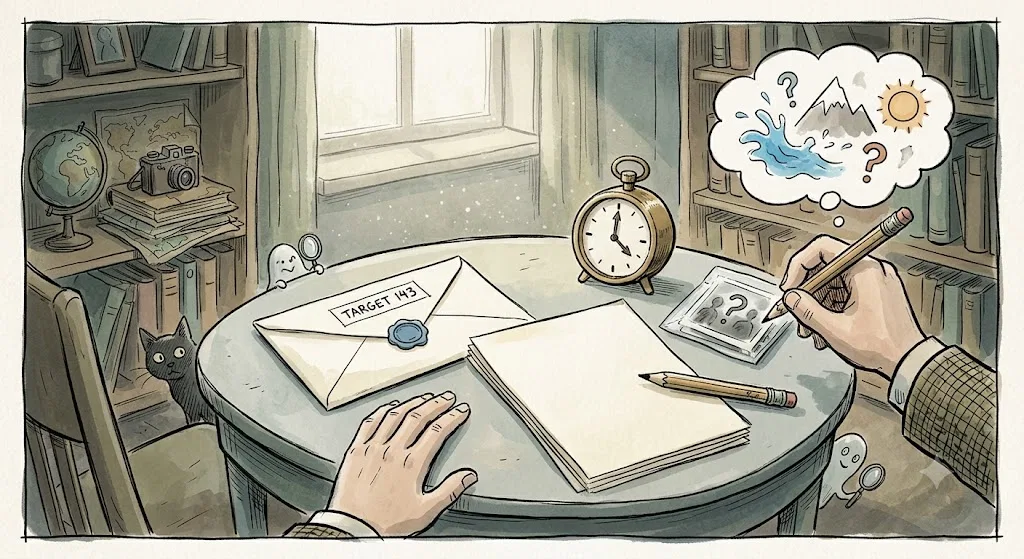
A beginner target should be concrete, distinctive and easy to compare. A photograph of a waterfall, a cathedral interior, a desert road or a crowded market is usually better than an abstract idea such as “hope” or “danger”. The reason is practical: remote viewing produces loose descriptions, so a target with visual, spatial and sensory features gives the viewer something testable to describe.
In formal remote viewing experiments, targets have often been selected from pools of photographs or other stimuli, with randomisation used to prevent the viewer or session monitor from knowing what will be chosen. One SAIC experiment described in later methodological analysis used static targets from National Geographic photographs and dynamic targets from video clips, grouped into sets of five so that a judge could compare the viewer’s response with the actual target and four alternatives.[Koestler Unit]koestlerunit.wordpress.comKoestler Unit Microsoft WordKoestler UnitMicrosoft Word - RVPAPERfinaljp…
For a beginner practice session, the same idea can be simplified:
- One person prepares a target pool of clear images.
- Each image is assigned a random target number.
- The viewer receives only the number, not the image or category.
- The viewer records impressions before seeing any feedback.
- The target is revealed only after the session record is complete.
The target number is not supposed to contain information. In Coordinate or Controlled Remote Viewing traditions, the viewer may be given a neutral reference number rather than a descriptive cue. Declassified CRV training material describes Coordinate Remote Viewing as a structured process using stages, while public summaries of CRV manuals describe the target reference number as a way to task the viewer without telling them what the site is.[CIA]cia.govCOORDINATE REMOTE VIEWING STAGES I-VI AND…The purpose of this document is to provide an overview of Coordinate Remote Viewing (CRV)…
The beginner mistake is choosing a target that is too easy to infer from context. If the same friend always chooses dramatic landscapes, the viewer may unconsciously learn the pattern. If the target folder is visible, file names can leak information. If the viewer knows the session is about “a famous monument”, the response has already been narrowed. A useful target protocol is boring on purpose: random, neutral and hidden.
Recording Impressions: What to Write Down Before Feedback
The session record should separate raw impressions from interpretation. Beginners often jump from “cold, vertical, echoing, stone, high ceiling” to “it must be a cathedral”. The first list is more useful than the second because it can be compared across many possible targets. The second may be right, but it may also be what remote viewing traditions call analytical overlay: the mind’s attempt to turn fragmentary impressions into a familiar story.
CRV material makes this distinction explicit. Publicly available CRV descriptions define an ideogram as an initial reflexive mark and analytical overlay as conscious interpretation that may or may not relate to the target. Declassified and archived CRV training material also stresses staged recording, sketches and the management of interpretation rather than treating the first named guess as the whole session.[rviewer.com]rviewer.comcrv theory controlled remote viewing manualcrv theory controlled remote viewing manual
A beginner session record can be organised into four parts:
- Sensory impressions: colours, textures, temperatures, sounds, smells, movement.
- Spatial impressions: open or enclosed, high or low, flat or vertical, natural or built.
- Sketches: rough shapes, layouts, lines of movement, object relationships.
- Declared interpretations: labelled guesses such as “bridge”, “factory”, “harbour” or “temple”, clearly marked as guesses rather than raw data.
The value of this structure is that it preserves uncertainty. A session that says “arched, stone, echoing, cold, vertical lines, people moving through a large interior” is easier to judge fairly than one that says only “cathedral”. If the target is a railway station, the first description may contain partial correspondences; the second may be counted as a clean miss. Good records make both hits and failures visible.
A monitor, if used, should ask neutral prompts: “What do you notice?” or “Describe the shape.” The monitor should not ask leading questions such as “Is there water?” unless the protocol already allows that kind of probing and the monitor is blind to the target. In research settings, the person interacting with the viewer is ideally also blind, because even subtle tone, hesitation or enthusiasm can become a cue.
Feedback and Comparison: Where Beginners Most Often Fool Themselves
Feedback is essential for learning, but it is also where remote viewing becomes easy to over-read. Once the target is revealed, the mind naturally searches for matches: a scribble becomes a coastline, a word such as “metal” becomes a bridge, a vague phrase such as “energy” becomes a crowd or a power station. That does not mean all matches are meaningless, but it does mean the comparison stage needs discipline.
Formal judging methods try to reduce this problem by comparing the viewer’s response against several possible targets, not just the correct one. In the SAIC example analysed by Wiseman and Milton, an independent judge received the viewer’s response along with a target set containing the actual target and four decoys. This kind of comparison matters because a free-response description can often be made to fit more than one image.[Koestler Unit]koestlerunit.wordpress.comKoestler Unit Microsoft WordKoestler UnitMicrosoft Word - RVPAPERfinaljp…
A beginner-friendly feedback routine can use three questions:
- What was clearly present in the target and clearly recorded before feedback?
- What was clearly wrong or absent?
- Would the same notes also fit several other possible targets?
The third question is the most neglected. A note such as “water, blue, movement” may sound impressive when the target is a waterfall, but it might also fit a harbour, swimming pool, stormy sea or glass building. Stronger correspondences are more specific: “a narrow suspended bridge over a steep green valley” is harder to retrofit than “outdoors, motion, natural”.
Feedback should also be delayed until the record is finished and saved. If the viewer sees the target halfway through and then adds details, the session is no longer clean. For practice, this is not a moral failure; it simply means the post-feedback material should be labelled separately and not counted as part of the blind session.
A Simple First Session Protocol
A workable beginner protocol can be done with two people, a small target pool and a shared commitment not to help the result look better than it is.
Before the session, the tasker selects 10 to 20 visually distinct images and assigns each one a random code. The tasker chooses one target by random method and writes down the answer somewhere the viewer cannot access. The viewer receives only the code.
During the session, the viewer writes the code, date and start time, then spends 10 to 20 minutes recording impressions. The viewer should write quickly and avoid explaining too much. Sketches are useful even when crude, because remote viewing responses often concern shapes, layouts and relationships rather than exact names.
After the session, the viewer writes an end time and stops. Only then is feedback shown. The viewer and tasker compare the notes against the target, marking clear matches, misses and ambiguous items. If possible, they also compare the notes against several decoy images from the same pool.
After several sessions, patterns matter more than one result. A single striking match can happen by chance, loose interpretation or genuine anomaly; one session cannot sort those explanations. A log of 20 or more sessions, judged consistently, is more informative than a favourite anecdote.
What “Blind” Really Means
In remote viewing, “blind” does not merely mean “the viewer has not seen the photo”. It means the viewer does not have normal access to information that could identify the target. Stronger protocols may blind the monitor, the judge and sometimes even the person handling session transcripts.
The AIR review of the U.S. government remote viewing programme focused heavily on whether experiments used adequate controls and whether the results had operational value. Jessica Utts argued that some later laboratory work showed statistically significant evidence, while Ray Hyman was more cautious, arguing that the evidence did not yet justify concluding that paranormal functioning had been established. The shared lesson for beginners is that protocol quality is not a side issue; it is the issue.[CIA]cia.govAN EVALUATION OF THE REMOTE VIEWING PROGRAMEvaluation Objectives. The CIA asked AIR to address a number of key objectives during the t…
Critics have repeatedly pointed to cueing and reconstruction problems. Wiseman and Milton’s re-examination of a key SAIC experiment argued that important procedural details were difficult to reconstruct and that possible flaws might account for the result. Their critique is especially useful for beginners because it shows how a study can look controlled in outline while still depending on small procedural details: who handled the response, who saw the target, when feedback was sent, whether original notes or copies were judged, and whether the judge could infer anything from context.[Koestler Unit]koestlerunit.wordpress.comKoestler Unit Microsoft WordKoestler UnitMicrosoft Word - RVPAPERfinaljp…
A beginner does not need a laboratory to learn from this. The practical rule is to assume that information leaks easily. File names, repeated target themes, facial expressions, enthusiastic reactions, casual hints and post-session editing can all contaminate a result.
The Difference Between Practice and Evidence
A beginner protocol can make remote viewing practice more disciplined, but it does not by itself establish that remote viewing works. Practice sessions are usually too informal, too small and too personally judged to settle the scientific question. Their value is narrower: they teach the difference between a pre-recorded impression and a later interpretation.
Recent pro-remote-viewing literature continues to argue that the field has produced positive statistical results. A 2023 systematic review and meta-analysis reported positive average effects across selected remote viewing studies up to 2022, while other researchers and critics continue to dispute whether the evidence is robust, independently repeatable and protected from methodological weaknesses.[ResearchGate]researchgate.net369604750 Remote Viewing a 1974 2022 systematic review and meta analysis369604750 Remote Viewing a 1974 2022 systematic review and meta analysis
That tension should shape how beginners interpret their own results. A good personal protocol can answer modest questions: Did I record anything specific before feedback? Am I improving at separating impressions from guesses? Do my notes match targets better than decoys? It cannot answer the larger scientific question unless the sessions are designed, randomised, blinded, archived and judged to a much higher standard.
Common Beginner Pitfalls
The most common beginner error is front-loading: giving the viewer too much information before the session. “The target is somewhere in Europe” or “this is connected with water” may feel harmless, but it narrows the range of guesses.
Another is retrofitting. After seeing the target, beginners may reinterpret vague marks as if they were precise sketches. To reduce this, compare the same notes with several decoys before celebrating a hit.
A third is overvaluing named guesses. If the viewer writes “Eiffel Tower” and the target is a radio mast, that may share a tall metal structure, but the named answer is still wrong. Raw descriptors should be judged separately from final labels.
A fourth is feedback contamination. Once feedback is shown, new impressions may arise. These can be interesting to the viewer, but they belong in a separate “after feedback” section and should not be counted as blind data.
A fifth is single-session thinking. Remote viewing lore often revolves around dramatic hits, but protocol-minded practice looks at the whole record: misses, vague sessions, target preferences, judging habits and the rate at which notes fit decoys.
How to Read a Remote Viewing Result
A fair reading of a session is neither credulous nor dismissive. It asks what the notes actually said before feedback, how specific they were, and whether the comparison was strict enough. A session containing “water, white spray, cliff, roaring sound, downward movement” against a waterfall target is stronger than a session containing “nature, blue, open space”. A sketch showing the main layout of a target is usually more useful than a later verbal explanation of what the sketch “must have meant”.
The strongest beginner results tend to have three features: they were produced blind, they contain several specific elements, and they would not fit most decoys equally well. The weakest results rely on broad words, emotional impressions or after-the-fact reinterpretation.
This is the main practical payoff of a beginner protocol. It does not require the reader to accept remote viewing as proven, and it does not reduce the subject to casual guessing. It creates a structured situation in which claims, impressions and errors can be seen on the page before the answer is known.
eBay marketplace picks
Marketplace Samples
Live-tested eBay searches with available results related to this page.



Endnotes
1.
Source: cia.gov
Link:https://www.cia.gov/readingroom/docs/CIA-RDP96-00791R000200180005-5.pdf
Source snippet
AN EVALUATION OF THE REMOTE VIEWING PROGRAMEvaluation Objectives. The CIA asked AIR to address a number of key objectives during the t...
2.
Source: researchgate.net
Link:https://www.researchgate.net/publication/333228024_An_Assessment_of_the_Evidence_for_Psychic_Functioning
Source snippet
An Assessment of the Evidence for Psychic Functioning"remote viewing," in which people try to gain a sense of distant or unse...
3.
Source: cia.gov
Link:https://www.cia.gov/readingroom/docs/CIA-RDP96-00788R001000400001-7.pdf
Source snippet
COORDINATE REMOTE VIEWING STAGES I-VI AND...The purpose of this document is to provide an overview of Coordinate Remote Viewing (CRV)...
4.
Source: rviewer.com
Title: crv theory controlled remote viewing manual
Link:https://rviewer.com/introduction-to-the-controlled-coordinate-remote-viewing-manual/crv-theory-controlled-remote-viewing-manual/
5.
Source: researchgate.net
Title: 369604750 Remote Viewing a 1974 2022 systematic review and meta analysis
Link:https://www.researchgate.net/publication/369604750_Remote_Viewing_a_1974-2022_systematic_review_and_meta-analysis
6.
Source: cia.gov
Link:https://www.cia.gov/readingroom/docs/CIA-RDP96-00789R002200200001-5.pdf
7.
Source: cia.gov
Link:https://www.cia.gov/readingroom/docs/CIA-RDP79-00999A000200010002-3.pdf
8.
Source: cia.gov
Link:https://www.cia.gov/readingroom/docs/CIA-RDP79-00999A000200010008-7.pdf
9.
Source: cia.gov
Link:https://www.cia.gov/readingroom/docs/CIA-RDP96-00789R002200070001-0.pdf
10.
Source: cia.gov
Link:https://www.cia.gov/readingroom/docs/CIA-RDP96-00791R000200180006-4.pdf
11.
Source: cia.gov
Link:https://www.cia.gov/readingroom/docs/CIA-RDP96-00788R001800170001-5.pdf
12.
Source: cia.gov
Link:https://www.cia.gov/readingroom/docs/CIA-RDP96-00789R001300010001-6.pdf
13.
Source: researchgate.net
Title: 374881423 Remote Viewing A 1974 2022 Systematic Review and Meta Analysis
Link:https://www.researchgate.net/publication/374881423_Remote_Viewing_A_1974-2022_Systematic_Review_and_Meta-Analysis
14.
Source: researchgate.net
Link:https://www.researchgate.net/figure/Showing-the-nine-phases-of-a-typical-ARV-protocol_tbl1_344470071
15.
Source: researchgate.net
Link:https://www.researchgate.net/publication/248497861_Remote_viewing_as_applied_to_futures_studies
16.
Source: researchgate.net
Title: 380349961 Experts’ remote viewing guidelines
Link:https://www.researchgate.net/publication/380349961_Experts%27_remote_viewing_guidelines
17.
Source: researchgate.net
Link:https://www.researchgate.net/publication/267978941Evaluation_of_Program_on%27Anomalous_Mental_Phenomena%27
18.
Source: researchgate.net
Title: 403180890 Experts’ Remote Viewing Guidelines
Link:https://www.researchgate.net/publication/403180890_Experts%27_Remote_Viewing_Guidelines
19.
Source: psi-encyclopedia.spr.ac.uk
Title: Psi Encyclopedia Remote Viewing – Psi Encyclopedia
Link:https://psi-encyclopedia.spr.ac.uk/articles/remote-viewing/
20.
Source: koestlerunit.wordpress.com
Title: Koestler Unit Microsoft Word
Link:https://koestlerunit.wordpress.com/wp-content/uploads/2015/06/wiseman-milton-1998.pdf
Source snippet
Koestler UnitMicrosoft Word - RVPAPERfinaljp...
21.
Source: paranormalsociety.co.uk
Title: Remote viewing
Link:https://paranormalsociety.co.uk/kb/index.php/Remote_viewing
22.
Source: ics.uci.edu
Link:https://www.ics.uci.edu/~jutts/may.pdf
23.
Source: Wikipedia
Title: Remote viewing
Link:https://en.wikipedia.org/wiki/Remote_viewing
Additional References
24.
Source: youtube.com
Title: Remote Viewing Training: Advanced Phases with Paul H. Smith
Link:https://www.youtube.com/watch?v=t4uS_7q-hnE
Source snippet
Remote Viewing Starter Kit for Beginners...
25.
Source: youtube.com
Title: Remote Viewing Starter Kit for Beginners
Link:https://www.youtube.com/watch?v=lTZsCX7FoQs
Source snippet
David Morehouse Remote Viewing Course and Project [Stargate]({{ 'stargate/' | relative_url }}) Overview...
26.
Source: academia.edu
Link:https://www.academia.edu/51621266/CIA_Initiated_Remote_Viewing_Program_at_Stanford_Research_Institute
27.
Source: emmind.net
Link:https://emmind.net/openpapers_repos/Nonlocality_Fields/Nonlocal_Mind/Various/2014_Explicit_Anomalous_Cognition_A_Review_of_the_Best_Evidence_in_Ganzfeld%2C_Forced-choice_Remote_Viewing_and_Dream_Studies.pdf
28.
Source: reddit.com
Link:https://www.reddit.com/r/remoteviewing/comments/r9dqcu/an_exploratory_study_using_ideograms_for_arv/
29.
Source: scribd.com
Link:https://www.scribd.com/doc/189703065/Military-Remote-Viewing-Manual
30.
Source: centerlane-rv.org
Link:https://centerlane-rv.org/wp-content/uploads/2025/04/1986-05-Coordinate-Remote-Viewing-Manual-Paul-_B138_F6.pdf
31.
Source: academia.edu
Link:https://www.academia.edu/136849593/Experts_Remote_Viewing_Guidelines
32.
Source: facebook.com
Link:https://www.facebook.com/groups/710805723530028/posts/1357377095539551/
33.
Source: reddit.com
Link:https://www.reddit.com/r/remoteviewing/comments/1ohbtfb/ive_built_clairv_free_remote_viewing_practice_tool/
Topic Tree