Within Statistics
When a Small Effect Is Still Not Useful
Small average effects can matter in statistics yet still fail when readers ask whether remote viewing works in real decisions.
On this page
- Why significance and effect size answer different questions
- How modest accuracy gains can disappear in practice
- What stronger practical reliability would require
Page outline Jump by section
Introduction
A central question in the remote-viewing debate is not whether some experiments report statistically significant results, but whether those results translate into information that is dependable enough for real-world use. This is where effect size becomes more important than statistical significance alone. A study can find an average result that is unlikely to have arisen by chance while still producing information that is too weak, inconsistent or ambiguous to support practical decisions.
This distinction explains why supporters and critics often reach different conclusions from the same body of evidence. Supporters argue that above-chance average performance indicates a genuine anomaly worthy of scientific attention. Critics respond that even if a small average effect exists, it does not necessarily provide the level of accuracy, specificity and repeatability that applications such as intelligence gathering, search operations or forecasting would require.[Journal of Scientific Exploration+2CIA]journalofscientificexploration.orgJournal of Scientific ExplorationRemote Viewing: A 1974-2022 Systematic Review and…19 Oct 2023 — This is the first meta-analysis of al…
Why significance and effect size answer different questions
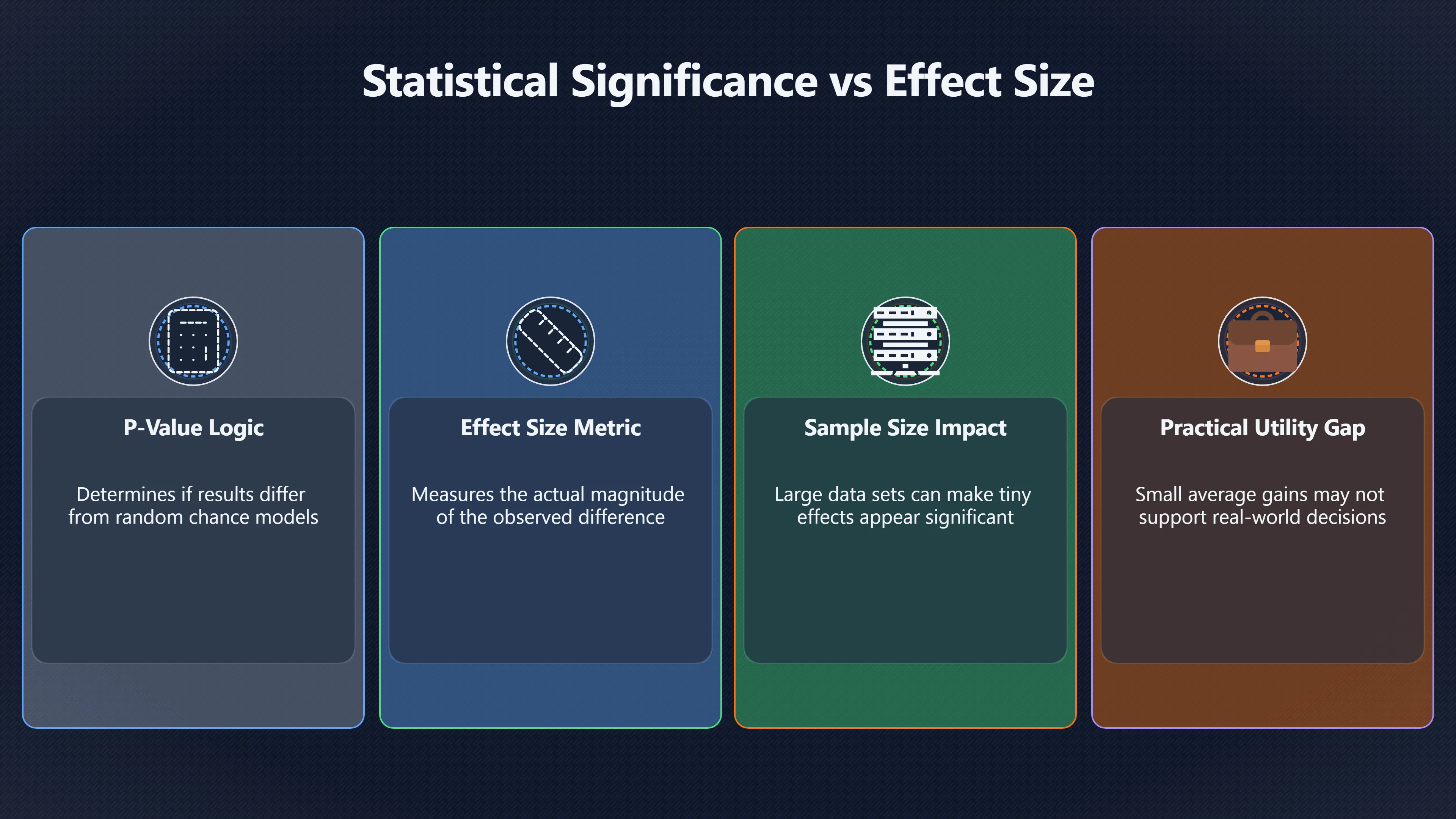
Statistical significance asks whether the observed results are unlikely under a specified chance model. Effect size asks how large the difference from chance actually is.
These questions are related but not interchangeable. Given enough observations, even a modest improvement over chance can become statistically significant. Conversely, a large-looking improvement based on only a handful of trials may disappear when more data are collected. The American Statistical Association specifically cautions that p-values do not measure the magnitude or practical importance of an effect and should not, by themselves, determine scientific conclusions or policy decisions.[stat.yale.edu]stat.yale.eduThe ASA's Statement on p-Values: Context, Process, and…29 Jan 2016 — p-values do not measure the size or importance of an effect, but…
In remote-viewing research, this distinction matters because the practical claim is demanding. A viewer is not merely expected to outperform random guessing on average across many sessions. The stronger claim is that an individual session can provide sufficiently accurate information to guide a real decision.
That raises a much higher standard than simply demonstrating an average statistical deviation.
How modest accuracy gains can disappear in practice
The translation problem arises because averaging across many experiments can conceal the variability of individual sessions.
A hypothetical example illustrates the issue. Suppose repeated experiments show that viewers perform modestly above chance over hundreds of trials. That finding may indicate a measurable average effect under laboratory scoring procedures. However, if any single session still contains numerous incorrect, vague or symbolic impressions alongside a few accurate elements, an operational user faces a different challenge.
Instead of asking, “Was the overall average above chance?”, they must ask:
- Which details are trustworthy?
- Which statements are metaphorical?
- Which impressions are incorrect?
- Can the correct information be identified before the outcome is already known?
Those questions are often much harder to answer than the statistical question.
Many remote-viewing protocols score an entire description against several candidate targets. A report may rank the correct target highest because of its overall resemblance, even if numerous individual statements are inaccurate. That scoring method can detect subtle average information while still producing reports that are difficult to interpret without hindsight.[CIA]cia.govAN EVALUATION OF REMOTE VIEWING: RESEARCH…A remote viewer is asked to visualize a place, location, or object being viewed by a "bea…
The practical consequence is that modest statistical gains do not automatically become usable intelligence.
The translation gap between laboratory scoring and decisions
Laboratory experiments deliberately simplify the judging problem.
Typical studies often ask judges to compare one transcript against a small set of candidate targets selected in advance. Even partial correspondence between description and target can improve the ranking score.
Real operational environments rarely offer those advantages.
Instead, decision-makers typically face questions such as:
- Where exactly is a missing person?
- Which of many possible locations should be searched?
- What event will occur next week?
- Which specific object should investigators examine?
These situations require selecting the correct answer from an enormous range of possibilities rather than from a handful of predefined alternatives.
As the number of realistic possibilities increases, small average improvements over chance may no longer produce decisions that outperform conventional investigative methods.
This difference between controlled scoring and open-ended decision-making is one reason why apparent laboratory effects do not necessarily demonstrate operational usefulness.
What the reported effect sizes actually imply
A recent systematic review and meta-analysis of remote-viewing experiments reported an average standardised effect size of approximately 0.34 after excluding statistical outliers and interpreted this as evidence for above-chance performance across the included studies. The authors argued that this represented meaningful experimental evidence for anomalous cognition and estimated an average improvement above chance in hit rates across their dataset.[Journal of Scientific Exploration]journalofscientificexploration.orgJournal of Scientific ExplorationRemote Viewing: A 1974-2022 Systematic Review and…19 Oct 2023 — This is the first meta-analysis of al…
However, even accepting those calculations at face value does not resolve the translation problem.
Several questions remain independent of the reported average effect:
- How often does a single viewing session produce sufficiently specific information?
- How stable is performance across different laboratories and independent research groups?
- Can successes be predicted in advance rather than recognised afterwards?
- Does performance remain useful when normal operational uncertainty replaces laboratory constraints?
These questions concern reliability rather than average statistical departure from chance.
Critics therefore argue that the existence of a measurable average effect, even if genuine, is not equivalent to demonstrating a dependable information source suitable for practical deployment. Supporters generally agree that reliability matters but contend that the accumulated statistical evidence warrants continued investigation into improving protocols rather than dismissing the phenomenon outright.[Journal of Scientific Exploration+2CIA]journalofscientificexploration.orgJournal of Scientific ExplorationRemote Viewing: A 1974-2022 Systematic Review and…19 Oct 2023 — This is the first meta-analysis of al…
What stronger practical reliability would require
Moving from statistical evidence to practical proof would require substantially stronger demonstrations than simply accumulating more statistically significant studies.
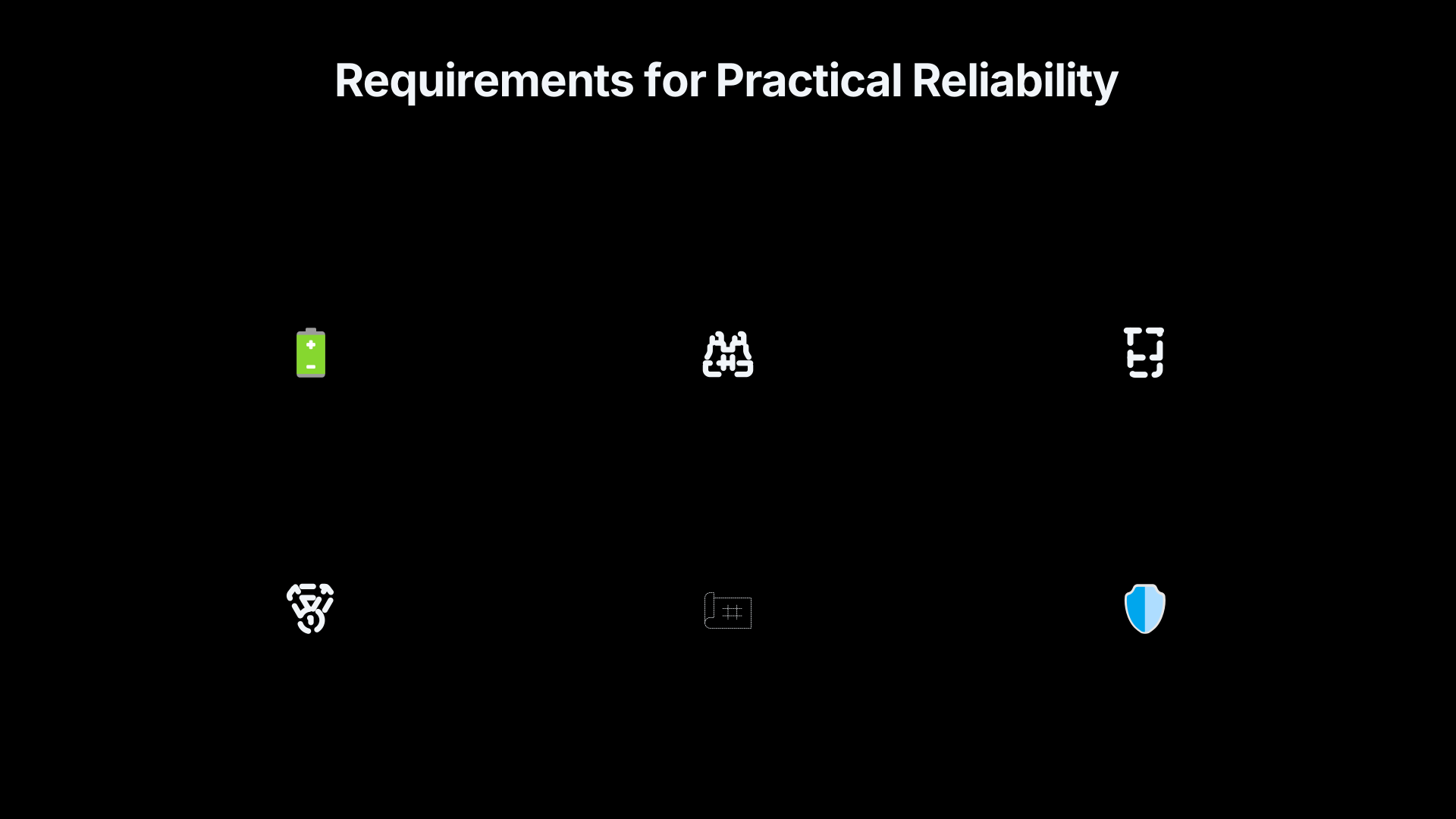
A convincing operational case would ideally show several features simultaneously:
- High session-to-session consistency, rather than occasional successful outcomes hidden within variable performance.
- Specific predictions, producing concrete information instead of broad descriptions that fit multiple targets.
- Prospective success, where correct information is recognised before independent confirmation rather than through retrospective matching.
- Independent replication, with similar performance achieved by unrelated research teams using transparent methods.
- Clear operational benefit, demonstrating that decisions made using remote-viewing information consistently outperform established alternatives.
These standards are considerably more demanding than showing that an experimental average differs from chance.
This distinction also helps explain the conclusions of the 1995 evaluation of the U.S. government’s remote-viewing programme. While some reviewers accepted that portions of the experimental literature appeared statistically interesting, the overall assessment found insufficient evidence that the information generated was reliable enough to provide practical value for intelligence operations.[CIA]cia.govAN EVALUATION OF REMOTE VIEWING: RESEARCH…A remote viewer is asked to visualize a place, location, or object being viewed by a "bea…
Why the distinction remains central
The debate over remote viewing increasingly turns less on whether isolated experiments can produce statistically significant averages and more on whether those averages translate into dependable knowledge.
Effect size measures the strength of an observed statistical pattern across groups of trials. Practical usefulness requires something different: individual outputs that are consistently accurate, sufficiently specific and reliable enough to support decisions before outcomes are known.
Until those two standards converge, statistical significance and practical proof remain separate questions. The translation problem is therefore not a technical footnote but one of the central reasons why disagreement persists over what the existing remote-viewing evidence actually demonstrates.
Amazon book picks
Further Reading
Books and field guides related to When a Small Effect Is Still Not Useful. Use these as the next step if you want deeper reading beyond the article.

The Art of Statistics
Clearly explains effect size, uncertainty, and practical interpretation.
Naked Statistics
Introduces statistical concepts relevant to interpreting small effects.
The Reality of ESP: A Physicist's Proof of Psychic Abilities
Represents the positive interpretation of reported effects.
eBay marketplace picks
Marketplace Samples
Live-tested eBay searches with available results related to this page.



Endnotes
1.
Source: cia.gov
Link:https://www.cia.gov/readingroom/document/cia-rdp96-00791r000200180006-4
Source snippet
AN EVALUATION OF REMOTE VIEWING: RESEARCH...A remote viewer is asked to visualize a place, location, or object being viewed by a "bea...
2.
Source: stat.yale.edu
Link:https://www.stat.yale.edu/~jtc5/238/readings/P%20values%20ASA%20Statement%20with%20commentary.pdf
Source snippet
The ASA's Statement on p-Values: Context, Process, and...29 Jan 2016 — p-values do not measure the size or importance of an effect, but...
3.
Source: youtube.com
Title: P value versus effect size
Link:http://www.youtube.com/watch?v=sTRPNxmBE2Y
Source snippet
Effect Size...
4.
Source: youtube.com
Title: Effect Size
Link:http://www.youtube.com/watch?v=6uYNVCy-8NA
Source snippet
Statistical Significance vs Effect Size: The Distinction Every Principal Needs...
5.
Source: journalofscientificexploration.org
Link:https://journalofscientificexploration.org/index.php/jse/article/view/2931
Source snippet
Journal of Scientific ExplorationRemote Viewing: A 1974-2022 Systematic Review and...19 Oct 2023 — This is the first meta-analysis of al...
Additional References
6.
Source: researchgate.net
Link:https://www.researchgate.net/publication/333228024_An_Assessment_of_the_Evidence_for_Psychic_Functioning
Source snippet
An Assessment of the Evidence for Psychic FunctioningResearch on psychic functioning, conducted over a two-decade period, is examined to...
7.
Source: reddit.com
Link:https://www.reddit.com/r/remoteviewing/comments/1dazs09/creation_of_study_on_statistical_evidence_of/
Source snippet
Creation of study on statistical evidence of remote viewingRemote Viewing - A 1974-2022 Systematic Review and Meta-Analysis is a recent r...
8.
Source: researchgate.net
Title: 369604750 Remote Viewing a 1974 2022 systematic review and meta analysis
Link:https://www.researchgate.net/publication/369604750_Remote_Viewing_a_1974-2022_systematic_review_and_meta-analysis
Source snippet
(PDF) Remote Viewing: a 1974-2022 systematic review...This is the first meta-analysis of all studies related to remote viewing tasks con...
9.
Source: academia.edu
Title: Remote Viewing A 1974 2022 Systematic Review and Meta Analysis
Link:https://www.academia.edu/108445581/Remote_Viewing_A_1974_2022_Systematic_Review_and_Meta_Analysis
Source snippet
Remote Viewing: A 1974- 2022 Systematic Review and...The meta-analysis reveals that remote viewing protocols produced an average effect...
10.
Source: youtube.com
Title: Statistical Significance and p-Values Explained Intuitively
Link:http://www.youtube.com/watch?v=DAkJhY2zQ3c
Source snippet
"Effect size" vs "statistical significance" research methodology explained P value versus effect size Social Psychology Explained...
11.
Source: youtube.com
Title: Statistical Significance vs Effect Size: The Distinction Every Principal Needs
Link:http://www.youtube.com/watch?v=Ht7Lk-GBoSI
Source snippet
Statistical Significance (p-values) & Practical Significance (Effect Size) of Research Results...
12.
Source: youtube.com
Link:http://www.youtube.com/watch?v=yFTuZmQiQf8
Source snippet
Statistical Significance and p-Values Explained Intuitively...
13.
Source: pmc.ncbi.nlm.nih.gov
Link:https://pmc.ncbi.nlm.nih.gov/articles/PMC10275521/
Source snippet
Central Intelligence Agency's (CIA...by Á Escolà‐Gascón · 2023 · Cited by 10 — We offer new statistical evidence suggesting a new approa...
14.
Source: gausslighter.com
Link:https://www.gausslighter.com/Explore.pdf
Source snippet
al.'s (2023) remote viewing research per the origby Á Escola-Gascón · Cited by 1 — This report describes and presents the raw data from E...
Topic Tree