Within Protocol
Why First Impressions Beat Clever Guesses
Separating textures, shapes and sensations from named guesses makes a session easier to judge and harder to retrofit.
On this page
- How raw sensory notes preserve uncertainty
- Why early labels can distort later recording
- A simple note format for impressions and guesses
Page outline Jump by section
Introduction
One of the most important habits in beginner remote viewing is separating what was first noticed from what was later inferred. Whether someone believes remote viewing reflects a genuine anomalous ability or regards it as an exercise in disciplined observation, the distinction matters because it creates a clearer record that can be evaluated afterwards. A note saying “hard, metallic, curved, echoing” can be compared directly with a target. A note saying “it’s probably a submarine” is already an interpretation.
This distinction became formalised in several structured remote viewing systems, where practitioners were taught to record immediate sensory impressions before allowing themselves to form broader interpretations. The aim was not to eliminate interpretation altogether, but to prevent it from overwriting the original observations. That makes sessions easier to judge and reduces the temptation to retrofit vague descriptions once the target has been revealed. At the same time, critics of remote viewing have argued that disciplined recording alone cannot establish paranormal perception; careful protocols remain necessary to avoid ordinary cueing and hindsight bias.[CIA]cia.govCOORDINATE REMOTE VIEWING STAGES I-VI AND…This is called. Analytical Overlay (AOL) (see glossary). Investigation of these overlay p…
How Raw Sensory Notes Preserve Uncertainty
In structured remote viewing methods, beginners are often encouraged to record impressions in their simplest form. Rather than asking “What is it?”, the immediate question becomes “What am I noticing?”
Raw observations typically include:
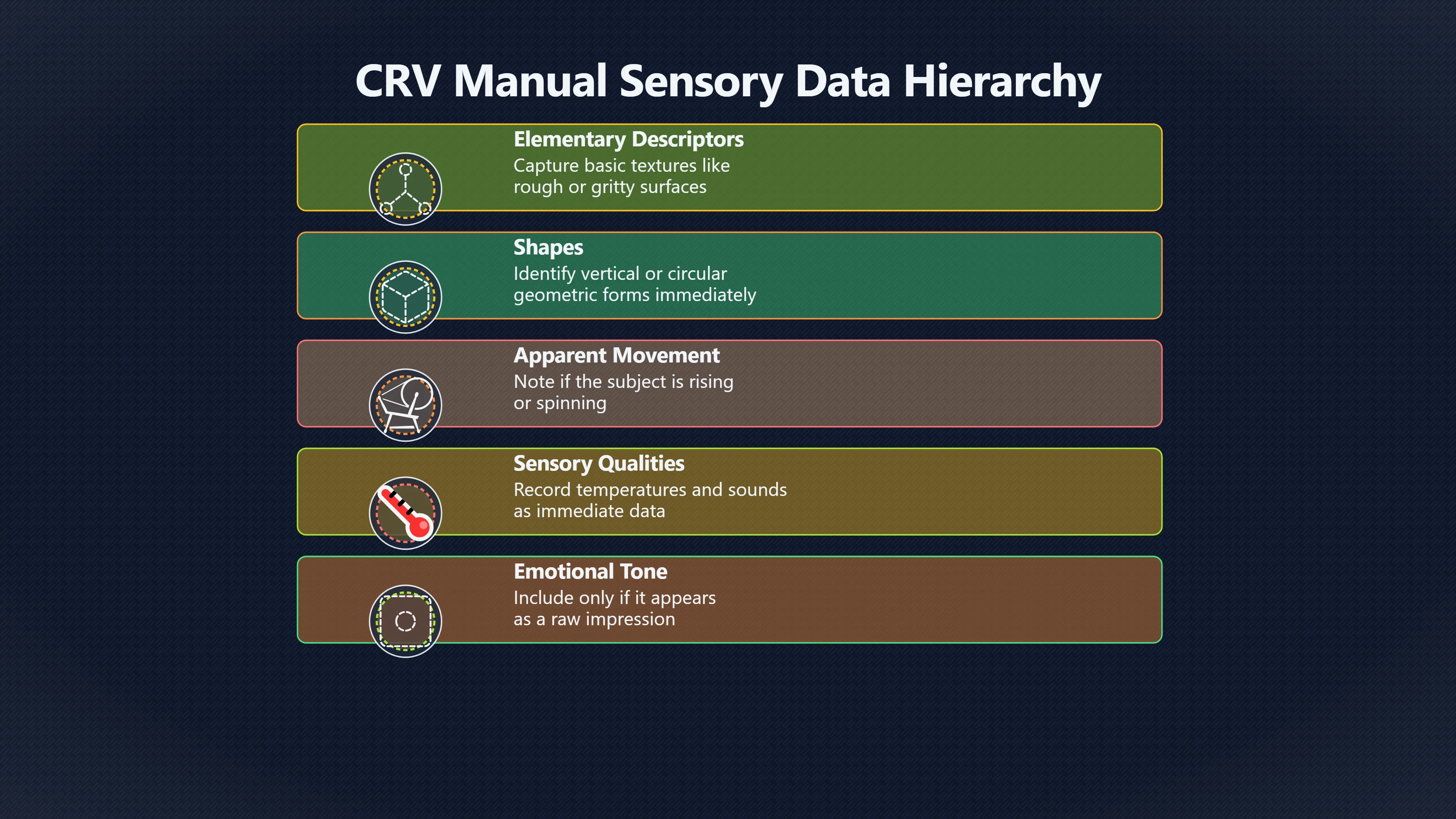
- textures such as rough, smooth, wet or gritty
- basic shapes such as vertical, circular or angular
- apparent movement such as rising, flowing or spinning
- simple colours or contrasts
- temperatures, sounds or other sensory qualities
- emotional tone only if it appears as an immediate impression rather than an explanation
These observations deliberately preserve uncertainty. A tall, cold, reflective object might eventually prove to be a skyscraper, a lighthouse or a metal tower. Recording only the immediate characteristics leaves several possibilities open instead of committing prematurely to one explanation.
Controlled Remote Viewing (CRV) manuals describe this early stage as collecting elementary descriptors before analytical thought becomes dominant. Early sensory fragments are treated as data, while complete object names are regarded as a different mental process that should be identified separately.[crvreg.org]crvreg.orgThe analytic response of the viewer's mind to signal line input. An AOL is usually wrong, especially in early stages…Read more…
Why Early Labels Can Distort Later Recording
The main risk of naming a target too soon is not simply being wrong. The larger problem is that a label can begin directing subsequent observations.
Imagine a viewer writes:
“Bridge.”
Once that word appears on the page, later impressions may unconsciously drift towards supporting it:
- steel cables
- traffic
- river
- suspension towers
If the original impression was merely “long, horizontal, elevated”, the later notes become difficult to separate from expectation.
Structured remote viewing literature refers to this tendency as Analytical Overlay (AOL)—the mind’s attempt to organise incomplete impressions into a familiar object or story. CRV manuals do not describe AOL as evidence against every interpretation; rather, they treat it as an ordinary cognitive process that can interfere with preserving the earliest impressions. The recommended response is usually to acknowledge the guess explicitly, record it as an interpretation, and then return to collecting fresh sensory information.[crvreg.org+2CIA]crvreg.orgThe analytic response of the viewer's mind to signal line input. An AOL is usually wrong, especially in early stages…Read more…
This approach reflects a broader principle found in many observational disciplines: once an explanatory narrative forms, it becomes harder to notice information that does not fit it.
A Simple Note Format for Impressions and Guesses
A practical way to preserve the distinction is to divide the page into separate categories.
Raw impressionsNamed guessesTallLighthouse?HardTower?WhiteRocket?WindyMonument?MetallicCrane?Circular topRadar dish?
The left-hand column contains only immediate observations. The right-hand column captures interpretations without allowing them to replace the original data.
Some practitioners also mark guesses with labels such as “AOL” or “Guess” before continuing. This makes later judging straightforward because reviewers can distinguish between descriptive material and speculative interpretation.[CIA]cia.govCOORDINATE REMOTE VIEWING STAGES I-VI AND…This is called. Analytical Overlay (AOL) (see glossary). Investigation of these overlay p…
Why This Improves Later Evaluation
Separating impressions from guesses benefits the session even if no paranormal explanation is assumed.
When feedback is finally revealed, reviewers can ask several distinct questions:
- Which raw observations matched the target?
- Which guesses happened to be correct?
- Which guesses were unsupported by the earlier sensory notes?
- Did the interpretation cause later notes to become narrower or more repetitive?
This produces a much richer assessment than simply asking whether the final answer was right.
For example, if the target was a waterfall, a session containing “cold”, “moving”, “white”, “mist”, “loud” and a later incorrect guess of “factory” still contains descriptive information that can be evaluated independently. Conversely, a correct guess unsupported by earlier observations may be harder to assess because it provides little insight into how the conclusion was reached.
Common Beginner Mistakes
Several recurring habits make sessions harder to interpret afterwards.
- Replacing rather than adding. Crossing out “curved” and replacing it with “bridge” removes potentially valuable information.
- Building stories. Writing complete narratives (“people are crossing a bridge into a city”) quickly mixes observation with imagination.
- Treating confidence as accuracy. A vivid impression is not necessarily a more reliable one.
- Editing after feedback. Altering notes once the target is known destroys the ability to judge what was genuinely recorded beforehand.
Preserving the original page—even if it looks messy or uncertain—is generally more useful than producing a polished summary later.
Why First Impressions Usually Remain the Most Useful Record
The emphasis on raw impressions is ultimately about record quality rather than belief. Whether remote viewing is viewed as a trainable perceptual skill, an experimental protocol or an unsupported claim, the original notes are the only evidence available before feedback.
Keeping textures, shapes, movement and simple sensory qualities separate from named objects preserves uncertainty exactly where uncertainty exists. That makes sessions easier to compare honestly with the target, easier to critique, and harder to reshape retrospectively once the answer is known.
Amazon book picks
Further Reading
Books and field guides related to Why First Impressions Beat Clever Guesses. Use these as the next step if you want deeper reading beyond the article.


Remote viewing secrets
Covers disciplined observation and avoiding analytical overlay.

eBay marketplace picks
Marketplace Samples
Live-tested eBay searches with available results related to this page.

Endnotes
1.
Source: cia.gov
Link:https://www.cia.gov/readingroom/docs/CIA-RDP96-00788R001000400001-7.pdf
Source snippet
COORDINATE REMOTE VIEWING STAGES I-VI AND...This is called. Analytical Overlay (AOL) (see glossary). Investigation of these overlay p...
2.
Source: crvreg.org
Link:https://www.crvreg.org/remoteviewing/assets/CRVManual.pdf
Source snippet
The analytic response of the viewer's mind to signal line input. An AOL is usually wrong, especially in early stages...Read more...
3.
Source: cia.gov
Link:https://www.cia.gov/readingroom/docs/CIA-RDP96-00789R002200070001-0.pdf
Source snippet
he subjective experiences associated with remote viewing...Read more...
4.
Source: Wikipedia
Title: Remote viewing
Link:https://en.wikipedia.org/wiki/Remote_viewing
Source snippet
Remote viewingRemote viewing (RV) is the practice of seeking impressions about a distant or unseen subject, purportedly sensing with t...
5.
Source: rviewer.com
Link:https://rviewer.com/controlled-remote-viewing/
Source snippet
tional) to help military personnel do just that.Read more...
Additional References
6.
Source: verevio.com
Link:https://verevio.com/remote-viewing
Source snippet
Remote Viewing Training ApplicationRemote Viewing (RV) is a structured and trainable practice that allows a human to access information a...
7.
Source: groundedpsychic.com
Link:https://www.groundedpsychic.com/post/unlocking-the-secrets-of-remote-viewing-a-step-by-step-guide-to-enhance-your-skills
Source snippet
Unlocking the Secrets of Remote Viewing: A Step-by-...11 May 2025 — This guide explores techniques, scientific perspectives, and practic...
Published: May 2025
8.
Source: elevify.com
Title: Remote Viewing Course Certificate | Free & Fast Course What will I learn?
Link:https://www.elevify.com/en-us/courses/health-and-medicine/alternative-medicine/remote-viewing-course-efbac
Source snippet
This course covers the complete Controlled Remote Viewing protocol from Stage 1 through Stage 6, including ideogram production, sensory...
9.
Source: researchgate.net
Title: 374881423 Remote Viewing A 1974 2022 Systematic Review and [Meta Analysis]({{ ‘meta-analysis/’ | relative_url }})
Link:https://www.researchgate.net/publication/374881423_Remote_Viewing_A_1974-2022_Systematic_Review_and_Meta-Analysis
Source snippet
(PDF) Remote Viewing: A 1974-2022 Systematic Review...Oct 26, 2023 — This is the first meta-analysis of all studies related to remote-vi...
10.
Source: scribd.com
Link:https://www.scribd.com/document/684640813/remote-viewing-training
Source snippet
It discusses concepts like the "A" and "B" components in the first stage of remote viewing.Read more...
11.
Source: rviewer.com
Link:https://rviewer.com/introduction-to-the-controlled-coordinate-remote-viewing-manual/crv-stage-1-coordinate-controlled-remote-viewing-manual/
Source snippet
manifested by the motion of the viewer's pen on paper, which motion is produced by...Read more...
12.
Source: scribd.com
Link:https://www.scribd.com/document/739477799/RV-Procedure
Source snippet
nt Analytical Overlay (AO) or Interpretive Overlay (IO), which...Read more...
13.
Source: documents2.theblackvault.com
Link:https://documents2.theblackvault.com/documents/cia/[stargate
Source snippet
9 cAnalytical Overlay; As the remote viewer becomes aware of the first few data bits, there appears to be a largely sponteneous and undis...
14.
Source: archive.org
Title: cia readingroom document cia rdp96 00788r001000400001 7
Link:https://archive.org/details/cia-readingroom-document-cia-rdp96-00788r001000400001-7
Source snippet
Investigation of these overlay patterns by SRI-International led to the model of...Read more...
15.
Source: reddit.com
Title: The greatest 15 minute
Link:https://www.reddit.com/r/remoteviewing/comments/gh27r7/the_greatest_15_minute_introduction_to_controlled/
Source snippet
introduction to Controlled Remote...The beginning of this video is a high-speed blast through the core concepts of stage 1 through 3 of...
Topic Tree