Within Cold War
When Strange Words Became Intelligence Signals
Different terminology made Soviet research hard to judge, turning words like psychoenergetics into intelligence problems as well as scientific ones.
On this page
- How psychoenergetics differed from U.S. parapsychology
- Why vocabulary complicated assessment
- How terminology shaped perceived risk
Page outline Jump by section
Introduction
During the Cold War, one of the greatest obstacles to assessing Soviet research into alleged psychic phenomena was not simply the lack of reliable evidence but the language used to describe it. American analysts searching for signs of a Soviet advantage in remote viewing and related fields encountered unfamiliar terms such as psychoenergetics, bioenergetics, biocommunications and psychotronics. These labels did not map neatly onto the American concept of parapsychology, making it difficult to determine whether Soviet scientists were pursuing genuinely different ideas or merely describing familiar claims with different terminology. The result was an intelligence problem as much as a scientific one: vocabulary itself became a potential indicator of military intent, bureaucratic priorities and technological ambition.[CIA]cia.govSOVIET AND CZECHOSLOVAKIAN PARAPSYCHOLOGY…Bioenergetics involves phenomena associated with the production of objectively detectable…

How psychoenergetics differed from U.S. parapsychology
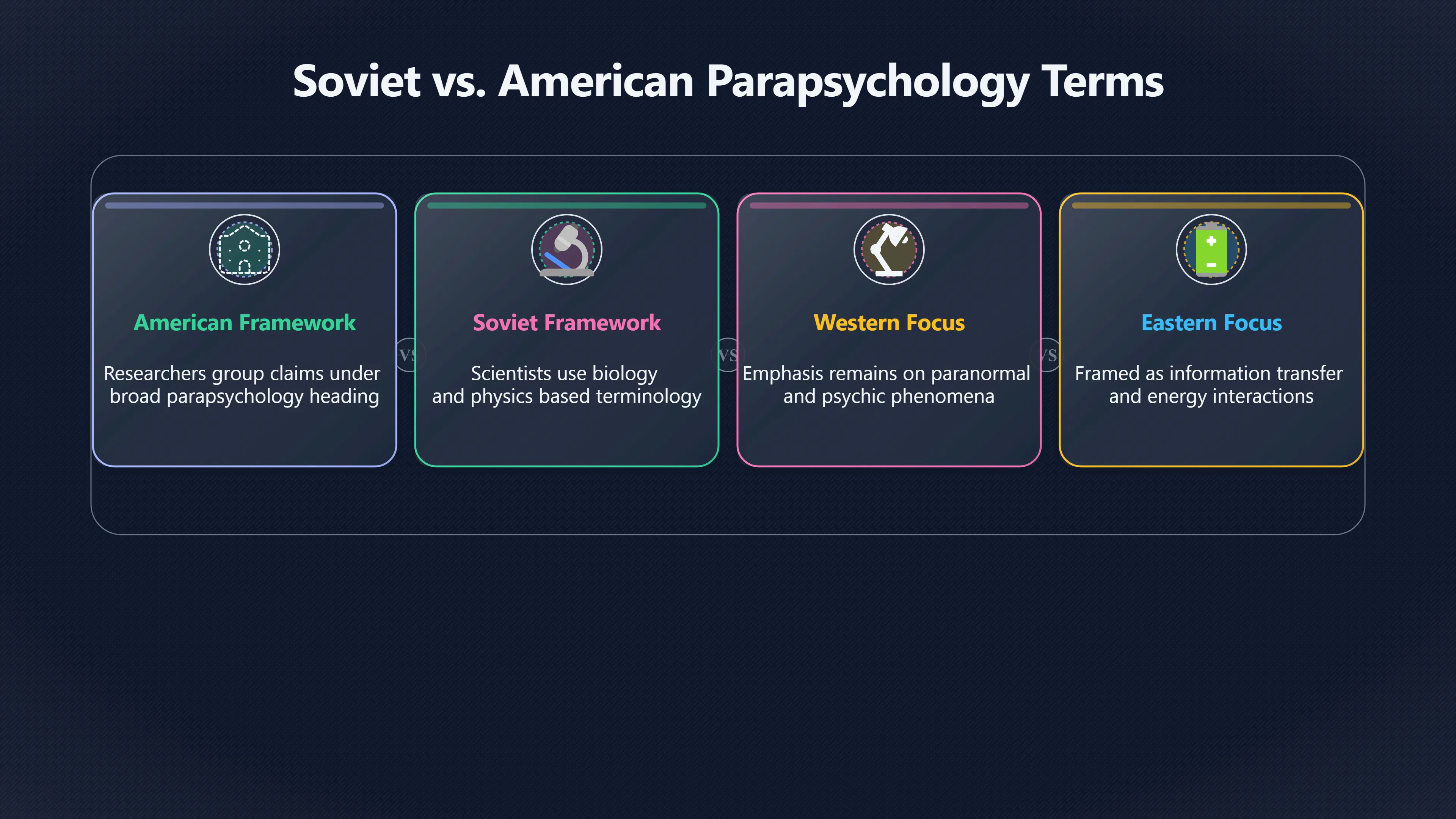
American researchers generally grouped claims such as telepathy, clairvoyance, psychokinesis and remote viewing under the broad heading of parapsychology. Soviet and Eastern Bloc researchers, however, often preferred terminology that sounded closer to biology, physics or engineering. Rather than emphasising the paranormal, many Soviet publications referred to “bioenergetics” or “biocommunications”, framing the subject as the study of possible information transfer or energy interactions involving living organisms.[CIA]cia.govSOVIET AND CZECHOSLOVAKIAN PARAPSYCHOLOGY…Bioenergetics involves phenomena associated with the production of objectively detectable…
Declassified U.S. intelligence reports noted that “biocommunications” served as an umbrella concept encompassing two broad categories:
- Bioinformation, covering alleged information transfer without ordinary sensory channels, including telepathy and precognition.
- Bioenergetics, referring to claimed energetic effects such as psychokinesis, dowsing and biological interactions with physical systems.[CIA]cia.govSOVIET AND CZECHOSLOVAKIAN PARAPSYCHOLOGY…Bioenergetics involves phenomena associated with the production of objectively detectable…
The label psychoenergetics emerged in American intelligence writing as a convenient umbrella for these diverse Soviet concepts. Rather than translating each specialised Soviet term literally, analysts frequently collapsed multiple overlapping ideas into a single English category. This simplification made reports easier to circulate within U.S. defence and intelligence agencies but also obscured distinctions that Soviet researchers themselves sometimes drew.
The terminology also reflected differences in scientific culture. Soviet publications frequently attempted to connect extraordinary claims with accepted disciplines such as physiology, cybernetics, biophysics or information theory. Whether those connections were scientifically justified is a separate question, but presenting the research in conventional scientific language made it appear less like occult investigation and more like an extension of state-supported biomedical research.[CIA]cia.govSOVIET AND CZECHOSLOVAKIAN PARAPSYCHOLOGY…Bioenergetics involves phenomena associated with the production of objectively detectable…
Why vocabulary complicated assessment
The language gap created several distinct problems for Western intelligence.
First, literal translation rarely captured conceptual meaning. A Soviet paper discussing “bioinformation” might overlap with what American researchers would call extrasensory perception, while “psychotronics” could encompass ideas ranging from psychokinesis to speculative biological fields. Analysts therefore had to interpret not only words but also the scientific assumptions behind them.[CIA]cia.govSOVIET AND CZECHOSLOVAKIAN PARAPSYCHOLOGY…Bioenergetics involves phenomena associated with the production of objectively detectable…
Second, terminology evolved over time. Different Soviet institutes, military organisations and Eastern European collaborators adopted different preferred labels. Czechoslovak researchers, for example, prominently used “psychotronics”, while Soviet literature more commonly referred to “biocommunications” or related expressions. From the outside, this changing vocabulary sometimes appeared to indicate entirely new research programmes when it may instead have reflected administrative or disciplinary preferences.[CIA]cia.govSOVIET AND CZECHOSLOVAKIAN PARAPSYCHOLOGY…Bioenergetics involves phenomena associated with the production of objectively detectable…
Third, political language mattered. Soviet science operated within an environment where terminology could influence whether research appeared compatible with official ideology. Framing investigations in terms of biology, physiology or information processing could make speculative work seem more acceptable than explicitly invoking psychic or supernatural concepts. Intelligence analysts therefore had to judge whether linguistic choices reflected scientific advances, bureaucratic strategy or ideological presentation.
Finally, translation errors could amplify uncertainty. A report using unfamiliar technical language might appear more sophisticated or more secret than it actually was. In intelligence analysis, ambiguity rarely reduces concern; it often increases it because uncertain capabilities must still be evaluated as potential threats.

How terminology shaped perceived risk
The terminology surrounding psychoenergetics affected how American officials interpreted Soviet intentions even when evidence for practical success remained weak.
Cold War intelligence did not require proof that a capability worked before considering it strategically significant. Instead, analysts asked whether an adversary appeared willing to invest resources in an area that might eventually produce useful military applications. If Soviet documents discussed psychoenergetics using technical, institutional language rather than mystical language, that alone could suggest a degree of official interest deserving attention.[CIA]cia.govSOVIET AND CZECHOSLOVAKIAN PARAPSYCHOLOGY…Bioenergetics involves phenomena associated with the production of objectively detectable…
This produced a feedback loop. Soviet publications prompted U.S. intelligence reviews; those reviews reinforced concern that the Soviet Union might possess knowledge unavailable to the West; that concern then helped justify continued American monitoring and limited research into remote viewing and related subjects. The vocabulary itself became part of the evidence being analysed rather than merely a neutral means of communication.
Importantly, declassified intelligence assessments generally distinguished between documenting Soviet interest and demonstrating operational success. Reports catalogued institutes, publications and terminology, but they did not establish that psychoenergetics had produced reliable intelligence capabilities or effective military systems. The uncertainty surrounding both the science and the language was itself a central feature of the intelligence picture.[CIA]cia.govSOVIET AND CZECHOSLOVAKIAN PARAPSYCHOLOGY…Bioenergetics involves phenomena associated with the production of objectively detectable…
When words became intelligence signals
The history of psychoenergetics illustrates a broader challenge in intelligence analysis: adversaries rarely describe research using the same conceptual framework. Analysts must translate institutional cultures, disciplinary traditions and political messaging alongside ordinary language.
In the case of remote-viewing-related research, unfamiliar Soviet vocabulary encouraged American analysts to ask whether they were observing an entirely different scientific programme or simply different names for similar speculative ideas. Because the answer was often unclear, terminology acquired strategic significance. Words such as psychoenergetics became indicators to be interpreted, compared and monitored, not merely translated.
That linguistic uncertainty did not prove that Soviet psychic research was more advanced than its Western counterparts. Instead, it demonstrates how, during the Cold War, differences in scientific language could shape intelligence assessments, influence funding decisions and contribute to the perception of a technological competition whose boundaries were never entirely clear.[CIA+2ar5iv]cia.govSOVIET AND CZECHOSLOVAKIAN PARAPSYCHOLOGY…Bioenergetics involves phenomena associated with the production of objectively detectable…
Amazon book picks
Further Reading
Books and field guides related to When Strange Words Became Intelligence Signals. Use these as the next step if you want deeper reading beyond the article.

eBay marketplace picks
Marketplace Samples
Live-tested eBay searches with available results related to this page.


Endnotes
1.
Source: cia.gov
Link:https://www.cia.gov/readingroom/docs/CIA-RDP96-00792R000600350001-3.pdf
Source snippet
SOVIET AND CZECHOSLOVAKIAN PARAPSYCHOLOGY...Bioenergetics involves phenomena associated with the production of objectively detectable...
2.
Source: ar5iv.labs.arxiv.org
Link:https://ar5iv.labs.arxiv.org/html/1312.1148
Source snippet
research in USSR and Russia: short overviewThis work briefly surveys unconventional research in Russia from the end of the 19th until the...
Additional References
3.
Source: archive.org
Link:https://archive.org/stream/CIA-RDP96-00787R000500420001-2/CIA-RDP96-00787R000500420001-2_djvu.txt
Source snippet
Full text of "Soviet & Czech 9-75 Parapsychology Research...ESP refers to information which is not received via the usual senses, and as...
4.
Source: studocu.com
Link:https://www.studocu.com/en-us/document/veritas-baptist-college/bachelor-of-science-in-information-technology-ii/remote-viewing/52763018
Source snippet
SOVIET PSI WARFARE: REMOTE VIEWING AND...As a result, remote viewers and psychotronics experts were trained to transmit negative. psi en...
5.
Source: studocu.com
Link:https://www.studocu.com/in/document/mahatma-gandhi-law-college/medical-coding/cia-rdp96-00792-r000600350001-3/97328945
Source snippet
Soviet and Czechoslovakian Parapsychology ResearchThe Soviet term biocommunications can be further subdivided into two general classifica...
6.
Source: facebook.com
Title: three newly released cia reports from 1963 and 1964 investigate the soviet union
Link:https://www.facebook.com/slashdot/posts/three-newly-released-cia-reports-from-1963-and-1964-investigate-the-soviet-union/10158558970035857/
Source snippet
Three newly released CIA reports from 1963 and 1964...Apr 1, 2022 — The Soviets called this area of study "psychotronics," combining psy...
7.
Source: reddit.com
Link:https://www.reddit.com/r/AskHistorians/comments/1fzyb8y/did_the_soviets_ever_do_any_research_into_the/
Source snippet
Occult, and as a result the trope of Nazis using or seeking supernatural weapons...
8.
Source: esd.whs.mil
Link:https://www.esd.whs.mil/Portals/54/Documents/FOID/Reading%20Room/International_Security_Affairs/paranormal_briefing.pdf
Source snippet
ther in some cohesive foshi~n a variety of biological phenomena...
9.
Source: medium.com
Link:https://medium.com/the-physics-arxiv-blog/revealed-the-soviet-unions-1-billion-psychotronic-arms-race-with-the-us-1b0b3d97df54
Source snippet
chotronics as the Soviets called it), mind control and remote...
10.
Source: documents.theblackvault.com
Link:https://documents.theblackvault.com/documents/remoteviewing/[stargate
Source snippet
refers to information which is not received via the usual senses, and as a general term, includes...
11.
Source: abebooks.com
Title: Supernatural Phenomena
Link:https://www.abebooks.com/9781422004999/Supernatural-Phenomena-Declassified-Government-Research-1422004996/plp
Source snippet
Declassified Government...It includes three major declassified Pentagon reports involving paranormal phenomena: (1) Paraphysics Research...
12.
Source: pmc.ncbi.nlm.nih.gov
Link:https://pmc.ncbi.nlm.nih.gov/articles/PMC10275521/
Source snippet
Central Intelligence Agency's (CIA...by Á Escolà‐Gascón · 2023 · Cited by 10 — Since 1972, the U.S. Central Intelligence Agency (CIA) co...
Topic Tree